
Products
RoosterReplenish-MSC-XF Xeno-Free Bioreactor Feed
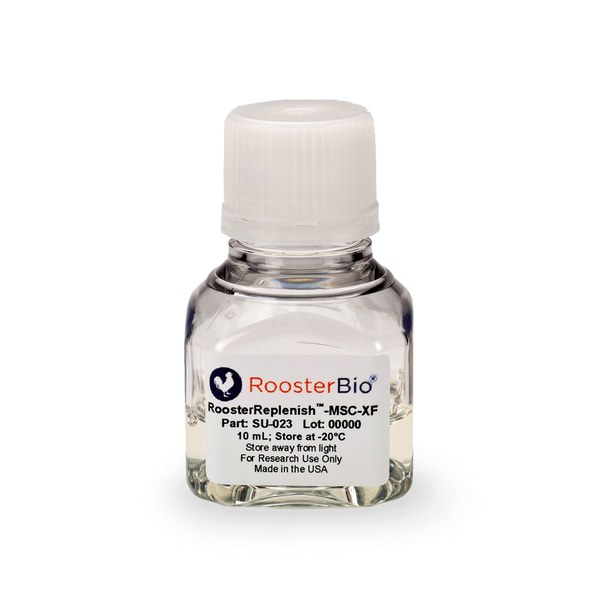
RoosterReplenish-MSC-XF (SU-023): concentrated xeno-free feed added on day 3 of fed-batch bioreactor culture, boosting media productivity by up to 70% and reaching up to 350 million hMSCs per litre without media exchange.
Product information
- Brand
- RoosterBio
- Catalog no.
- SU-023
- Specification
- 10 mL
Get more cells out of every litre of medium
In bioreactor MSC expansion, media productivity is a central lever for cost reduction, and the usual fix — half-volume media exchanges — adds labour, handling steps and contamination risk. RoosterReplenish-MSC-XF takes the opposite route: a concentrated bioreactor feed that turns batch culture into a fed-batch process. Added on day 3 of culture, it supplies additional mitogenic factors so that hMSCs, iPSC-MSCs, immortalized MSCs and fibroblasts on microcarriers keep growing without a media exchange.
Catalogue number and format
| Catalogue number | Product | Volume | Use ratio | Storage (label) |
|---|---|---|---|---|
| SU-023 | RoosterReplenish-MSC-XF | 10 mL | One bottle supplements 500 mL of RoosterNourish-MSC-XF | -20 °C, away from light |
Intended use: research use only. RoosterBio offers an analogous version for cGMP manufacturing; contact us for cGMP formats.
Fed-batch results
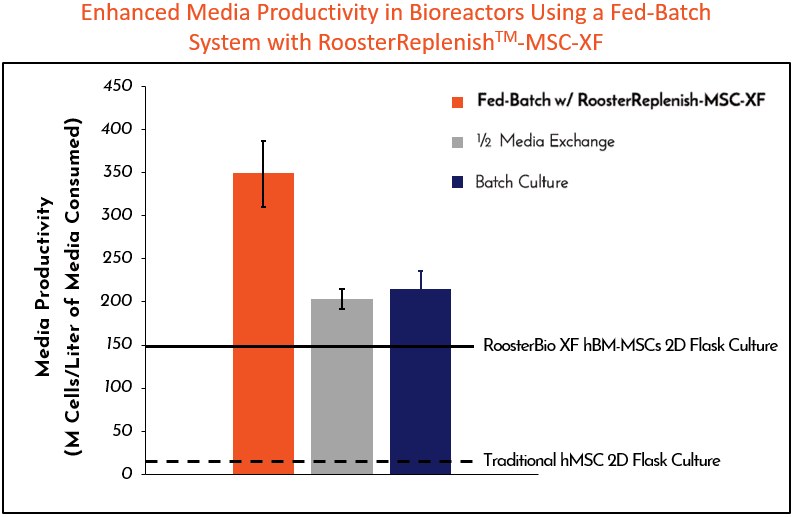
- Boosts media productivity (millions of cells produced per litre of medium consumed) by up to 70%
- In RoosterBio's bioreactor data, fed-batch culture with RoosterReplenish-MSC-XF was the most productive feeding regimen, ahead of both half-volume media exchange and batch culture, reaching up to 350 million cells/L
- That is more than 17 times the media productivity of traditional hMSC flask culture (about 20 million cells/L); total cell yield is donor-dependent
- Maintains stable nutrient and waste profiles through 7 days of culture, comparable to batch culture
- Minimizes media preparation time, eliminates media exchange and reduces the contamination risk of in-process manipulation
Why it shortens development
The feed is designed to pair with RoosterBio's xeno-free hMSCs from multiple tissue types and with RoosterNourish-MSC-XF, so the media-efficiency optimisation step drops out of small- and large-scale MSC process development. The result: shorter development timelines, larger cell lots and fewer manufacturing steps on the path to commercial-scale production, with translation-friendly processes and components built in.
Where it fits
- 3D microcarrier bioreactor expansion of RoosterVial XF hMSCs (for example RoosterVial-hBM-10M-XF) in RoosterNourish-MSC-XF
- Fed-batch fibroblast and hDF-EV processes, combined with RoosterCollect-EV for the collection phase
- Cost-of-goods reduction studies where media volume per cell is the target
Planning a fed-batch MSC bioreactor process? Contact TechWave for RoosterReplenish-MSC-XF selection support, spinner-flask protocols and a quotation.
Related brands
Related products
Technical resources
- Serum or Serum-Free? Stop Mixing Up SFM, XF, AF and CD: One Label-Attribute Map and Two Comparison Tables That Link Media Selection to Your Next Development Step
- Most of the Exosomes You Worked Hard to Grow Are Lost in Downstream Filtration: RoosterBio Agent V-DSP Relieves Filter Fouling and Lifts Cumulative Downstream Particle Recovery from 5%–10% to 40%–70%
- Low exosome yield and too many medium changes? Rooster HD-EV all-in-one expansion and collection medium: 10–20-fold more EVs than conventional batch culture, background ≤1.0E8 particles/mL
- Scaling MSC-EV from 250 mL to 15 L without losing yield or quality: about 4E5 cells/mL, about 1.7E10 particles/mL and about 91% membrane-dye-positive particles
- MSC-EV yields too low and background particles drowning the signal? RoosterBio's four-stage media suite: over 10-fold expansion in 4–5 days and collection medium at ≤1E8 particles/mL
- Choosing XF, AF or CD serum-free media: adaptation, lot consistency, downstream purification and compliance — 7 dimensions in one table
- The Cell Bank Is the Entry Ticket for MSC and EV Drug INDs: RoosterBio's Three Tiers from Research Grade to cGMP CliniControl, Checked Item by Item Against CDE Testing Requirements
- Scale Is the Engineering Goal, Equivalence Is the Hard Constraint: RoosterBio Anchors MSC 2D-to-3D Comparability on Cell Age (PDL), with Multi-Donor Final PDL of 16–20 and More Than 25 Billion Cells per 50 L Batch