
Technical column
Choosing XF, AF or CD serum-free media: adaptation, lot consistency, downstream purification and compliance — 7 dimensions in one table
XF, AF and CD serum-free media are not a ladder where higher is always better; they are three formulation logics. XF adapts easily and behaves closest to serum systems, AF balances biosafety and cost, and CD has the smallest lot-to-lot variation with fully traceable components. We compare them on cell growth and adaptation, lot stability, biosafety and compliance, downstream purification and cost, variable control and use cases, with a summary table and a media-change validation method.
Definition
XF (xeno-free), AF (animal-origin-free) and CD (chemically defined) are the three classes of serum-free media, defining different control boundaries for xenogeneic components, animal-derived components and formulation definition.

Three parallel culture routes represent formulation boundaries and validation choices.
After switching to serum-free medium, cells attach poorly, grow slowly and drift after a few passages; or they grow well, only for the team to find at purification or filing stage that raw materials cannot be traced. The root cause is usually that selection asked only one question: which of XF, AF and CD is the "higher grade"?
The three classes represent three different formulation logics, and they affect the whole culture workflow through cell growth, experimental stability, biosafety, downstream processing, research precision and cost. Choosing well means matching the formulation boundary to your cells, stage and quality goals — not chasing the highest label.
First, separate the three labels
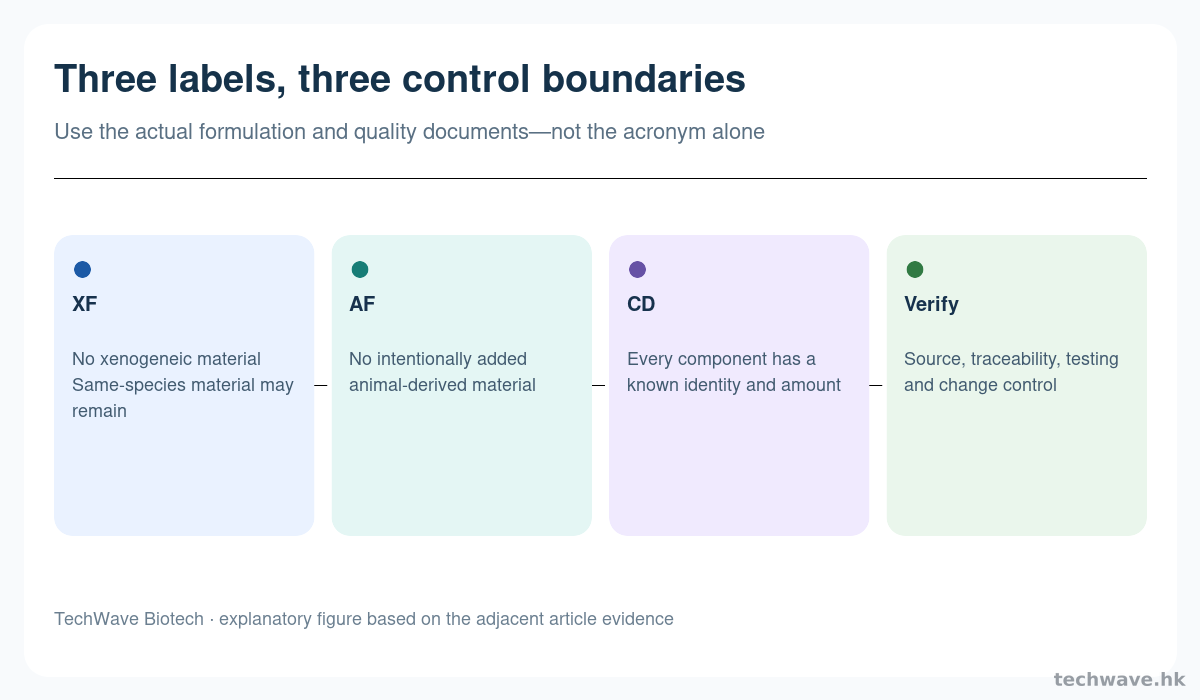
The labels describe different control boundaries. They inform risk assessment but do not by themselves prove cell performance, medicinal compliance or application suitability.
- XF (xeno-free): contains no xenogeneic animal components, but allows same-species natural proteins and extracts (such as human serum albumin and human plasma fractions);
- AF (animal-origin-free): removes all animal-derived components; proteins are mostly recombinant, and plant- or microbe-derived nutrients may be used;
- CD (chemically defined): the chemical structure and amount of every component are defined, with no poorly defined natural extracts or hydrolysates.
Dimension 1: cell growth and adaptation difficulty
Differences in nutrient richness and how natural the components are directly determine how hard cells are to adapt and how they grow.
- XF: nutrient composition is closer to the in-vivo environment, and attachment efficiency, proliferation rate and stability are closer to serum-containing medium. Most cells adapt directly or quickly, making XF well suited to the initial expansion of hard-to-culture cells such as stem and primary cells.
- AF: nutrients rely on plant hydrolysates and microbe-derived components, and the formulated nutrient system differs from natural serum. Routine cell lines adapt well, but some primary and stem cells need 3–5 passages of gradual adaptation to grow stably.
- CD: contains no natural extracts or unknown growth-promoting factors, so the nutrient system is demanding, cells show stronger stress responses and adaptation usually takes longer; some primary cells highly dependent on growth factors cannot even survive in pure CD medium without a customized combination of recombinant factors.
Dimension 2: lot stability and reproducibility
How well components are defined directly determines lot-to-lot consistency, a key indicator in both research and production.
- XF: still contains same-species natural extracts that vary with donors and preparation, so some lot-to-lot fluctuation remains, causing lot differences in growth rate and protein expression and limiting reproducibility.
- AF: recombinant proteins are far more lot-stable than natural extracts, but complex raw materials such as plant hydrolysates and yeast extracts still carry trace variation; overall consistency is clearly better than XF and meets routine industrial lot requirements.
- CD: the formula, purity and amount of every component are precisely controlled, with no unknown mixtures, so lot differences are small and growth and product expression are more stable — an important system for process validation and data traceability in regulatory filings.
Dimension 3: biosafety and downstream compliance
This is a major basis for industrial choice and maps directly to application and regulatory requirements.
- XF: removes only xenogeneic risk and keeps same-species tissue-derived components, so a potential risk of same-species pathogen (such as human virus) transmission remains; it is generally used for basic and preclinical research and struggles to meet filing requirements for clinical-grade cell therapy and medicinal biologics.
- AF: removes all animal tissue-derived components, avoiding at source the risk of contamination by animal viruses, mycoplasma, prions and other adventitious agents; biosafety rises substantially, and AF is the basic compliance threshold for biopharmaceutical and cell-therapy process development.
- CD: goes beyond AF by eliminating every poorly defined raw material, so biosafety risk is lower still, and every component is traceable and quality-controllable, which helps meet raw-material quality requirements for clinical-grade cell products and recombinant biologics; it is a highly suitable system for clinical filing and commercial production.
Dimension 4: downstream purification and overall cost
The level of impurity proteins directly determines downstream complexity and overall cost.
- XF: total protein is high and the impurity background complex, so downstream processing needs extra chromatography and host-protein removal steps, with longer purification, lower product recovery and higher downstream cost.
- AF: impurity protein is much lower than XF, purification can be simplified, and medium price and downstream cost are both moderate — a balanced cost-performance ratio.
- CD: mostly low- or protein-free formulations with a low exogenous protein background, so purification needs fewer steps and simpler processes and product recovery improves markedly. CD media cost more per unit, but in large-scale industrial production the downstream savings can offset the medium cost, making the overall cost more favourable.
Dimension 5: variable control and research precision
For mechanism studies, how well components are defined directly determines how rigorous the conclusions are.
- XF: natural extracts contain many unknown growth factors, metabolites and signalling molecules, so not all variables can be controlled and it is hard to tell whether an effect comes from the target factor or an unknown medium component; unsuitable for single-factor or pathway studies.
- AF: definition improves greatly, but complex raw materials such as plant hydrolysates still contain some unknown metabolites, limiting precision; suitable for expansion and expression work with modest precision needs.
- CD: every component's structure and amount are defined, so single nutrients or signalling molecules can be dosed precisely and background interference excluded — the ideal system for cell metabolism, drug mechanism and signalling-pathway research.
Dimension 6: suitable cell types and use cases
Coverage differs clearly, and a higher class is not broader in application.
- XF: broad cell compatibility with an emphasis on "easy to culture"; mostly used for research-grade expansion of hard-to-culture stem, primary and immune cells and for preclinical process exploration.
- AF: suits most adapted engineered lines (such as CHO and HEK293) and is common in industrial production of recombinant proteins, monoclonal antibodies and vaccines.
- CD: demands more of the cell line, usually requiring lines specifically adapted to serum-free culture; mostly used in large-scale commercial production, clinical-grade cell manufacturing and basic research needing tight variable control.
In one line: choose XF for ease of use and good cell condition; AF for a balance of compliance and cost; CD for the highest stability, compliance and research precision.
All three systems in one table
| Dimension | Xeno-free (XF) medium | Animal-origin-free (AF) medium | Chemically defined (CD) medium |
|---|---|---|---|
| Definition | No xenogeneic animal components; same-species natural proteins and extracts allowed | All animal-derived components removed; proteins mostly recombinant, with plant or microbial nutrients | Chemical structure and amount of all components defined; no poorly defined natural extracts or hydrolysates |
| Cell growth and adaptation | Nutrition close to physiological; easy adaptation, most cells adapt directly | Good for routine cell lines; primary/stem cells usually need 3–5 passages of gradual adaptation | Demanding nutrient system, long adaptation; some primary cells need custom recombinant factors |
| Lot stability | Natural extracts fluctuate between lots; limited reproducibility | Recombinant proteins stable; only complex materials vary slightly; meets routine industrial production | Defined, controllable components; small lot differences; higher stability and reproducibility |
| Biosafety and compliance | Removes only xenogeneic risk; same-species pathogen risk remains; for research and preclinical work | Avoids animal-derived contamination risk; basic compliance threshold for biopharma and cell therapy | Lower biosafety risk, all components traceable and quality-controlled; suits clinical filing and commercial production |
| Downstream purification and cost | Complex impurity background; many purification steps; high cost | Low impurity protein; simplified purification; balanced cost-performance | Few impurity proteins and purification steps; higher medium price but better overall cost at large scale |
| Research variable control | Many unknown components; variables uncontrollable; unsuitable for detailed mechanism studies | Moderate precision; suits routine expansion and expression | Single, controllable variables; single-factor tuning; suits high-precision mechanism studies |
| Typical use cases | Research expansion of hard-to-culture stem and primary cells; preclinical process exploration | Engineered cells such as CHO and HEK293; industrial production of recombinant proteins, antibodies and vaccines | Large-scale commercial production, clinical-grade cell manufacturing, high-precision basic research |
Trend: CD is the long-term direction for industrial and clinical routes
XF media remain a common choice in many sectors and, in the short term, a compromise for cell expansion. But for industrial production and clinical research of cells and extracellular vesicles (EVs), regulators worldwide (NMPA, FDA, EMA) keep tightening requirements on raw-material traceability, impurity risk and process reproducibility, and moving the whole process to chemically defined (CD) media is the long-term industry trend.
How to change media without rework
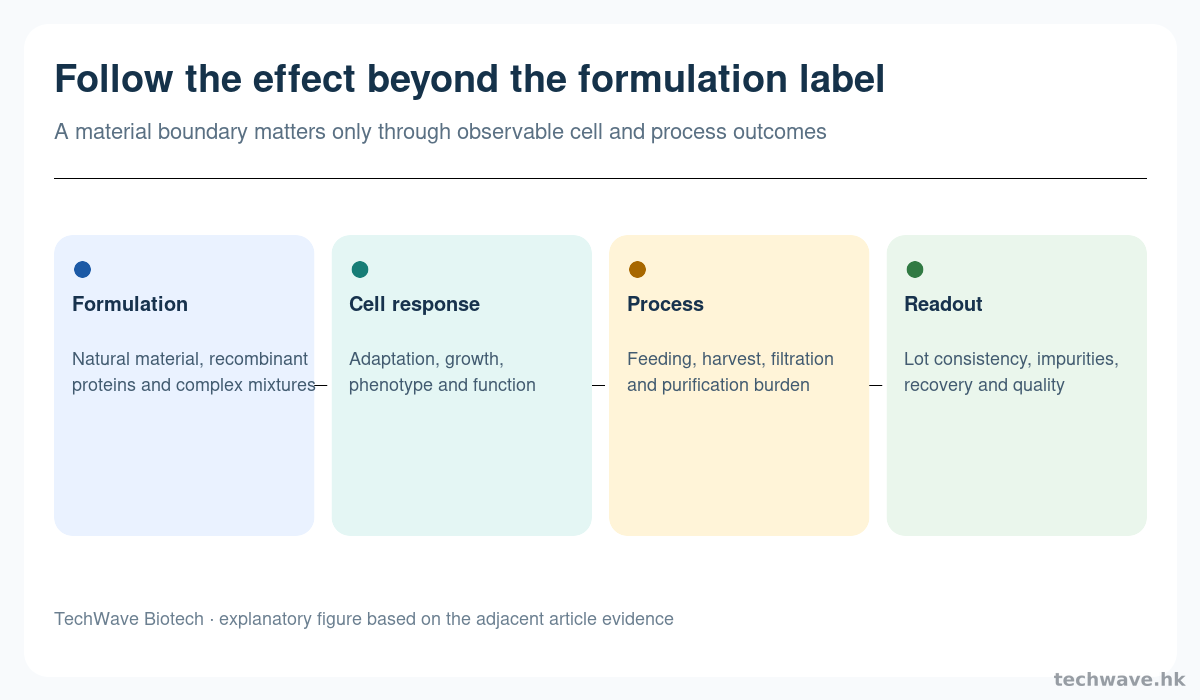
The medium label is not the endpoint. Observe how it changes growth, phenotype, impurity background, lot variation and the final functional readout.
Once the class is chosen, success depends on media-change validation. Cover at least five groups of readouts when comparing old and new systems:
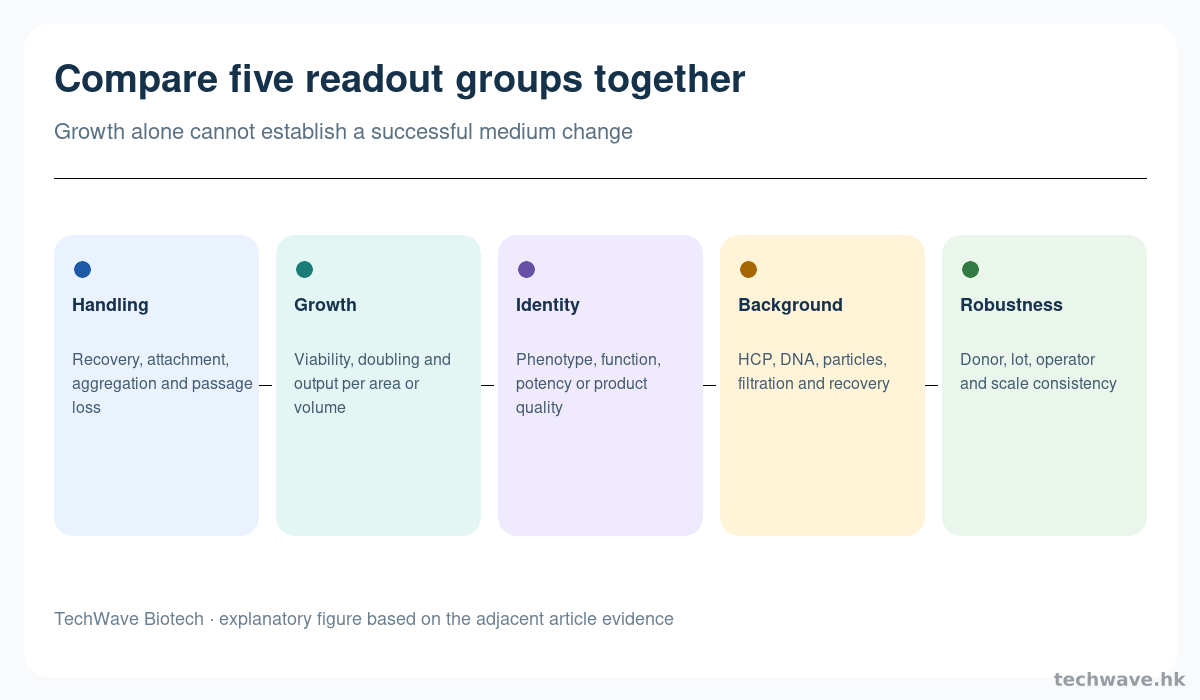
Adaptation and handling, growth, identity and function, downstream background and robustness are compared together instead of relying on one cell count.
| Dimension | Suggested readouts | Common mistake |
|---|---|---|
| Adaptation and handling | Recovery viability, attachment, clumping, adaptation passages, passage losses | Keeping only samples that finally adapted |
| Growth | Doubling time, cumulative doublings, output per area or volume | Comparing cell numbers on one day only |
| Identity and function | Phenotype, differentiation, potency, product quality | Treating normal morphology as functional proof |
| Downstream background | Free protein, HCP, DNA, filter pressure, recovery | Using medium price instead of total process cost |
| Robustness | Multiple donors, lots, operators and scales | Extrapolating one lot to production |
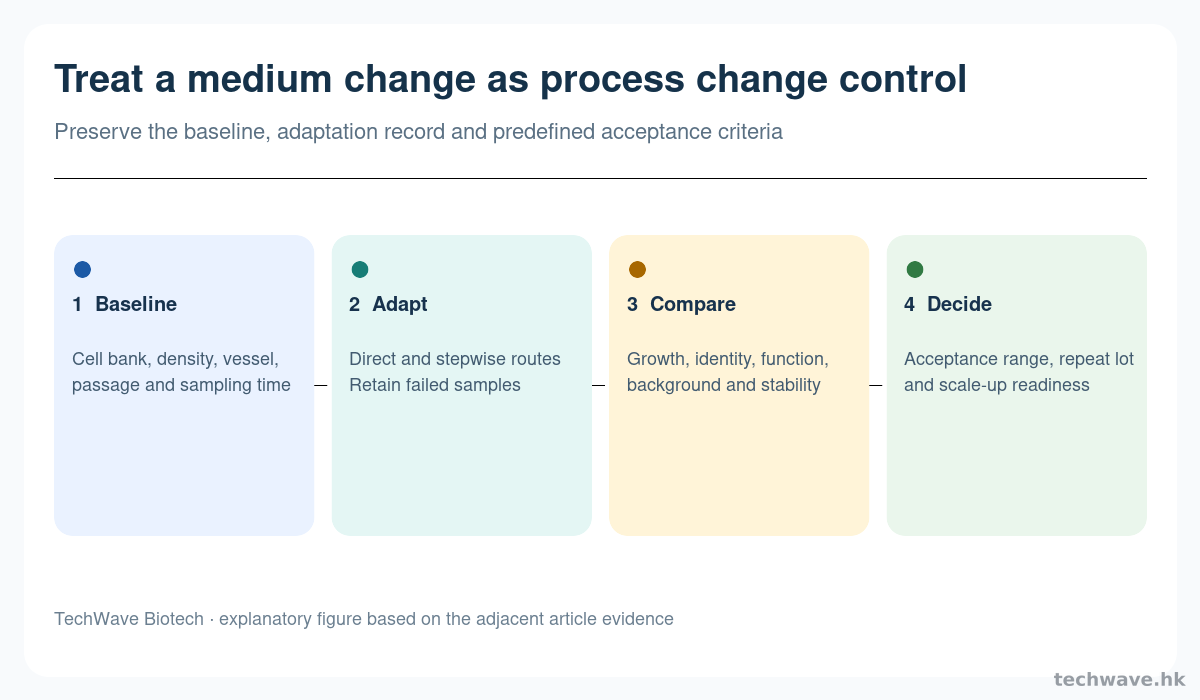
A medium change is a small process change, not a purchasing substitution: establish a baseline, adapt in steps, verify identity, function and downstream performance, then consider scale-up.
A practical workflow has four steps: first establish a baseline in the current system, fixing the cell bank, seeding density, passaging method, vessels and sampling times; then run direct switch and gradual transition in parallel, keeping failed samples and adaptation records; next compare growth, phenotype, genetic stability, function and impurity background at predefined serial-passage points; and only when critical quality attributes fall within predefined acceptance ranges, assess larger scale and longer culture. MSC and EV processes should also treat expansion and harvest separately: a medium that supports fast expansion may not suit low-background collection, so a staged expansion–transition–collection system can be used.
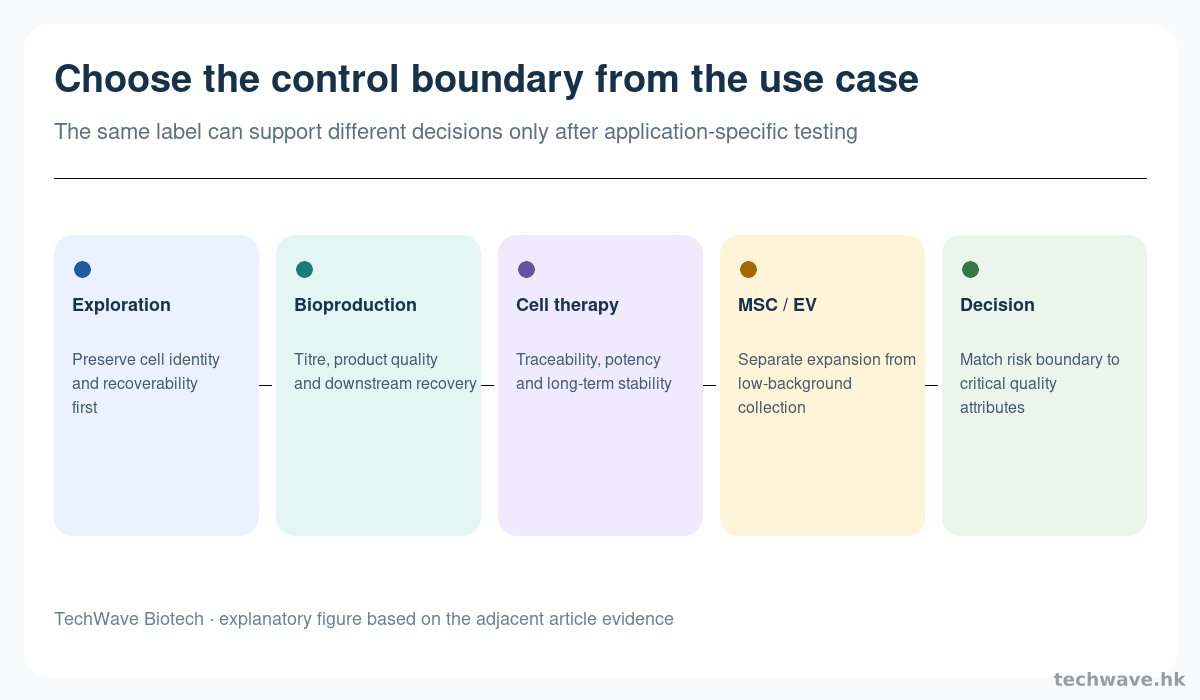
Define the use case and critical quality attributes before tightening the material boundary and selecting validation depth.
One boundary is worth remembering: XF, AF and CD help define risk questions, but no abbreviation replaces a specific product's formulation statement, quality documents and media-change validation data.
Let TechWave help you choose the right serum-free system
Whether you need an easier-to-adapt serum-free expansion system for stem or primary cells, or are planning a clinically and industrially oriented raw-material route for MSC and EV processes, contact TechWave. Based on your cell type, development stage and quality goals, we can provide selection advice, technical documents and quotations for serum-free culture systems including RoosterBio.
Uses and applicable scenarios
- Selecting serum-free media for expanding stem, primary and immune cells
- Recombinant protein, antibody and vaccine production in engineered lines such as CHO and HEK293
- Media changes and comparability validation in MSC and EV processes
- Mechanism studies such as cell metabolism and signalling that require tight variable control
Limitations
- A class label cannot replace a specific product's formulation statement, quality documents and media-change validation data
- Adaptation time, overall cost and clinical or commercial suitability must be measured for the specific cells and process
Related brands
Related products
- RoosterHD™-EV
- prcRoosterNourish™-MSC-CC
- AgentV™-DSP
- RoosterCollect™-EV-CC
- RoosterVial hUC-MSC Cell Banks (Umbilical Cord MSC: XF, DEV+, cGMP CC)
- RoosterVial hBM-MSC Cell Banks (Bone Marrow MSC: XF, DEV+, cGMP CC)
- RoosterVial hAD-MSC Cell Banks (Adipose MSC, Xeno-Free)
- RoosterVial hDF Neonatal Dermal Fibroblast Cell Banks (XF, DEV+, cGMP CC)
- RoosterNourish-MSC-XF Serum-Free, Xeno-Free hMSC Expansion Medium
- RoosterReplenish-MSC-XF Xeno-Free Bioreactor Feed
- RoosterCollect-EV Chemically Defined EV Collection Medium (RUO)