
Technical column
Serum or Serum-Free? Stop Mixing Up SFM, XF, AF and CD: One Label-Attribute Map and Two Comparison Tables That Link Media Selection to Your Next Development Step
Media selection affects more than whether cells grow: it shapes batch reproducibility, product background and downstream purification cost. This article first separates the four functions of serum and its three concentration bands (2%–5%, 5%–10%, 15%–20%), then maps the five serum-free formulation routes, and explains why XF (xeno-free), AF (animal-free) and CD (chemically defined) are three different dimensions rather than one ladder. It closes with a seven-dimension comparison of serum-containing and serum-free systems and selection guidance for routine research, primary isolation, biomanufacturing and cell therapy.
Definition
Serum-free medium (SFM) contains no animal serum and replaces serum functions with defined components such as recombinant proteins, hormones, growth factors, binding proteins and small molecules; XF, AF and CD describe three different composition-control attributes: xeno-free, animal-free and chemically defined.
Media selection affects more than whether cells grow: it also shapes batch reproducibility, product background and downstream purification cost. Serum-containing systems provide rich natural support, while serum-free systems allow more targeted formulation design. Comparing serum functions, raw-material origin and compositional definition separately is how you find a medium that fits today's cells and connects to the next development stage.
Video explainer
"Serum-Free" Doesn't Mean Animal-Free: XF, AF and CD Are Three Dimensions, Not One Ladder
Watch on YouTube ↗Video transcript
If a medium says serum-free, does that mean it has no animal components? Not necessarily. Serum-free, SFM, only means no animal serum was added. It can still contain animal-derived proteins such as bovine serum albumin, or it can be chemically defined.
XF, xeno-free, is defined relative to the cells' species. For human cells it excludes non-human animal sources such as cow or horse, but allows human-derived components like human serum albumin. AF, animal-free, is about where ingredients come from.
Within the product's stated scope, animal-derived components are excluded, but complex non-animal ingredients such as plant hydrolysates may still be used. CD, chemically defined, is about whether the composition is known: every component and its amount is specified.
It doesn't mean protein-free, and it doesn't say where any protein comes from. So XF, AF and CD are three different dimensions, not one ladder. A formulation can be serum-free, animal-free and chemically defined all at once, but one label doesn't imply another.
When choosing, the full composition and suitable cell types in the product documents tell you more than the label alone. Full article: the TechWave technical column at techwave.hk.
Produced by TechWave. For research reference only; not medical advice.
1. What the Two Media Types Are
Serum-Containing Medium: Natural Mixtures That Support Growth
Serum-containing medium adds a proportion of animal serum to a basal synthetic medium such as DMEM, RPMI1640 or MEM. It was developed early and remains a commonly used complete culture system. Serum's value comes from a combination of functions:
- Growth factors, hormones and cell-adhesion factors that support proliferation and attachment;
- Transport proteins such as albumin and transferrin that help deliver nutrients and trace elements;
- Small-molecule nutrients such as amino acids, lipids and vitamins;
- Some neutralization of harmful substances in the culture environment and reduced mechanical shear damage to cells.
This combined support suits many routine cultures, but it also makes lot selection an important variable: the same addition ratio does not mean the same composition of growth factors, proteins and metabolites.
Serum-Free Medium: Rebuilding Serum Functions Around Cell Needs
Serum-free medium (SFM) contains no animal serum and replaces its physiological functions with components such as recombinant proteins, hormones, growth factors, binding proteins and small-molecule additives. Its main design goal is to remove the compositional uncertainty, large lot-to-lot variation and biosafety risk that serum brings, making the culture system controllable and standardized. As biomanufacturing and cell therapy have developed, serum-free media have become one of the common systems for industrial production.
Note that an SFM may still contain animal-derived proteins or complex raw materials, or it may be a chemically defined formulation. When studying a specific signalling pathway, check whether the formulation introduces other undefined components; when developing purification for a secreted product, look at total protein and particle background rather than the words "serum-free" alone.
2. How Culture Media Are Classified
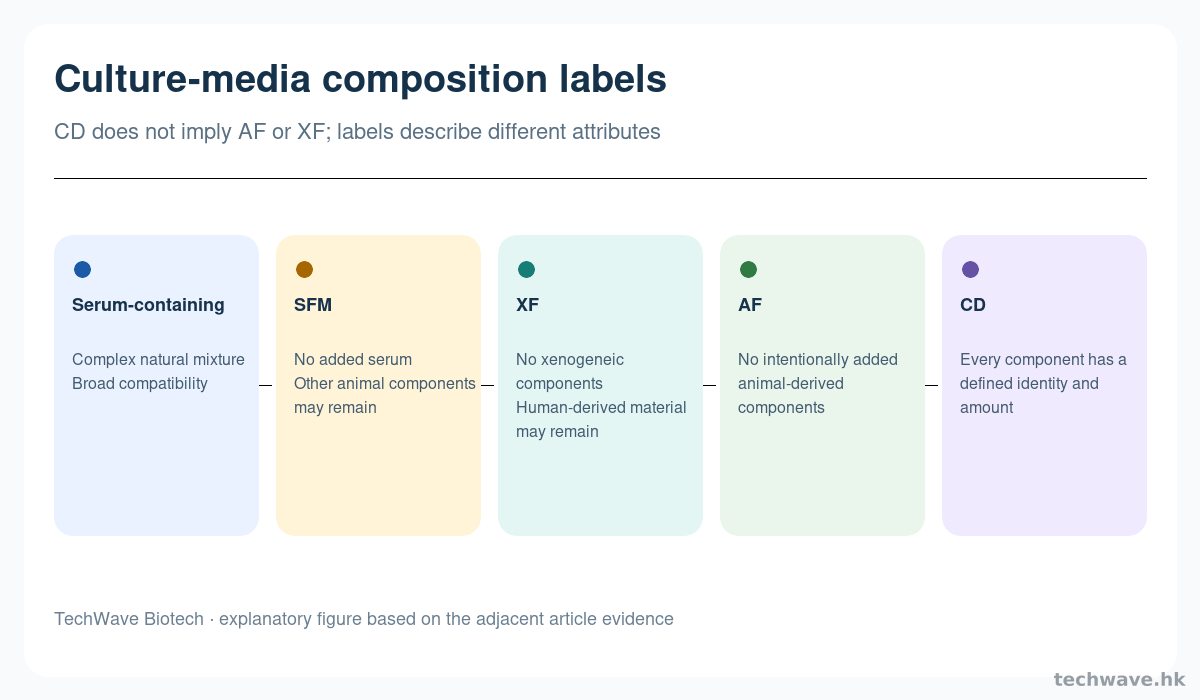
SFM, XF, AF and CD describe different composition-control boundaries and should not be used as synonyms.
Serum-Containing Media: Concentration First, Then Source
By serum concentration, the common bands and uses are:
- Low serum (2%–5%): maintains survival and basal metabolism while restraining excessive proliferation, often used for cell synchronization and quiescence studies; whether cells survive and proliferate depends on the specific cells;
- Standard serum (5%–10%): the usual laboratory formulation, meeting the growth needs of most passaged cell lines;
- High serum (15%–20%): strengthens nutrient supply, often used for primary cultures, clonal selection and early expansion of hard-to-culture cells.
By serum source:
- Fetal bovine serum (FBS/FCS): widely used, rich in growth-supporting components and suited to most cell lines — the classic research choice;
- Newborn calf serum (NBCS): from calves shortly after birth, with a different and somewhat lower growth-factor content than FBS and lower cost, often used for large-scale expansion of routine cell lines;
- Other species' sera: horse serum and human serum, for example, used for specific cell types such as skeletal muscle cells and human immune cells; the final choice still depends on the cells' needs.
Five Common Serum-Free Formulation Routes
- Low-protein serum-free medium: no serum, but may still contain bovine serum albumin or animal-derived transferrin. Total protein is far lower than in serum media and lot variation is reduced, but animal-origin risk remains, and it is mostly used for cost-sensitive research-grade serum-free culture; lowering total protein background and fully excluding animal-derived raw materials are two different goals.
- Serum replacements: complex additives used with a basal medium to replace FBS, falling into human blood-derived routes such as human platelet lysate (hPL) and purely recombinant-protein or plant-derived routes. hPL is a complex biological raw material, not a chemically defined one.
- Animal-free serum-free medium: excludes animal-derived raw materials within the scope the product declares, using non-animal components such as recombinantly expressed proteins (for example recombinant human insulin and transferrin), with markedly improved biosafety — a basic choice for biomanufacturing and cell therapy. Whether a recombinant protein fits that scope also depends on its manufacturing inputs.
- Chemically defined medium: every component's identity and amount are defined, with no protein hydrolysates, plant extracts or other undefined raw materials, giving good lot consistency and reproducible results — suited to mechanistic studies and industrial process development that need tight variable control.
- Protein-free medium: no protein raw materials, only amino acids, vitamins, inorganic salts and small molecules, with fewer downstream purification steps and lower cost, often used for large-scale expression of recombinant proteins and monoclonal antibodies; whether the other components are defined is a separate attribute.
These routes can be combined: one formulation can be serum-free, animal-free and chemically defined at once, but none of these names automatically implies the others.
XF, AF and CD: Three Dimensions, Not One Ladder
XF (xeno-free) is defined relative to the species of the cultured cells. For human cells, an XF system excludes serum, extracted proteins and tissue extracts from non-human animals such as cattle and horses, but allows human natural components such as human serum albumin and human plasma extracts, and can add recombinant human proteins. It greatly reduces the risk of adventitious agents from other animal species while keeping some natural nutrient supply, with good cell compatibility and easier adaptation; it is widely used for research-grade culture of human stem and immune cells and for preclinical process development.
AF (animal-free) focuses on raw-material origin: the formulation removes all animal-derived components, protein functions are mostly supplied by recombinant products, and nutrients can come from non-animal sources such as plant hydrolysates or microbial materials. Compared with XF, AF avoids animal-origin viral, mycoplasma and prion risks and offers better lot stability, but nutrient supply depends entirely on the designed formulation, so some cells are harder to adapt. It is a common choice for producing recombinant proteins and monoclonal antibodies and for cell therapy processes with strict limits on animal-derived components. AOF claims must be read against each product's definition, and a plant hydrolysate does not make a formulation chemically defined.
CD (chemically defined) focuses on how well composition is defined: every component's chemical structure, purity and amount is known, with no protein hydrolysates, plant extracts, tissue extracts or other undefined mixtures. CD media offer very strong lot consistency and reproducibility, eliminate interference from unknown components, and simplify downstream purification with higher product recovery; but they are more demanding on cell compatibility, and most cells need gradual adaptation. They suit industrial production that needs process stability, clinical-grade cell therapy manufacturing, and signalling and metabolism research that needs precise variable control. Note that a defined protein can be part of a CD formulation, so CD says nothing by itself about a protein's biological origin: it is not a synonym for protein-free, AF or XF.
| Label | Core attribute | Selection meaning |
|---|---|---|
| XF | Excludes raw materials from animal species other than the cultured cells | Human systems may still use suitable human natural components |
| AF | Excludes animal-derived raw materials within the declared scope | Reduces animal-origin dependence; may still contain complex non-animal materials |
| CD | Component identities and amounts are defined | Helps control research variables; protein content and biological origin are judged separately |
Table 1. How serum-free labels map to formulation attributes.
Specific products can combine these attributes. Solallis MSC Growth Medium AF-GMP separately declares serum-free, AOF and chemically defined status, suiting MSC programmes that need to compare these attributes together; Cell Applications' Defined Medium category shows that defined composition and the presence of animal-derived albumin or transferrin are different classification questions. The full composition and cell suitability information in product documents is more useful for selection than a category name alone.
3. Serum-Containing vs Serum-Free: Seven Dimensions
| Dimension | Serum-containing medium | Serum-free medium |
|---|---|---|
| Composition | Thousands of proteins and metabolites, complex, with many unknown components | Designed around cell needs; can be defined or complex |
| Lot consistency | Serum varies with animal source, lot and origin, which can affect reproducibility | Removing serum eliminates one source of variation and helps control formulation and raw materials |
| Cell compatibility | Broadly applicable; many cell lines and primary cells can use it directly | Usually more cell-type specific; some cells need gradual adaptation |
| Downstream purification | High serum-protein background with more separation steps and higher cost | Low-protein or low-particle formulations can reduce background; the benefit depends on product and formulation |
| Biological-origin risk | Adventitious agents such as viruses, mycoplasma and endotoxin in serum must be managed | Animal-free routes can reduce these risks; SFM is not necessarily AF |
| Cost | Basal medium is cheap, but good serum is a large share of cost | Higher medium price with no serum purchase; compare on usable output at scale |
| Handling | Simple preparation and high cell tolerance | Stricter demands on aseptic technique, culture environment, feeding and passaging rhythm |
Table 2. Seven selection dimensions for serum-containing and serum-free media.
4. Choosing for Typical Applications
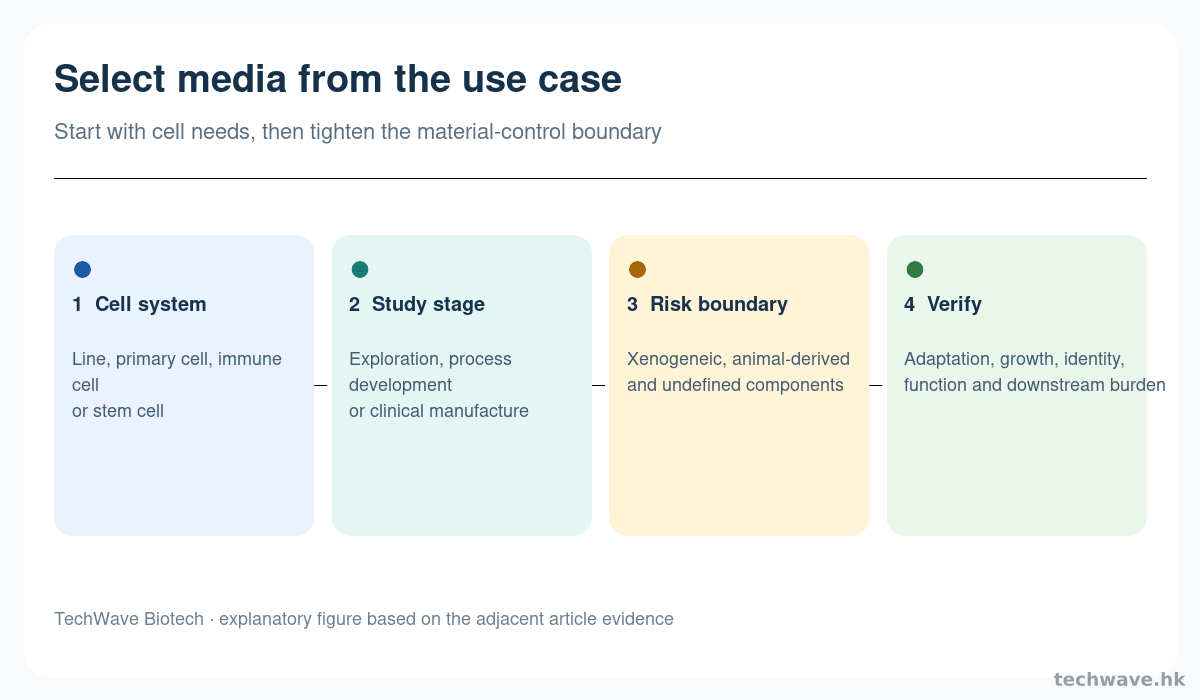
Defensible media selection connects cell needs, development stage, material risk and verification readouts.
Serum-Containing Systems: Broad Support and a Strong Start
- Routine basic research: passaging ordinary cell lines, cell banking and routine functional assays — the classic laboratory choice;
- Primary cell isolation: in the first culture stage, higher serum concentrations provide ample nutrition and improve survival and attachment;
- Initial adaptation of hard-to-culture cells: primary or thawed cells in poor condition can recover in serum or serum-replacement systems before moving gradually to serum-free culture;
- Research-grade large-scale expansion: where downstream purification and biosafety requirements are modest, serum systems offer cost and handling advantages.
Serum-Free Systems: Aligning Culture Goals with Downstream Needs
- Industrial biomanufacturing: large-scale production of monoclonal antibodies, recombinant proteins, vaccines and other biologics, reducing the downstream purification burden and improving lot consistency;
- Clinical-grade cell therapy manufacturing: for CAR-T, NK and stem cell production, formulations with suitable origin and composition attributes can be chosen for the cells' needs, reducing material risk;
- Mechanistic research: when studying specific growth factors or signalling pathways, serum-free systems remove interference from unknown serum components;
- Specific functional experiments: for transfection, viral packaging, protein expression and purification, the formulation must match the actual application; "serum-free" by itself does not determine efficiency.
In short, neither type is inherently better; each suits different stages. Serum-containing systems are versatile with a low barrier to entry, suiting basic research, primary isolation and routine expansion; serum-free systems can specify origin and composition separately along the XF, AF and CD dimensions, with stable lots and low adventitious risk, better meeting the standardization and compliance needs of biomanufacturing, clinical-grade cell manufacturing and mechanistic research. A sustainable path is to establish stable cells in a compatible system first, then connect formulation attributes to downstream purification, function and scale-up goals.
Let TechWave Help You Compare Media Options
If you are evaluating moving cells from serum-containing to serum-free culture, or choosing between XF, AF and CD for MSCs, immune cells or production cell lines, contact TechWave. We can help compare media types and product documentation (including serum-free, animal-free formulations such as Solallis), map selection to your cells, development stage and downstream needs, and arrange a quotation.
Uses and applicable scenarios
- Selecting cell culture media and evaluating a media change
- Moving biomanufacturing processes to serum-free culture
- Raw-material planning for clinical-grade cell therapy manufacturing
- Signalling-pathway and metabolism studies that require controlled variables
Limitations
- Classification terms such as XF, AF and CD must be checked against each product's definition and composition
- Some cells need gradual adaptation when moved into serum-free systems
- Culture performance depends on the specific cells, formulation and process
Related brands
Related products
- RoosterHD™-EV
- prcRoosterNourish™-MSC-CC
- AgentV™-DSP
- RoosterCollect™-EV-CC
- RoosterVial hUC-MSC Cell Banks (Umbilical Cord MSC: XF, DEV+, cGMP CC)
- RoosterVial hBM-MSC Cell Banks (Bone Marrow MSC: XF, DEV+, cGMP CC)
- RoosterVial hAD-MSC Cell Banks (Adipose MSC, Xeno-Free)
- RoosterVial hDF Neonatal Dermal Fibroblast Cell Banks (XF, DEV+, cGMP CC)
- RoosterNourish-MSC-XF Serum-Free, Xeno-Free hMSC Expansion Medium
- RoosterReplenish-MSC-XF Xeno-Free Bioreactor Feed
- RoosterCollect-EV Chemically Defined EV Collection Medium (RUO)