
Technical column
Most of the Exosomes You Worked Hard to Grow Are Lost in Downstream Filtration: RoosterBio Agent V-DSP Relieves Filter Fouling and Lifts Cumulative Downstream Particle Recovery from 5%–10% to 40%–70%
One hidden cost of exosome manufacturing is that EVs produced upstream keep disappearing during downstream purification: conventional processes recover only 5%–10% of particles cumulatively. The root cause is filter fouling by cell debris, protein aggregates and extracellular-matrix components in the conditioned medium. RoosterBio Agent V-DSP (catalogue S46999) is a chemically defined downstream processing reagent: adding 1 mL per litre of medium and incubating for 30 minutes at room temperature before downstream processing lowers TFF filtration pressure and keeps recovery higher across NFF, TFF, chromatography and sterile filtration, while EV size distribution, CD63/CD9/CD81 markers and CD73 enzyme activity stay consistent. In the complete RoosterBio system scenario, cumulative recovery reached 40%–70% and the number of 50 L bioreactors needed for 2,500 doses fell from 8 to 1.
Definition
Agent V-DSP is RoosterBio's chemically defined downstream processing reagent containing specific recombinant biomolecules; it treats harvested MSC-EV conditioned medium before filtration to relieve filter fouling by cell debris, protein aggregates and extracellular-matrix components, raising cumulative downstream particle recovery.
If the additional MSC-EVs you obtain upstream keep disappearing during clarification, concentration and purification, the extra investment rarely turns into usable output. In a recent webinar, RoosterBio pointed to exactly this industry pain point: conventional exosome purification loses large numbers of vesicles, so much of the upstream material cost is lost in downstream processing, driving up total manufacturing cost.
Agent V-DSP targets membrane fouling: it treats harvested conditioned medium to relieve the rise in filtration pressure, letting more particles reach the next step. Its value has to be judged together from cumulative recovery, the measured EV quality attributes and the economics of the whole manufacturing system.
Why Nine-Tenths of Exosomes Are "Lost" Downstream
The Core Problem: Filter Fouling
In exosome manufacturing, conditioned medium is the starting point for downstream purification. It is not just a carrier of EVs but a complex biological mixture containing soluble proteins, cytokines, metabolites, cell debris and extracellular-matrix components. When these components enter downstream processing along with the EVs, problems follow.
During tangential-flow filtration (TFF) concentration, cell debris and extracellular-matrix components quickly foul the membrane. According to RoosterBio process data, untreated TFF filtration pressure rises rapidly with processing time, forcing operators to change filters frequently mid-process — and every filter change means EV losses through hold-up and transfer.
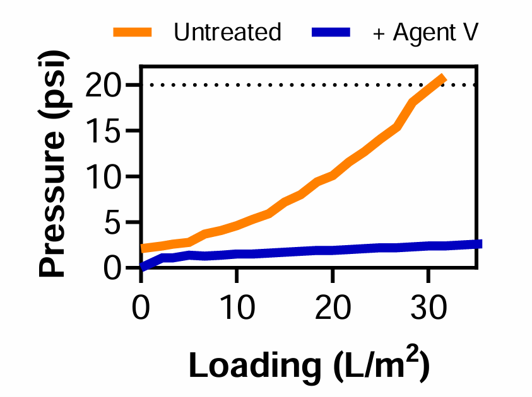
Figure 1. TFF filter pressure over time during downstream processing with and without Agent V-DSP
Yield Multiplies Upstream Cost
Downstream yield is not a standalone economic metric but a multiplier on upstream manufacturing input: a cumulative downstream particle recovery of only 5%–10% means most upstream output never reaches the end of the process. According to a comparison from RoosterBio's blog and webinar (May 2026):
| Parameter | Conventional EV process | RoosterBio system (with Agent V-DSP) |
|---|---|---|
| Cumulative downstream particle recovery | 5%–10% | 40%–70% |
| 50 L bioreactors needed for 2,500 doses | 8 | 1 |
Table 1. Manufacturing parameters compared in a specific complete-process scenario.
At about 10% recovery, meeting a fixed demand of 2,500 doses requires eight 50 L bioreactor runs; with recovery raised to 40%, and combined with factors such as upstream medium efficiency, the same demand needs a single 50 L bioreactor. The change from about 10% to 40% recovery is a fourfold improvement in recovery, while the reduction from eight bioreactors to one also includes upstream medium efficiency — the two numbers describe benefits at different levels, and the 8-to-1 reduction cannot be attributed entirely to one downstream reagent. In this complete-system scenario, fewer culture runs mean proportionally less medium, labour, facility time and QC testing, lowering manufacturing cost per dose.
Agent V-DSP: A Defined Formulation Against Filter Fouling
Product Information
Agent V-DSP (catalogue S46999) is a chemically defined downstream processing reagent developed by RoosterBio, containing specific recombinant biomolecules and designed to solve filter fouling in EV downstream purification. It treats the supernatant before downstream operations rather than replacing TFF or chromatography; adding 1 mL of Agent V-DSP per litre of harvested medium raises particle recovery across the whole process.
| Item | Product information |
|---|---|
| Product name | Agent V-DSP |
| Catalogue no. | S46999 |
| Pack size | 5 mL |
| Supernatant volume treated | 5 L, at 1 mL reagent per L of medium |
| Formulation | Chemically defined, containing recombinant biomolecules |
Table 2. Agent V-DSP product and study dosing information.
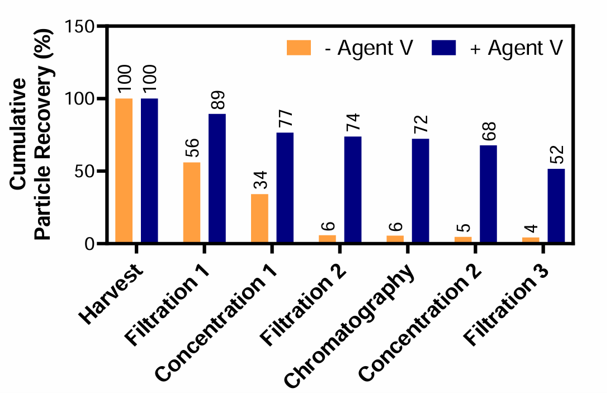
Figure 2. Recovery at each downstream purification stage with and without Agent V-DSP
Every unit operation in the downstream process is a "yield checkpoint"; in conventional processes EVs are lost at every step until little remains. Agent V-DSP protects recovery from normal-flow filtration (NFF) clarification onward and creates a cascade effect: the improved filtration recovery carries through TFF concentration, chromatography and sterile filtration, raising yield across the whole process.
Mechanism: From "Blocked" to "Flowing"
Agent V-DSP's mechanism can be summarized as filter fouling prevention: cell debris, protein aggregates and extracellular-matrix components in the conditioned medium cause rapid membrane blocking and sharply rising pressure, and the molecules in Agent V-DSP interact with these components to relieve their fouling effect before filtration.
According to RoosterBio study data (Lenzini et al., ISCT 2025 poster), the treatment brings four direct benefits; this study is separate from the May 2026 manufacturing-economics scenario above:
- Much lower filtration pressure: the treated group's pressure curve stays flat while the untreated group's rises sharply, reducing frequent filter changes;
- Smaller cut-off pore sizes: with fouling under control, smaller-pore filters could be used in the evaluated conditions, further improving impurity removal;
- Higher filter loading capacity: a larger volume of conditioned medium can be processed in one pass;
- Yield protection across the whole process: particle recovery stays higher not only at NFF but through subsequent TFF concentration, chromatography and sterile filtration.
How the Study Set Treatment Conditions and Checked EV Quality
Dose, Time, Temperature and 3D Supernatant Validation
The RoosterBio team compared three doses (0.1X, 1X and 5X), a 30-minute treatment time and a temperature range from room temperature to 37°C, and settled on adding a 1X dose of Agent V-DSP to harvested conditioned medium and incubating for 30 minutes at room temperature before downstream purification.
The treatment was effective across the wide range from room temperature to 37°C, giving good process flexibility — in practice this means no extra temperature-control step is needed. The study also validated these conditions in conditioned medium from 3D microcarrier bioreactors, supporting transfer from 2D culture to 3D scale-up.
Higher Yield Without Sacrificing Quality
In exosome drug development, yield gains must not come at the expense of critical quality attributes (CQAs). According to Lenzini et al. (ISCT 2025 poster), several measured CQAs of purified MSC-EVs stayed consistent with and without Agent V-DSP:
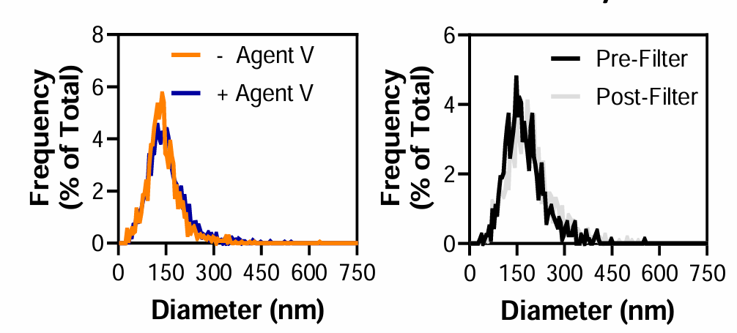
Figure 3. Exosome size distribution with and without Agent V-DSP
- Size distribution: EV size distribution was unchanged with treatment, both before and after filtration;
- EV identity markers: the tetraspanins CD63, CD9 and CD81 were detected in both treated and untreated groups;
- Functional enzyme activity: purified EVs from both groups showed CD73 enzyme activity;
- Particle concentration: measured by ZetaView nanoparticle tracking analysis (NTA), the treated group had higher post-filtration particle concentration than the untreated group, consistent with the yield data.
In other words, Agent V-DSP raised yield while preserving EV size characteristics, identity-related markers and CD73 activity. Note that CD73 is one function-related endpoint and does not mean every potential biological effect has been measured.
Part of RoosterBio's MSC-EV Manufacturing System: From Cells to Product
Agent V-DSP is not an isolated downstream tool but one component of RoosterBio's MSC-EV manufacturing system.
Upstream: Cell Banks and Expansion Medium
RoosterBio offers human mesenchymal stem cells from bone marrow (hBM), adipose tissue (hAD) and umbilical cord (hUC). The companion Rooster Nourish-XF expansion medium supports robust expansion in 2D batch culture and 3D microcarrier bioreactors, providing sufficient, consistent cells for downstream EV production. According to RoosterBio, the cGMP-grade CliniControl line is filed in a Type II FDA Master File and has supported cross-referencing in multiple clinical trials.
Midstream: Rooster Collect-EV Collection
Once cells enter the EV-secretion phase, the chemically defined Rooster Collect-EV collection medium collects secreted EVs continuously, raising output per cell; separating expansion from collection helps match cell numbers and per-cell EV output to their respective needs.
Downstream: Agent V-DSP Connects the Purification Steps
Harvested conditioned medium is incubated with Agent V-DSP for 30 minutes and then enters the standard downstream process: NFF clarification, TFF concentration/diafiltration, chromatography and sterile filtration. The study's compatibility comparisons cover this whole route, so supernatant properties, membrane fouling and cumulative recovery can be analysed as one problem when selecting materials.
About RoosterBio
Founded in 2013 and headquartered in Maryland, USA, RoosterBio focuses on hMSC cell banks, bioprocess media and exosome production solutions. Its range includes bone marrow, adipose and umbilical cord-derived hMSC banks, Rooster Nourish no-medium-change expansion medium, Rooster Replenish bioreactor feed, Rooster Collect-EV exosome collection medium and Rooster HD-EV integrated expansion and collection medium, with RUO and cGMP-grade product paths and, according to RoosterBio, a Type II FDA Master File and international regulatory support files that can be cross-referenced in submissions. The no-medium-change expansion of Rooster Nourish applies within compatible culture workflows; it does not mean any culture condition or the EV collection phase needs no medium change.
Let TechWave Help You Recover What Downstream Is Losing
If your MSC-EV process is seeing rising filtration pressure, frequent filter changes or low cumulative recovery, it is often better to lose less of what you already have than to make more upstream. Contact TechWave: we can help gather specifications and application data for Agent V-DSP (S46999) and the companion RoosterBio cell banks and media, assess how it fits your current downstream process, and arrange a quotation.
Uses and applicable scenarios
- Controlling filter fouling and filtration pressure in MSC-EV downstream purification
- Raising cumulative particle recovery across NFF clarification, TFF concentration, chromatography and sterile filtration
- Downstream processing of conditioned medium from 2D culture and 3D microcarrier bioreactors
- EV manufacturing economics and bioreactor scale planning
Limitations
- The 8-to-1 bioreactor comparison also includes upstream medium efficiency and cannot be attributed entirely to Agent V-DSP
- The CQA compatibility conclusion is limited to the measured size, markers and CD73 activity and does not mean every biological effect was measured
- The treatment conditions were established in the evaluated MSC-EV process; other processes need verification
Related brands
Related products
- RoosterHD™-EV
- prcRoosterNourish™-MSC-CC
- AgentV™-DSP
- RoosterCollect™-EV-CC
- RoosterVial hUC-MSC Cell Banks (Umbilical Cord MSC: XF, DEV+, cGMP CC)
- RoosterVial hBM-MSC Cell Banks (Bone Marrow MSC: XF, DEV+, cGMP CC)
- RoosterVial hAD-MSC Cell Banks (Adipose MSC, Xeno-Free)
- RoosterVial hDF Neonatal Dermal Fibroblast Cell Banks (XF, DEV+, cGMP CC)
- RoosterNourish-MSC-XF Serum-Free, Xeno-Free hMSC Expansion Medium
- RoosterReplenish-MSC-XF Xeno-Free Bioreactor Feed
- RoosterCollect-EV Chemically Defined EV Collection Medium (RUO)