
Technical column
MSC-EV yields too low and background particles drowning the signal? RoosterBio's four-stage media suite: over 10-fold expansion in 4–5 days and collection medium at ≤1E8 particles/mL
Scaling MSC-EV production has long been blocked by three problems: low yield, unstable quality and processes that will not scale. RoosterBio splits production into expansion, clean collection, 3D scale-up and clinical translation, each with a dedicated medium: RoosterNourish-MSC-XF needs no medium change or surface coating and gives over 10-fold expansion in 4–5 days; RoosterCollect-EV is chemically defined with a release specification of ≤1E8 particles/mL and a 6–72 hour collection window; 3D is validated beyond 50 L; and the cGMP line is supported by an FDA Type II Master File.
Definition
The RoosterBio exosome media suite is a matched set of media covering four stages — MSC expansion, clean EV collection, 3D scale-up and cGMP clinical translation — each with a dedicated product designed to connect seamlessly to the next.
Exosomes and extracellular vesicles (EVs) are moving quickly from basic research into clinical drug development as a next-generation cell-free therapeutic vehicle. Yet scaling MSC-EV production keeps running into the same three problems: insufficient yield, unstable quality and a process that cannot be controlled at scale.
RoosterBio's answer is not a single bottle of medium but a complete process chain that splits production into four stages, each with its own dedicated product: RoosterNourish-MSC-XF for expansion, with no medium change and over 10-fold expansion in 4–5 days; a switch to the chemically defined RoosterCollect-EV for collection, released at ≤1E8 particles/mL; a 3D bioreactor kit for scale-up; and the cGMP CliniControl line, which the company states is supported by an FDA Type II drug Master File.
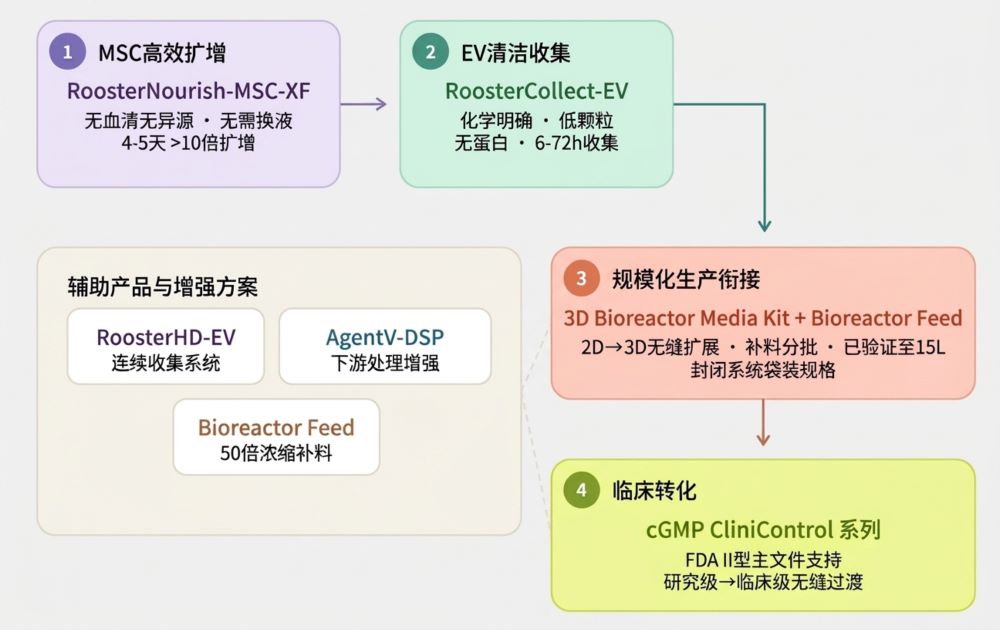
Figure 1. RoosterBio's complete process-chain product overview. Note: stage 3 of the figure is labelled "validated to 15 L", while the manufacturer's text states that 3D bioreactor systems are validated beyond 50 L. Both values are as stated in the source, and no new scale-up conclusion is derived from them here.
Three bottlenecks in MSC-EV drug development
Mesenchymal stem cell-derived extracellular vesicles (MSC-EVs) naturally carry bioactive molecules including proteins, lipids, mRNA and microRNA, and show considerable clinical promise in tissue repair, immunomodulation, anti-inflammatory applications and drug delivery. Moving them from the laboratory into drug development, researchers commonly hit three process problems:
- Problem 1, insufficient EV yield: daily EV output per cell is limited, making it hard to reach the production scale that drug development requires;
- Problem 2, unstable quality attributes: serum-containing or poorly defined media introduce high background particles and xenogeneic proteins that interfere with EV characterization and make critical quality attributes (CQAs) hard to control;
- Problem 3, processes that will not scale: 2D static culture cannot be extended to industrial scale, and without a consistent path from basic research to GMP/clinical grade the translation route breaks.
According to RoosterBio, the company serves more than 25 countries and over 500 partners, and its cells and media have been cited in more than 350 peer-reviewed papers since 2015. Its media suite is designed around the three problems above.
The core idea: expand first, then collect
RoosterBio's approach follows an "expand first, collect second" principle, splitting MSC-EV production into four defined stages, each with a validated dedicated medium, forming a process chain that connects without gaps.
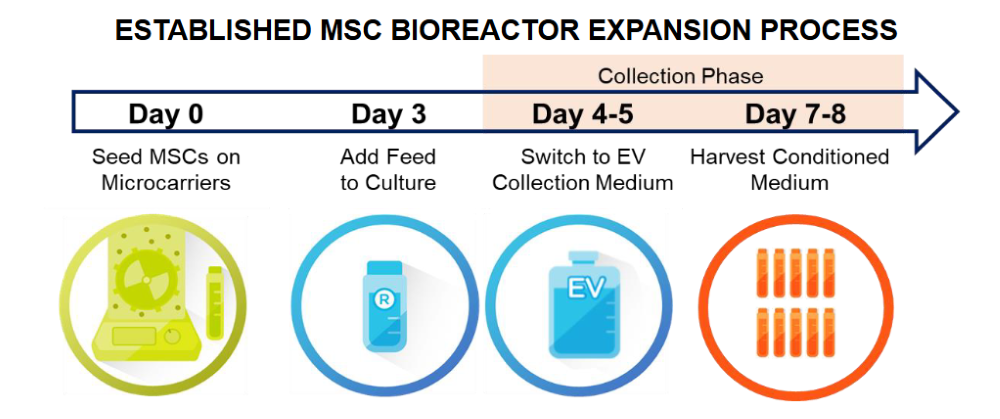
Existing processes separate the MSC expansion and EV collection stages.
Stage 1: MSC expansion — RoosterNourish-MSC-XF
Cell expansion is the foundation of EV production. RoosterNourish-MSC-XF is a serum-free, xeno-free hMSC expansion medium:
- Formulation: serum-free and xeno-free, removing the xenogeneic proteins and particle interference that serum brings and giving a clean starting point for EV collection;
- Handling: no medium change and no surface coating, simplifying culture and reducing lot-to-lot variation from manual intervention;
- Expansion efficiency: supports low-density seeding down to 3,000 cells/cm², with over 10-fold expansion in 4–5 days;
- Cell types: validated in hMSCs (bone marrow, adipose and umbilical cord derived), iPSC-MSCs, immortalized MSCs and fibroblasts;
- Culture compatibility: supports both conventional 2D batch culture and 3D fed-batch bioreactor culture;
- Product composition: 500 mL RoosterBasal2.0-CC plus 10 mL RoosterBooster-MSC-XF, supplied ready to use.
Process connection: after expansion in RoosterNourish-MSC-XF, switch directly to RoosterCollect-EV for collection with no intermediate medium change.
Stage 2: clean EV collection — RoosterCollect-EV
RoosterCollect-EV is a chemically defined exosome/EV collection medium designed for "clean collection" of MSC-derived exosomes:
- Formulation: chemically defined, protein-free and low-particle, with a low background that simplifies downstream purification and characterization;
- Xeno-free: forms a consistent xeno-free chain with RoosterNourish-MSC-XF;
- Collection window: supports a scalable 6 to 72 hour EV collection, adjustable to the experiment;
- Culture scale: usable in both 2D flasks and 3D bioreactors;
- Particle control: a dedicated particle release specification controls total particles per lot at ≤1E8 particles/mL, a background below the detection limit of most NTA systems;
- Grade: research use (RUO), with a cGMP version, RoosterCollect-EV-CC, available for clinical-grade applications;
- Regulatory support: according to RoosterBio, the cGMP version is supported by a US FDA Type II drug Master File that can be cross-referenced during filing;
- Origin: Rooster Bio, Inc., Maryland, USA.
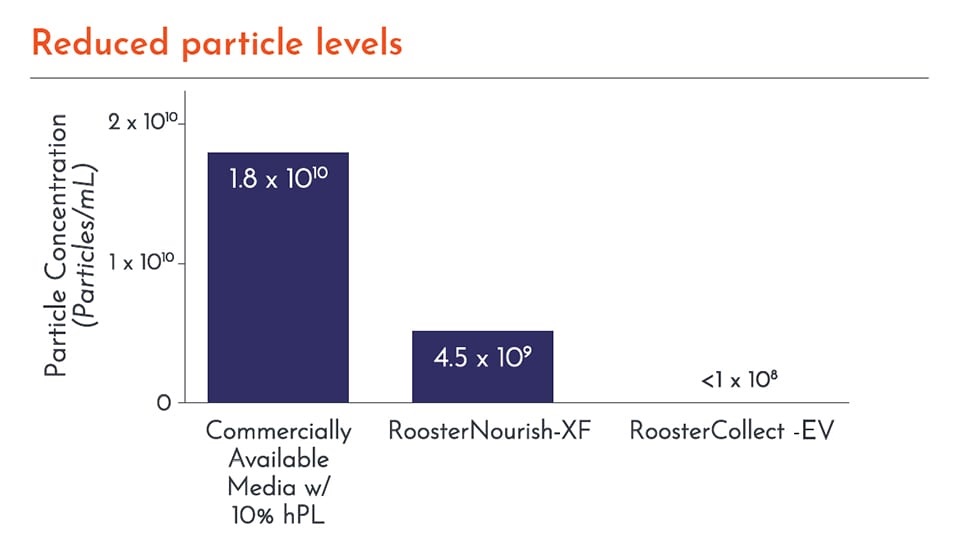
Particle background of commercial media, expansion medium and a dedicated EV collection medium compared.
A low particle background brings two direct benefits:
- More reliable characterization: with very low background noise, researchers can distinguish genuine cell-secreted EVs from particles contributed by the medium, giving more reliable yield data and purer downstream product — important for controlling critical quality attributes (CQAs);
- Easier downstream work: by avoiding exogenous particulate impurities at the formulation level, the process from hMSC expansion through the medium change to EV collection does not introduce xenogeneic vesicles or protein aggregates, so high-purity supernatant can be harvested directly, easing the impurity burden on downstream units such as TFF concentration and SEC and shortening the production chain.
Stage 3: scale-up — 3D Bioreactor Media Kit and Bioreactor Feed
To move from laboratory 2D culture to industrial 3D bioreactors, RoosterBio provides a complete bridge:
- 3D Bioreactor Media Kit: xeno-free medium designed for fed-batch bioreactor expansion;
- hMSC Bioreactor Feed: a 50× concentrated feed that removes the need for medium changes during 3D culture, simplifying handling and lowering contamination risk;
- Bag formats: suited to the closed-system needs of large bioreactors, maintaining sterile integrity in production;
- Validated for 3D exosome culture: performance data exist in both 2D and 3D bioreactors;
- Multiple cell types: validated in hMSCs, iPSC-MSCs, immortalized MSCs and fibroblasts.
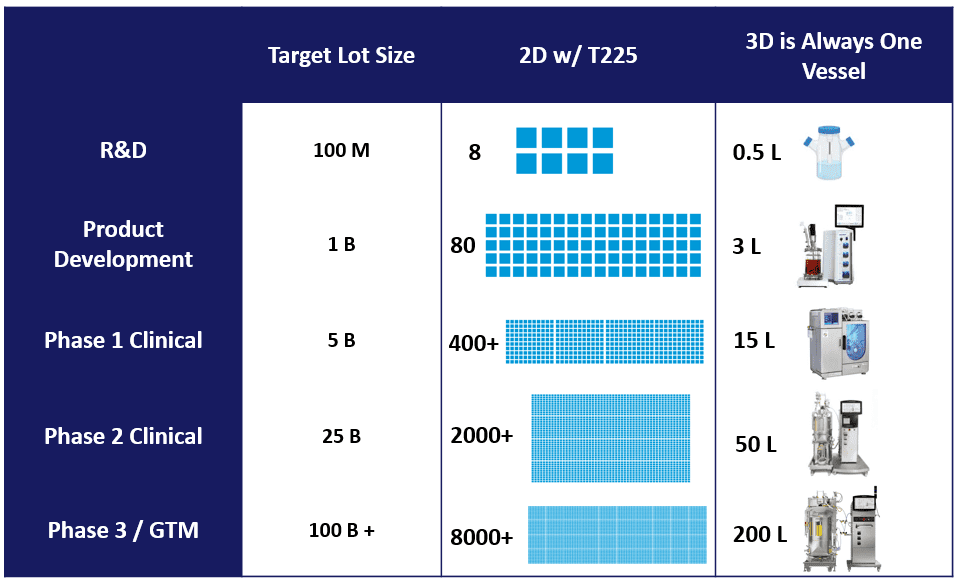
The source workflow links target batch size, development stage and vessel scale.
According to RoosterBio, the 3D media have been cross-validated across the main reactor categories and are compatible with most commercial bioreactors, including stirred tanks, vertical wheels, fixed beds, hollow fibres and spinner flasks, keeping equipment adaptation straightforward. The company also reports process models and production cases across multiple cell types and scales, with complete practical workflows from 0.1 L to 50 L and 2D process data that transfer to 3D scale-up. Researchers can choose between two standardized routes — a 2D process and a 3D bioreactor process — according to project stage and yield needs.
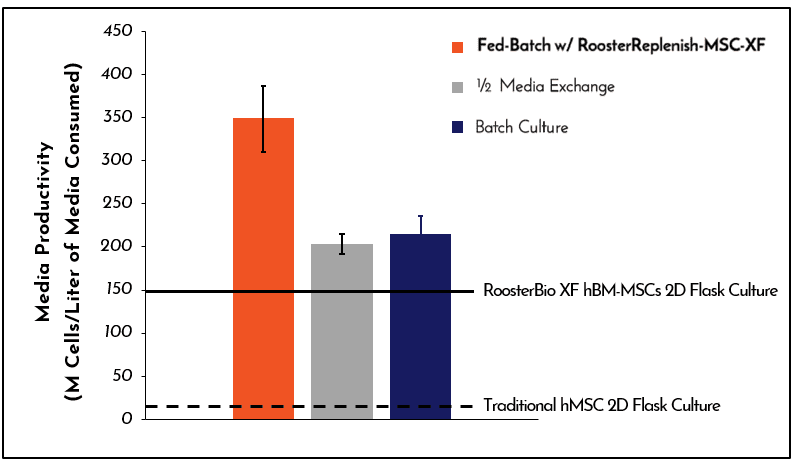
Medium utilisation in fed-batch culture compared with half-volume medium exchange and batch culture.
Stage 4: clinical translation — the cGMP CliniControl line
- RoosterNourish-MSC-CC: cGMP bioprocess medium using pathogen-reduced components for manufacturing therapeutic hMSCs;
- RoosterCollect-EV-CC: cGMP exosome/EV collection medium addressing the regulatory requirements of clinical-grade EV production;
- cGMP hMSC Bioreactor Feed: clinical-grade bioreactor feed supporting scaled culture in a GMP environment;
- FDA Type II Master File support: according to RoosterBio, its cGMP products are filed under an FDA Master File that researchers can cross-reference in IND filings, and several ongoing or planned registrational trials use its cGMP media and cells.
Six headline performance figures
| Metric | Figure |
|---|---|
| MSC expansion efficiency | Over 10-fold expansion in 4–5 days (RoosterNourish-MSC-XF with RoosterVialXF cells) |
| EV collection window | 6–72 hours, adjustable (RoosterCollect-EV) |
| Medium background particles | Chemically defined, protein-free formulation; release specification ≤1E8 particles/mL |
| Scale-up validation | 3D bioreactor systems validated beyond 50 L |
| Regulatory support | cGMP products filed under an FDA Type II Master File, citable in IND filings |
| Academic record | More than 350 peer-reviewed papers citing RoosterBio cells and media |
Two recommended process routes
Standard 2D process (laboratory scale):
- Thaw RoosterVialXF-hMSC cells and seed into RoosterNourish-MSC-XF (recommended density 3,000–5,000 cells/cm²);
- Expand for 4–5 days with no medium change until cells reach a suitable density;
- Discard the expansion medium and replace it with RoosterCollect-EV;
- Collect EVs, 6–72 h in the standard version, adjustable to the experimental plan;
- Harvest the conditioned medium for downstream purification (such as iZON TFF plus SEC) and characterization.
3D bioreactor process (scaled production):
- Complete 2D seed expansion in RoosterNourish-MSC-XF;
- Transfer to a 3D microcarrier suspension bioreactor and run fed-batch expansion with the 3D Bioreactor Media Kit and hMSC Bioreactor Feed;
- After expansion, switch to RoosterCollect-EV for exosome collection;
- Pass the collected conditioned medium into downstream purification (TFF plus SEC);
- After full characterization of the exosome product, decide whether to move onto the cGMP CliniControl route.
About RoosterBio
RoosterBio was founded in 2013 and is headquartered in Maryland, USA, focusing on highly engineered hMSC cell banks, bioprocess media and exosome production solutions. Its product lines cover bone marrow, adipose and umbilical cord-derived hMSCs, RoosterNourish expansion media that need no medium change, RoosterReplenish bioreactor feeds and RoosterCollect-EV exosome collection medium, with research-grade and CliniControl cGMP grades running in parallel and regulatory support documents such as drug Master Files available for cross-reference in filings.
One boundary is worth keeping in mind: the expansion folds, collection windows and particle release specifications above come from manufacturer information and specific process conditions. Validate them in parallel with your own MSC source, seeding density, culture vessels and harvest window; and a low medium particle background does not mean purification is complete — EV identity, potency and impurities still need orthogonal methods.
Let TechWave help you connect your exosome process
If you are looking for a low-background collection approach for an MSC-EV project, or planning to scale from 2D bench work to a bioreactor while keeping a raw-material route open for future clinical filings, contact TechWave. Based on your cell source, target batch size and development stage, we can help map out a combination of RoosterBio expansion, collection, 3D scale-up and cGMP products, provide technical documents and arrange a quotation.
Uses and applicable scenarios
- Serum-free, xeno-free expansion of hMSCs
- MSC-EV collection under low particle background
- Fed-batch scale-up in 3D bioreactors
- Moving an exosome process from research grade to cGMP
Limitations
- Expansion fold, collection window and similar parameters must be confirmed with your own MSC source, seeding density and culture vessels
- Low medium background is not the same as completed purification; clinical translation still requires full process and regulatory validation
Related brands
Related products
- RoosterHD™-EV
- prcRoosterNourish™-MSC-CC
- AgentV™-DSP
- RoosterCollect™-EV-CC
- RoosterVial hUC-MSC Cell Banks (Umbilical Cord MSC: XF, DEV+, cGMP CC)
- RoosterVial hBM-MSC Cell Banks (Bone Marrow MSC: XF, DEV+, cGMP CC)
- RoosterVial hAD-MSC Cell Banks (Adipose MSC, Xeno-Free)
- RoosterVial hDF Neonatal Dermal Fibroblast Cell Banks (XF, DEV+, cGMP CC)
- RoosterNourish-MSC-XF Serum-Free, Xeno-Free hMSC Expansion Medium
- RoosterReplenish-MSC-XF Xeno-Free Bioreactor Feed
- RoosterCollect-EV Chemically Defined EV Collection Medium (RUO)