
Products
RoosterCollect-EV Chemically Defined EV Collection Medium (RUO)
RoosterCollect-EV (M2001): chemically defined, protein-free, xeno-free and low-particulate EV collection medium for clean exosome and secretome collection from 2D vessels to 15 L bioreactors.
Product information
- Brand
- RoosterBio
- Catalog no.
- M2001
- Specification
- 500 mL
Clean collection: start downstream with less background
Every particle and protein in the collection medium ends up competing with your EVs in characterization and in downstream purification. RoosterCollect-EV is a chemically defined extracellular vesicle (EV) collection medium designed to remove that noise at the source: protein-free and low-particulate, it enables "clean collection" for higher yields and easier downstream processing, and it slots into EV, exosome or cell secretome production platforms across many cell and tissue types, in both 2D planar and 3D bioreactor culture.
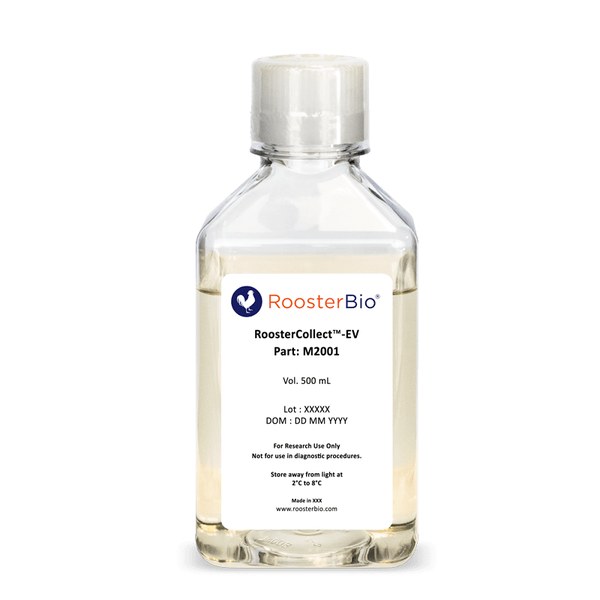
Catalogue number and format
| Catalogue number | Product | Volume | Storage (label) | Intended use |
|---|---|---|---|---|
| M2001 | RoosterCollect-EV | 500 mL | 2–8 °C, away from light | Research use only |
For clinical manufacturing, the cGMP version is RoosterCollect-EV-CC.
What the medium delivers
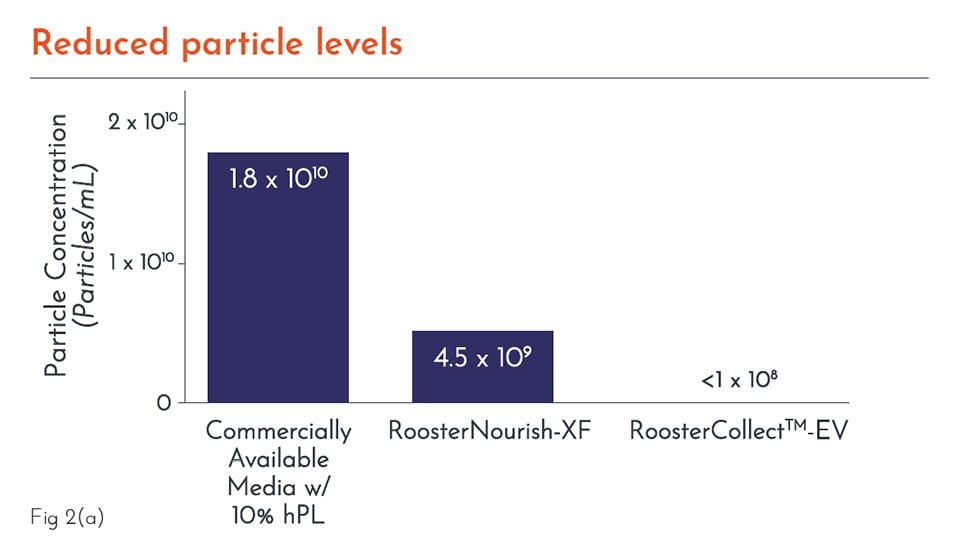
- Low-particulate medium: in RoosterBio's comparison, below 1E8 particles/mL, against 4.5E9 particles/mL for RoosterNourish-XF and 1.8E10 particles/mL for a commercially available medium with 10% hPL
- Xeno-free, protein-free and chemically defined
- Supports sEV (small extracellular vesicle) characterization as recommended by MISEV
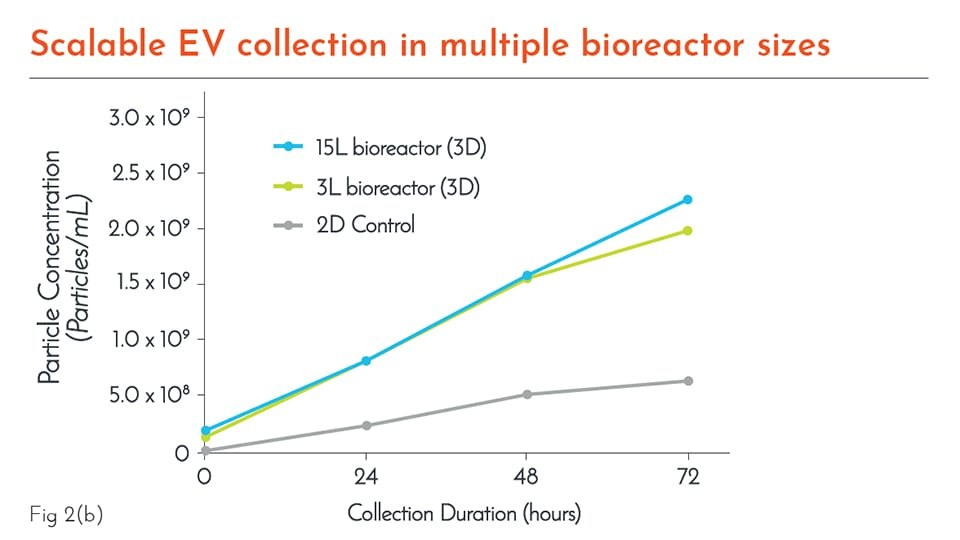
- Collection scales with your system: EV collection from 6 to 72 hours in 2D vessels and 3D bioreactors, shown up to 15 L
- Used in EV, secreted protein and conditioned medium applications
Turn the RoosterBio MSC platform into an exosome platform
RoosterCollect-EV works on its own with your preferred cell types, but combined with RoosterBio hMSCs and expansion media it turns the RoosterBio cell culture platform into a highly optimized exosome production platform: expand RoosterVial cells in RoosterNourish-MSC-XF, then switch to RoosterCollect-EV for the collection phase. In RoosterBio's 3D bioreactor data with RoosterVial-hDF (C55001DF), RoosterNourish-MSC-XF paired with RoosterReplenish-MSC-XF and RoosterCollect-EV reached >1E10 particles/mL.
Where it fits
- Research-scale MSC-EV, fibroblast-EV and secretome production where low background matters for sEV characterization as recommended by MISEV
- Process development before moving to the cGMP RoosterCollect-EV-CC
- The collection step ahead of AgentV-DSP downstream processing; for a single medium that expands cells and collects EVs at the same time, compare Rooster HD-EV
Setting up EV collection? Contact TechWave for RoosterCollect-EV selection support, collection protocols and a quotation.
Related brands
Related products
Technical resources
- Serum or Serum-Free? Stop Mixing Up SFM, XF, AF and CD: One Label-Attribute Map and Two Comparison Tables That Link Media Selection to Your Next Development Step
- Most of the Exosomes You Worked Hard to Grow Are Lost in Downstream Filtration: RoosterBio Agent V-DSP Relieves Filter Fouling and Lifts Cumulative Downstream Particle Recovery from 5%–10% to 40%–70%
- Low exosome yield and too many medium changes? Rooster HD-EV all-in-one expansion and collection medium: 10–20-fold more EVs than conventional batch culture, background ≤1.0E8 particles/mL
- Scaling MSC-EV from 250 mL to 15 L without losing yield or quality: about 4E5 cells/mL, about 1.7E10 particles/mL and about 91% membrane-dye-positive particles
- MSC-EV yields too low and background particles drowning the signal? RoosterBio's four-stage media suite: over 10-fold expansion in 4–5 days and collection medium at ≤1E8 particles/mL
- Choosing XF, AF or CD serum-free media: adaptation, lot consistency, downstream purification and compliance — 7 dimensions in one table
- The Cell Bank Is the Entry Ticket for MSC and EV Drug INDs: RoosterBio's Three Tiers from Research Grade to cGMP CliniControl, Checked Item by Item Against CDE Testing Requirements
- Scale Is the Engineering Goal, Equivalence Is the Hard Constraint: RoosterBio Anchors MSC 2D-to-3D Comparability on Cell Age (PDL), with Multi-Donor Final PDL of 16–20 and More Than 25 Billion Cells per 50 L Batch