
Products
RoosterVial hUC-MSC Cell Banks (Umbilical Cord MSC: XF, DEV+, cGMP CC)
RoosterVial hUC-MSC cell banks (C43001UC / C43002UC / C56010UC / C04020UC): xeno-free human umbilical cord MSCs from the perivascular Wharton's Jelly, offered as XF research vials, DEV+ pre-clinical vials and cGMP CliniControl vials, with >10-fold, media-exchange-free expansion in days.
Product information
- Brand
- RoosterBio
- Catalog no.
- C43001UC / C43002UC / C56010UC / C04020UC
- Specification
- 1M / 10M / 20M cells/vial
Umbilical cord MSCs from first experiment to clinical manufacturing
Changing cell supplier between research, process development and the clinic adds comparability work and a new round of starting-material qualification. RoosterVial hUC-MSC cell banks keep that path with one manufacturer and one RoosterBio expansion platform: human umbilical cord-derived mesenchymal stem/stromal cells (hUC-MSCs), isolated from the perivascular Wharton's Jelly region of the cord, are available in three grades — xeno-free (XF) research vials, DEV+ vials for pre-clinical development and cGMP CliniControl (CC) vials designed for clinical manufacturing. hUC-MSCs are an off-the-shelf, well-characterized starting material for allogeneic cell therapy and extracellular vesicle (EV) production.
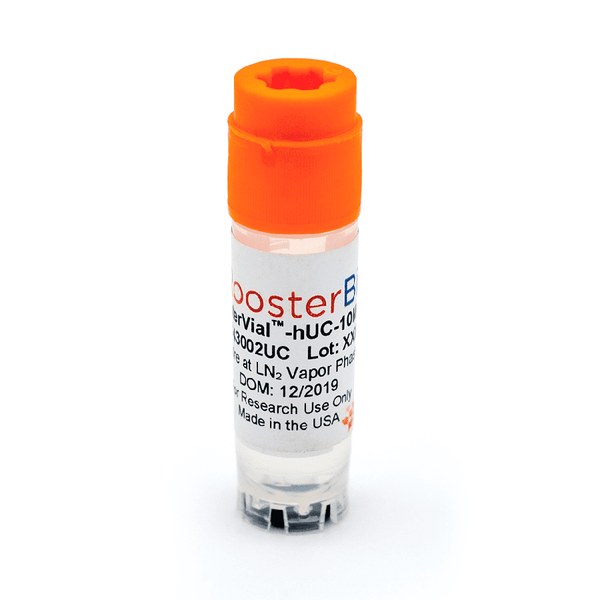
Catalogue numbers and formats
| Catalogue number | Product | Cells per vial | Grade | Intended use |
|---|---|---|---|---|
| C43001UC | RoosterVial-hUC-1M-XF | 1M | Research, xeno-free | Research use only |
| C43002UC | RoosterVial-hUC-10M-XF | 10M | Research, xeno-free | Research use only |
| C56010UC | RoosterVial-hUC-10M-DEV+ | 10M | Pre-clinical development | Research use only |
| C04020UC | RoosterVial-hUC-20M-CC | 20M | cGMP (CliniControl) | For further manufacturing use only |
Every format is supplied as cryopreserved xeno-free cells, one vial per unit.
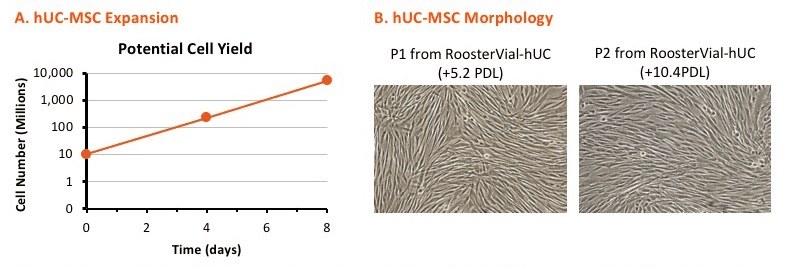
XF research grade: >10-fold expansion in 4–6 days, no media exchange
- Expanded to a population doubling level (PDL) of 14–20; 1M or high-volume 10M cells per vial, with multiple donors available
- Every lot is release-tested to expand more than 10-fold within 4–6 days in a media-exchange-free process when paired with RoosterNourish-MSC-XF
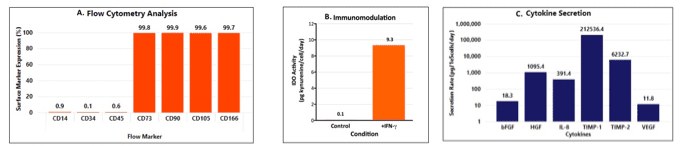
- Conforms to the ISCT minimal criteria for hMSC identity: cell surface markers (CD73, CD90, CD105, CD166) and tri-lineage differentiation potential, plus expansion potential and sterility
- The accompanying QC Brief adds functional characterization: immunomodulatory potential (IDO activity in response to IFN-γ) and angiogenic cytokine secretion
- Manufactured with cGMP-compatible processes; easy-to-follow 2D and 3D bioreactor expansion protocols are supplied, so you skip months of process development
DEV+: a cost-effective pre-clinical development tool
- Donor tissue sourced under Good Tissue Practice (GTP) standards in accordance with 21 CFR Part 1271; 10M cells per vial manufactured to a consistent PDL
- Lot-specific testing supports >10-fold expansion within 4–5 days in RoosterNourish-MSC-XF and more than 20 additional population doublings from thaw
- Release testing: cell count, viability and flow cytometry for CD90 and CD166, with CD34 and CD45 as negative markers; safety testing for sterility and mycoplasma
- Characterization: PDL, IDO immunomodulatory potential, angiogenic cytokine secretion (bFGF, HGF, IL-8, TIMP-1, TIMP-2, VEGF) and tri-lineage differentiation potential
- Additional viral testing is conducted on the Master Cell Bank in accordance with the FDA draft guidance "Safety Testing of Human Allogeneic Cells Expanded for Use in Cell-Based Medical Products"
cGMP CliniControl C04020UC: built for allogeneic manufacturing
- 20M xeno-free cells per vial, cGMP-manufactured from umbilical cord donor tissue sourced under GTP standards (21 CFR Part 1271), at ISO 9001-certified manufacturing sites
- Supported by an FDA Type II Master File, which RoosterBio states is in place to streamline regulatory submissions
- Lot-specific testing supports >10-fold expansion within 4–5 days in prcRoosterNourish-MSC-CC and more than 20 additional population doublings from thaw
- Release testing: cell count, viability and flow cytometry for CD90 and CD166, with CD34 and CD45 as negative markers
- Safety testing: sterility, endotoxin, mycoplasma and in vitro adventitious agents, with additional viral testing on the Master Cell Bank under the same FDA draft guidance
- Characterization: G-band karyotyping, PDL, IDO enzymatic activity, cytokine secretion profile (bFGF, HGF, IL-8, TIMP-1, TIMP-2, VEGF) and tri-lineage differentiation potential
- Compatible with scalable 2D and 3D protocols to manufacture billions of cells or trillions of hMSC-EVs, with no media exchanges or surface coatings
- Intended use: for further manufacturing use only; not intended for diagnostic use or for direct human or veterinary therapeutic use
RoosterBio can also be asked about off-the-shelf Master Cell Bank availability to support gene-modified banks and iPSC reprogramming.
QuickShip: a custom hUC-MSC bank made to your specification
Need a bank that matches your own process? QuickShip hMSCs are made to order: choose the donor and tissue from RoosterBio's library (hUC is available xeno-free), 2D multi-layer vessels or 3D bioreactor production, early-passage cells for further expansion or pre-expanded cells for direct use, and the fill format. Up to >1E9 hMSCs can be produced per lot, filled and cryopreserved to your specification, and analysed for the hallmark surface markers CD73, CD90, CD105 and CD166 with safety and sterility testing. QuickShip hMSCs are for research use only.
Where it fits
- Research and feasibility work: start with C43001UC or C43002UC and the supplied RoosterNourish-MSC-XF protocols
- Locking a pre-clinical process: move to C56010UC, with GTP-sourced donor tissue, lot-specific release testing and Master Cell Bank viral testing
- Clinical manufacturing of allogeneic cell therapies or hMSC-EVs: C04020UC with prcRoosterNourish-MSC-CC
Building an umbilical cord MSC or MSC-EV programme? Contact TechWave for RoosterVial selection support, QC documentation, expansion protocols and a quotation.
Related brands
Related products
Technical resources
- Serum or Serum-Free? Stop Mixing Up SFM, XF, AF and CD: One Label-Attribute Map and Two Comparison Tables That Link Media Selection to Your Next Development Step
- Most of the Exosomes You Worked Hard to Grow Are Lost in Downstream Filtration: RoosterBio Agent V-DSP Relieves Filter Fouling and Lifts Cumulative Downstream Particle Recovery from 5%–10% to 40%–70%
- Low exosome yield and too many medium changes? Rooster HD-EV all-in-one expansion and collection medium: 10–20-fold more EVs than conventional batch culture, background ≤1.0E8 particles/mL
- Scaling MSC-EV from 250 mL to 15 L without losing yield or quality: about 4E5 cells/mL, about 1.7E10 particles/mL and about 91% membrane-dye-positive particles
- MSC-EV yields too low and background particles drowning the signal? RoosterBio's four-stage media suite: over 10-fold expansion in 4–5 days and collection medium at ≤1E8 particles/mL
- Choosing XF, AF or CD serum-free media: adaptation, lot consistency, downstream purification and compliance — 7 dimensions in one table
- The Cell Bank Is the Entry Ticket for MSC and EV Drug INDs: RoosterBio's Three Tiers from Research Grade to cGMP CliniControl, Checked Item by Item Against CDE Testing Requirements
- Scale Is the Engineering Goal, Equivalence Is the Hard Constraint: RoosterBio Anchors MSC 2D-to-3D Comparability on Cell Age (PDL), with Multi-Donor Final PDL of 16–20 and More Than 25 Billion Cells per 50 L Batch