
Technical column
Low exosome yield and too many medium changes? Rooster HD-EV all-in-one expansion and collection medium: 10–20-fold more EVs than conventional batch culture, background ≤1.0E8 particles/mL
Scaling exosome production is usually held back by low yield, high background impurities, laborious handling and high scale-up cost. Rooster HD-EV is a fully chemically defined medium that combines expansion and collection: cells grow while EVs are collected, and according to the manufacturer EV yield rises 10–20-fold over conventional batch culture. The medium's baseline particle background is ≤1.0E8 particles/mL, it needs no washing or medium change and runs fed-batch, and it supports continuous production for up to 12 days in a 3D bioreactor.
Definition
Rooster HD-EV (Highly-productive, chemically-Defined system for maximized exosome production) is a fully chemically defined medium from RoosterBio that merges MSC expansion and exosome (EV) collection into a single, simultaneous process.
Exosomes and extracellular vesicles (EVs) are moving from basic research into drug development, but scaled production keeps being held back by the same old problems: low yield, high background impurities, laborious handling and high scale-up cost. The conventional route expands cells, washes and changes the medium, then switches to a collection medium — and every extra step is another chance to lose EVs or introduce contamination.
RoosterBio's Rooster HD-EV compresses that chain into a single step: in a fully chemically defined medium, cells secrete EVs while they grow and the supernatant is harvested directly. According to RoosterBio's data, EV yield is 10–20-fold higher than in conventional batch culture, the medium's baseline background is ≤1.0E8 particles/mL, and continuous production runs for up to 12 days in a 3D bioreactor.
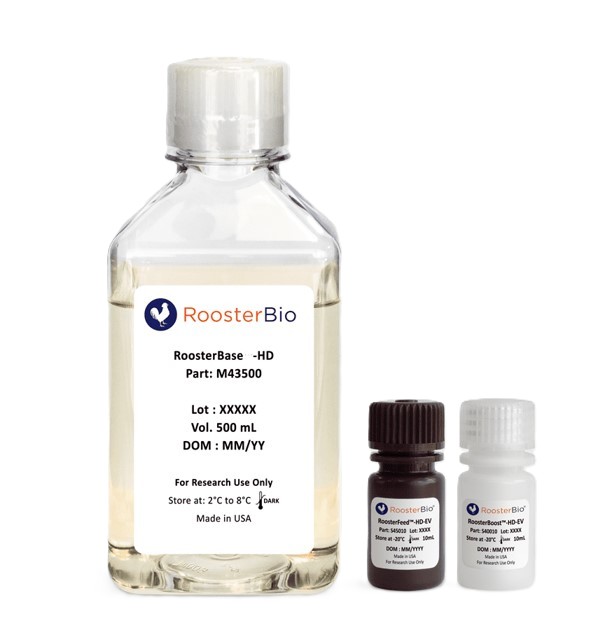
Figure 1. Chemically defined Rooster HD-EV all-in-one expansion and collection medium
Six design points aimed at the core bottlenecks of exosome scale-up
Full product name: Rooster HD-EV Highly-productive, chemically-Defined system for maximized exosome production. According to RoosterBio, it is designed around six points:
- Higher EV yield, beyond the ceiling of conventional culture: collection runs in step with cell growth, raising output 10–20-fold over conventional batch culture and substantially reducing the reactor capacity required.
- Low-particle-background formulation that lightens downstream purification: the medium's baseline background is ≤1.0E8 particles/mL, with background impurities far below those of conventional EV collection media, reducing the load on downstream chromatography and improving the purity of the final EV product.
- No washing and no medium change, simplifying the whole workflow: the multi-step "expand–wash–change medium–collect" sequence is replaced by harvesting supernatant directly during cell growth, removing wash and exchange steps, reducing EV loss and contamination risk and shortening the culture cycle; the process runs in fed-batch mode with no manual medium change at any point.
- Process consistency: standardized handling, and a fully chemically defined formulation designed to ensure high lot-to-lot consistency, providing a quality basis for developing and commercially manufacturing clinical-grade exosome therapeutics.
- Full 2D/3D compatibility for flexible multi-cycle processes: a 3D bioreactor production solution compatible with a range of mainstream stirred reactors; according to the manufacturer it scales linearly, maintains EV quality attributes and needs no process re-optimization.
- Similar quality attributes: particle size distribution and marker expression remain stable.
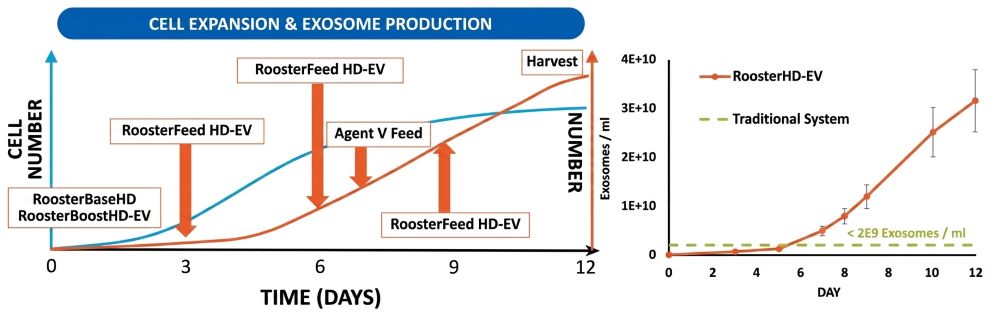
Figure 2. Rooster HD-EV supports continuous exosome production for up to 12 days in a 3D bioreactor
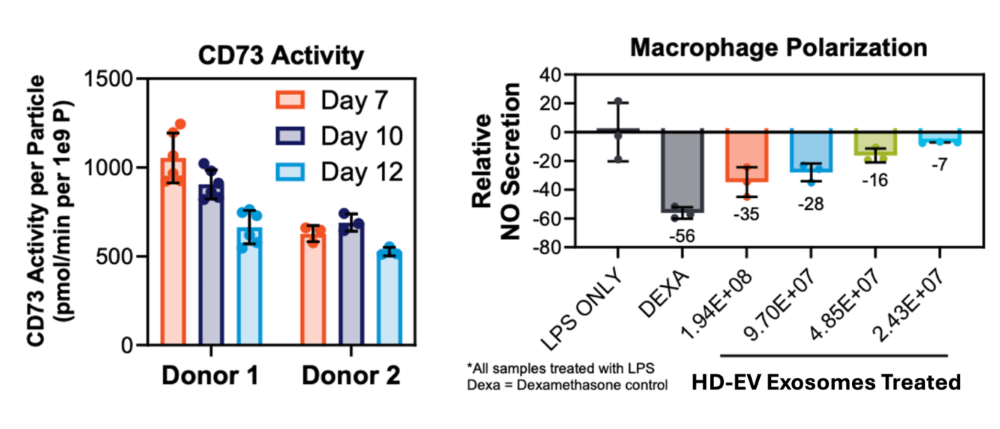
Figure 3. CD73 activity and immunomodulatory function assays of hMSC-derived EVs
Why "all-in-one" addresses yield and purity at the same time
- One less medium change, one less loss: the conventional route washes and changes the medium between expansion and collection, so EVs are lost with the discarded medium and each open manipulation adds contamination risk; the integrated design starts harvesting during cell growth.
- Lower background, truer signal: particles carried by the medium are counted alongside cell-secreted EVs and enter purification with them. A baseline of ≤1.0E8 particles/mL means fewer exogenous particles for downstream chromatography and more trustworthy yield data.
- Chemically defined, comparable between lots: removing serum and other poorly defined additives makes raw-material specifications and lot comparisons easier to document — an unavoidable step when a process moves towards clinical filing.
- One formulation across 2D and 3D: screen process conditions in small-scale 2D, then scale up in 3D stirred reactors, reducing the redevelopment that comes with switching systems.
About RoosterBio
Founded in 2013 and headquartered in Maryland, USA, RoosterBio is a well-known company in MSC biomanufacturing. It focuses on highly engineered hMSC cell banks, bioprocess media and exosome production solutions, aiming to simplify scaled manufacture of mesenchymal stem cells and exosomes.
Its media portfolio spans upstream MSC expansion, high-yield EV collection, 3D scale-up and clinical-translation filing, supporting cell and exosome production on efficiency, purity, scale-up and compliance at every stage from basic research to process development and new-drug filing.
- Core product lines: bone marrow, adipose and umbilical cord-derived hMSCs, Rooster Nourish expansion medium that needs no medium change, Rooster Replenish bioreactor feed and Rooster Collect-EV exosome collection medium
- Product grades: RUO and cGMP grades in parallel
- Regulatory support: according to RoosterBio, an FDA Type II Master File and international regulatory support documents are available for cross-reference in filings
A boundary worth keeping in mind: the 10–20-fold yield increase, the ≤1.0E8 particles/mL baseline and the 12-day continuous production all come from manufacturer information and specific process conditions. Before adopting the medium, compare it in parallel with your existing two-stage process using the same starting cells and harvest criteria; and a low medium background does not mean purification is complete — EV identity, purity and function still need downstream processing and orthogonal methods.
Let TechWave help you evaluate an integrated exosome process
If your MSC-EV project is held back by insufficient yield, too many medium changes or a heavy downstream purification burden, or you are planning to move from 2D bench work into 3D bioreactors, contact TechWave. Based on your cell source, target batch size and development stage, we can help evaluate Rooster HD-EV together with RoosterBio expansion, feed and collection products, provide technical documents and arrange a quotation.
Uses and applicable scenarios
- High-yield upstream production of MSC-derived exosomes
- Fed-batch continuous collection without washing or medium changes
- Exosome scale-up in 3D stirred bioreactors
- Low-particle-background collection to reduce downstream purification burden
Limitations
- The 10–20-fold yield increase and 12-day continuous production come from the manufacturer's specific process conditions; validate them in parallel with your own MSC source, vessels and feeding scheme
- A low medium background does not mean the EVs are purified; EV identity, purity and function still need downstream processing and orthogonal methods
Related brands
Related products
- RoosterHD™-EV
- prcRoosterNourish™-MSC-CC
- AgentV™-DSP
- RoosterCollect™-EV-CC
- RoosterVial hUC-MSC Cell Banks (Umbilical Cord MSC: XF, DEV+, cGMP CC)
- RoosterVial hBM-MSC Cell Banks (Bone Marrow MSC: XF, DEV+, cGMP CC)
- RoosterVial hAD-MSC Cell Banks (Adipose MSC, Xeno-Free)
- RoosterVial hDF Neonatal Dermal Fibroblast Cell Banks (XF, DEV+, cGMP CC)
- RoosterNourish-MSC-XF Serum-Free, Xeno-Free hMSC Expansion Medium
- RoosterReplenish-MSC-XF Xeno-Free Bioreactor Feed
- RoosterCollect-EV Chemically Defined EV Collection Medium (RUO)