
Products
Biolaminin 421 LN (LN421)
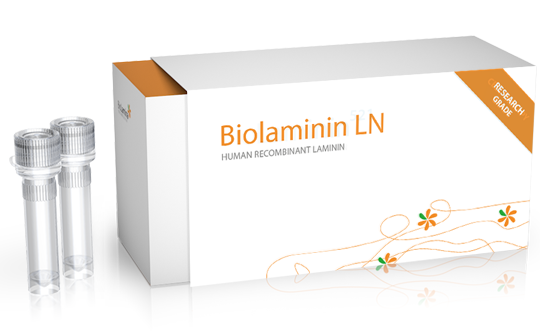
Biolaminin 421 LN (LN421-02 / LN421-0501): full-length human laminin-421 for endothelial and kidney mesangial cells and maturation of neuromuscular junctions.
Product information
- Brand
- BioLamina
- Catalog no.
- LN421-02 / LN421-0501
- Specification
- 100 μg (1 mL) / 500 μg (5 mL)
The laminin for endothelial, mesangial and synapse-forming cultures
Endothelial and kidney mesangial cells, and the synapses of the neuromuscular junction, rely on laminin-421. Biolaminin 421 LN is a full-length human recombinant laminin-421 that supports several tissue-specific cell types such as endothelial and kidney cells, and has been suggested to be important for renal, synaptic and inflammatory functions — chemically defined and animal origin-free.
Key specifications
| Parameter | Specification |
|---|---|
| Catalogue numbers | LN421-02 (100 μg, 1 mL) / LN421-0501 (500 μg, 5 mL) |
| Protein | Full-length human recombinant laminin-421 (laminin-9) |
| Classification | Animal origin-free, human recombinant protein; chemically defined and xeno-free |
| Concentration | 0.1 mg/mL |
| Appearance | Clear, colourless buffered solution, pH 7.2, with 10% glycerol and 0.02% NaN3 |
| Storage | −20 °C to −80 °C; shipped on dry ice |
| Declaration | For research use only |
Why laminin-421
In the kidney, laminin-421 is produced by mesangial cells and is presumably important for the development and repair of the microvasculature and for glomerulogenesis, whereas podocytes bind mainly to laminin-521. Laminin-421 has also been implicated in renal cell carcinomas and glial brain tumours. In chemical synapses it is crucial for the correct localization of pre- and post-synaptic specializations: in mice lacking the laminin β2 chain, neuromuscular junctions fail to form presynaptic active zones and neurotransmitter release is disrupted.
Recommended applications
- Endothelial cell culture; angiogenesis and vascular ageing studies; iPSC differentiation into endothelial cells
- Kidney mesangial cells and kidney tissue models
- Maturation of neuromuscular junctions; neural cells
- Compatible with serum-free media, various surface materials, 3D models, large-scale production and automation
Coating essentials
- Thaw slowly at +4 °C, dilute in 1× DPBS and coat tissue culture-treated surfaces at 0.5–2 μg/cm² (optimize per cell line)
- Seal the plate and incubate overnight at 2–8 °C, or 2 hours at 37 °C; never let the coating dry, as this inactivates the laminin
- Thawed, undiluted stock is stable for 3 months at 2–8 °C; for longer storage aliquot and keep at −30 °C to −80 °C; avoid repeated freeze–thaw
- Coated plates can be stored aseptically at 2–8 °C for up to 4 weeks
Selection notes
Compare with Biolaminin 411 for vascular and islet work; kidney podocytes bind mainly laminin-521, so consider Biolaminin 521 for podocyte cultures.
Selected publications
- Tjin MS, et al. Biologically relevant laminin as chemically defined and fully human platform for human epidermal keratinocyte culture. Nat Commun. 2018;9(1):4432. doi:10.1038/s41467-018-06934-3
- Saito N, et al. Laminin‐421 produced by lymphatic endothelial cells induces chemotaxis for human melanoma cells. Pigment Cell Melanoma Res. 2009;22(5):601-610. doi:10.1111/j.1755-148x.2009.00590.x
- Glasgow HL, et al. Laminin targeting of a peripheral nerve-highlighting peptide enables degenerated nerve visualization. Proc Natl Acad Sci USA. 2016;113(45):12774-12779. doi:10.1073/pnas.1611642113
- Pęziński M, et al. An improved method for culturing myotubes on laminins for the robust clustering of postsynaptic machinery. Sci Rep. 2020;10(1):4524. doi:10.1038/s41598-020-61347-x
- Källén A, et al. 3D Culture in Functionalized FN‐Silk Networks Facilitate Proliferation, Differentiation and Phenotypic Stability of Mature Human Primary Cells and Stem Cells. Biotech & Bioengineering. 2025;122(9):2522-2534. doi:10.1002/bit.70002
Choosing the right laminin isoform for your cell type? Contact TechWave for Biolaminin 421 LN selection support, coating protocols and quotations.
Related brands
Related products
Technical resources
- One-stop iPSC workflow selection: from reprogramming, expansion, gene editing and directed differentiation to 0.1–80 L suspension scale-up, 525 mL/min closed filling and ambient transport for up to 2 weeks
- Change the matrix lot and differentiation results shift? Choosing an iPSC matrix: Matrigel, VTN, E8 fragments and full-length Biolaminin 521 compared
- Both pass in 2D — week six decides: an LN521:LN111 laminin blend keeps 3D vascularized liver spheroids more uniform and intact for longer, with human albumin still in mouse plasma 14 days after transplant
- Twenty years of Yamanaka factors: iPS cell therapies win conditional approval and partial reprogramming enters its first human trial — how close is “making cells young again”?
- Give β-cells a real basement membrane: BioLamina full-length laminins deliver 3.9-fold higher SC-islet insulin secretion, 20–25% more NKX6.1/NEUROD1 cells and 3- to 4-fold primary-islet expansion versus tissue-extracted matrix
- Is Differentiation Purity Stuck? After Rounds of Factor and Medium Changes, the Overlooked Variable May Be the Matrix: Matrigel, Vitronectin, E8 Fragments and Full-Length Laminins Compared, Plus 11 Biolaminin Products by Lineage