
Products
Biolaminin 411 LN (LN411)
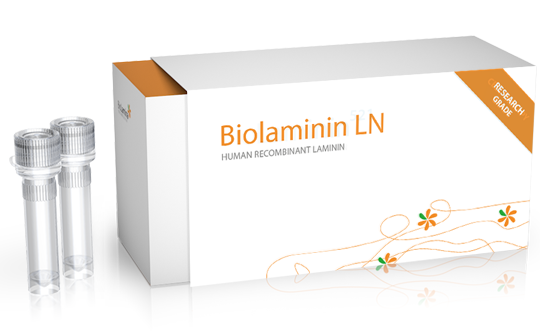
Biolaminin 411 LN (LN411-02 / LN411-0501): full-length human laminin-411, the vascular laminin, for endothelial, pancreatic islet, adipocyte and immune cell culture.
Product information
- Brand
- BioLamina
- Catalog no.
- LN411-02 / LN411-0501
- Specification
- 100 μg (1 mL) / 500 μg (5 mL)
The vascular laminin for endothelial, islet and immune cell culture
Endothelial cells build their basal lamina largely from laminin-411, and pancreatic islets depend on it from their capillaries. Biolaminin 411 LN is a full-length human recombinant laminin-411 that supports diverse tissue cell types from the pancreas and the vascular, immune, nervous and hematopoietic systems — chemically defined and animal origin-free.
Key specifications
| Parameter | Specification |
|---|---|
| Catalogue numbers | LN411-02 (100 μg, 1 mL) / LN411-0501 (500 μg, 5 mL) |
| Protein | Full-length human recombinant laminin-411 (laminin-8) |
| Classification | Animal origin-free, human recombinant protein; chemically defined and xeno-free |
| Concentration | 0.1 mg/mL |
| Appearance | Clear, colourless buffered solution, pH 7.2, with 10% glycerol and 0.02% NaN3 |
| Storage | −20 °C to −80 °C; shipped on dry ice |
| Declaration | For research use only |
Why laminin-411
Laminin-411 is one of the main laminins produced by endothelial cells in capillaries and larger vessels and has a pivotal role in endothelial basal lamina function; mice lacking the α4 chain show severely disorganized microvessels. During sprouting angiogenesis, laminins deposited from stalk cells to tip cell filopodia control vessel lumen diameter. Laminin-411 is secreted by lymphocytes and supports their proliferation, adhesion and migration, and it is involved in the survival, adhesion and migration of blood neutrophils. Islet β cells cannot make laminin-411 or -511 themselves — capillary endothelial cells supply them — and BioLamina notes that LN411 and LN511 in culture can partially substitute the pancreatic environment and help maintain β cell insulin production during islet transplantation before revascularization.
Recommended applications
- iPSC differentiation into endothelial cells; mature vascular endothelial cells and vascular disease models
- Pancreatic islet cells
- Adipocytes and epidermal cells
- Neural and hematopoietic cell culture
- Compatible with serum-free media, various surface materials, 3D models, large-scale production and automation
Coating essentials
- Thaw slowly at +4 °C, dilute in 1× DPBS and coat tissue culture-treated surfaces at 0.5–2 μg/cm² (optimize per cell line)
- Seal the plate and incubate overnight at 2–8 °C, or 2 hours at 37 °C; never let the coating dry, as this inactivates the laminin
- Thawed, undiluted stock is stable for 3 months at 2–8 °C; for longer storage aliquot and keep at −30 °C to −80 °C; avoid repeated freeze–thaw
- Coated plates can be stored aseptically at 2–8 °C for up to 4 weeks
Selection notes
For endothelial and kidney mesangial work compare with Biolaminin 421; for islets, Biolaminin 511 and 521 are the α5 alternatives.
Selected publications
- Singh R, et al. Enhanced structure and function of human pluripotent stem cell-derived beta-cells cultured on extracellular matrix. Stem Cells Translational Medicine. 2021;10(3):492-505. doi:10.1002/sctm.20-0224
- Sigmundsson K, et al. Culturing functional pancreatic islets on α5-laminins and curative transplantation to diabetic mice. Matrix Biology. 2018;70:5-19. doi:10.1016/j.matbio.2018.03.018
Choosing the right laminin isoform for your cell type? Contact TechWave for Biolaminin 411 LN selection support, coating protocols and quotations.
Related brands
Related products
Technical resources
- One-stop iPSC workflow selection: from reprogramming, expansion, gene editing and directed differentiation to 0.1–80 L suspension scale-up, 525 mL/min closed filling and ambient transport for up to 2 weeks
- Change the matrix lot and differentiation results shift? Choosing an iPSC matrix: Matrigel, VTN, E8 fragments and full-length Biolaminin 521 compared
- Both pass in 2D — week six decides: an LN521:LN111 laminin blend keeps 3D vascularized liver spheroids more uniform and intact for longer, with human albumin still in mouse plasma 14 days after transplant
- Twenty years of Yamanaka factors: iPS cell therapies win conditional approval and partial reprogramming enters its first human trial — how close is “making cells young again”?
- Give β-cells a real basement membrane: BioLamina full-length laminins deliver 3.9-fold higher SC-islet insulin secretion, 20–25% more NKX6.1/NEUROD1 cells and 3- to 4-fold primary-islet expansion versus tissue-extracted matrix
- Is Differentiation Purity Stuck? After Rounds of Factor and Medium Changes, the Overlooked Variable May Be the Matrix: Matrigel, Vitronectin, E8 Fragments and Full-Length Laminins Compared, Plus 11 Biolaminin Products by Lineage