
Products
Biolaminin 211 LN (LN211)
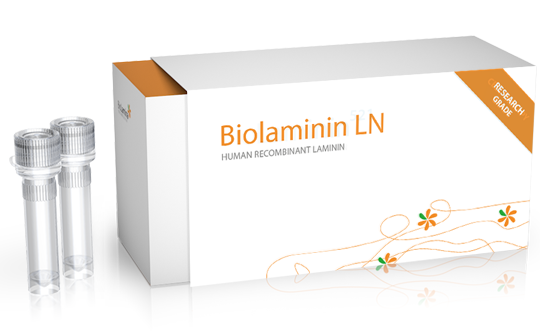
Biolaminin 211 LN (LN211-02 / LN211-0501): full-length human laminin-211, a main laminin of adult muscle, for cardiomyocytes, skeletal muscle and motor neurons.
Product information
- Brand
- BioLamina
- Catalog no.
- LN211-02 / LN211-0501
- Specification
- 100 μg (1 mL) / 500 μg (5 mL)
The muscle and nerve laminin for cardiomyocytes, skeletal muscle and motor neurons
Muscle and nerve cells mature best on the matrix they meet in the body. Biolaminin 211 LN is a full-length human recombinant laminin-211 — one of the main laminins of adult muscle — that supports the growth, survival and differentiation of tissue-specific cell types including motor neurons, cardiac cells and skeletal muscle cells, in a chemically defined, animal origin-free format.
Key specifications
| Parameter | Specification |
|---|---|
| Catalogue numbers | LN211-02 (100 μg, 1 mL) / LN211-0501 (500 μg, 5 mL) |
| Protein | Full-length human recombinant laminin-211 (laminin-2) |
| Classification | Animal origin-free, human recombinant protein; chemically defined and xeno-free |
| Concentration | 0.1 mg/mL |
| Appearance | Clear, colourless buffered solution, pH 7.2, with 10% glycerol and 0.02% NaN3 |
| Storage | −20 °C to −80 °C; shipped on dry ice |
| Declaration | For research use only |
Why laminin-211
Laminin-211 is crucial for muscle development and function and is one of the main isoforms in adult muscle, alongside varying amounts of laminin-221, -521 and -421 depending on the tissue; mutations of the LAMA2 gene are the most common cause of congenital muscular dystrophy. Laminin-211 and -221 are both expressed in the extracellular matrix of developing cardiomyocytes and in the basement membrane zones of the endo- and pericardium and capillaries. Laminin-211 is also a major isoform made by Schwann cells in the developing peripheral nervous system, important for axonal elongation and myelination, and α2-chain laminins in the ventricular zone of the developing mouse brain suggest a role in regulating neural stem and progenitor cells.
Recommended applications
- iPSC differentiation into cardiomyocytes
- Motor neurons and other peripheral nervous system neurons; cortical neurons; glial cells
- Skeletal and smooth muscle cells; muscle development and neuromuscular disease models
- Blood–brain barrier models
- Compatible with serum-free media, various surface materials, 3D models, large-scale production and automation
Coating essentials
- Thaw slowly at +4 °C, dilute in 1× DPBS and coat tissue culture-treated surfaces at 0.5–2 μg/cm² (optimize per cell line)
- Seal the plate and incubate overnight at 2–8 °C, or 2 hours at 37 °C; never let the coating dry, as this inactivates the laminin
- Thawed, undiluted stock is stable for 3 months at 2–8 °C; for longer storage aliquot and keep at −30 °C to −80 °C; avoid repeated freeze–thaw
- Coated plates can be stored aseptically at 2–8 °C for up to 4 weeks
Selection notes
For cardiac maturation compare with Biolaminin 221; for pluripotent stem cell expansion before differentiation, use Biolaminin 521.
Selected publications
- Holmberg J, Durbeej M. Laminin-211 in skeletal muscle function. Cell Adhesion & Migration. 2013;7(1):111-121. doi:10.4161/cam.22618
- Barraza-Flores P, et al. Human laminin-111 and laminin-211 protein therapy prevents muscle disease progression in an immunodeficient mouse model of LAMA2-CMD. Skeletal Muscle. 2020;10(1):18. doi:10.1186/s13395-020-00235-4
Choosing the right laminin isoform for your cell type? Contact TechWave for Biolaminin 211 LN selection support, coating protocols and quotations.
Related brands
Related products
Technical resources
- One-stop iPSC workflow selection: from reprogramming, expansion, gene editing and directed differentiation to 0.1–80 L suspension scale-up, 525 mL/min closed filling and ambient transport for up to 2 weeks
- Change the matrix lot and differentiation results shift? Choosing an iPSC matrix: Matrigel, VTN, E8 fragments and full-length Biolaminin 521 compared
- Both pass in 2D — week six decides: an LN521:LN111 laminin blend keeps 3D vascularized liver spheroids more uniform and intact for longer, with human albumin still in mouse plasma 14 days after transplant
- Twenty years of Yamanaka factors: iPS cell therapies win conditional approval and partial reprogramming enters its first human trial — how close is “making cells young again”?
- Give β-cells a real basement membrane: BioLamina full-length laminins deliver 3.9-fold higher SC-islet insulin secretion, 20–25% more NKX6.1/NEUROD1 cells and 3- to 4-fold primary-islet expansion versus tissue-extracted matrix
- Is Differentiation Purity Stuck? After Rounds of Factor and Medium Changes, the Overlooked Variable May Be the Matrix: Matrigel, Vitronectin, E8 Fragments and Full-Length Laminins Compared, Plus 11 Biolaminin Products by Lineage