
Technical column
Both pass in 2D — week six decides: an LN521:LN111 laminin blend keeps 3D vascularized liver spheroids more uniform and intact for longer, with human albumin still in mouse plasma 14 days after transplant
The real hurdle in liver tissue engineering is not getting stem cells to attach but keeping 3D tissue structurally and functionally stable over time. A translational study in Cells starts from clinical-grade hESCs and runs BioLamina full-length human recombinant Laminin 521 and Laminin 111 through stem cell expansion, hepatic and endothelial differentiation and 3D vascularized liver spheroid assembly: in 2D both matrices yield HNF4α-positive hepatic progenitors and VE-cadherin-positive endothelial cells; over six weeks of 3D culture the difference emerges — LN521-only spheroids become granular with a tendency to form a necrotic core, while LN521:LN111 spheroids stay more uniform and structurally intact for longer, with AFP falling and ALB, A1AT secretion and CYP1A2 activity maintained. The process scales from 6-well plates to T175, and human albumin is still detectable in mouse plasma 14 days after renal-capsule transplant.
Definition
This vascularized liver tissue workflow uses full-length recombinant Laminin 521 and Laminin 111 to build a defined, animal-origin-free extracellular matrix environment that supports pluripotent stem cell expansion, directed hepatic and endothelial differentiation, and self-assembly of the two cell types into 3D vascularized liver spheroids.
In 2D the differentiation results all look good — then by week six the 3D liver spheroids start to grow necrotic cores. Many liver tissue engineering projects have hit this wall. Clinical treatment of end-stage liver disease has long been limited by donor organ shortage, and stem cell-derived engineered liver tissue is a promising alternative; but stable ex vivo expansion of stem cells, directed differentiation and maturation, and long-term functional maintenance of 3D tissue all depend heavily on a suitable extracellular matrix (ECM) environment.
A recent translational study in Cells [1] gives a direct answer: starting from clinical-grade human embryonic stem cells (hESCs), running BioLamina full-length recombinant laminins through the whole workflow and blending LN521 with LN111 kept 3D liver spheroids more uniform and structurally intact for longer over six weeks of culture, and took vascularized liver tissue all the way from laboratory preparation to third-party in vivo validation.
One Matrix System Across Three Process Stages
The human recombinant laminin matrices used are defined, animal-origin-free commercial products: BioLamina full-length human recombinant Laminin 521 (LN521) and recombinant Laminin 111 (LN111).
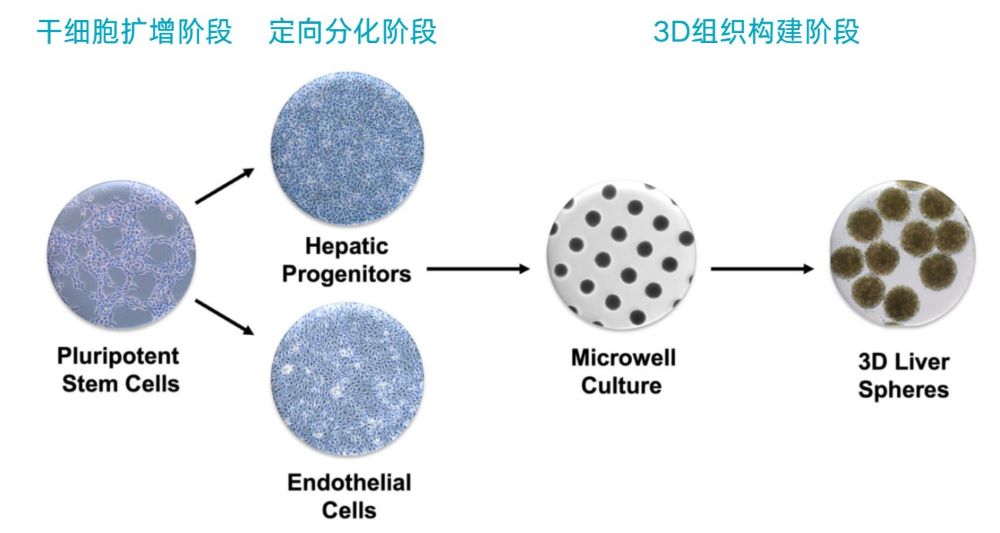
Workflow from pluripotent cells through hepatic and endothelial differentiation to vascularized liver spheroids.
Unlike designs that use a matrix only for initial attachment, recombinant laminin coating here runs through every stage of liver tissue construction:
- Stem cell expansion: vessels are coated 24 hours in advance to support thawing, passaging and scaled expansion of clinical-grade hESCs;
- Directed differentiation: separate coated vessels for hepatic and endothelial differentiation guide cells into the corresponding lineages;
- 3D tissue assembly: functional cells obtained on full-length recombinant human laminin matrices are mixed and self-assemble into vascularized 3D liver spheroids.
The advantage of this continuous material design is that the matrix can be judged together with later spheroid performance, not by short-term attachment alone.
The 2D Stage: Both Matrices Start Level
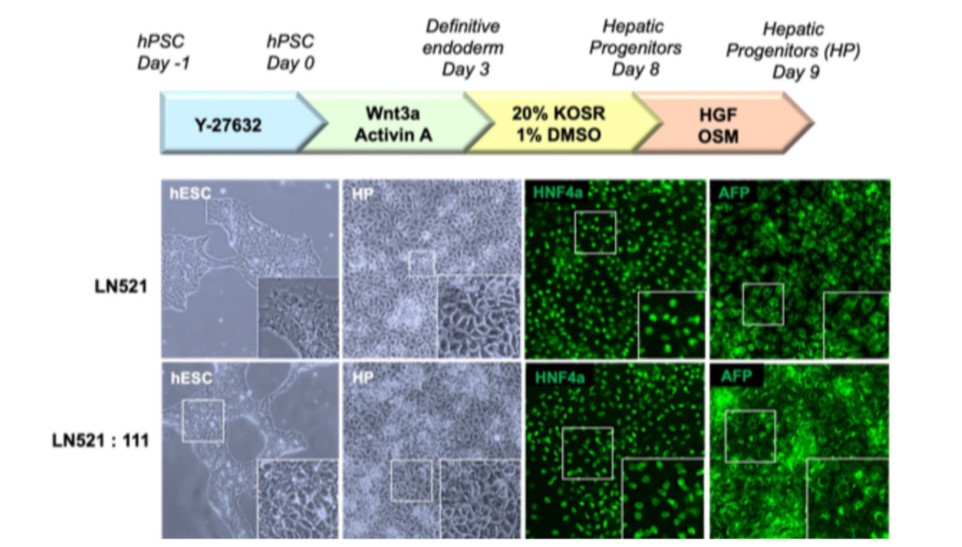
Hepatic progenitor differentiation on LN521 and LN521:111 matrices.
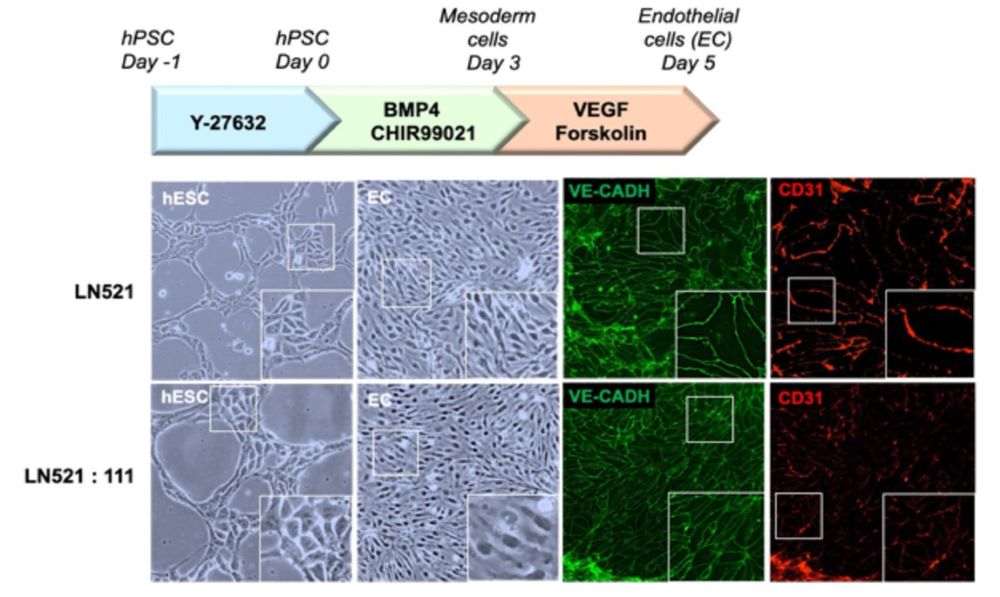
Endothelial differentiation on LN521 and LN521:111 matrices.
During 2D expansion and directed differentiation, both recombinant laminin matrices supported hESC pluripotency and gave hepatocyte nuclear factor 4α (HNF4α)-positive hepatic progenitors and VE-cadherin-positive endothelial cells, with cell morphology and marker expression as expected:
- Immunofluorescence of hepatic progenitors on day 9 shows HNF4α and alpha-fetoprotein (AFP) expression;
- Immunofluorescence of endothelial cells on day 5 shows VE-CADH and CD31 expression;
- Both image sets are at 10× magnification, with white boxes marking the enlarged regions.
Abbreviations in the hepatic differentiation workflow include KOSR (knockout serum replacement), DMSO (dimethyl sulfoxide), HGF (hepatocyte growth factor) and OSM (oncostatin M); in the endothelial differentiation figure, BMP4 is bone morphogenetic protein 4 and VEGF is vascular endothelial growth factor, and the illustrated workflow also includes CHIR99021 and forskolin.
Both formulations supported differentiation early on — which is exactly why, for long-term models, a matrix comparison cannot stop at the 2D endpoint.
Six Weeks in 3D: Where the Gap Opens
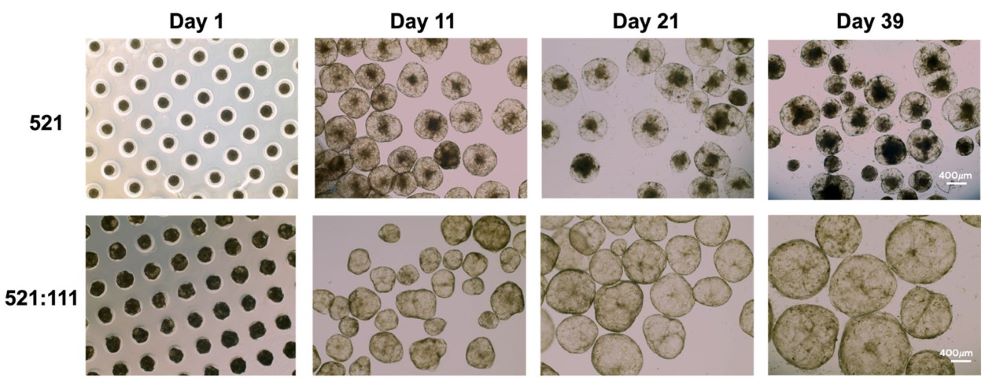
Long-term morphological changes of spheroids cultured on the two matrix formulations.
Structure: Blend Spheroids Stay More Uniform and Intact
Over six weeks of 3D spheroid culture, the two formulations diverged clearly:
- Spheroids made with LN521 alone became progressively granular with a tendency to form a necrotic core;
- Spheroids made with the LN521 and LN111 blend stayed more uniform and retained structural integrity for longer.
The scale bar in the morphology figure is 400 μm, allowing formulations and time points to be compared on a consistent scale.
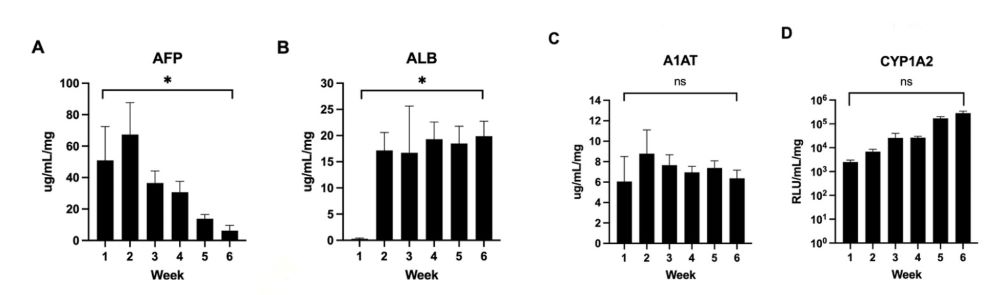
Hepatocyte secretory markers and CYP1A2 activity during extended culture.
Function: Progressive Maturation That Holds
Blend-derived spheroids showed progressive maturation over the six-week culture: secretion of the fetal marker AFP fell steadily, albumin (ALB) secretion continued and rose with time, alpha-1 antitrypsin (A1AT) secretion was maintained, and cytochrome P450 (CYP1A2) metabolic activity stayed at a usable level.
The study tracked these readouts weekly: AFP, ALB and A1AT by secretion assays such as ELISA, with CYP1A2 providing metabolic activity information. Falling AFP together with sustained secretory and metabolic function points to progressive maturation of the spheroids; related research has also reported that hepatocytes obtained on blended laminin systems are more mature than those on LN521 alone.
On this basis, the study selected the LN521:LN111 blend for subsequent scaled preparation and transplantation experiments.
From 6-Well Plates to T175: The Process Travels
Standardizing the matrix formulation is a key step in translating academic work into industry. The optimized recombinant laminin process fits culture scales from 6-well plates to T175 flasks, each with its own seeding density and process parameters, enabling stable batch preparation of spheroid products. After quality control, the prepared tissue products can be shipped by cold chain to a third-party contract research organization for in vivo work, with process stability sufficient for cross-institution validation.
For teams moving from small-scale models to batch experiments, a continuous matrix system means the material stays the same at stage transitions, giving a more consistent starting point for comparing tissue structure and function.
In Vivo Validation: Human Albumin Detected After Both Transplant Routes
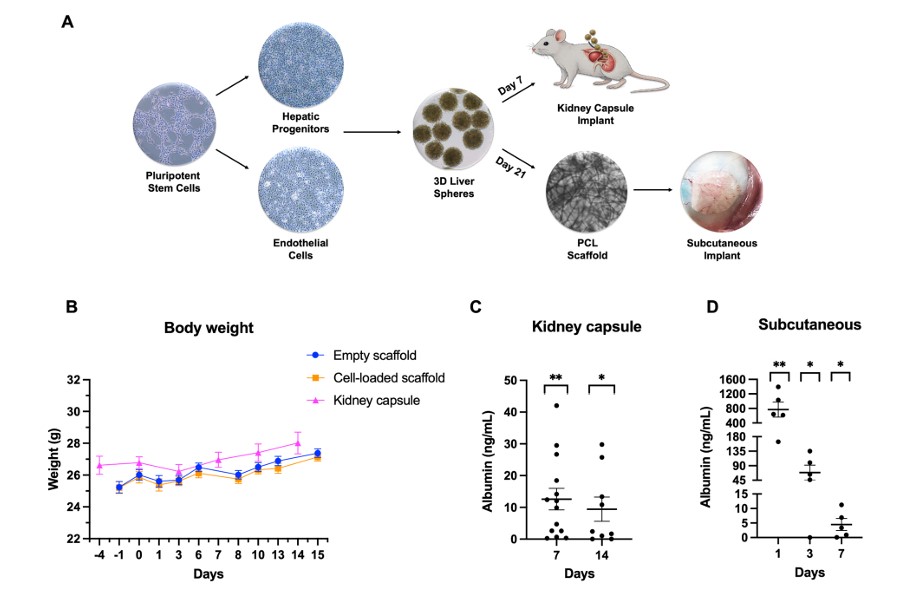
The renal capsule and subcutaneous transplant routes with body weight and albumin readouts.
The study validated the tissue in vivo by subcapsular renal injection and by subcutaneous PCL scaffold implantation:
- For tissue transplanted under the renal capsule, human albumin was still detectable in mouse plasma 14 days after surgery;
- For tissue implanted on a subcutaneous PCL scaffold, circulating human albumin was detectable early after implantation, the implantation site was well vascularized, and no obvious rejection was observed.
These results demonstrate that liver tissue prepared with the laminin process has the potential to exert synthetic function in vivo in mice.
Where It Fits and How to Choose
- When the goal is long-term 3D liver spheroids or vascularized liver tissue, include the LN521:LN111 blend in a parallel comparison with LN521 alone; this study did not establish a universal ratio for all cell lines and differentiation systems.
- The current evidence covers in vitro process optimization and in vivo validation in mice; six-week in vitro stability and a 14-day post-transplant albumin readout answer questions on different time scales, and clinical translation still requires safety and long-term efficacy validation in large-animal models and a further refined manufacturing process.
Three Common Questions
Why choose recombinant laminin? Recombinant laminin is chemically defined with good lot-to-lot stability and no exogenous risk from animal-derived components, and it precisely regulates cell adhesion, proliferation and differentiation, which suits standardized, scalable cell process development. BioLamina LN521 and LN111 provide comparable matrix options so that material design can run through expansion, differentiation and 3D tissue assembly.
How do LN521 alone and the LN521:LN111 blend differ? Both support 2D expansion and differentiation of stem cells; in long-term 3D spheroid culture, blend-derived spheroids keep a more stable morphology, are less prone to necrotic cores and maintain liver function for longer, making the blend better suited to long-term experiments and in vivo transplantation.
What steps remain before clinical use? What has been completed is in vitro process optimization and in vivo functional validation in small animals; next comes validation of safety and long-term efficacy in large-animal models, further refinement of the manufacturing process and stepwise clinical translation.
Summary
The extracellular matrix is a key factor in building stem cell-derived liver tissue. A matrix system based on recombinant laminin can support the whole workflow from stem cell expansion through directed differentiation to 3D tissue assembly; optimizing the ratio of LN521 to LN111 effectively improves the long-term stability and functional maturity of 3D liver tissue, provides a basis for process scaling and in vivo transplant validation, and offers a workable technical path for industrial translation of liver tissue engineering.
From 2D lineage markers through six weeks of structure and function to in vivo readouts in mice, the value of LN521 and LN111 rests on one continuous chain of evidence. To build long-term liver tissue models or scale up preparation, choosing the matrix as a key process material — not just comparing short-term attachment — is what decides success.
Let TechWave Help You Compare Matrix Options
If you are working on PSC-derived liver organoids, vascularized 3D tissue or other long-term 3D models and want to move the matrix from a short-term attachment material to a process material that runs through the whole workflow, contact TechWave. We can help you gather product documentation and application literature for BioLamina LN521, LN111 and other full-length recombinant laminins, design a ratio comparison for your cell line and differentiation workflow, and arrange a quotation.
> The Laminin 521 and Laminin 111 used in the study are from BioLamina.
References
- Szkolnicka D, et al. Translating Human Prototype Liver Implant Technology from Academia to Industry for Third-Party Transplant and In Vivo Validation. Cells. 2026;15(10):905. https://doi.org/10.3390/cells15100905
Uses and applicable scenarios
- PSC-derived liver tissue engineering and vascularized 3D liver spheroid culture
- Matrix formulation comparison for long-term 3D liver models
- Process scale transfer from small culture plates to T175
- Translational process development for cell therapy and tissue engineering
Limitations
- Current evidence covers in vitro process work and in vivo validation in mice; large-animal and longer-term safety and efficacy studies are still needed
- The LN521 to LN111 ratio should be optimized for each cell line and differentiation workflow