
Technical column
Change the matrix lot and differentiation results shift? Choosing an iPSC matrix: Matrigel, VTN, E8 fragments and full-length Biolaminin 521 compared
Same cells, same medium, same protocol — change the matrix lot and colony morphology, spontaneous differentiation and differentiation efficiency can all shift. We compare four mainstream iPSC matrices on biological relevance, defined composition, lot consistency and clinical translation, map the right choice to each project stage, and explain why long-term line, genome-editing and cell-therapy programmes are better served by full-length recombinant human Biolaminin 521.
Definition
An iPSC culture matrix controls pluripotency, fate decisions, functional maturation and karyotypic stability through integrin signalling, making it a foundational reagent for cell quality, reproducibility and the clinical translation path.
Same cell line, same medium, same protocol — then one new lot of matrix, and colony morphology collapses, spontaneous differentiation surges and differentiation results can no longer be reproduced. Many teams check the incubator, the growth factors and the dissociation time, yet miss the most fundamental variable of all: the surface the cells grow on.
A matrix is never just a consumable that "makes cells stick". Through integrin signalling it directly controls iPSC pluripotency, fate decisions, functional maturation and even karyotypic stability. Choose the wrong matrix and variability, process rework and stalled regulatory filings are built in from day one; choose the right one and expansion, differentiation and translation run on a single platform from start to finish.
The bottom line: VTN can bridge short pilot studies, Matrigel can stay in pure basic research, and E8 fragments are an option for expansion only. For long-term line establishment, genome editing, disease modelling and cell-therapy pipelines, full-length recombinant human laminin Biolaminin 521 offers the most complete combination of performance and translational path.
Video explainer
New Matrix Lot, Different iPSC Results? Matrigel, VTN, E8 Fragments, Full-Length Biolaminin 521
Watch on YouTube ↗Video transcript
Same cell line, same medium, same protocol. Only the matrix lot changed, and the iPS cell colonies look worse, spontaneous differentiation rises and the differentiation experiments no longer reproduce. Many teams check the incubator, the growth factors and the dissociation time, yet miss the matrix under the cells. Today we line up four common iPS cell matrices: Matrigel, recombinant vitronectin or VTN, laminin E8 fragments, and BioLamina's full-length Biolaminin 521.
A matrix is never just a consumable that makes cells stick. In the developing human embryo, embryonic stem cells in the inner cell mass do not float; they are wrapped in laminin they secrete themselves, a natural stem-cell niche. In the pre-implantation inner cell mass, human pluripotent stem cells mainly express and secrete LN521, which appears earlier than LN511.
Cells grip these matrix proteins through surface receptors called integrins, switching on pathways such as PI3K/Akt and FAK that control pluripotency, proliferation and differentiation. First, Matrigel. Matrigel is a crude extract of mouse EHS sarcoma tissue.
Its main laminin is the extra-embryonic LN111, mixed with collagen, nidogen and variable amounts of growth factors such as TGF-β, BMP and EGF: hundreds of components, none of them quantified. On the plus side, Matrigel has a large literature, works in 2D and 3D, and has a low entry cost.
The risks sit in the same mixture. LN111 is not a natural part of the human embryonic stem-cell niche, and the admixed growth factors disturb pathways such as Wnt and TGF-β, driving spontaneous differentiation, so researchers spend a lot of time picking out differentiated colonies.
Protein activity and growth-factor content can vary several-fold between lots, and the same differentiation protocol can lose efficiency sharply after a lot change. Weakness three is animal origin: a mouse-tumour source brings xenogeneic proteins, potential pathogens and endotoxin risk, and does not meet the xeno-free requirement for cell therapy.
Switching matrix once a project reaches the IND stage, the application to start clinical trials, means earlier data can hardly be reused. Next, recombinant vitronectin, or VTN. VTN uses a short peptide motif called RGD to bind αvβ5 integrin on the cell surface, which gives basic attachment. Recombinant VTN is defined, animal-origin free, low in unit price and simple to coat, suited to short-term expansion and low-demand pilot experiments.
But a single RGD signal cannot give full stem-cell-niche control. Over long-term passage, pluripotency markers such as Oct4 and Sox2 gradually decline, spontaneous differentiation rises and karyotypic abnormalities can even appear.
Single-cell passage depends on ROCK inhibitors, and the ROCK inhibitor itself interferes with gene expression and later differentiation. Once differentiation starts, target-cell purity and functional maturity are generally low.
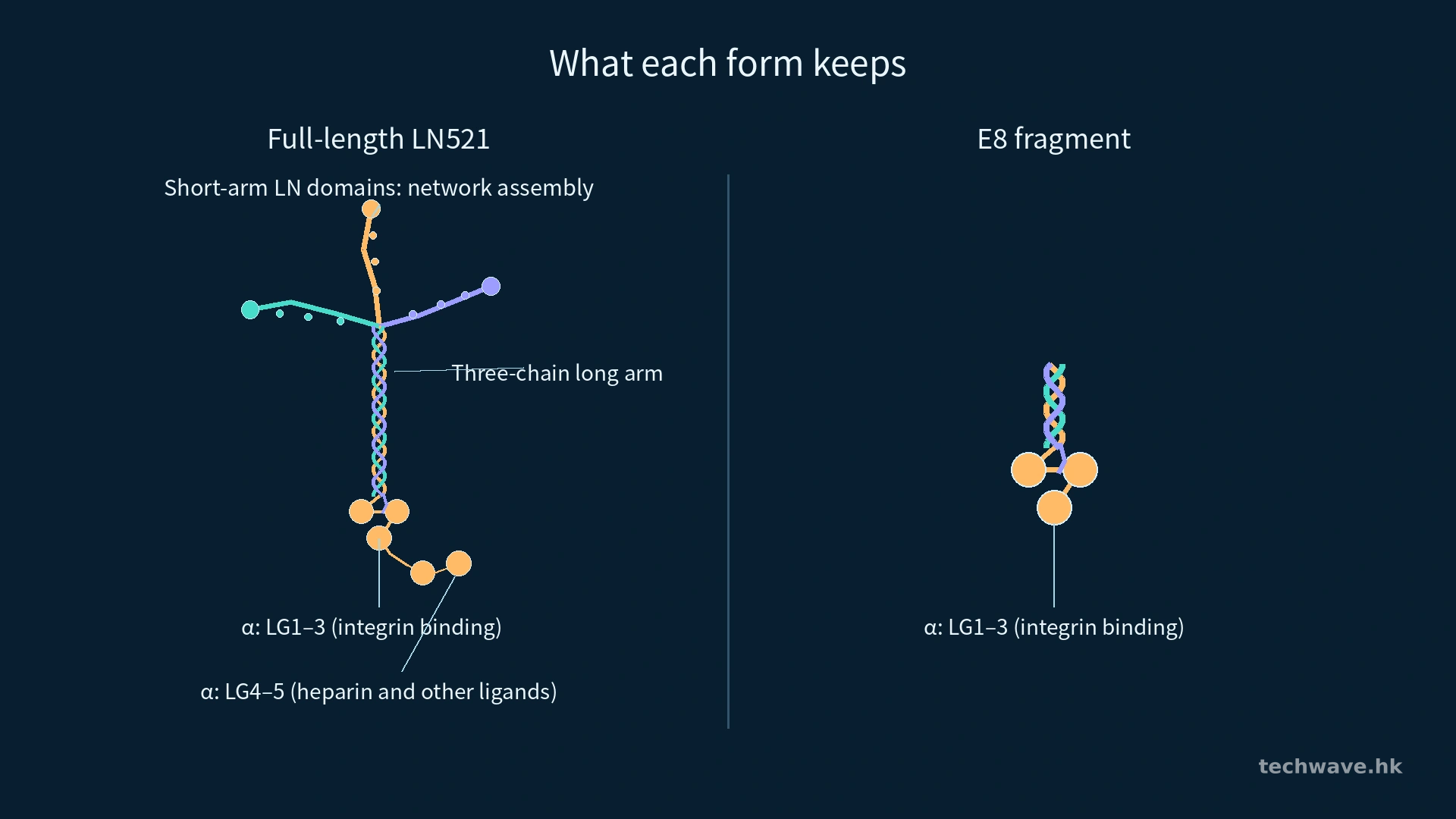
The third class is laminin E8 fragments: truncated recombinant laminin, chemically defined and free of animal components. A full laminin is built from three chains, α, β and γ, arranged like a cross. The tips of the three short arms let molecules link up into a network, and the very end of the long arm is what the cell grips.
The E8 fragment is that end of the long arm, without the network-forming LN domains or the α-chain LG4–5. For attaching cells, E8 fragments hold nothing back: in the 2012 study by Miyazaki and colleagues with LN511-E8 and LN332-E8, the E8 fragments adhered cells better than Matrigel and better than intact laminin-511 and -332.
Under that study's conditions, the coating needed for maximal adhesion was about 15 micrograms per square centimetre for Matrigel, 3 to 6 for intact laminin, and just 1.5 for E8 fragments. Above 50,000 cells per square centimetre, 40 to 70 % of completely dissociated single cells attached to E8 fragments, with no ROCK inhibitor used, and over one month cell numbers were more than 200-fold those of conventional colony culture.
Two limits apply to these data. First, the study tested LN511-E8 and LN332-E8, not LN521, so it cannot show that E8 fragments hold cells better than LN521. Second, on differentiation, the study only checked three-germ-layer potential. iMatrix-511, which is made of LN511-E8, has its own article on our website.
The fourth class is BioLamina's Biolaminin: full-length recombinant human laminin that keeps the native trimeric structure and all functional domains. iPS cells highly express α6β1 integrin, and binding to LN521 activates survival and self-renewal signalling.
BioLamina data show that LN521 supports single-cell passage without ROCK inhibitors, with high clonal efficiency. Single-cell passage without ROCK inhibitors was also achieved with E8 fragments in the Miyazaki study. What sets LN521 apart is that the full-length molecule also keeps the network-forming LN domains and LG4–5.
Biolaminin also comes in three grades: research LN, transitional MX and cell-therapy CTG, with the same amino-acid sequence and key performance, differing only in quality-control standards and traceability documentation.
According to BioLamina, process and efficacy data built up in development can carry into clinical filings without changing matrix, and the CTG grade provides full quality and traceability documentation to support IND filings.
In terms of projects, the article gives four choices. For short pilot studies on a tight budget with simple passage only, recombinant VTN can serve as a bridge, but it is not recommended for long-term passage or differentiation.
For pure basic research with no translation plans and tolerance for lot variation, Matrigel meets basic needs, but screen lots and read differentiation results with care. For mainly expansion and single-cell passage, E8 fragments attach strongly at low coating and need no ROCK inhibitor, the value choice; before directed differentiation, compare side by side with your own protocol.
For long-term line establishment, genome editing, disease models and cell-therapy pipelines, the article recommends full-length Biolaminin 521, for stable cell quality, reproducible results and a translational path that carries forward.
The trade-off is a higher unit price, and the isoform has to match the target tissue. Whichever you choose, matrix performance depends on the cell line, medium, coating conditions, passaging method and differentiation protocol. Before switching matrix, compare at least 3 lots in parallel with the same cell line and medium, recording lot numbers, coating concentration and freeze–thaw history.
When moving from LN to MX or CTG grade, run one bridging comparison with the same cell bank. So when a new matrix lot changes your results, look beyond the incubator to the matrix under the cells. The full comparison table and selection map for all four classes are in the article of the same name on our website.
New Matrix Lot, Worse iPSC Colonies? Matrigel, VTN, E8 or Full-Length Biolaminin 521
Watch on YouTube ↗Video transcript
Same cells, same medium, same protocol. Only the matrix lot changed, and the iPS cell colonies got worse. The cause may be the matrix under the cells. One: Matrigel. A large literature and a low entry cost, but Matrigel is a crude mouse sarcoma extract with hundreds of components, and activity and growth-factor content can vary several-fold between lots.
Two: recombinant VTN. Defined and simple to coat, good for short pilots; but pluripotency declines over long-term passage, and single-cell passage depends on ROCK inhibitors. Three: E8 fragments, which keep only the end of laminin that cells grip.
In a 2012 study, 40 to 70 % of single cells attached without any ROCK inhibitor; that study did not test LN521. Four: BioLamina's full-length Biolaminin 521, which keeps every domain. BioLamina data show that LN521 supports single-cell passage without ROCK inhibitors.
The article's picks: VTN as a bridge for pilots; for pure basic research with no translation plans and acceptable lot variation, Matrigel can meet basic needs, with lot screening; E8 fragments for mainly expansion and single-cell passage; for long-term lines, genome editing, disease models and cell-therapy pipelines, the article recommends full-length Biolaminin 521.
Before switching matrix, compare at least 3 lots in parallel with the same cell line and medium. The full comparison is in the article on our website.
Produced by TechWave. For research reference only; not medical advice.
Four yardsticks for choosing the right matrix
In human embryonic development, embryonic stem cells in the inner cell mass (ICM) do not grow in suspension; they are wrapped in laminins they secrete themselves, forming a natural stem-cell niche. Human pluripotent stem cells in the pre-implantation inner cell mass mainly express and secrete LN521, which appears earlier than LN511. By binding these matrix proteins through surface integrins, cells activate pathways such as PI3K/Akt and FAK that control pluripotency, proliferation and differentiation.
A qualified iPSC matrix therefore has to pass four tests at once:
- 【Biological relevance】Does it match the natural composition of the human stem-cell niche and deliver physiological signalling?
- 【Defined composition】Does it contain unknown proteins or endogenous growth factors that introduce extra variables?
- 【Lot consistency】Are composition and activity uniform between lots, so that results reproduce reliably?
- 【Translational fit】Can it support the whole path from basic research to clinical filing, with early data carried forward?
| Dimension | Matrigel | Recombinant VTN | Laminin-E8 fragment | Full-length Biolaminin 521 |
|---|---|---|---|---|
| Origin and composition | Crude extract of mouse EHS sarcoma, hundreds of unquantified components | Recombinant, adhesion through the RGD motif | Recombinant truncated fragment keeping only the C-terminal integrin-binding region | Recombinant full-length human trimer retaining all functional domains |
| Animal origin | Yes | Animal-origin free | Animal-origin free | Animal-origin free |
| Lot consistency | Activity and growth-factor content can vary several-fold between lots | Varies with source and fragment length; hard to guarantee | Recombinant, defined composition | Highly uniform composition and activity between lots |
| Core strength | Extensive literature, 2D/3D use, low entry cost | Low unit price, simple coating | Stronger adhesion than VTN, lower price than full-length protein | Long-term pluripotency, single-cell passage, directed differentiation, research-to-clinical grade continuity |
| Main weakness | Unknown factors, lot variation, blocked clinical translation | Declining pluripotency over time, ROCK-inhibitor dependence, weak differentiation support | No network-forming LN domains and no LG4–5 | Higher unit price; isoform must match the target tissue |
Matrigel: the lowest entry barrier, and the most hidden risk
Matrigel is a crude extract of mouse Engelbreth-Holm-Swarm (EHS) sarcoma tissue. Its main laminin isoform is the extra-embryonic LN111, mixed with type IV collagen, nidogen, heparan sulfate proteoglycan and variable amounts of endogenous growth factors such as TGF-β, BMP and EGF — hundreds of components without defined quantities. It has a long history, a large literature and a low research-grade price, and supports both 2D iPSC expansion and 3D organoid embedding, which is why many laboratories start with it.
The problem is three structural weaknesses:
- 【Poor physiological match, frequent spontaneous differentiation】LN111 belongs to the extra-embryonic basement membrane and is not a natural component of the human embryonic stem-cell niche. The admixed growth factors non-specifically disturb key pathways such as Wnt and TGF-β, driving spontaneous differentiation, and researchers spend large amounts of time manually removing differentiated colonies.
- 【Large lot-to-lot variation, poor reproducibility】Composition changes with the source tumour tissue and the extraction process, and protein activity and growth-factor content can vary several-fold between lots. The same differentiation protocol can lose efficiency or drift in phenotype after a lot change. Many teams are forced to stockpile a full year of a single lot, tying up capital and storage.
- 【Animal origin blocks clinical translation】A mouse-tumour source brings xenogeneic proteins, potential pathogens and endotoxin risk, and does not meet the xeno-free requirement for cell therapy. Switching matrix once a project reaches the IND stage means earlier expansion, differentiation and efficacy data can hardly be reused, and the process starts over.
Vitronectin (VTN): cheap and easy, but not built for long-term culture
Vitronectin binds αvβ5 integrin on the cell surface through its short RGD peptide motif, providing basic attachment. Recombinant VTN is defined, animal-origin free, low in unit price and simple to coat, making it suitable for short-term expansion and low-demand pilot experiments.
A single RGD signal, however, cannot provide full stem-cell-niche control:
- 【Quality declines over long-term passage】Pluripotency markers such as Oct4 and Sox2 gradually decline with passage, spontaneous differentiation rises and karyotypic abnormalities can appear; VTN from different sources and with different fragment lengths affects pluripotency gene expression noticeably differently.
- 【Single-cell passage depends on ROCK inhibitors】Without laminin-mediated survival signalling, apoptosis after single-cell dissociation is high and a ROCK inhibitor is required to maintain colony formation. The inhibitor itself interferes with gene expression and later differentiation, and clearly lowers the yield of positive clones in genome editing and single-clone screening.
- 【Weak differentiation support】It maintains only basic expansion; after differentiation starts, target-cell purity and functional maturity are generally low, with disordered polarity and tissue structure.
Laminin-E8 fragments: gripping cells is their strength; building the network is not their job
E8 fragments are truncated recombinant laminins: chemically defined and free of animal components. To see where they are strong and what they leave out, start with the shape of a laminin. It is built from three chains, α, β and γ, arranged like a cross: three short arms at one end and one long arm at the other. The division of labour is clear. The tips of the three short arms let molecules link up into a network; the very end of the long arm is what the cell grips. The E8 fragment is the end of the long arm: the last third of the coiled coil formed by the three chains, plus the three globular LG1–3 domains of the α chain (reference 11).
【Where the name "E8" comes from】"E8" is not a model number but a lab label. In the 1980s, researchers digested laminin-111 from the mouse EHS tumour with elastase (the "E" in the name) and obtained several protease-resistant fragments, each named with an E and a number. E8 came from the end of the long arm: in 1984 Edgar and colleagues found that the elastase-derived E8 fragment promoted neurite outgrowth from cultured chick sympathetic neurons (reference 13), and later work showed that this same end of the long arm is what cells use to attach to laminin through integrins (references 11 and 12). Early E8 was cut out by the enzyme, whereas the E8 fragments sold today are recombinant: the truncated C-terminal sequences of the α, β and γ chains are expressed directly and assembled into a trimer in vitro, at about 150 kDa, less than a fifth of the full-length molecule (about 800 kDa). Nor is E8 tied to a single isoform: E8 fragments can be made from laminin-511, -521 and others, and a common one on the market is LN511-E8.
On that basis the difference between the two splits into three parts:
| Region | Role | E8 fragment | Full-length laminin (such as LN521) |
|---|---|---|---|
| Long-arm tip: LG1–3 and the γ-chain tail | Binds integrins; the cell attaches through it | Kept | Kept |
| Short-arm tips (LN domains) | Link molecules into a network | Absent | Present |
| α-chain LG4–5 | Binds heparin, α-dystroglycan and others | Absent | Present |
【For attaching cells, the E8 fragment holds nothing back】The integrin-binding site cannot be shrunk to a short peptide such as the RGD motif of fibronectin; it depends on the intact heterotrimeric E8 region, and when the glutamate near the end of the γ-chain tail is replaced by glutamine, cell attachment is sharply lost (references 11 and 12). The 2012 experiments of Miyazaki and colleagues with recombinant LN511-E8 and LN332-E8 put numbers on this:
- 【Stronger attachment, less protein】Under that study's conditions the E8 fragments adhered cells better than Matrigel and better than intact laminin-511 and -332. The coating amount needed for maximal adhesion was about 15 µg/cm² for Matrigel, 3–6 µg/cm² for intact laminin and just 1.5 µg/cm² for the E8 fragments.
- 【Single-cell passage without ROCK inhibitor】At densities above 50,000 cells per cm², 40–70% of completely dissociated single cells attached to the E8 fragments; the team therefore chose 50,000 cells per cm² (5E4 cells/cm²) as the seeding density for passaging and did not use the ROCK inhibitor Y-27632. H9 cells dissociated to single cells in the same way mostly stayed as single cells on Matrigel, fibronectin and vitronectin and died quickly.
- 【Fast, steady expansion】The split ratio was about 1:10 (about 1:4 for conventional colony passage), and cell numbers over one month were more than 200-fold those of conventional culture. Three human embryonic stem cell lines and two iPSC lines passed at least 10 passages in defined media with normal karyotypes at passage 10, and human embryonic stem cells cultured on E8 fragments for 25 passages still formed teratomas containing all three germ layers.
- 【Easier to make】Per litre of culture supernatant the team purified about 4.1 mg of LN511-E8 against about 0.74 mg of intact LN511, roughly 5.5-fold by weight; purification took 2–3 days against 1–2 weeks for the intact molecule.
【Where each one sits】The review summarises the structural division of labour: only laminins with a full set of LN domains on their short arms polymerise into a network in vitro and at the surface of cultured cells, and an E8 fragment by definition contains no LN domains (reference 11). Miyazaki and colleagues observed that cells dissociated to single cells on E8 fragments migrated and regrouped into small colonies within 24 hours (reference 12).
One point to keep in mind: the E8 study tested LN511-E8 and LN332-E8, not LN521, and its differentiation work only checked three-germ-layer potential. iMatrix-511, which is made of LN511-E8, has its own article on this site; performance information on full-length LN521 is in the next section of this article.
Full-length Biolaminin 521: recreating the natural niche, from research all the way to the clinic
Biolaminin is full-length recombinant human laminin that retains the native trimeric structure and all functional domains. It recreates the in-vivo stem-cell microenvironment at a physiological level rather than simply providing adhesion. iPSCs highly express α6β1 integrin; binding to LN521 activates survival and self-renewal signalling such as PI3K/Akt and FAK, so cells proliferate faster and migrate more actively.
Four advantages cover the full development cycle:
- 【Long-term pluripotency and single-cell passage】Supports uniform iPSC monolayers, reduces spontaneous differentiation and stably maintains Oct4, Sox2 and Nanog expression and a normal karyotype. BioLamina data show that LN521 supports single-cell passage without ROCK inhibitors with high clonal efficiency, an ideal platform for genome editing and single-clone screening. E8 fragments managed the same in the Miyazaki study (see the previous section); what sets LN521 apart is that the full-length molecule also keeps the network-forming LN domains and LG4–5.
- 【Fully defined composition, highly reproducible results】Recombinant, animal-origin free and free of unknown growth factors and contaminating proteins, with highly uniform composition and activity in every lot. This removes matrix-driven variables at the source and greatly reduces the labour and consumables spent on repeat experiments.
- 【Broad isoform coverage supporting differentiation end to end】9 or more human laminin isoforms match the natural basement membranes of different tissues: LN521 for iPSC pluripotency and reprogramming, LN111 for neural differentiation (dopaminergic neurons), and LN511 and LN411 for islet and endothelial differentiation. According to BioLamina, beyond expansion these isoforms help differentiated cells establish correct polarity and raise functional maturity and purity.
- 【Three product grades, seamless research-to-clinic continuity】Research (LN), transitional (MX) and cell-therapy (CTG) grades share the same amino-acid sequence and key performance and differ only in quality-control standards and traceability documentation. According to BioLamina, process and efficacy data accumulated in development can be carried into clinical filings without changing matrix; the CTG grade provides complete quality and traceability documentation according to USP <1043> ancillary-material standards to support NMPA and FDA IND filings.
Automation and organoids: where full-length matrix pulls further ahead
Automated culture is especially sensitive to coating uniformity, liquid-handling error and single-cell survival. Because LN521 supports uniform monolayers and single-cell passage, it reduces manual colony picking and ROCK-inhibitor dependence, making automated workflows run more reliably.
Organoids and long-term tissue models need isoforms matched to the tissue: LN521 maintains pluripotency during expansion, and after entry into ocular, kidney, neural, islet, endothelial or other lineages, isoforms such as LN111, LN211, LN332, LN411 and LN511 are chosen according to the native basement membrane; BioLamina has published application material on ocular cells, 2D/3D kidney models, long-term tissue-specific organoids and automated culture (references 2 and 7–10).
Which matrix fits your project?
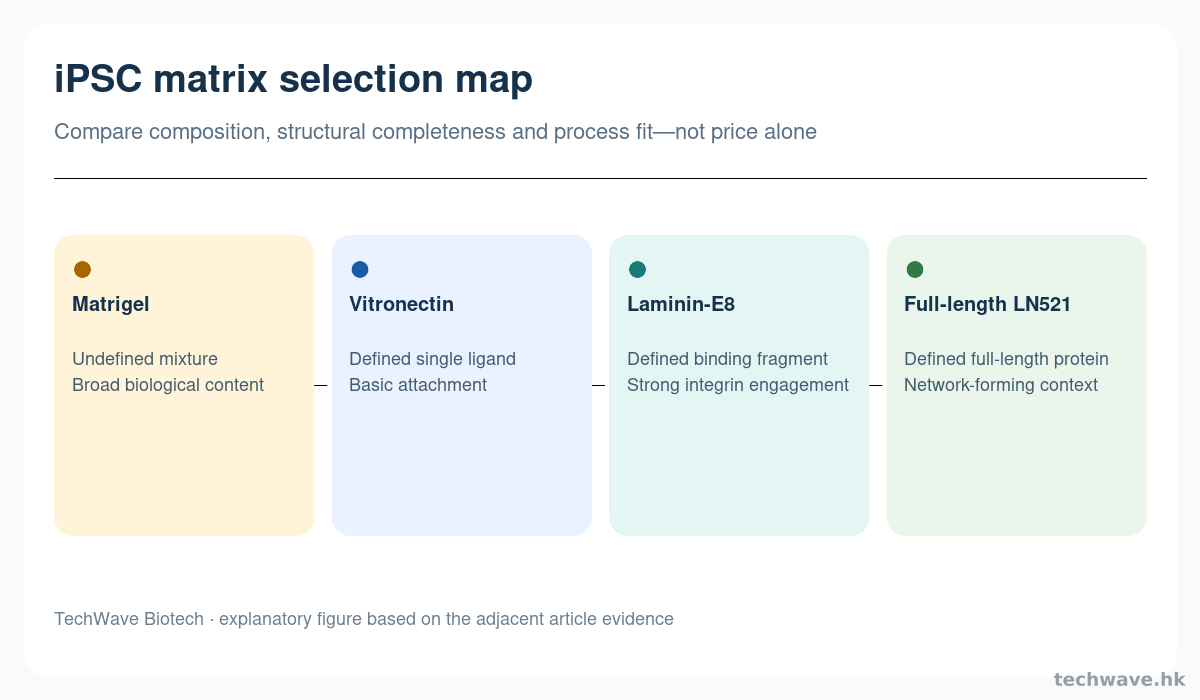
The four matrix classes differ in compositional definition, structural completeness and fit for automation or complex models.
- 【Short pilot studies, tight budget, simple passage only】Recombinant VTN can serve as a bridge; it is not recommended for long-term passage or differentiation.
- 【Pure basic research, no translation plans, lot variation acceptable】Matrigel meets basic needs, but lots must be screened and differentiation results interpreted with care.
- 【Mainly expansion and single-cell passage】E8 fragments attach cells strongly at a low coating amount without a ROCK inhibitor, which makes them the value choice; before using them for directed differentiation, run a side-by-side comparison with your own differentiation protocol.
- 【Long-term line establishment, genome editing, disease models, cell-therapy pipelines】Full-length Biolaminin 521 is the best overall choice: stable cell quality, reproducible results and a translational path that carries forward.
The number that really matters is total cost
Looking only at unit purchase price misses the hidden costs of an inferior matrix: labour and consumables for repeat experiments, capital tied up in lot screening and stockpiling, time spent removing differentiated colonies, ROCK inhibitors and withdrawal validation, longer maturation, and the heavy cost of rebuilding the process in the clinical stage together with missed project windows.
For iPSC development, the matrix is a foundational reagent that determines cell quality, experimental efficiency and project success. A biologically relevant, defined, lot-consistent and clinically translatable matrix is, in essence, an investment in R&D efficiency and project success. Measured per qualified cell, per successful differentiation lot and against later change risk, full-length laminin is often the more economical choice.
Let TechWave help you choose the right matrix
TechWave directly supplies BioLamina full-length recombinant human laminins, including Biolaminin 521 LN research grade and the MX and CTG transitional and cell-therapy grades. Whether you want to replace Matrigel, remove your dependence on ROCK inhibitors or lock in a clinically compatible matrix early for a cell-therapy pipeline, contact the TechWave technical team for isoform selection advice, coating protocols, samples and quotations.
References
- Hughes CS, Postovit LM, Lajoie GA. Matrigel: A complex protein mixture required for optimal growth of cell culture. Proteomics. 2010;10(9):1886-1890. doi:10.1002/pmic.200900758
- Biolamina. Biorelevant ocular cell culture on full-length Biolaminin substrates [EB/OL]. White Paper, 2026-05-26.
- Biolamina. Substrates are a crucial part in securing PSC-derived cell therapy development and manufacturing across the production workflow [EB/OL]. Poster, 2026-05-13.
- Biolamina. Biolaminin 521, a cost-efficient and biorelevant substrate for xeno-free and clinical-compatible mesenchymal stromal cells [EB/OL]. Poster, 2026-05-13.
- Biolamina. Transfer from: LN521 to MX521 or CT521 [EB/OL]. Instruction and Guide, 2026-04-14.
- Biolamina. From stem cells to neurons: advancing Parkinson's research toward therapies [EB/OL]. Webinar, 2026-02-12.
- Biolamina. Biorelevant Differentiation of Ocular Cell Types on Biolaminin Substrates [EB/OL]. Application Overview, 2026-01-20.
- Biolamina. Long-term and tissue-specific organoids [EB/OL]. Application Overview.
- Biolamina. Improving automated cell culture [EB/OL]. Application Note, 2025-10-23.
- Biolamina. Modelling the kidney in 2D and 3D [EB/OL]. Application Note, 2025-06-25.
- Hohenester E. Structural biology of laminins. Essays in Biochemistry, 2019, 63(3): 285–295. DOI: 10.1042/EBC20180075
- Miyazaki T, Futaki S, Suemori H, et al. Laminin E8 fragments support efficient adhesion and expansion of dissociated human pluripotent stem cells. Nature Communications, 2012, 3: 1236. DOI: 10.1038/ncomms2231
- Edgar D, Timpl R, Thoenen H. The heparin-binding domain of laminin is responsible for its effects on neurite outgrowth and neuronal survival. The EMBO Journal, 1984, 3(7): 1463–1468. DOI: 10.1002/j.1460-2075.1984.tb01997.x
Uses and applicable scenarios
- Long-term line establishment and single-cell passage
- Genome editing and single-clone screening
- Directed differentiation, organoids and automated culture
- Research-to-clinical matrix continuity for cell-therapy pipelines
Limitations
- Matrix performance depends on the cell line, medium, coating conditions, passaging method and differentiation protocol
- Before switching matrix, compare at least 3 lots in parallel with the same cell line and medium, recording lot numbers, coating concentration and freeze–thaw history
- When moving from LN to MX or CTG grade, run one bridging comparison with the same cell bank
Frequently asked questions
Which holds iPSCs better, an E8 fragment or full-length laminin?
In the 2012 experiments of Miyazaki and colleagues, E8 fragments (LN511-E8, LN332-E8) adhered cells better than Matrigel and better than intact laminin-511 and -332, and needed less coating (about 1.5 µg/cm² for E8, 3–6 µg/cm² for intact laminin). That study did not test LN521, so it cannot be stretched to "E8 holds cells better than LN521".
What does an E8 fragment lack compared with full-length laminin?
The E8 fragment keeps only the end of the long arm: the last third of the three-chain coiled coil plus the α-chain LG1–3 domains, which carry the integrin-binding site. It lacks the LN domains at the short-arm tips, which link molecules into a network, and the α-chain LG4–5 domains, which bind heparin, α-dystroglycan and others.
What measured results exist for single-cell passage of iPSCs on E8 fragments?
Miyazaki and colleagues passaged three human embryonic stem cell lines and two iPSC lines on E8 fragments in defined media for at least 10 passages, with normal karyotypes at passage 10. They used no ROCK inhibitor, split at about 1:10, and obtained more than 200-fold the cell number of conventional colony culture over one month. These are results for that study's particular cell lines and media.
What is the structural division of labour between an E8 fragment and full-length laminin?
In full-length laminin the end of the long arm binds integrins, while the LN domains at the three short-arm tips let molecules polymerise into a network. The E8 fragment contains only the end of the long arm and no LN domains. The review states that only laminins with a full set of LN domains polymerise into a network in vitro and at the surface of cultured cells.
What does the "E8" in E8 fragment mean?
It is a lab label, not a model number. In the 1980s, researchers digested laminin-111 with elastase and named the protease-resistant fragments with an E and a number; E8 came from the end of the long arm, the stretch that cells use to attach through integrins. Today's E8 fragments are made recombinantly rather than by enzyme digestion; they can be produced from laminin-511, -521 and other isoforms, and a common one on the market is LN511-E8.