
Technical column
Twenty years of Yamanaka factors: iPS cell therapies win conditional approval and partial reprogramming enters its first human trial — how close is “making cells young again”?
In 2006 Shinya Yamanaka used four factors — OCT4, SOX2, KLF4 and c-MYC — to reprogram mature somatic cells into iPS cells. Twenty years on, Japan granted conditional approval in March 2026 to two iPS cell therapies, for Parkinson’s disease and heart failure, and Life Biosciences’ ER-100 is running the first human partial-reprogramming trial with three Yamanaka factors. Drawing on TIME’s interview and the original papers, this article sets out what full reprogramming, iPS cell replacement therapy and partial reprogramming have each actually shown, and how laboratories use these tools for disease modelling, drug screening and cell manufacturing.
Definition
Cellular reprogramming uses defined transcription factors to change the identity or state of mature cells; full reprogramming produces induced pluripotent stem cells (iPS cells), while partial reprogramming tries to restore some functions while keeping the cell’s lineage identity.
Twenty years ago, biology held that the development of human cells ran one way and could not be reversed. Shinya Yamanaka overturned that with four genes: any mature adult cell can be turned back to an embryo-like state and regain the potential to become many kinds of cells. The discovery has now moved from the paper to the bedside — in 2026 the first iPS-cell-based therapies received conditional approval in Japan, and a partial-reprogramming therapy that uses Yamanaka factors to “make cells young again” entered human testing for the first time.
According to TIME’s August 2026 profile, Yamanaka is now so well known in Japan that, wanting a quiet beer in a Montreal hotel bar after a day of conference sessions, he was recognized by a group of Japanese businessmen. The influence he values more is different: his work has reshaped developmental biology, regenerative medicine and the treatment of chronic disease, and is now transforming longevity research. Speaking at Kyoto University’s Center for iPS Cell Research and Application (CiRA), he said he could hardly believe twenty years had passed, and that the work can now be used clinically on a small scale.
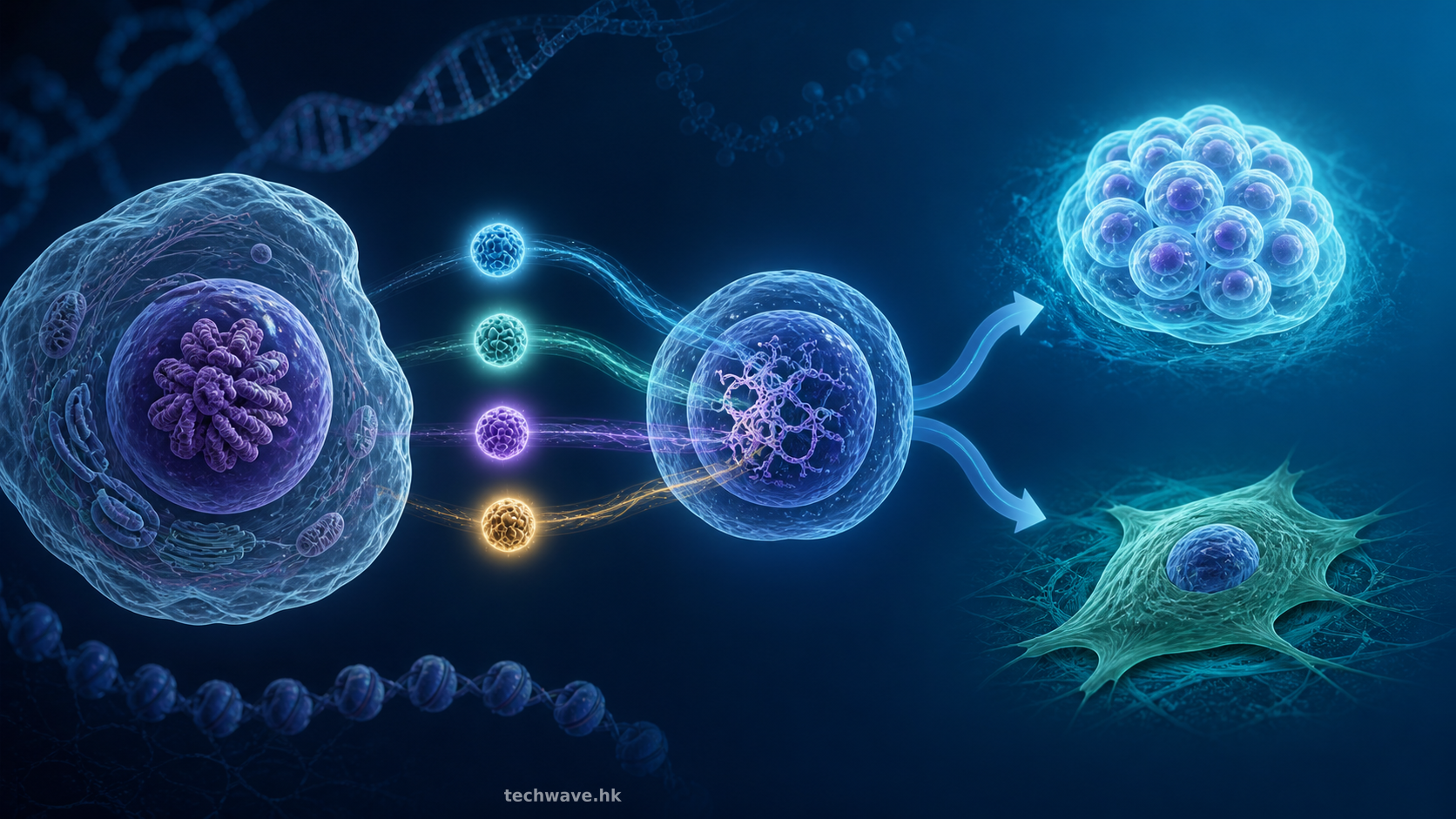
Branching paths of full reprogramming, iPS cell replacement therapy and partial reprogramming.
Video explainer
The Kid Who Took Radios Apart — and Later Turned Back a Cell's Clock
Watch on YouTube ↗Video transcript
A kid loved taking clocks and radios apart. The problem? He often could not put them back together. His name was Shinya Yamanaka. What he did later was, in a way, still taking things apart and rebuilding them: returning a mature cell to its starting state.
Twenty years ago, cell development was thought to be a one-way street. Forward only. No going back. He screened 24 candidate genes, step by step, and narrowed them down to 4. Those 4 became known as the Yamanaka factors.
When he first saw the result, he thought he had made a mistake. He asked colleagues to repeat it, again and again, until it worked reliably in both mouse and human cells. The mouse results were published in 2006. Human iPS cells followed in 2007.
In 2012, he received the Nobel Prize in Physiology or Medicine. Twenty years later, in March 2026, Japan granted conditional approval to two iPS cell therapies, for Parkinson's disease and heart failure. Conditional approval means that long-term effectiveness and safety are still being evaluated.
There is a newer path, too: briefly switching on three of the factors to try to improve aging-related measures. In June 2026, the first human trial of this approach dosed its first participant. It targets two eye diseases, and its primary endpoint is safety.
Hold on — let's check the source. This is a Phase 1 safety trial. It does not mean we can already make people younger. What he really wanted was for people in their eighties and nineties to still be able to look after themselves.
Produced by TechWave. For research reference only; not medical advice.
Three Routes, Three Promises: Know Which One You Are Working On
Full reprogramming uses OCT4, SOX2, KLF4 and c-MYC (together OSKM, the Yamanaka factors) to push mature somatic cells back to the induced pluripotent stem cell (iPS cell) state. Cell replacement therapy prepares, expands and differentiates iPS cells in vitro and then uses specific cell types to repair damaged tissue. Partial reprogramming expresses the reprogramming signal only briefly, cyclically or with fewer factors, aiming to shift aging-related epigenetic and functional readouts while keeping the original cell lineage.
The first two routes are already in multiple clinical studies; the third has just crossed from animal models into a first human safety trial. All three share one molecular toolkit but answer entirely different questions — and conflating them is the most common error in “age reversal” coverage.
A Contrarian Question: From 24 Candidate Genes to Four
Yamanaka was born in Osaka, where his father made parts for saw blades. As a child he took apart clocks and radios, often failing to put them back together, and subscribed to a science monthly for schoolchildren, building the experiment kits it came with. Following his father’s wishes he studied medicine at Kobe University and chose orthopedics — partly because of injuries from judo and rugby — but found that surgery could not answer the question that interested him most: why disease happens. He then earned a doctorate in pharmacology at Osaka City University (TIME’s report originally said Osaka University and was later corrected) and did postdoctoral work at the Gladstone Institutes at the University of California, San Francisco, where he found a gene that lowered cholesterol in mice and learned to culture mouse embryonic stem cells.
After returning to Japan in 1996, his basic-research proposals repeatedly failed to win funding and he considered going back to clinical practice. The Nara Institute of Science and Technology then offered him his own laboratory, and he bet on a project he describes as very high risk but capable of changing medicine. The mainstream was to differentiate embryonic stem cells into mature functional cells, such as insulin-secreting islet cells; he went the other way: start from fully differentiated mature cells and try to turn them back into the embryonic state.
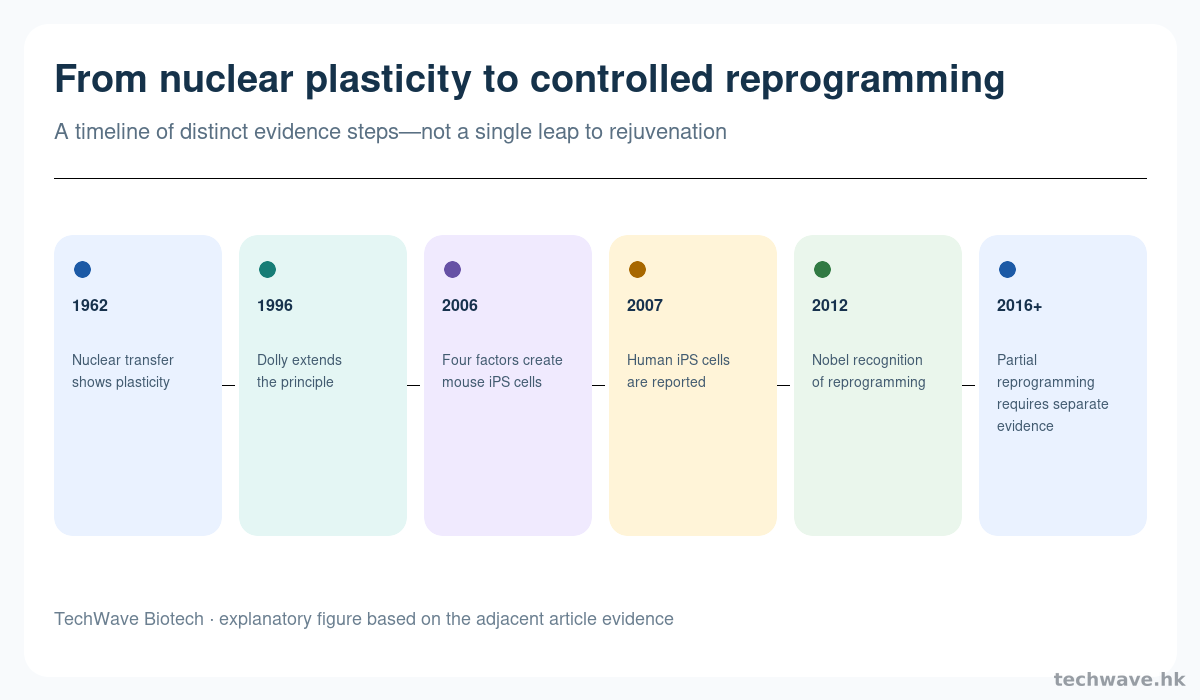
Nuclear transfer, iPS cell induction and partial reprogramming are historically connected, but each supports a different biological claim.
Two earlier studies gave him confidence. In the 1960s John Gurdon showed that mature tadpole body cells still carry the full genetic information to develop into a complete frog; in 1996 Ian Wilmut cloned Dolly the sheep from an adult ewe’s body cell. Yamanaka’s team reframed the question: without relying on an egg cell, could a small number of genes directly rewrite the state of a mature cell? They first screened key genes that regulate embryonic development, then used modified, non-pathogenic viral vectors to introduce these genes into adult cells, narrowing 24 candidates down to four.
When he first saw mouse cells that had been reprogrammed, Yamanaka assumed something had gone wrong and had colleagues repeat the experiment again and again — until the result reproduced reliably in different mouse cells and in human cells. In 2006 Takahashi and Yamanaka reported that four factors reprogram mouse fibroblasts into pluripotent cells[1]; human iPS cells followed in 2007[2]. Dieter Egli, associate professor of developmental cell biology at Columbia University, says iPS cells run through every field of life science, from disease modelling to developmental research, describing this reversal of cellular development as a miracle of life science. In 2012 Yamanaka shared the Nobel Prize in Physiology or Medicine with Gurdon.
From Paper to Patients: iPS Cell Therapies Win First Conditional Approvals
The Japanese government invested heavily in Kyoto University’s CiRA to keep improving iPS cell manufacturing. Yamanaka founded the institute and led it as director for 12 years; he remains a professor and director emeritus there, and his team still calls him “Yamanaka sensei.” The team found that one of the four factors (c-MYC) carries a tumour-promoting risk, so they developed a reprogramming protocol without it: conversion efficiency fell slightly, but safety improved markedly, and together with standardized manufacturing this produced iPS cells suitable for human clinical trials. Later work adopted non-integrating vectors, mRNA and other delivery methods and strengthened testing for genomic integrity, residual undifferentiated cells and tumorigenicity.
The payoff has arrived. According to TIME, Japan granted conditional approval in March 2026 to two iPS cell therapies, for Parkinson’s disease and heart failure — the first supplying dopaminergic neural precursors, the second aimed at cardiac repair; conditional approval means long-term efficacy and safety are still being confirmed. Beyond the clinic, iPS cells are a workhorse in the laboratory: patient-derived cells are used for disease modelling, drug screening and developmental research.
Partial Reprogramming: The First Human Trial Has Begun
If damaged cells can be replaced, can aged cells be reprogrammed to recover youthful function? This is now one of the hottest and best-funded directions in longevity research. Yamanaka says interest in the field is extremely high and that partial reprogramming could very well help people live healthier and longer lives. He stresses that the first goal is to extend healthspan rather than lifespan alone, so that people in their eighties and nineties can still look after themselves without needing care from others.
Long-term full expression of OSKM erases cell identity and brings risks of dedifferentiation and teratomas; partial reprogramming aims to stop exposure before cells cross the pluripotency threshold. Proof of concept in animals is already clear: in 2016 Ocampo et al. cyclically and briefly expressed OSKM in progeroid and naturally aged mice and improved several aging hallmarks and tissue repair capacity[3]; in 2020 Lu et al. used OSK without c-MYC in a mouse eye model and achieved retinal ganglion cell axon regeneration and improved visual function readouts[4].
The human trial has followed. In June 2026 Life Biosciences announced that the first participant had been dosed in its ER-100 Phase 1 trial (ClinicalTrials.gov: NCT07290244) for open-angle glaucoma and non-arteritic anterior ischemic optic neuropathy. The human body cannot regenerate retinal cells, which are damaged progressively with age and can ultimately cause irreversible blindness. ER-100 is an investigational gene therapy based on controlled expression of three Yamanaka factors — OCT4, SOX2 and KLF4 — not an injection of iPS cells; its primary endpoints are safety and tolerability, with visual function also assessed. Media coverage has also noted that researchers are exploring iPS-cell-derived exosomes to modulate inflammation; Yamanaka himself is studying which cells resist reprogramming, and whether newly generated cells match normally developed cells in function and safety.
Ethics: One Threshold Crossed, a Higher One Ahead
Yamanaka recalls that when his team succeeded in making human iPS cells, he was simply happy for a week. iPS technology avoided the controversy of obtaining cells from human embryos, but he soon realized the new problems were harder: any adult body cell could be reprogrammed and differentiated into eggs or sperm, and the resulting genetic changes would pass to offspring and permanently alter the human gene pool. He therefore proposed that the Japanese government draft guidelines defining the limits on using iPS cells to make germ cells, and invited ethicists to work at CiRA. As the technology advances ever faster, he argues, the discussion cannot be postponed and rules have to be set now. Protocols for producing sperm and eggs from iPS cells have not yet been approved for human clinical trials.
Where It Fits and How to Choose
- Today iPS cells are most mature for disease modelling, drug screening and cell replacement therapy; partial reprogramming is at the stage of animal proof of concept and a first human Phase 1 safety trial and has not been shown to reverse human aging.
- When judging “rejuvenation” data, a drop in a single biological-age clock does not show that a cell has become younger overall; confirm that cell identity is retained, function genuinely improves, the effect persists and there is no abnormal proliferation or genomic instability. A safety window from local eye dosing cannot be extrapolated to systemic use.
- For reprogramming or iPS cell research, define the factor combination (OSKM, OSK, etc.), the expression window and the functional endpoints for your purpose; in vitro cells, animal models and human trials answer questions at different levels.
Three Common Questions
Can Yamanaka factors already make people young again? Not yet. OSKM can reprogram mature cells into iPS cells under experimental conditions; partial reprogramming shows signs of functional improvement in animal models, and human ER-100 has only just entered Phase 1.
Are iPS cell therapy and partial reprogramming the same thing? No. The first obtains and differentiates cells in vitro for replacement or repair; the second tries to adjust a cell’s state while keeping its identity.
Why not simply switch the Yamanaka factors on for a long time? Sustained or uncontrolled expression can cause dedifferentiation, loss of cell identity and tumour risk, so the factor combination, tissue scope, dose and timing must be controlled.
Let TechWave Help You Build Your iPS Cell Workflow
From iPS cell line derivation and expansion to directed differentiation and scaled manufacturing, the materials at every step shape cell quality and reproducibility. If you are working on iPS cell disease modelling, drug screening or cell therapy process development, contact TechWave. We can help compile specifications and application information for iPS-cell materials such as StemFit media, Qkine cytokines and BioLamina laminin matrices, plan a material path for your cell type and project stage, and arrange a quotation.
References
- Takahashi K, Yamanaka S. Induction of Pluripotent Stem Cells from Mouse Embryonic and Adult Fibroblast Cultures by Defined Factors. Cell. 2006;126:663–676. doi:10.1016/j.cell.2006.07.024
- Takahashi K, et al. Induction of Pluripotent Stem Cells from Adult Human Fibroblasts by Defined Factors. Cell. 2007;131:861–872. doi:10.1016/j.cell.2007.11.019
- Ocampo A, et al. In Vivo Amelioration of Age-Associated Hallmarks by Partial Reprogramming. Cell. 2016;167:1719–1733.e12. doi:10.1016/j.cell.2016.11.052
- Lu Y, et al. Reprogramming to recover youthful epigenetic information and restore vision. Nature. 2020;588:124–129. doi:10.1038/s41586-020-2975-4
Uses and applicable scenarios
- iPS cell line derivation, disease modelling and drug screening
- Regenerative medicine and cell replacement therapy
- Partial reprogramming and research on aging mechanisms
Limitations
- Human partial reprogramming is at its first Phase 1 safety trial, and functional improvements in animal models cannot be extrapolated to reversing human aging
Frequently asked questions
What are the four Yamanaka factors, and how do OSKM and OSK differ?
They are OCT4, SOX2, KLF4 and c-MYC, together called OSKM, used to fully reprogram mature somatic cells into iPS cells. OSK is the three-factor set without c-MYC; the CiRA team found that c-MYC carries a tumour-promoting risk, and both the mouse eye study of Lu et al. (2020) and Life Biosciences' ER-100 use three factors without c-MYC. Choose the combination according to the research aim, expression window and functional endpoint.
Were the iPS cell therapies Japan approved in 2026 given full approval?
No, they received conditional approval. According to TIME, in March 2026 Japan granted conditional approval to two iPS cell therapies, for Parkinson's disease and heart failure. Conditional approval means long-term efficacy and safety are still being confirmed.
Is ER-100 an iPS cell therapy, and what does its trial mainly measure?
No. ER-100 is an investigational gene therapy based on controlled expression of three Yamanaka factors, OCT4, SOX2 and KLF4, not an injection of iPS cells. Its Phase 1 trial (NCT07290244) covers open-angle glaucoma and non-arteritic anterior ischemic optic neuropathy, with safety and tolerability as primary endpoints and visual function also assessed.
If a biological-age clock goes down, does that mean the cells have become younger?
A drop in a single biological-age clock is not enough to show that a cell has become younger overall. When judging rejuvenation data, also confirm that cell identity is retained, function genuinely improves, the effect persists and there is no abnormal proliferation or genomic instability. A safety window from local eye dosing cannot be extrapolated to systemic use either.
What is the animal evidence for partial reprogramming?
Two main proofs of concept: in 2016 Ocampo et al. cyclically and briefly expressed OSKM in progeroid and naturally aged mice and improved several aging hallmarks and tissue repair capacity; in 2020 Lu et al. used OSK in a mouse eye model and achieved retinal ganglion cell axon regeneration and improved visual function readouts. These are animal-model results and cannot be extrapolated directly to human rejuvenation.
Related brands
Related products
- Biolaminin 521 LN (LN521)
- Biolaminin 521 CTG (CT521)
- Biolaminin 111 LN (LN111)
- Biolaminin 121 LN (LN121)
- Biolaminin 211 LN (LN211)
- Biolaminin 221 LN (LN221)
- Biolaminin 332 LN (LN332)
- Biolaminin 411 LN (LN411)
- Biolaminin 421 LN (LN421)
- Biolaminin 511 LN (LN511)
- Biolaminin 521 MX (MX521) Pre-clinical
- Activin E PLUS (human) 50μg
- Activin E PLUS (human) 100μg
- Activin E PLUS (human) 500μg
- Activin E PLUS (human) 1000μg
- GM-CSF (human)
- Flt3L (human) 25μg
- Flt3L (human) 50μg
- Flt3L (human) 100μg
- Flt3L (human) 500μg
- Flt3L (human) 1000μg
- IL-3 (human)
- IL-1β (human)
- axoCells Human iPSC-Derived Motor Neurons (≥2 million cells),symptomatic ALS (C9orf72 carrier) male donor
- axoCells Human iPSC-Derived Motor Neurons (≥2 million cells) ,symptomatic ALS (C9orf72) female donor
- axoCells Human iPSC-Derived Motor Neurons (≥2 million cells),unaffected male donor
- axoCells Human iPSC-Derived Motor Neurons (≥2 million cells), unaffected male donor
- axoCells Human iPSC-Derived Motor Neurons (≥2 million cells) ,symptomatic ALS (TDP43) female donor
- axoCells Human iPSC-Derived Motor Neurons (≥2 million cells) Cells, Media, Supplements and Coating kit,unaffected male donor (ax0178)
- axoCells Human iPSC-Derived Motor Neurons (≥2 million cells) Cells, Media, Supplements and Coating kit, C9orf72 carrying male donor
- axoCells Human iPSC-Derived Motor Neurons (≥2 million cells) Cells, Media, Supplements and Coating kit, SOD1 carrying female donor
- axoCells Human iPSC-Derived Motor Neurons (≥2 million cells) Cells, Media, Supplements and Coating kit, C9orf72 carrying female donor
- axoCells™ Human iPSC-Derived Motor Neurons, Media, Supplements and Coating Kit (ax0076, unaffected male donor aged 40–50), ≥2 million cells (ax0186)
- axoCells Human iPSC-Derived Motor Neurons (≥2 million cells) Cells, Media, Supplements and Coating kit, TDP43 carrying female donor
- axoCells Human iPSC-Derived Microglia Cell, Media and Supplement kit, male donor