
Products
Biolaminin 332 LN (LN332)
Biolaminin 332 LN (LN332-0202 / LN332-0502): full-length human laminin-332 for keratinocytes, retinal pigment epithelium and hair follicle stem cells.
Product information
- Brand
- BioLamina
- Catalog no.
- LN332-0202 / LN332-0502
- Specification
- 100 μg (1 mL) / 500 μg (5 mL)
The epithelial basement-membrane laminin for keratinocytes, RPE and hair follicle cells
Epithelial cells anchor to a basement membrane rich in laminin-332. Biolaminin 332 LN is a full-length human recombinant laminin-332 that supports cells of epithelial basement membranes in several tissues, giving keratinocyte, retinal pigment epithelium (RPE) and hair follicle stem cell cultures a defined, animal origin-free substrate.
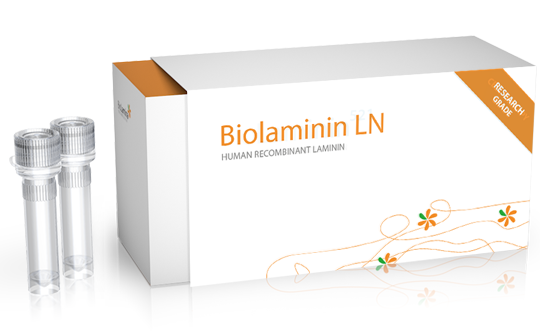
Key specifications
| Parameter | Specification |
|---|---|
| Catalogue numbers | LN332-0202 (100 μg, 1 mL) / LN332-0502 (500 μg, 5 mL) |
| Protein | Full-length human recombinant laminin-332 (laminin-5) |
| Classification | Animal origin-free, human recombinant protein; chemically defined and xeno-free |
| Concentration | 0.1 mg/mL |
| Appearance | Clear, colourless buffered solution, pH 7.2, with 10% glycerol and 0.02% NaN3 |
| Storage | −20 °C to −80 °C; shipped on dry ice |
| Declaration | For research use only |
Why laminin-332
Laminin-332 strongly influences keratinocyte proliferation and mediates strong adhesion of keratinocytes to the basement membrane through the hemidesmosome complex; its importance is evident in junctional epidermolysis bullosa, a blistering disease associated with laminin-332 gene mutations. Its expression rises during wound healing, affecting keratinocyte migration, invasion and tissue remodelling. In hair follicles it is highly expressed in the catagen phase and antagonizes laminin-511-driven hair growth in vitro. RPE cells produce and bind most strongly to laminin-332, which in vitro best preserves the phenotypic stability of mature RPE cells.
Recommended applications
- Skin keratinocytes and epithelial tissue models; in vitro wound-repair studies
- Retinal pigment epithelium (RPE) cells
- Hair follicle stem cells
- Bone and cartilage cells; cancer cell studies
- Compatible with serum-free media, various surface materials, 3D models, large-scale production and automation
Coating essentials
- Thaw slowly at +4 °C, dilute in 1× DPBS and coat tissue culture-treated surfaces at 0.5–2 μg/cm² (optimize per cell line)
- Seal the plate and incubate overnight at 2–8 °C, or 2 hours at 37 °C; never let the coating dry, as this inactivates the laminin
- Thawed, undiluted stock is stable for 3 months at 2–8 °C; for longer storage aliquot and keep at −30 °C to −80 °C; avoid repeated freeze–thaw
- Coated plates can be stored aseptically at 2–8 °C for up to 4 weeks
Selection notes
For long-term keratinocyte expansion also consider Biolaminin 511, and Biolaminin 421 for endothelial or kidney work.
Selected publications
- Kariya Y, et al. Polymerized Laminin-332 Matrix Supports Rapid and Tight Adhesion of Keratinocytes, Suppressing Cell Migration. PLoS ONE. 2012;7(5):e35546. doi:10.1371/journal.pone.0035546
- Dobre O, et al. A Hydrogel Platform that Incorporates Laminin Isoforms for Efficient Presentation of Growth Factors – Neural Growth and Osteogenesis. Adv Funct Materials. 2021;31(21):2010225. doi:10.1002/adfm.202010225
- Rousselle P, Scoazec JY. Laminin 332 in cancer: When the extracellular matrix turns signals from cell anchorage to cell movement. Seminars in Cancer Biology. 2020;62:149-165. doi:10.1016/j.semcancer.2019.09.026
Choosing the right laminin isoform for your cell type? Contact TechWave for Biolaminin 332 LN selection support, coating protocols and quotations.
Related brands
Related products
Technical resources
- One-stop iPSC workflow selection: from reprogramming, expansion, gene editing and directed differentiation to 0.1–80 L suspension scale-up, 525 mL/min closed filling and ambient transport for up to 2 weeks
- Change the matrix lot and differentiation results shift? Choosing an iPSC matrix: Matrigel, VTN, E8 fragments and full-length Biolaminin 521 compared
- Both pass in 2D — week six decides: an LN521:LN111 laminin blend keeps 3D vascularized liver spheroids more uniform and intact for longer, with human albumin still in mouse plasma 14 days after transplant
- Twenty years of Yamanaka factors: iPS cell therapies win conditional approval and partial reprogramming enters its first human trial — how close is “making cells young again”?
- Give β-cells a real basement membrane: BioLamina full-length laminins deliver 3.9-fold higher SC-islet insulin secretion, 20–25% more NKX6.1/NEUROD1 cells and 3- to 4-fold primary-islet expansion versus tissue-extracted matrix
- Is Differentiation Purity Stuck? After Rounds of Factor and Medium Changes, the Overlooked Variable May Be the Matrix: Matrigel, Vitronectin, E8 Fragments and Full-Length Laminins Compared, Plus 11 Biolaminin Products by Lineage