
Products
Biolaminin 521 MX (MX521) Pre-clinical
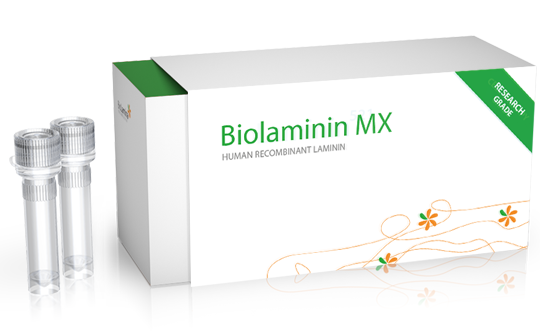
Biolaminin 521 MX (MX521-0201 / MX521-0501): pre-clinical, animal origin-free full-length human laminin-521 for robust hPSC culture on the path from discovery to clinical cell production.
Product information
- Brand
- BioLamina
- Catalog no.
- MX521-0201 / MX521-0501
- Specification
- 100 μg (1 mL) / 500 μg (5 mL)
Pre-clinical laminin-521 that bridges discovery and clinical cell production
A matrix change late in development can mean repeating comparability work. Biolaminin 521 MX is the pre-clinical member of the Biolaminin 521 family: a full-length, chemically defined, animal origin-free (AOF) human recombinant laminin-521, produced from a GMP-tested master cell bank with animal-origin-free materials and designed for robust culture of human pluripotent stem cells (hPSCs) in studies aiming for clinical applications. Research-grade LN521, pre-clinical MX521 and the cell-therapy-grade CT521 let you keep laminin-521 from the first experiment to clinical production.
Ordering information
| Catalogue number | Grade | Size | Intended use (manufacturer) |
|---|---|---|---|
| MX521-0201 | Pre-clinical | 100 μg (1 mL) | Human ES and iPS cells |
| MX521-0501 | Pre-clinical | 500 μg (5 mL) | Human PSCs, MSCs and most anchorage-dependent progenitor cell types |
Key specifications
| Parameter | Specification |
|---|---|
| Protein | Full-length human recombinant laminin-521 (laminin-11) |
| Classification | MX521-0201: AOF human recombinant laminin; MX521-0501: AOF human recombinant laminin including primary packaging |
| Concentration | 0.1 mg/mL |
| Appearance | Clear, colourless solution, pH 7.5, with 20 mM HEPES, 0.25 M NaCl and 10% glycerol |
| Storage | −20 °C to −80 °C, protected from light; shipped on dry ice |
| Declaration | For research use and pre-clinical development |
What full-length laminin-521 does for your cells
Laminin-521 is the natural laminin for pluripotent stem cells. As an inherent stem cell niche protein, it provides a biologically relevant environment that improves survival and supports efficient growth from single-cell culture to large-scale production. BioLamina lists these benefits:
- Activates intrinsic stem cell signalling pathways for stable stem cell behaviour in vitro
- Removes the need for apoptosis inhibitors by acting as a key factor of the stem cell niche
- Higher cell yield and survival through optimal attachment, with uniform cellular responses and a more robust culture system
- Higher cloning efficiency and single-cell survival after genome editing
- Maintained pluripotency and stable cell identity, standardized pluripotency gene expression and maximized genetic stability
- Consistent performance within standardized protocols, compatible with many stem cell lines, serum-free media, surface materials, 3D models, large-scale production and automation
Beyond self-renewal, laminin-521 promotes the maturation, polarization and organization of specialized cell types, and its natural occurrence in the nervous system, pancreas and eye makes it a preferred substrate for a set of primary cell types. BioLamina reports that hundreds of scientific articles and tens of ongoing clinical cell therapy programmes use its laminin.
Recommended applications
- Expansion, single-cell passaging, clonal culture and genome editing of human iPSCs and ESCs; iPSC reprogramming
- Mesenchymal stromal cells and most anchorage-dependent progenitor cell types
- Differentiation and maintenance of hepatocytes, cardiomyocytes and neurons; neural, retinal pigment epithelium and pancreatic lineages; endothelial cells
- 3D culture and organoids; pre-clinical cell production process development
Handling notes
- Coat at 0.5–2 μg/cm² after dilution in DPBS containing Ca²⁺ and Mg²⁺, which supports laminin assembly; never let the coating dry
- Single-cell passaging or small clumps are recommended; most cells attach within an hour and form a homogeneous monolayer, typically ready to passage 3–6 days after seeding at 60–99% confluence
- Thawed, undiluted stock is stable for 3 months at 2–8 °C; coated plates keep for up to 4 weeks at 2–8 °C
- Biolaminin is full-length laminin with all domains intact, unlike E8 fragments, which are C-terminal fragments lacking the N-terminal domains
Choosing within the 521 family
LN521 is the research grade; MX521 is aimed at pre-clinical studies and a smooth transition toward clinical applications; CT521 (Biolaminin 521 CTG) is the cell-therapy grade. The 500 μg MX521-0501 is also listed with CT521-0501 on our Biolaminin 521 CTG page.
Selected publications
- Rodin S, et al. Clonal culturing of human embryonic stem cells on laminin-521/E-cadherin matrix in defined and xeno-free environment. Nat Commun. 2014;5(1):3195. doi:10.1038/ncomms4195
- Rodin S, et al. Monolayer culturing and cloning of human pluripotent stem cells on laminin-521–based matrices under xeno-free and chemically defined conditions. Nat Protoc. 2014;9(10):2354-2368. doi:10.1038/nprot.2014.159
- Uhlin E, et al. Integration Free Derivation of Human Induced Pluripotent Stem Cells Using Laminin 521 Matrix. JoVE. 2017;(125):e56146. doi:10.3791/56146
- Namipashaki A, et al. Integration of xeno-free single-cell cloning in CRISPR-mediated DNA editing of human iPSCs improves homogeneity and methodological efficiency of cellular disease modeling. Stem Cell Reports. 2023;18(12):2515-2527. doi:10.1016/j.stemcr.2023.10.013
- Niclis JC, et al. Efficiently Specified Ventral Midbrain Dopamine Neurons from Human Pluripotent Stem Cells Under Xeno-Free Conditions Restore Motor Deficits in Parkinsonian Rodents. Stem Cells Translational Medicine. 2017;6(3):937-948. doi:10.5966/sctm.2016-0073
Planning a stem cell programme that will move toward the clinic? Contact TechWave for Biolaminin 521 MX selection support, quality documentation and quotations.
Related brands
Related products
Technical resources
- One-stop iPSC workflow selection: from reprogramming, expansion, gene editing and directed differentiation to 0.1–80 L suspension scale-up, 525 mL/min closed filling and ambient transport for up to 2 weeks
- Change the matrix lot and differentiation results shift? Choosing an iPSC matrix: Matrigel, VTN, E8 fragments and full-length Biolaminin 521 compared
- Both pass in 2D — week six decides: an LN521:LN111 laminin blend keeps 3D vascularized liver spheroids more uniform and intact for longer, with human albumin still in mouse plasma 14 days after transplant
- Twenty years of Yamanaka factors: iPS cell therapies win conditional approval and partial reprogramming enters its first human trial — how close is “making cells young again”?
- Give β-cells a real basement membrane: BioLamina full-length laminins deliver 3.9-fold higher SC-islet insulin secretion, 20–25% more NKX6.1/NEUROD1 cells and 3- to 4-fold primary-islet expansion versus tissue-extracted matrix
- Is Differentiation Purity Stuck? After Rounds of Factor and Medium Changes, the Overlooked Variable May Be the Matrix: Matrigel, Vitronectin, E8 Fragments and Full-Length Laminins Compared, Plus 11 Biolaminin Products by Lineage