
Technical column
Can iPSC passaging skip precoating? iMatrix-511 premix delivers comparable attachment at about one-fifth to one-tenth the dose—with a 2026 hepatic stellate cell protocol example
Precoating has long been treated as essential for adherent human pluripotent stem cell culture, requiring one to several hours in advance; coated vessels also cannot be stored at ambient temperature. Miyazaki and colleagues reported in Scientific Reports in 2017 that adding iMatrix-511 directly to the cell suspension during passage, without precoating, supports rapid, firm single-cell attachment. Maximum attachment matched precoating, while substrate usage fell from more than 1 µg/cm² to 0.13–0.25 µg/cm². Full-length laminin-521 and truncated vitronectin were unsuitable for this application in the same study. After more than 10 passages, cells retained undifferentiated markers, normal karyotypes and three-germ-layer differentiation potential. A 2026 Bio-protocol method for hiPSC-derived fetal-like hepatic stellate cells also adds iMatrix-511 to the day-0 seeding medium without precoating. Here are the parameters and application boundaries of both studies.
Definition
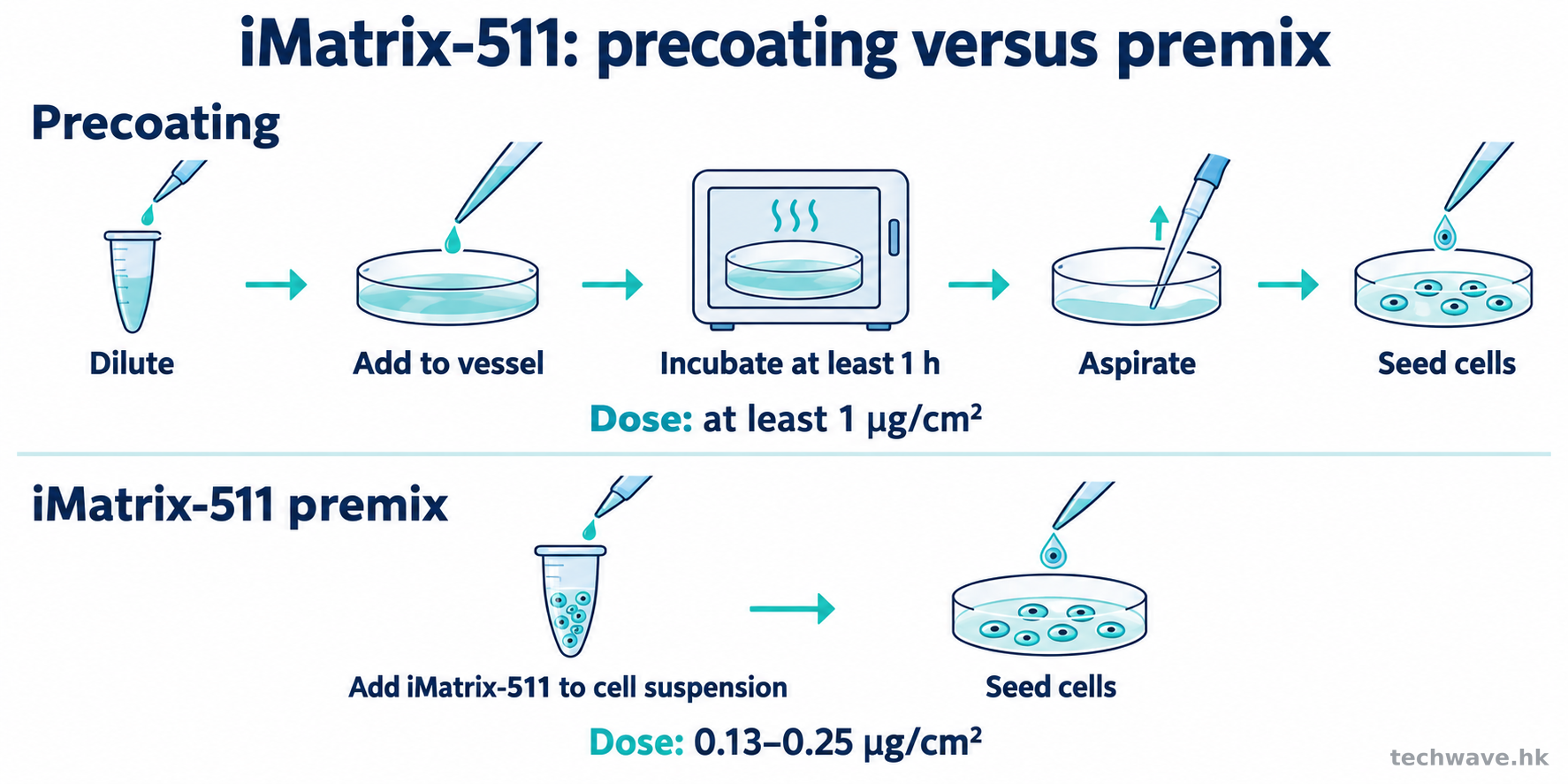
The iMatrix-511 premix or uncoated method adds recombinant human laminin-511 E8 fragments directly to the cell suspension or seeding medium during passage or seeding, rather than precoating culture vessels. The fragments mediate attachment during seeding, removing the precoating wait and reducing substrate consumption.
Anyone maintaining human pluripotent stem cells (hPSCs) without feeders knows the sequence: dilute the substrate, cover the dish, incubate for at least an hour, then seed. Coated vessels cannot simply be stored at ambient temperature [1]. An unexpected need for extra plates can mean another wait.
In 2017, Miyazaki and colleagues reported a counterintuitive finding in Scientific Reports: iMatrix-511 can be added straight to the cell suspension without precoating—and uses less substrate [1].
Video explainer
iMatrix-511 uncoated premix
Watch on YouTube ↗Video transcript
Passaging again? Precoating takes another hour! A 2017 paper in Scientific Reports reported that iMatrix-511 can go straight into the cell suspension, with no precoating. That was thought to be impossible because proteins in the medium occupy the culture surface first, leaving no room for the matrix to attach.
The study compared three commercial matrices: full-length laminin 521, truncated vitronectin rhVTN-N, and iMatrix-511. Full-length 521: without precoating, even high concentrations failed to support attachment. Vitronectin: high concentrations allowed attachment, but it was weak.
A medium change washed the cells away. iMatrix-511 matched the maximum attachment achieved with precoating, using less than 0.25 micrograms per square centimeter. Precoating needed at least 1. Premixing needed just 0.13 to 0.25, about one-fifth to one-tenth as much.
After more than 10 passages, pluripotency markers stayed high, karyotypes were normal, and cells could differentiate into all three germ layers. A 2026 hepatic stellate cell differentiation protocol uses this approach at seeding on Day 0, explicitly stating that no precoating is needed.
Three reminders: first, this was validated only for iMatrix-511. Second, compare doses when changing cell lines or media. Third, precoating is still useful for long-term maintenance and later differentiation stages. Find the full article and parameter table in the TechWave technical column.
Produced by TechWave. For research reference only; not medical advice.
Why skipping precoating seemed unlikely
Culture substrates generally need to adsorb onto the vessel to support attachment. Proteins in the medium, including serum albumin, can occupy or mask the surface and interfere with adsorption [1]. Adding substrate to medium was therefore considered inefficient.
The researchers systematically compared precoated and uncoated use of three representative commercial recombinant substrates in two media [1]:
| Comparison | Study setup [1] |
|---|---|
| Substrates | iMatrix-511 (laminin-511 E8), full-length laminin-521, rhVTN-N (truncated human vitronectin, amino acids 20–398) |
| Media | TeSR-E8 (low protein), StemFit AK03 (protein rich) |
| Cells | H9 hESCs and 253G1 hiPSCs |
| Precoating | 0–4 µg/cm² for 3 hours at 37 °C immediately before seeding; 1 µg/cm² in passage comparisons |
Core result: only iMatrix-511 supports the uncoated approach, at a lower dose
Dose–attachment curves
- With precoating, all three substrates supported dose-dependent attachment. iMatrix-511 gave the highest maximum attachment, rhVTN-N was comparable but medium-dependent, and full-length laminin-521 was slightly lower [1].
- Without precoating, their behavior diverged [1]:
- Full-length laminin-521 failed to support attachment even at high concentrations.
- rhVTN-N supported attachment at high concentrations, but its maximum was below precoating; attachment was weaker and cells were easily washed away during medium exchange.
- Uncoated iMatrix-511 reached the same maximum attachment as precoating, at below 0.25 µg/cm² versus more than 1 µg/cm² for precoating, across both media and cell types.
At 1 µg/cm², attachment did not differ significantly between uncoated and precoated iMatrix-511 (H9/TeSR-E8: P = 0.059; H9/StemFit AK03: P = 0.696; 253G1/TeSR-E8: P = 0.681; 253G1/StemFit AK03: P = 0.723). At 0.25 µg/cm², all four comparisons were significant (P < 0.001): uncoated use gave better attachment at the low dose [1].
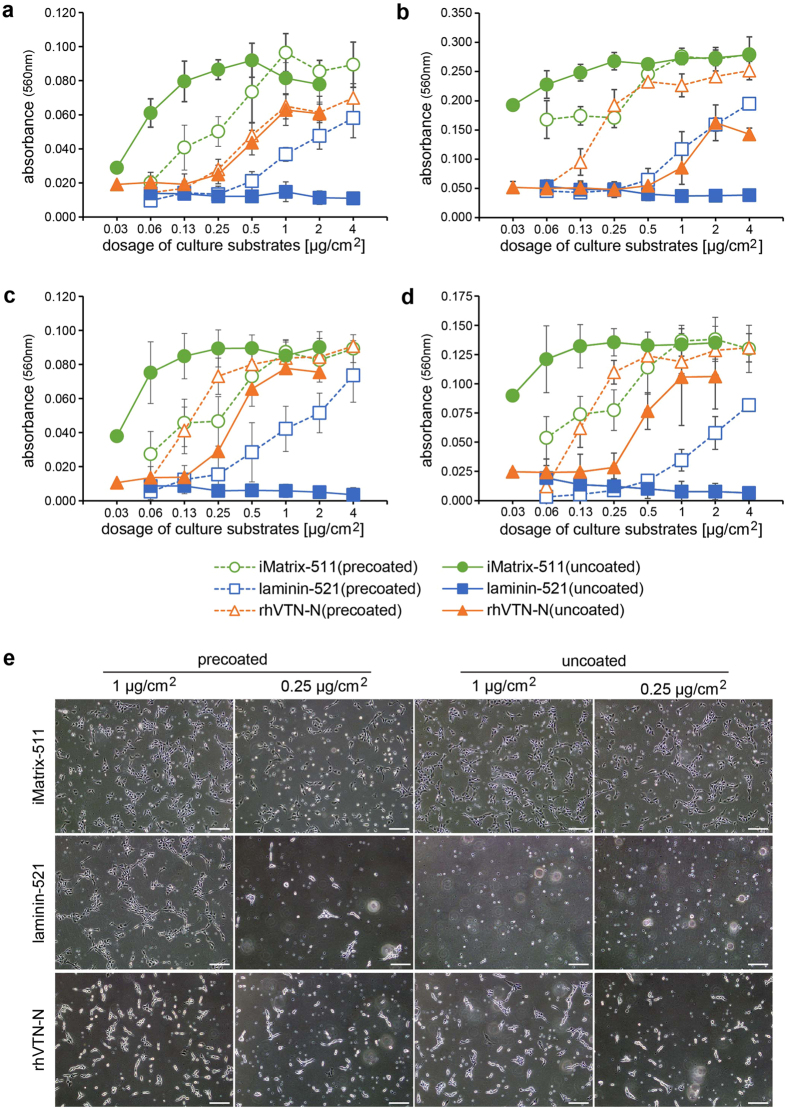
In the discussion, the authors summarize maximum attachment at 0.13–0.25 µg/cm² iMatrix-511, about one-fifth to one-tenth the precoating amount [1].
Attachment speed and morphology
At maximum-attachment concentrations, cells in uncoated iMatrix-511 (0.25 µg/cm²) were flat with elongated filopodia, resembling precoating at 1 µg/cm² [1]. Dynamic imaging showed similarly rapid attachment and morphological changes after seeding. Uncoated controls without iMatrix-511 remained curled without specific attachment [1].
Growth and long-term passage
| Test | Result with uncoated iMatrix-511 [1] |
|---|---|
| Short-term growth | Similar proliferation to precoating, without colony detachment |
| Serial passage | Good growth and typical morphology beyond 10 passages |
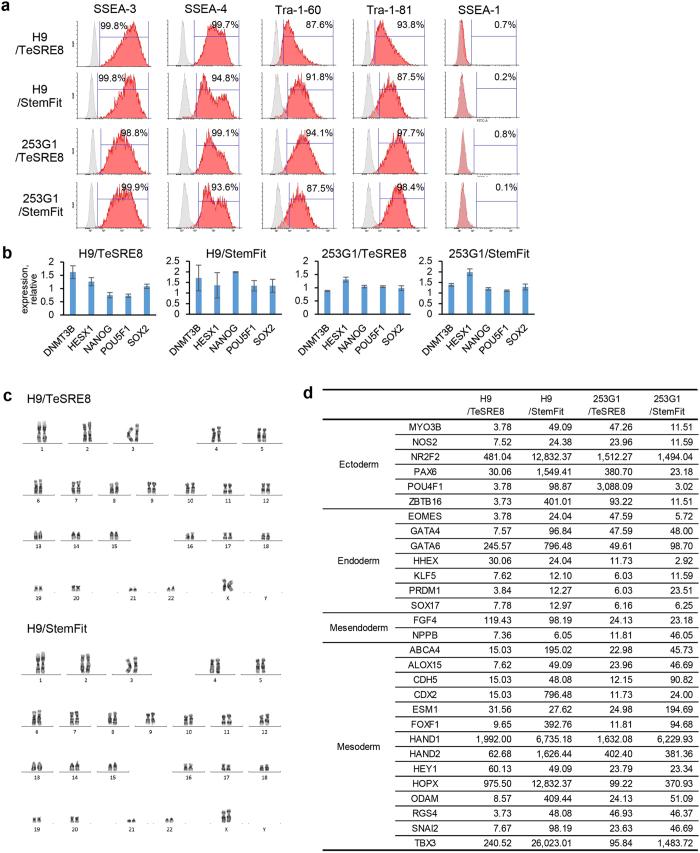
| Undifferentiated surface markers | High SSEA-3, SSEA-4, TRA-1-60 and TRA-1-81; no SSEA-1 |
| Undifferentiated gene expression | Similar expression after 29 uncoated passages versus 10 precoated passages |
| Karyotype | Normal G-banding (H9: 46, XX) |
| Differentiation potential | Normal embryoid-body formation and increased three-germ-layer marker expression after 14 days |
Why iMatrix-511?
The authors propose molecular size as an explanation. iMatrix-511 retains only the integrin-binding E8 region of laminin-511. Its small size may make receptors across the cell surface easier to reach in suspension, enabling more effective attachment to the culture surface [1]. Protein-rich medium did not impair the effect; the substrate protein's properties appeared decisive. The authors also state that the reason iMatrix-511 alone works at much lower concentrations than precoating remains incompletely understood [1].
The foundational LN511-E8 work demonstrating efficient attachment and expansion of dissociated human pluripotent cells was published by Miyazaki and colleagues in Nature Communications in 2012 [3].
A 2026 example: day 0 of hepatic stellate cell differentiation
In October 2026, Yang and colleagues published a Bio-protocol method for efficient generation of expandable fetal-like hepatic stellate cells (HSCs) from hiPSCs [2]. The corresponding Developmental Cell research reports expansion greater than 10^5-fold and promotion of maturation and vascularization in liver organoids derived entirely from iPSCs [4].
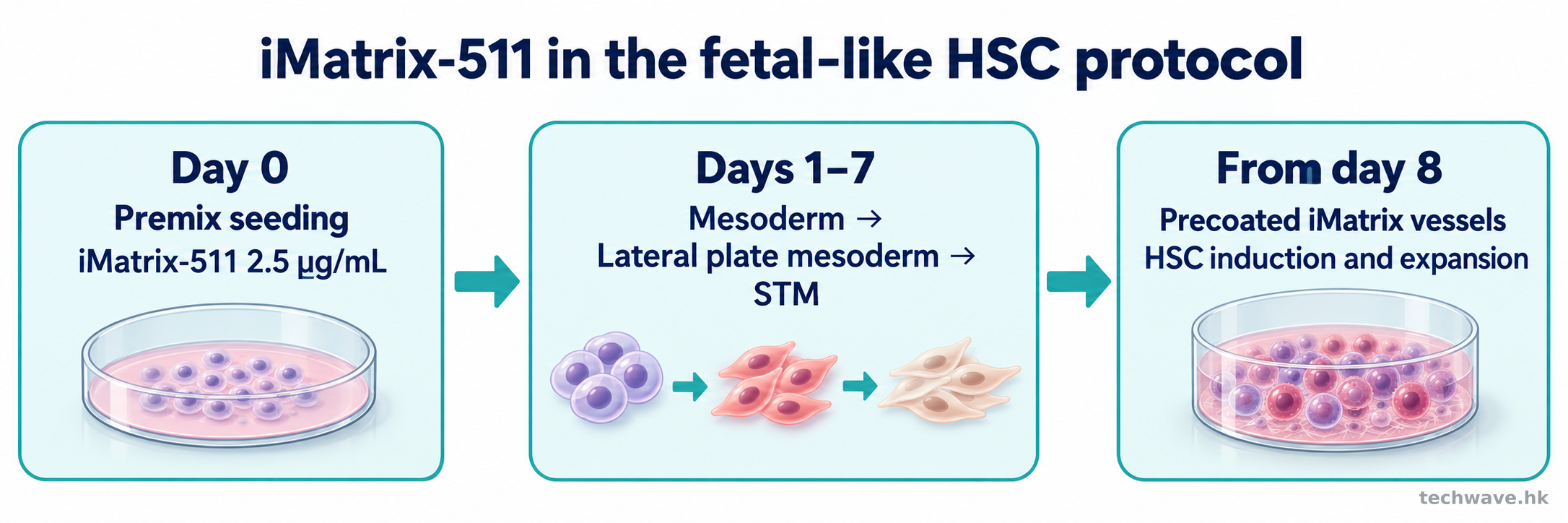
The protocol starts with the premix approach [2]:
| Stage | Protocol [2] |
|---|---|
| iPSC culture | M48 hiPSCs maintained in StemFit AK02N |
| Day-0 seeding medium | Complete StemFit AK02N + 10 µM Y-27632 + 2.5 µg/mL iMatrix-511 |
| Day-0 seeding | 1 mL seeding medium per 12-well-plate well; harvest at 50%–60% confluence and seed at 1.32E4 cells/cm²; no precoating required |
| Density optimization | Four recommended densities: 0.79E4, 1.32E4, 1.84E4 and 2.63E5 cells/cm² |
| From day 8 | Passage into precoated iMatrix vessels for HSC induction and expansion |
| Subsequent coating | iMatrix-511 diluted to 2.5 µg/mL in D-PBS, 1 hour at 37 °C; use that day or store at 4 °C for up to 1 week |
Two details matter:
- Premix and precoating serve different stages: day 0 simplifies initial seeding; from day 8, HSC induction, expansion, recovery after cryopreservation and functional assays use precoated iMatrix vessels [2].
- The protocol is not animal-component-free throughout: HSC induction and expansion medium contains 5% fetal bovine serum [2].
Practical selection points
- Start with a dose curve. Miyazaki 2017 established its effective range in 96-well assays [1]. For a different line, medium or vessel, compare attachment around 0.13–0.25 µg/cm² and 1 µg/cm² before setting routine usage.
- Apply the premix evidence specifically to iMatrix-511. Neither full-length laminin-521 nor rhVTN-N matched their precoating performance this way [1]. Full-length laminin-521 still supports normal attachment when precoated.
- Design for single-cell seeding. Both studies begin with dissociated single cells; the Bio-protocol seeding medium also includes 10 µM Y-27632 [1][2].
- Precoating remains useful. Long-term maintenance, later differentiation stages and steps requiring a consistent surface can retain precoating, as in the Bio-protocol workflow [2].
Frequently asked questions
Does a lower premix dose mean weaker attachment or cells washing away?
With uncoated iMatrix-511, Miyazaki 2017 observed no colony detachment during growth and normal culture beyond 10 passages [1]. Easy removal during medium exchange occurred with uncoated rhVTN-N, not iMatrix-511 [1].
Can the method be used with StemFit?
It is a supported starting point. Miyazaki 2017 includes StemFit AK03 in its dose curves and short-term growth experiments [1], while the 2026 Bio-protocol day-0 seeding medium is based on StemFit AK02N [2].
Does this apply to every iMatrix model?
The study tested only iMatrix-511 [1]. Other laminin-fragment models require separate evaluation.
Conclusion
Precoating is not essential for iMatrix-511. Systematic dose curves, dynamic imaging and more than 10 serial passages in Miyazaki 2017 showed that adding iMatrix-511 directly to the cell suspension achieves comparable attachment, growth and pluripotency maintenance using about one-fifth to one-tenth the substrate [1]. The 2026 HSC differentiation protocol uses this approach on day 0 [2]. For frequent passage, parallel plates or unplanned seeding, it offers time and substrate savings backed by peer-reviewed data.
Optimize iMatrix-511 use with TechWave
Considering premix in your iPSC process, or choosing between premix and precoating? TechWave can supply product information for Matrixome iMatrix laminin-fragment substrates and Ajinomoto StemFit media, and help plan dose comparisons and passage parameters. Share your cell line, medium and culture scale.
References
- Miyazaki T, Isobe T, Nakatsuji N, Suemori H. Efficient adhesion culture of human pluripotent stem cells using laminin fragments in an uncoated manner. Sci Rep. 2017;7:41165. doi:10.1038/srep41165
- Yang X, et al. Efficient generation of fetal hepatic stellate cells from hiPSC. Bio-protocol. 2026;16:e5827. doi:10.21769/BioProtoc.5827
- Miyazaki T, Futaki S, Suemori H, et al. Laminin E8 fragments support efficient adhesion and expansion of dissociated human pluripotent stem cells. Nat Commun. 2012;3:1236. doi:10.1038/ncomms2231
- Yang X, Nie YZ, Lu C, et al. Human pluripotent stem cell-derived fetal hepatic stellate cells promote vascularization and maturation in liver organoids. Dev Cell. 2026;61(1):208–223.e8. doi:10.1016/j.devcel.2025.09.002
Uses and applicable scenarios
- Routine single-cell passage of human ES/iPS cells without advance coating
- High-throughput or parallel multi-plate seeding with fewer coating steps and lower substrate consumption
- Day-0 seeding for differentiation starting from hiPSCs
- Unplanned passage or expansion when precoated vessels are unavailable
Limitations
- Miyazaki 2017 tested H9 hESCs and 253G1 hiPSCs in TeSR-E8 and StemFit AK03; other lines, media and vessels require initial dose and attachment evaluation
- Only iMatrix-511 was suitable for this method in the study; full-length laminin-521 did not support uncoated attachment, while truncated vitronectin required high concentrations and gave weaker attachment
- The Bio-protocol method uses uncoated seeding only on differentiation day 0; subsequent HSC induction and expansion use precoated iMatrix vessels, and the medium contains 5% fetal bovine serum