
Technical column
Synthetic Peptide PG-008 in Place of Recombinant WNT3A: Two Orders of Magnitude More Expansion of Patient Colonic Organoids in 5 Weeks, About 82% Establishment Across 60 Patients
Turning patient-derived intestinal organoids into a regenerative-medicine starting material demands cultures that are both stable and scalable. A team at Institute of Science Tokyo, writing in Stem Cell Research & Therapy (2026), built a GMP-compliant colonic organoid workflow: clinical-grade Type-I collagen replaced Matrigel, and organoids were established from 81.67% of 60 patients. Swapping 2 µg/mL recombinant WNT3A for 20 ng/mL of the synthetic peptide PG-008 delivered two orders of magnitude more expansion over 5 weeks and sharply reduced patient-to-patient variation. Single-cell sequencing showed the PG-008 cultures were almost entirely stem and transit-amplifying cells. Adding PG-001, PG-004 and PG-009 left a medium that was nearly protein-free apart from R-spondin 1.
Definition
PG-008 is a chemically synthesized Wnt/β-catenin pathway agonist peptide from PeptiGrowth, used in organoid and stem-cell culture in place of recombinant WNT3A protein; the study described here replaced 2 µg/mL recombinant WNT3A in the medium with 20 ng/mL PG-008.
Same protocol, different patient biopsy, and one organoid line grows plump while the next barely takes off. For a disease model that is an inconvenience. For a programme that wants to expand a patient's own intestinal organoids and transplant them back to repair the mucosa, it decides whether the approach can work at all: the cells have to be plentiful, consistent from batch to batch, and made with materials that hold up to clinical-grade production.
A team at Institute of Science Tokyo has now published a complete answer in Stem Cell Research & Therapy (2026) [1]. They built a GMP-compliant workflow for establishing colonic organoids, replaced Matrigel with clinical-grade Type-I collagen, and established organoids from 81.67% (about 82%) of 60 patients. The decisive step was swapping the 2 µg/mL recombinant WNT3A (rWNT3A) in the medium for 20 ng/mL of the synthetic peptide PG-008: one hundredth of the mass concentration, yet the organoids grew faster, expanded two orders of magnitude more than with rWNT3A over 5 weeks, and differed far less from one patient to the next.
Video explainer
PG-008 vs Recombinant WNT3A: Patient Colon Organoids Grew Two Orders of Magnitude More in 5 Weeks
Watch on YouTube ↗Video transcript
Same protocol, a different patient's biopsy, and one organoid line grows plump while the next barely takes off. If you hope to expand a patient's own gut organoids and transplant them back one day, that is a big problem.
You need plenty of cells, and consistent batches. In 2026, a team at Institute of Science Tokyo published a GMP-compliant workflow for colonic organoids. Today's clue: Wnt. Paper detective, on the case. Step one was the foundation: clinical-grade Type-I collagen instead of Matrigel, which comes from a mouse tumour and varies from batch to batch.
Organoids were established from 49 of 60 patients, about 82%. Some cases still failed, so there was room to improve. For human gut organoids, added WNT3A is the key. It supplies the Wnt signal. The catch: GMP-grade recombinant WNT3A must be carrier-free.
Without serum, only the detergent CHAPS keeps it dissolved, like a swim ring. Once CHAPS is diluted in the medium, WNT3A can lose solubility and activity. The Wnt signal becomes unstable and short-lived. The team switched to PG-008, a synthetic Wnt pathway agonist peptide from PeptiGrowth, for three stated reasons: compatibility with GMP manufacturing, stability in culture medium, and low cost.
The dose: 2 micrograms per millilitre of recombinant WNT3A became 20 nanograms per millilitre of PG-008. One hundredth, by mass. PG-008 still established organoids from patient crypts, and over repeated passages its cultures kept a larger organoid area.
Over 5 weeks, PG-008 cultures expanded two orders of magnitude more than recombinant WNT3A cultures. And they grew evenly: growth rates across patients became far more consistent. Plus, 2 cases that failed with recombinant WNT3A were established with PG-008.
Why? Single-cell sequencing showed that, compared with recombinant WNT3A, canonical stem cells rose from 12.0% to 51.4% with PG-008, and differentiated enterocytes fell from 47.4% to 1.1%. PG-008 cultures were almost all stem cells and dividing cells, which fits the idea that stem-cell enrichment brings higher, steadier growth.
How can a small peptide stand in for a big protein? Look at a 2015 paper. It targets Met, the receptor for HGF, not Wnt, but it shows how this kind of artificial growth factor is designed. First, screen an mRNA library of ten to the fourteenth sequences for ring peptides that grip the receptor.
But one ring alone, however tightly it binds, gets no response. Join two rings into a dimer, pull two receptors together, and the signal switches on, reaching the same maximal phosphorylation as human HGF. Keep them apart: those ring peptides are research compounds, not PeptiGrowth catalogue products, and their data do not transfer.
Back to the organoids. PG-001, PG-004 and PG-009 then replaced HGF, Noggin and EGF, leaving a medium nearly protein-free apart from R-spondin 1. The four-peptide mix grew about as fast as PG-008 alone, so the gain came mainly from PG-008.
Hold on, let's check the source. First, the PG-008 in the paper was not GMP grade. It can be made in a GMP-compliant facility on request. Second, the study made clinical-grade organoids. It did not test transplantation or clinical efficacy.
Third, PG-008 cultures have almost no differentiated cells. If you need mature cells, withdraw the Wnt agonist and differentiate them separately. Fourth, a 2018 study found a Met-targeting ring peptide that matched HGF for migration in flat culture, yet formed no tubules at all in 3D collagen.
So before you switch, validate the function you need on your own cells and culture format. Full data, doses and references: the TechWave technical column at techwave.hk.
Mini Guts in a Dish: PG-008 vs Recombinant WNT3A, Two Orders of Magnitude More in 5 Weeks
Watch on YouTube ↗Video transcript
From a patient's own gut tissue, you can grow mini guts in a dish. They are called organoids. But they need a Wnt signal, which usually comes from a protein called WNT3A. Without serum, it needs a detergent to stay dissolved, and once that detergent is diluted, it can lose its activity.
A team in Tokyo swapped in a small synthetic peptide, PG-008, at one hundredth of the dose by mass. Over 5 weeks, they expanded two orders of magnitude more than with recombinant WNT3A, and grew far more evenly from patient to patient.
The secret: they were almost entirely stem cells and dividing cells. Hold on, let's check the source. The PG-008 in the paper was not GMP grade, and the study made organoids for future transplants. It did not test transplantation or efficacy.
Full article: the TechWave technical column at techwave.hk.
Produced by TechWave. For research reference only; not medical advice.
Why intestinal organoids are still one step short of the clinic
First reported in 2009, intestinal organoids are self-renewing, self-organizing three-dimensional cultures. They quickly became a platform for studying gut disease and screening drugs, and a candidate route for expanding stem cells for cell therapy. Preclinical work is encouraging: organoids transplanted into several mouse colonic injury models engrafted at the injury and helped recovery, an ability that depends on their intestinal stem cells (ISCs); in a rat short bowel syndrome model, replacing colonic epithelium with small-intestinal organoids produced a therapeutic "small intestinalized colon"; and small-intestinal organoids from children with intestinal failure have been seeded onto human intestinal scaffolds to build transplantable grafts with absorptive and digestive function.
Moving towards the clinic needs a culture system that can reliably and efficiently mass-produce clinical-grade patient-derived organoids, and that is exactly what intestinal organoids have lacked. The first hurdle is the matrix: the widely used Matrigel comes from a mouse tumour and varies considerably between batches; many studies have grown intestinal organoids in Type-I collagen instead, but none with GMP-grade materials. The second is scale: Matrigel cultures of IBD patient organoids have reached biobank scale, collagen cultures have not, so how reliably collagen supports establishment had never been shown.
Step one: clinical-grade collagen instead of Matrigel, 81.67% establishment across 60 patients
The team kept the familiar sequence of biopsy, mechanical fragmentation, enzymatic digestion, filtering and gel embedding, took 8 endoscopic biopsies per patient and used GMP-compliant reagents and factors throughout. The clinical-grade collagen used to embed the crypts had previously been used in transplantation of human iPSC-derived retinal pigment epithelial cell sheets.
- Formation and expansion: organoids formed in both collagen and Matrigel, with distinctly cystic organoids in collagen; both matrices yielded comparable numbers of organoids from biopsies, pointing to similar expansion efficiency. Organoids were passaged weekly and stayed highly proliferative over several passage cycles.
- Cell composition: after three passages, FABP1, CA2, MUC2 and TFF3 expression in collagen cultures was significantly lower than in Matrigel, while stem-cell markers showed no consistent trend. The authors read this as long-term collagen culture reducing absorptive and secretory differentiated cells in favour of undifferentiated cells, including LGR5+ stem cells.
- Establishment rate: from non-inflamed ascending-colon mucosa of 60 patients (53 with IBD, 7 without), organoids were established in 81.67% (49/60) overall: 81.13% (43/53) for IBD patients and 85.71% (6/7) for non-IBD controls, a slight improvement on earlier reports of IBD patient intestinal organoids established in Matrigel.
Some cases still failed and culture efficiency had room to improve, so the team ran every further optimization in the collagen system.
The bottleneck was WNT3A
Exogenous WNT3A is the key to growing human intestinal organoids. The catch is that GMP-grade rWNT3A has to be carrier-free, so in serum-free conditions its solubility rests entirely on the detergent CHAPS. Once CHAPS is diluted in the culture medium, WNT3A can lose solubility and activity, leaving Wnt signalling unstable and short-lived. WNT3A is also hydrophobic, which makes it hard to purify and use and prone to aggregation that hampers its diffusion.
Alternatives exist. Several substitute Wnt agonist proteins have shown promise, but none is currently GMP compatible. The small-molecule GSK3β inhibitor CHIR99021 can replace WNT3A in mouse organoids, but no full replacement has yet been reported for human organoids, and it raises concerns: off-target effects at the micromolar concentrations it needs, and the fact that it bypasses WNT3A by acting downstream of it. The team chose PeptiGrowth's synthetic peptide Wnt/β-catenin agonist PG-008, for three stated reasons: GMP compatibility, stability in culture media and low cost.
PG-008 in the medium: five results
| Culture condition | Wnt source | In place of HGF | In place of Noggin | In place of EGF |
|---|---|---|---|---|
| Conventional | rWNT3A 2 µg/mL | Recombinant HGF 100 ng/mL | Recombinant Noggin 200 ng/mL | Recombinant EGF 100 ng/mL |
| Wnt replacement | PG-008 20 ng/mL | Recombinant HGF 100 ng/mL | Recombinant Noggin 200 ng/mL | Recombinant EGF 100 ng/mL |
| Peptide culture | PG-008 20 ng/mL | PG-001 10 ng/mL | PG-004 25 ng/mL | PG-009 100 ng/mL |
All three conditions shared the remaining components: Stemfit AK03N basal medium with 2 µg/mL recombinant R-spondin1, 500 nM A83-01, 10 µM SB202190 and 10 µM Y-27632, 500 µL per well, with the medium changed every 2 days; organoids were passaged 1:2–4 every 6–8 days.
- It establishes organoids: with PG-008 in place of rWNT3A, organoids grew from patient crypts as they did with rWNT3A, showing that PG-008 supplies enough Wnt signal to establish patient-derived colonic organoids.
- Formation efficiency holds or improves: across several cases, PG-008 formed organoids from primary crypts as efficiently as rWNT3A or better.
- The gap widens with passaging: over several passage cycles, PG-008 cultures consistently showed larger organoid area.
- Faster and more uniform growth: over 5 weeks, PG-008 cultures expanded two orders of magnitude more than rWNT3A cultures, and the spread in growth rate between patient lines narrowed markedly (F-test at week 5, p < 0.05). For downstream use this means a shorter, more predictable route to the cell numbers required.
- Two lines rescued: in 2 cases organoids failed with rWNT3A but were established with PG-008, suggesting PG-008 may help raise colonic organoid establishment rates.
Why it works better: a strong enrichment of stem cells
By RT-PCR, PG-008 cultures showed significantly higher expression of the stem-cell markers and Wnt target genes LGR5 and AXIN2 than rWNT3A cultures, and clearly lower absorptive and secretory markers, consistently across 3 patient lines and 2 time points. Structurally, PG-008 gave more, smaller cystic organoids; both conditions showed proper E-cadherin adherens junctions and apical villin1, comparable Ki67+ proliferating cells and expression of the enterocyte marker CA2. The rare MUC2+ or MUC5B+ goblet cells seen with rWNT3A were completely absent with PG-008. When rWNT3A or PG-008 was withdrawn to induce differentiation, both cultures produced goblet cells and CA1+ mature enterocytes.
Single-cell RNA sequencing of the two integrated datasets resolved 7 populations: LGR5+ canonical stem cells (CSCs), 3 transit-amplifying (TA) clusters, early and mature enterocyte clusters, and a cluster next to the CSCs that lacked their marker genes but highly expressed genes of injury-induced LGR5− regenerative stem cells (RSCs). The two conditions differed as follows:
| Cell type | rWNT3A culture | PG-008 culture |
|---|---|---|
| Early and mature enterocytes | 47.4% | 1.1% |
| Canonical stem cells (CSC) | 12.0% | 51.4% |
| Regenerative stem cells (RSC) | 12.1% | 22.1% |
| Transit-amplifying cells (TA) | 28.5% | 25.4% |
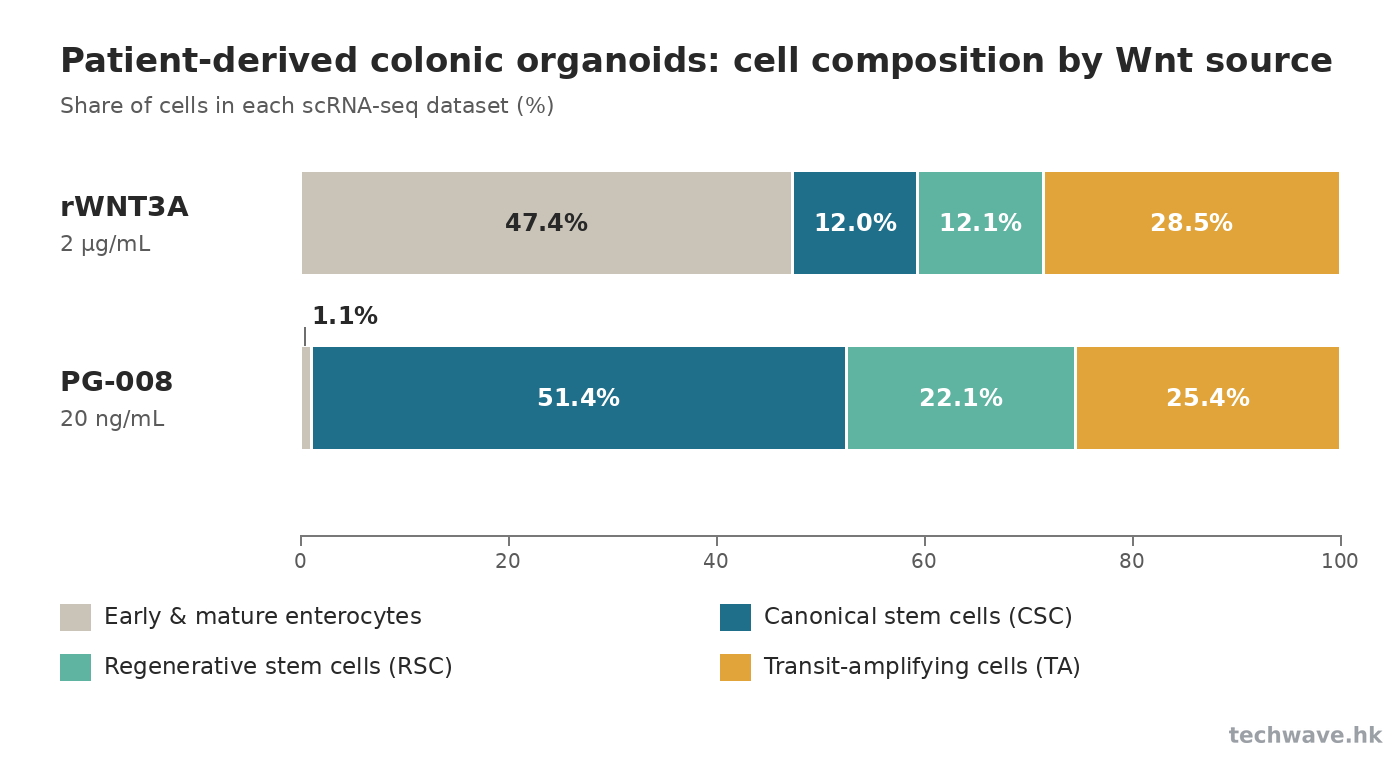
PG-008 cultures, in other words, consist almost entirely of stem cells and proliferating TA cells, and the similar TA share indicates comparable proliferative capacity. The authors suggest that PG-008 may both restrain enterocyte differentiation and promote stem-cell maintenance. When organoids were dissociated to single cells and re-formed, PG-008 cultures showed significantly higher organoid-forming capacity, in line with stem-cell enrichment being the source of their higher, steadier expansion.
RNA velocity analysis added the trajectories. Both datasets rooted at TA cells. With rWNT3A, TA3 cells either differentiated into early enterocytes or dedifferentiated into CSCs; with PG-008, TA3 cells only dedifferentiated into CSCs and RSCs. The two stem-cell populations stayed largely independent with rWNT3A, whereas PG-008 cultures showed a clear trajectory from CSCs to RSCs.
The RSCs deserve attention in their own right. They are enriched in YAP-activated and injury-associated gene signatures, and immunostaining found cells with nuclear YAP and ANXA1+ cells in both conditions; YAP inhibition with Verteporfin was lethal to these organoids, while YAP activation with a LATS inhibitor raised the RSC marker ANXA3 and lowered LGR5. The authors conclude that Type-I collagen culture alone is sufficient to induce RSCs in human colonic organoids, without extrinsic modulators. Along the CSC-to-RSC transition they also identified genes such as HBEGF, RGCC and FOSB, previously reported to rise during intestinal injury, which makes these PG-008 organoids a human model for studying how regenerative stem cells are induced after injury.
Scaling up output: area-based passaging and one-well plates
- Cell number from organoid area: because collagen organoids are cystic, the team measured organoid area with a high-speed imaging scanner and found a significant correlation with cell count (R² = 0.91, p < 0.0001); area also tracked the split ratios chosen by two experienced technicians. When area set the timing and ratio of passages, organoid area and cell count stayed within a stable window over several cycles, with no progressive overcrowding or thinning. The result is a non-destructive, time- and labour-saving way to estimate cell numbers, and a split ratio that can be standardized across operators and facilities.
- One-well plate culture: large-scale culture conventionally uses 6-well plates at roughly 300 µL of matrix per well. In a one-well plate, the team seeded a 6 × 10 cm patch of 7.5 mL collagen cell suspension, 4.17-fold the culturable collagen volume of a 6-well plate. After one week, one-well plates consistently yielded 5.14 ± 0.16 times the cells of paired 6-well plates, above the 4.17-fold expected from volume, and allow up to 2E7 cells per plate.
One step further: four synthetic peptides and a nearly protein-free medium
The team then replaced HGF, Noggin and EGF with PG-001, PG-004 and PG-009 respectively and compared this with replacing rWNT3A alone. Both conditions established organoids from patient crypts and kept them viable and expandable over several passages, with a cell expansion rate similar to PG-008 culture. Peptide-based colonic organoid culture is therefore feasible, and the earlier gain in efficiency comes mainly from PG-008.
That leaves a medium that is almost protein-free apart from R-spondin 1. The authors suggest that PDPS (Peptide Discovery Platform System), the proprietary screening system behind PG-008, could deliver peptide alternatives to R-spondin 1 and other growth factors, further reducing reliance on recombinant proteins, and that peptide- and small-molecule-based culture could cut costs significantly across the organoid field, which is vital for making organoid-based therapy more accessible.
Where it fits and how to choose
- Who it suits: teams that establish and expand patient-derived intestinal organoids at scale and want clinical-grade cells for future transplantation or bioengineering; organoid platforms that want to escape the solubility problems of rWNT3A and narrow batch-to-batch and patient-to-patient variation.
- Be clear on GMP grade: the PG-008 used in the paper was not GMP grade; it can be manufactured in a GMP-compliant facility on request. The authors note that because PG-008 is made by chemical synthesis, a GMP-grade product would be structurally and functionally identical to the one used in the study. The study produced the clinical-grade organoids themselves; it did not test transplantation or clinical efficacy.
- Stem-cell enrichment cuts both ways: PG-008 cultures have almost no differentiated cells, which suits the expansion stage; endpoints that need mature absorptive or secretory cells call for withdrawing the Wnt agonist and inducing differentiation.
- Starting doses: the replacement concentrations in this study were PG-008 20 ng/mL (for rWNT3A 2 µg/mL), PG-001 10 ng/mL, PG-004 25 ng/mL and PG-009 100 ng/mL; when moving to organoids from other tissues, use these as the starting point for a concentration series in your own system.
Build a peptide-based organoid medium with TechWave
Setting up a patient-derived organoid platform, or looking to replace rWNT3A, HGF, Noggin and EGF with chemically synthesized components? TechWave can provide product information and concentration-design advice for PeptiGrowth synthetic peptides including PG-008, PG-001, PG-004 and PG-009, and help you plan the path from research grade to GMP grade. Tell us your organoid type and culture scale and we will take it from there.
References
- Sugihara HY, Nagata S, Kawasaki S, et al. Peptide-based Wnt signal activation enables scalable production of clinical-grade patient-derived intestinal organoids for regenerative cell therapy. Stem Cell Res Ther. 2026;17:177. doi:10.1186/s13287-026-04995-6
Uses and applicable scenarios
- Establishing and expanding patient-derived intestinal (colonic) organoids at scale
- Designing clinical-grade organoid culture systems for regenerative medicine, transplantation or bioengineering
- Replacing recombinant WNT3A, HGF, Noggin and EGF with chemically synthesized components to cut reliance on recombinant proteins
- Human in vitro models of the relationship between canonical intestinal stem cells and injury-induced regenerative stem cells
Limitations
- The PG-008 used in the study was not GMP grade; it can be manufactured in a GMP-compliant facility on request
- The study produced clinical-grade organoids intended for future transplantation; it did not test transplantation or clinical efficacy
- PG-008 cultures contain very few differentiated cells, so experiments that need mature epithelial cells require a separate differentiation step
- The four-peptide combination expanded at a rate similar to PG-008 alone, and the medium still needs recombinant R-spondin 1