
Products
PG-001 HGF Alternative Peptide (c-Met Agonist)
PG-001: a fully chemically synthesized HGF alternative peptide that dimerizes and activates c-Met. Activity matches recombinant HGF per molecule at about 1/16 of the mass concentration, and at least 70% of the peptide remains after 14 days in medium at 37 °C.
Product information
- Brand
- PeptiGrowth
- Catalog no.
- PG-001
- Specification
- 5 µg / 50 µg / 500 µg
Replace HGF with a small cyclic peptide: same activity per molecule, about 1/16 of the mass
Recombinant HGF is expensive, varies from lot to lot and decays quickly in medium at 37 °C, so long cultures depend on frequent medium changes. PeptiGrowth's PG-001 is a fully chemically synthesized HGF alternative peptide: it binds the c-Met receptor and induces its dimerization, triggering receptor phosphorylation and downstream signalling the way HGF does. According to the manufacturer, each PG-001 molecule is as active as recombinant HGF, while its molecular weight of about 4.7 kDa is roughly 1/16 of recombinant HGF. On a mass basis (ng/mL), PG-001 therefore reaches comparable activity at about 1/16 of the recombinant HGF concentration.
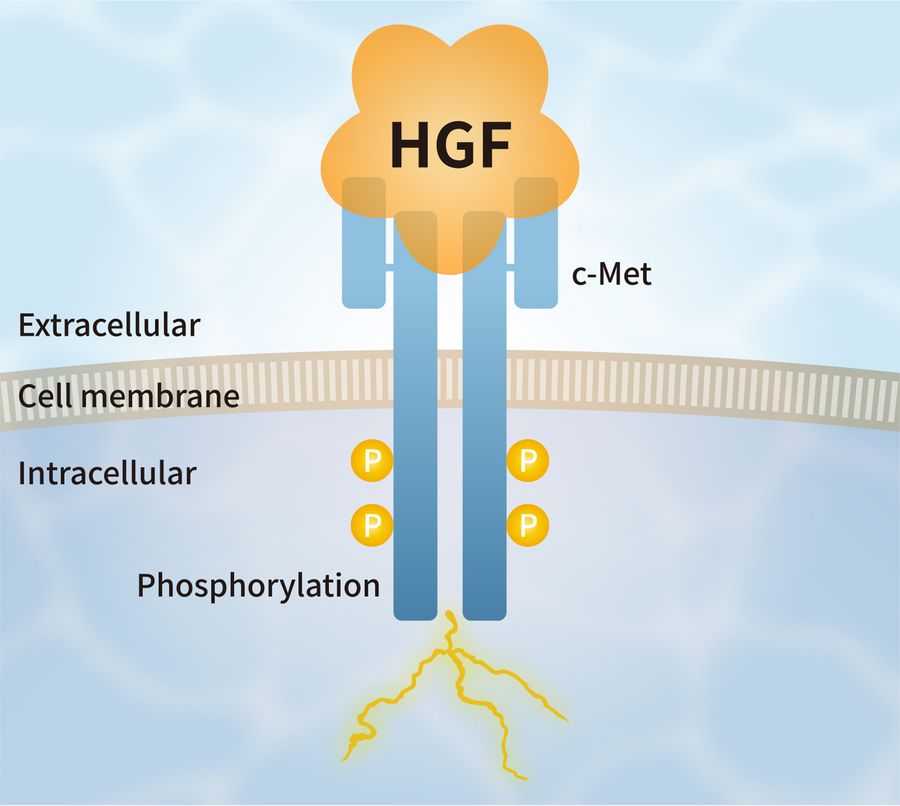
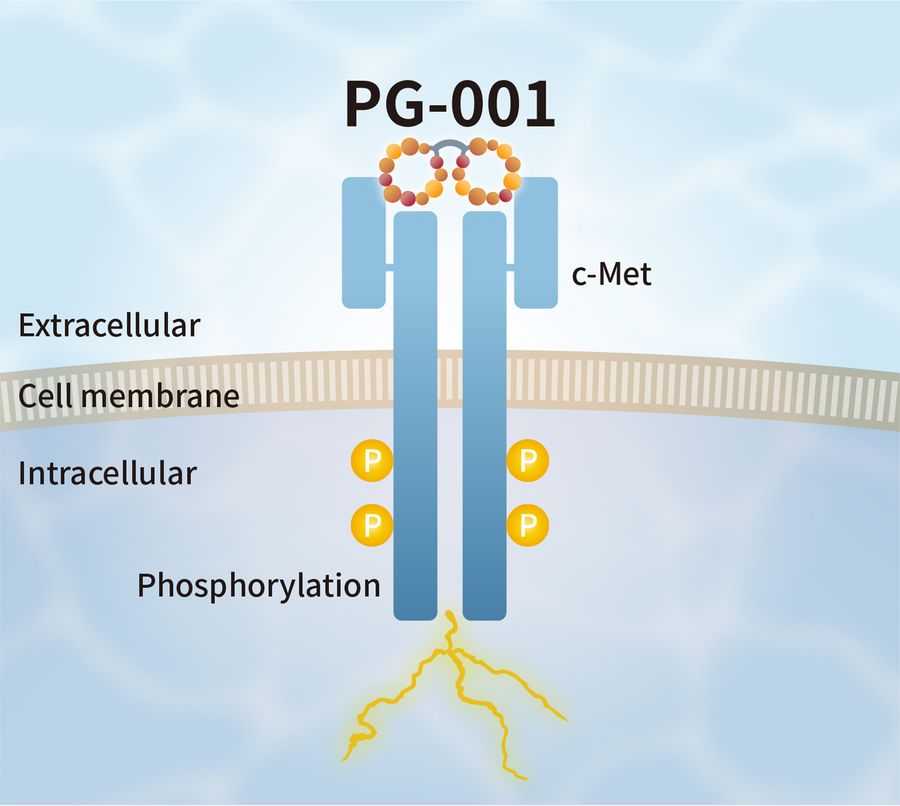
Manufacturer data: receptor phosphorylation and cell proliferation
PeptiGrowth compared PG-001 with commercially available recombinant HGF. In c-Met phosphorylation in A431 cells and in HUVEC proliferation, PG-001 performed at the same level per molecule as recombinant HGF. The information sheet gives an expected ED50 of 3–5 ng/mL.
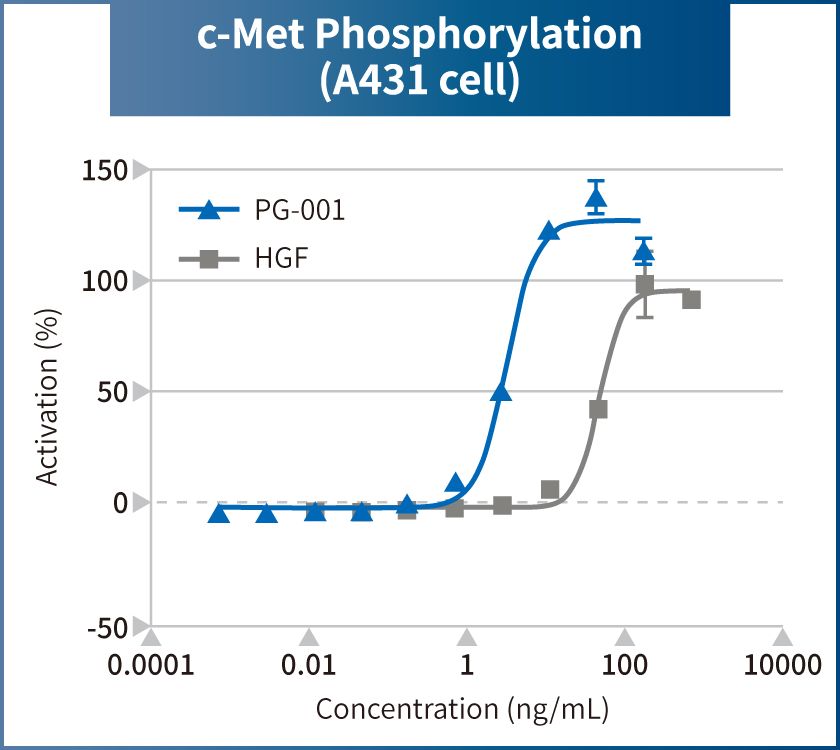
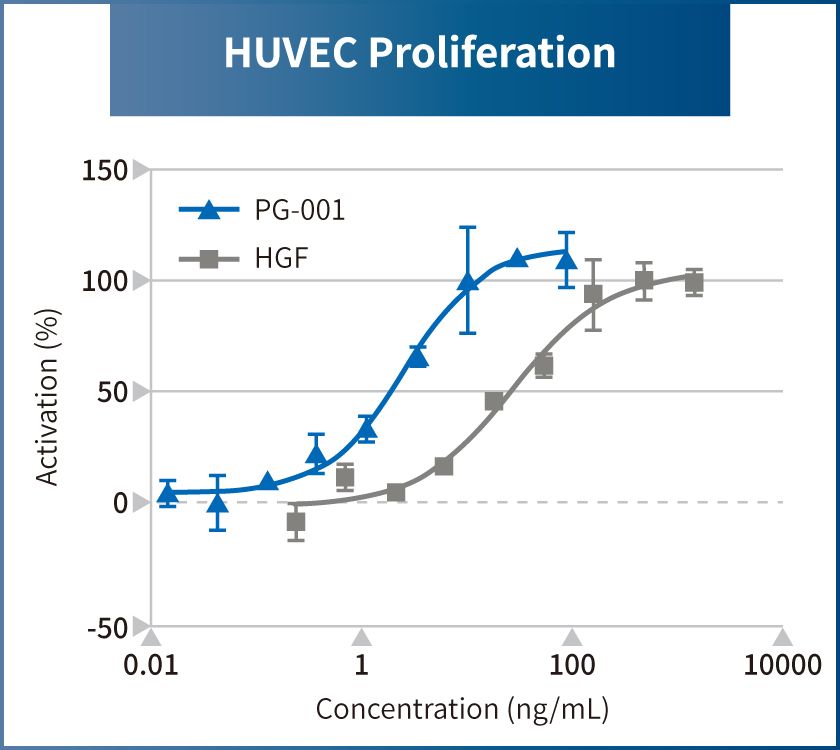
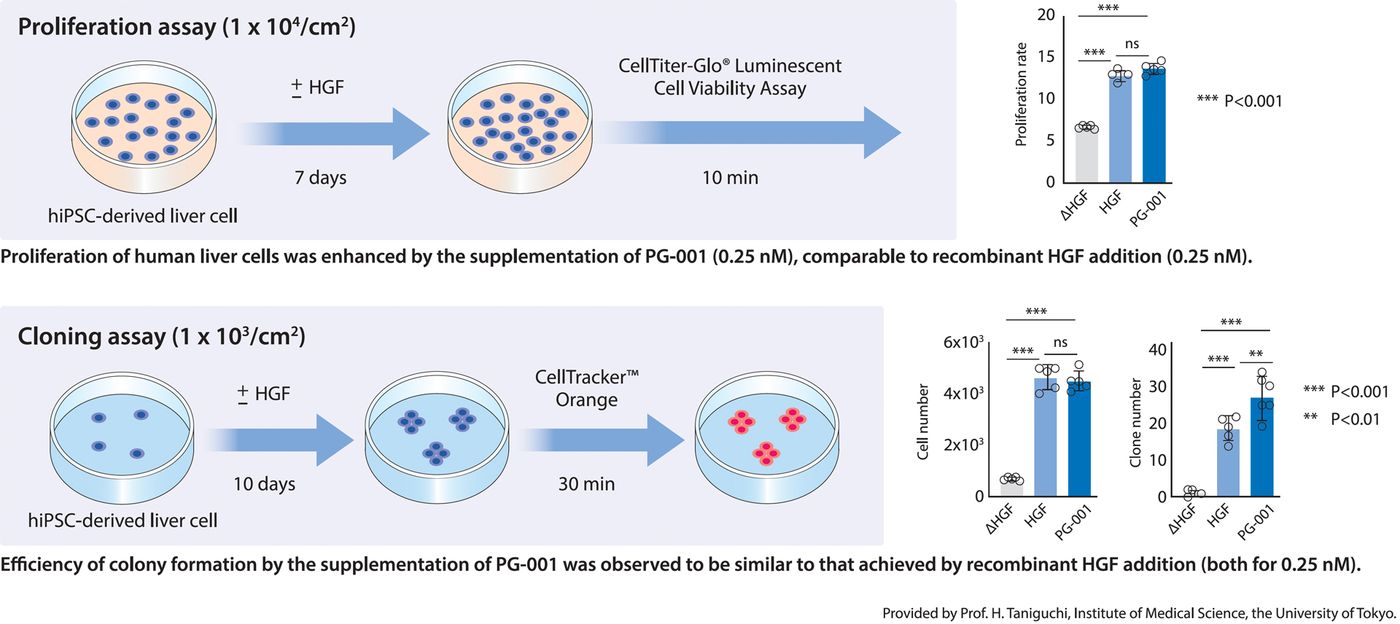
Professor Hideki Taniguchi at the Institute of Medical Science, University of Tokyo, ran proliferation and cloning tests on iPSC-derived liver cells with recombinant HGF or PG-001 and confirmed that PG-001 is as active as HGF: 0.25 nM PG-001 enhanced human liver-cell proliferation to the same extent as 0.25 nM recombinant HGF, and colony-formation efficiency was similar for the two at 0.25 nM.
Stability: at least 70% remaining after 14 days at 37 °C
The manufacturer's application note cites a report that commercially available recombinant human HGF degrades to 40% of its initial concentration within a few hours in liquid medium. PeptiGrowth added PG-001 (100 nM final) to commercially available DMEM/F-12, held it at 37 °C for 14 days and measured relative concentration by LC/MS on days 0, 1, 3, 7 and 14: at least 70% remained after 14 days (N=3). The test measures peptide concentration; whether a longer feeding interval works is decided by activity readouts in the target system.
Specifications
| Item | Details |
|---|---|
| Catalogue number | PG-001 |
| Replaces | HGF (hepatocyte growth factor) |
| Target | Human c-Met (agonist; specific to human c-Met) |
| Pack sizes | 5 µg (equivalent to rHGF 80 µg), 50 µg (equivalent to rHGF 800 µg), 500 µg (equivalent to rHGF 8 mg) |
| Formulation | Lyophilized from 0.2 µm-filtered DMSO solution |
| Purity | ≥95% (HPLC) |
| Molecular weight | 4825.39 (acetate) |
| Storage | Unopened vial at −20 °C or below |
| Grade | Research use only (RUO); the manufacturer offers GMP-grade product and bulk supply on request |
Starting concentration and reconstitution
- The manufacturer expects PG-001 to match recombinant HGF at 1/8–1/16 of its mass concentration. Start at 1/16 of rHGF and add at least two higher concentrations (for example 1/8 and 1/4) to find the optimum under your conditions.
- Reconstitute at 100–200 µg/mL in DMSO: centrifuge the vial before opening and rinse the inside thoroughly with DMSO. For example, 5 µg in 50 µL DMSO gives 100 µg/mL.
- For further dilution of the DMSO solution, use a buffered solution (such as PBS) with a carrier component to limit peptide adhesion, and use the peptide promptly after opening and reconstitution.
Where it fits
- iPSC hepatic cultures that use HGF for hepatocyte proliferation and differentiation, and other c-Met-dependent systems
- Long-term culture and process development that aim to cut growth-factor usage and lot-to-lot variation
- Gastrointestinal organoids: together with PG-004, PG-008 and PG-009, PG-001 has been used in a low-protein culture system for patient-derived colonic organoids
Looking for an HGF alternative for hepatic differentiation or organoid culture? Contact TechWave for PG-001 selection advice, concentration-design support and a quotation.