
Technical column
Wnt-C59: a PORCN inhibitor that blocks Wnt reporter signalling at 74 pM — with CHIR99021 and a rescue matrix, find out where your Wnt signal comes from
Organoids that will not expand, differentiation efficiency that swings between runs, tumour models that ignore Wnt intervention: often nobody has established whether the Wnt signal comes from exogenous ligand, the culture environment or the cells' own secretion. Wnt-C59 inhibits PORCN in the endoplasmic reticulum and cuts Wnt off at the secretion step, with a reporter IC50 of 74 pM; combined with downstream CHIR99021 and exogenous Wnt3a in a rescue matrix, it separates ligand dependence from downstream plasticity.
Definition
Wnt-C59 is a PORCN (Porcupine) inhibitor that blocks acylation and secretion of newly made Wnt ligands, testing whether a model's phenotype depends on ligand-driven Wnt signalling.
Organoids that will not expand, differentiation efficiency that is high in one run and low in the next, a tumour model that shows no response to a Wnt inhibitor: often the inhibitor is not too weak — nobody has answered a more upstream question. Does the Wnt signal in this model come from added recombinant ligand, from the medium/matrix environment, or from the cells' own autocrine and paracrine secretion?
Wnt-C59 is the tool for that question. It inhibits PORCN on the endoplasmic reticulum membrane and cuts Wnt off at the secretion step, with a reporter IC50 of 74 pM. Combined with downstream CHIR99021 and active exogenous Wnt3a, it separates "where does the Wnt signal come from" from "can the downstream still respond" in the same model.
Why start from ligand secretion
The Wnt pathway is closely tied to embryonic development, tissue homeostasis, stem-cell self-renewal, organoid culture and many tumour models. Real projects rarely ask a binary "does Wnt matter" question; they ask about the source: exogenous ligand, environment or the cells' own secretion? The answer decides which class of tool compound to use — activating β-catenin downstream or blocking ligand supply further upstream.
Mechanism: without PORCN acylation, Wnt cannot leave the cell
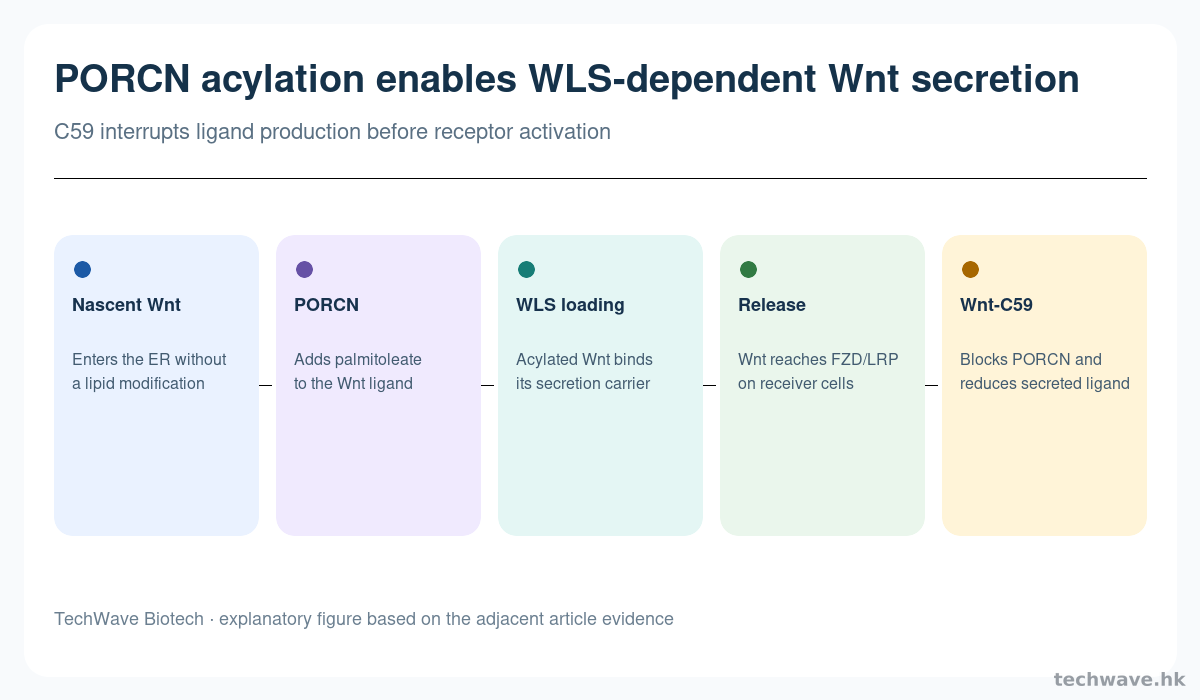
Porcupine (PORCN) is an O-acyltransferase on the endoplasmic reticulum (ER) membrane that adds a palmitoleate modification to a specific serine residue of Wnt proteins. This lipid modification is required for Wnt folding and maturation and is the prerequisite for Wnt binding the ER/Golgi chaperone Wntless/WLS (also called Evi/GPR177): only acylated Wnt can be carried by WLS to the cell surface, released and then bind Frizzled/LRP5-6 receptors to activate the pathway. For WNT3A, Coombs et al. (2010) linked Ser209 acylation, PORCN-dependent modification, WLS binding and secretion in one mechanism. In other words, Wnt secretion and activity depend almost entirely on PORCN acylation. Wnt-C59 inhibits PORCN, leaving Wnt retained in the ER and blocking downstream signalling.
The evidence should be kept apart by source:
- The 2009 chemical-genetics work by Chen et al. in Nature Chemical Biology identified IWP-class Wnt secretion inhibitors and placed Porcupine as the target; the chemical series of Wnt-C59 traces to patent WO2010101849A1. Manufacturer information gives an IC50 below 0.11 nM for Wnt-C59 in a Wnt-Luc reporter assay;
- Direct cellular and mouse pharmacology comes from Proffitt et al. (Cancer Research, 2013; PMID:23188502): at sub-nanomolar concentrations C59 blocked PORCN-mediated Wnt palmitoylation, Wnt–WLS binding, Wnt secretion and β-catenin reporter activation, with an IC50 of 74 pM (below 0.11 nM) in a WNT3A-driven reporter assay;
- In the MMTV-WNT1 mouse mammary tumour model, 10 mg/kg daily oral dosing for 17 days slowed tumour progression and reduced Wnt/β-catenin target-gene expression, with no obvious intestinal or systemic toxicity observed at that therapeutic dose.
How it differs from the IWP series and CHIR99021
PORCN inhibitors form a small family: IWP-2, IWP-3 and IWP-4 work like Wnt-C59, blocking Wnt secretion by inhibiting PORCN. According to Cellagen Technology, the manufacturer of Wnt-C59, Wnt-C59 offers higher potency, better selectivity and better chemical/physical properties than the IWP series, making it more suitable for in-vitro and in-vivo research.
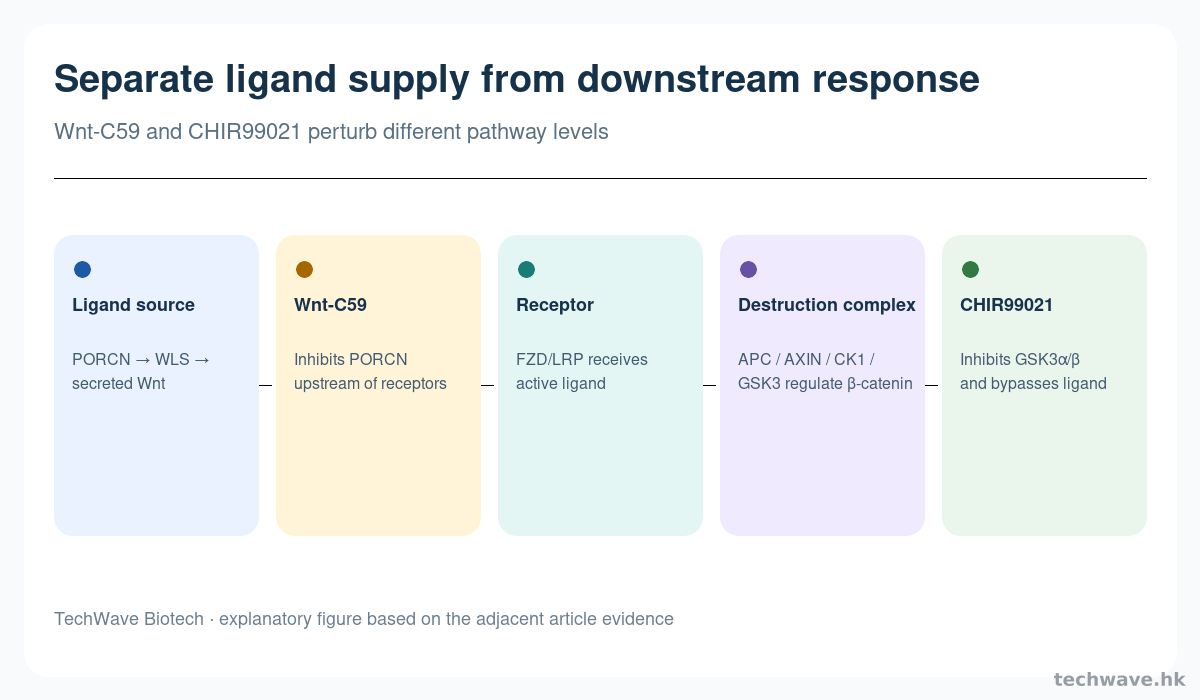
In the Wnt toolkit, the most common downstream control is CHIR99021, which inhibits GSK3α/β and stabilizes β-catenin downstream of the destruction complex. Ring et al. measured in-vitro IC50 values of about 6.7 nM for GSK3β and 10 nM for GSK3α, but that study concerned GSK3 inhibition and glucose metabolism, not a fixed dose transferable to Wnt-directed differentiation.
- Wnt-C59 (upstream): blocks Wnt ligand production and affects only ligand-dependent Wnt signalling (autocrine, paracrine or exogenous); no direct effect on pathways driven by downstream β-catenin mutations;
- CHIR99021 (downstream): bypasses the ligand step to stabilize β-catenin directly and also touches other GSK3 substrates; it still acts on ligand-independent Wnt output such as APC loss or activating β-catenin mutations.
Wnt-C59 is not a "stronger Wnt inhibitor"; it targets a more upstream, mechanistically more specific node. Used together, the two separate "where the Wnt signal comes from" and "how plastic the downstream is" in one model.
The rescue matrix: four arms to locate ligand dependence
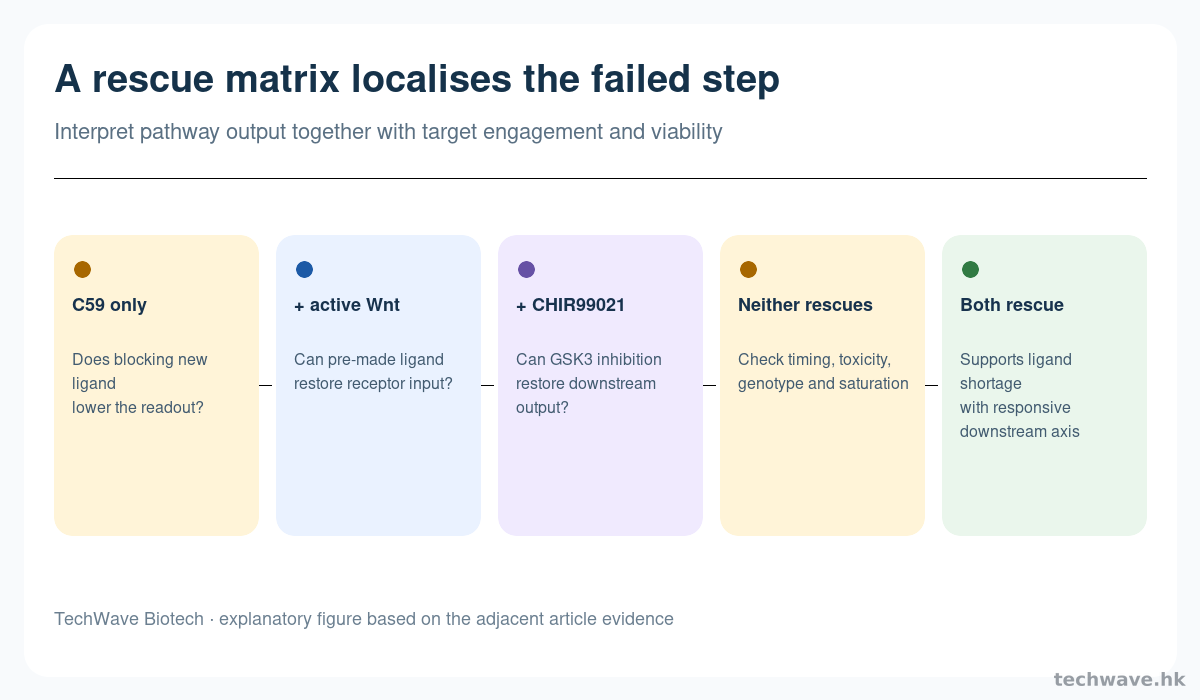
The most informative design does not just compare vehicle with Wnt-C59; it runs baseline, Wnt-C59, Wnt-C59 plus exogenous Wnt3a added after treatment, and Wnt-C59 plus CHIR99021 in parallel. Active Wnt3a or conditioned medium prepared in advance and added to receiver cells bypasses the secretion block in those cells; Wnt3a expressed by the same C59-treated producer cells still requires PORCN and is not a genuine downstream rescue.
- Wnt-C59 lowers the readout and both active Wnt3a and CHIR99021 restore it: supports insufficient ligand supply with a responsive receptor-to-β-catenin axis;
- Only CHIR99021 restores it: check exogenous Wnt activity, the Frizzled/LRP receptor layer, secretion problems beyond WLS/PORCN and medium inactivation;
- Neither restores it: downstream responsiveness may be impaired, the window may be wrong, the readout saturated or the toxicity non-Wnt — one negative result cannot declare the model "Wnt-independent";
- Wnt-C59 has no effect but CHIR99021 raises the readout: baseline ligand input is low but downstream can still be activated; also confirm that PORCN inhibition actually reached its target.
Three main applications
Organoids: is the system driven by Wnt ligand?
In intestinal, liver, pancreatic, kidney and other organoid systems, Wnt signalling often works with R-spondin, EGF, Noggin and other factors to form the niche that maintains stem-cell proliferation and lineage identity. Dependence on Wnt varies: some systems rely heavily on exogenous Wnt3a and R-spondin, others may be sustained by Wnt ligand from the cells themselves or the matrix. Adding Wnt-C59 and observing how organoid-forming efficiency, morphology, proliferation, lineage markers and Wnt targets such as AXIN2 change once ligand processing and secretion are blocked shows whether the system depends on ligand-driven Wnt — which answers "where does the signal come from" better than downstream β-catenin output alone.
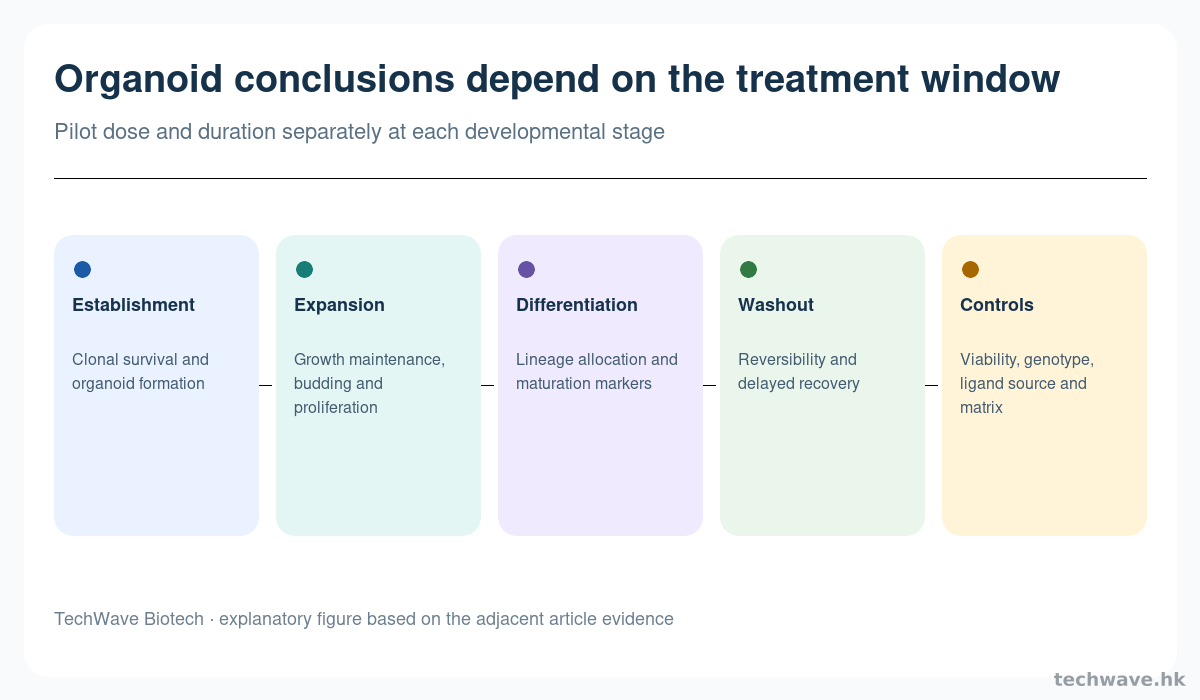
Wnt requirements in organoids change with tissue, genotype, matrix, accompanying stromal cells and culture stage. Treatment during establishment tests whether colony formation depends on ligand, during expansion tests growth maintenance, and a short pulse during differentiation tests a lineage transition. R-spondin potentiates receptor-level signalling but is not a Wnt ligand and cannot simply replace Wnt when effective Wnt input is absent. Systems containing exogenous Wnt3a, feeder cells or stromal cells must also document where Wnt comes from and whether those producer cells are also exposed to C59.
Tumour models: testing ligand dependence
Wnt plays different roles in different tumours: some depend on ligand-driven paracrine/autocrine Wnt, while others carry downstream CTNNB1, APC or AXIN mutations and are insensitive to upstream PORCN inhibition. The work of Proffitt et al. in mammary tumour models suggests that Wnt-C59 is suited to testing the specific question "does this model depend on Wnt ligand secretion?", not to general anti-tumour conclusions. In vitro, Wnt3a conditioned-medium add-back can confirm whether a phenotype is really caused by ligand loss.
Stem-cell differentiation: hit the timing window
In many directed-differentiation protocols Wnt signalling has a clear timing effect: some stages need activation (such as early lineage decisions) and others inhibition (such as maintaining maturation). Combined with small molecules such as CHIR99021 and SB431542, Wnt-C59 lets Wnt input be tuned precisely at each stage, giving differentiation systems a complete upstream–downstream intervention set.
Experiment design essentials
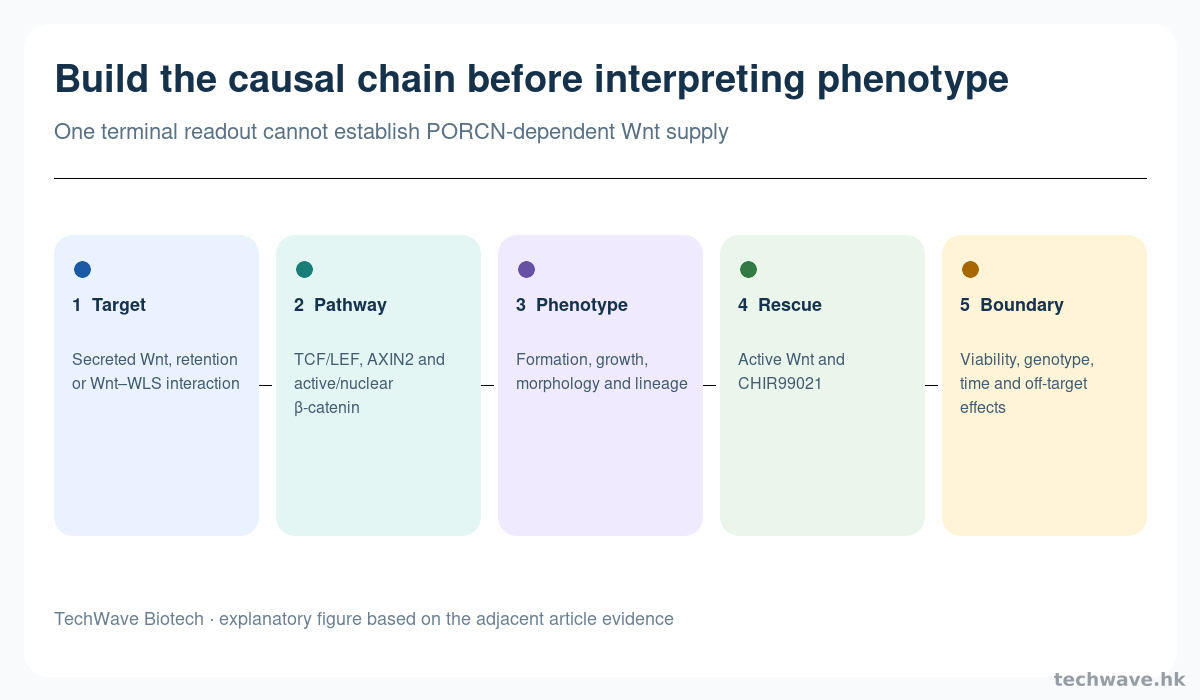
Answer four questions before starting:
- Does the model have autocrine or paracrine Wnt signalling? Is Wnt3a or R-spondin added to the medium? This decides whether Wnt-C59 treatment can produce an observable phenotype;
- Does the treatment cover the key window? Organoid formation, tumour-sphere maintenance and differentiation stages all affect results, so run a time–dose pilot first;
- What are the downstream readouts? Combine AXIN2 and other target-gene qPCR, β-catenin immunofluorescence/subcellular localization, a TopFlash reporter and functional phenotypes (proliferation, morphology, lineage markers) rather than drawing conclusions from one indicator; where possible also measure Wnt in conditioned medium, intracellular Wnt retention or Wnt–WLS interaction to confirm target engagement;
- Are positive and negative controls in place? CHIR99021 (downstream activation control) and recombinant Wnt3a (ligand add-back control) effectively distinguish "no Wnt input" from "no Wnt output".
On dose, do not derive organoid concentrations from the 74 pM reporter IC50: 3D diffusion, protein binding, matrix adsorption, medium changes and cell composition all change effective exposure. Use a dose–time matrix recording viability, organoid-forming rate, size and morphology, EdU/Ki-67, lineage markers and Wnt targets, and check reversibility after withdrawal; interpret cell death, metabolic activity and non-specific growth inhibition separately from Wnt pathway readouts.
Reagent handling: Wnt-C59 is a research-use small molecule. Watch the final DMSO concentration (≤0.1% recommended and equal across all groups), stock freeze–thaw cycles, storage (powder dry at 4 °C; DMSO stock aliquoted at -20 °C) and cytotoxicity. Cellagen Wnt-C59 comes in two formats:
| Catalogue no. | Format | Better suited to |
|---|---|---|
| C7641-2 | 2 mg powder | Labs that control stock over the long term or run batch experiments |
| C7641-2s | 2 mg as 10 mM DMSO ready-made solution | Confirmatory experiments that want direct dosing and a quick concentration series |
Suitable concentrations, combinations and readouts still need pilot optimization for the specific cell source, culture system and endpoint: Wnt-C59 is a research tool for locating the signal source, not a fixed protocol.
Let TechWave help you complete your Wnt pathway toolkit
If you are testing the Wnt dependence of organoid or tumour models, or need an upstream and downstream small-molecule combination for a differentiation protocol, contact TechWave. We can provide selection advice, specifications and quotations for Cellagen Wnt-C59 (C7641-2, C7641-2s) and complementary small molecules such as CHIR99021.
References
- Chen B, Dodge ME, Tang W, et al. Small molecule-mediated disruption of Wnt-dependent signaling in tissue regeneration and cancer. Nature Chemical Biology. 2009;5:100–107. doi:10.1038/nchembio.137
- Coombs GS, Yu J, Canning CA, et al. WLS-dependent secretion of WNT3A requires Ser209 acylation and vacuolar acidification. Journal of Cell Science. 2010;123:3357–3367. doi:10.1242/jcs.072132
- Proffitt KD, Madan B, Ke Z, et al. Pharmacological inhibition of the Wnt acyltransferase PORCN prevents growth of WNT-driven mammary cancer. Cancer Research. 2013;73:502–507. doi:10.1158/0008-5472.CAN-12-2258
- Ring DB, Johnson KW, Henriksen EJ, et al. Selective glycogen synthase kinase 3 inhibitors potentiate insulin activation of glucose transport and utilization in vitro and in vivo. Diabetes. 2003;52:588–595. doi:10.2337/diabetes.52.3.588
- Cheng D, Zhang G, Han D, et al. N-(hetero)aryl, 2-(hetero)aryl-substituted acetamides for use as Wnt signaling modulators. WO2010101849A1. 2010.
Uses and applicable scenarios
- Determining whether an organoid system depends on ligand-driven Wnt signalling
- Testing the Wnt ligand-secretion dependence of tumour models
- Timing Wnt input during directed stem-cell differentiation
- Combining with CHIR99021 and exogenous Wnt3a to separate signal source from downstream output
Limitations
- A reporter IC50 cannot be used directly as the working concentration for organoids, primary cells or in-vivo work
- It has no direct effect on constitutive β-catenin output caused by downstream APC, AXIN or CTNNB1 mutations, and short-term mouse tolerability cannot be extrapolated to long-term or clinical safety