
Products
PG-008 Wnt3a Alternative Peptide (β-catenin Pathway Agonist)
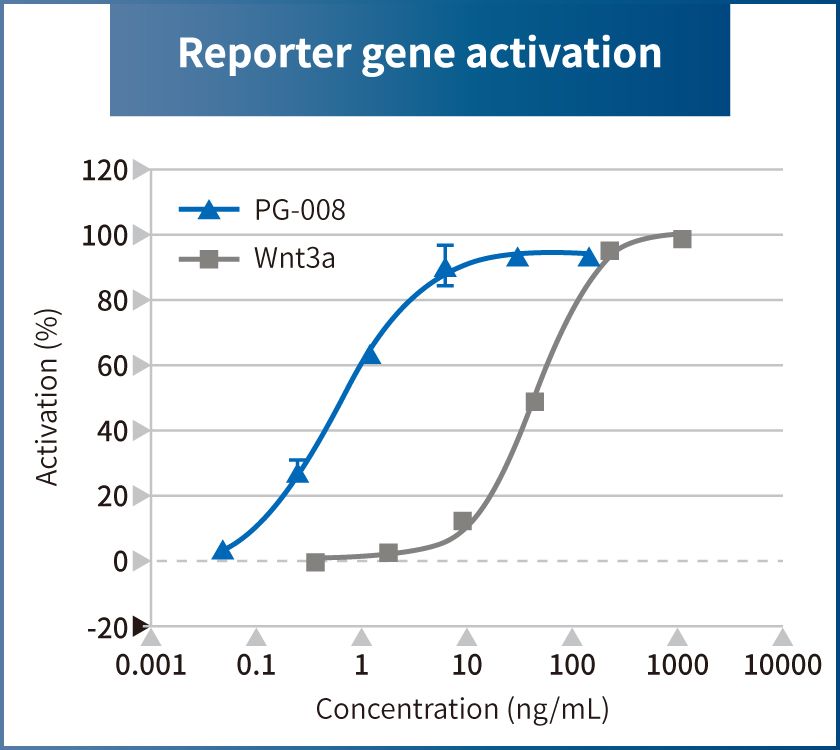
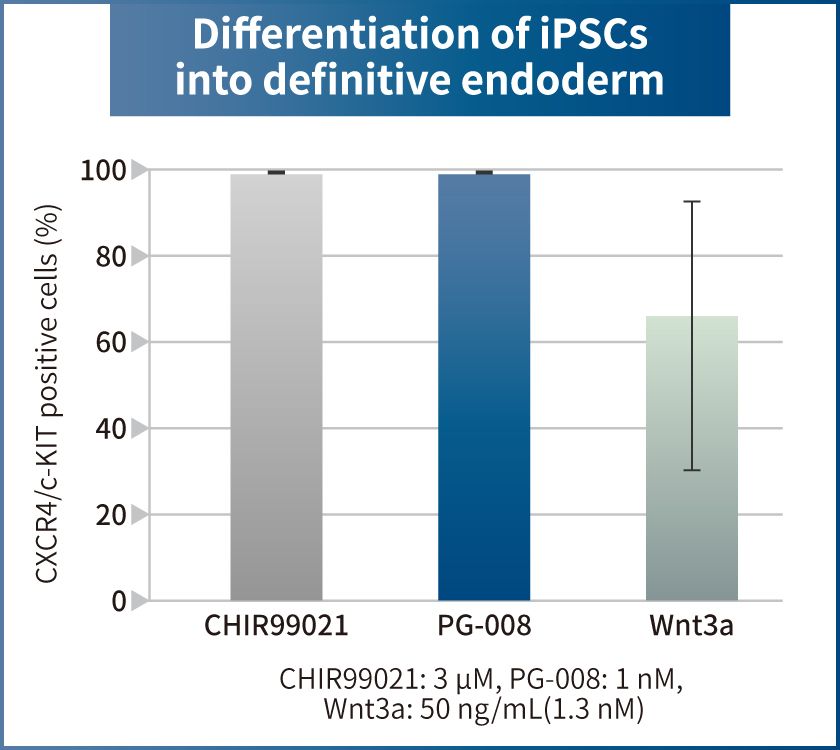
PG-008: a heterodimer of two cyclic peptides that bind Frizzled and LRP5/6 and activate canonical Wnt/β-catenin signalling. It activates a reporter more strongly than recombinant Wnt3a at lower concentrations, 1 nM matches 3 µM CHIR99021 in definitive-endoderm induction, and at least 80% remains after 14 days in medium at 37 °C.
Product information
- Brand
- PeptiGrowth
- Catalog no.
- PG-008
- Specification
- 10 µg / 100 µg / 1 mg
Wnt signalling that survives dilution: a synthetic peptide in place of recombinant Wnt3a
Wnt proteins are lipidated and highly hydrophobic, so they can only be isolated in solutions containing detergents. Even then, purified Wnt is structurally unstable and tends to lose its activity within 24 hours under standard culture conditions at 37 °C, which forces frequent medium changes in long cultures. PeptiGrowth's PG-008 takes a different route: it is a heterodimer of two cyclic peptides, one binding Frizzled and the other LRP5/6, that brings the two Wnt co-receptors together and activates the β-catenin pathway of Wnt signalling the way Wnt3a does. The whole molecule is made by chemical synthesis, without animal-derived components.
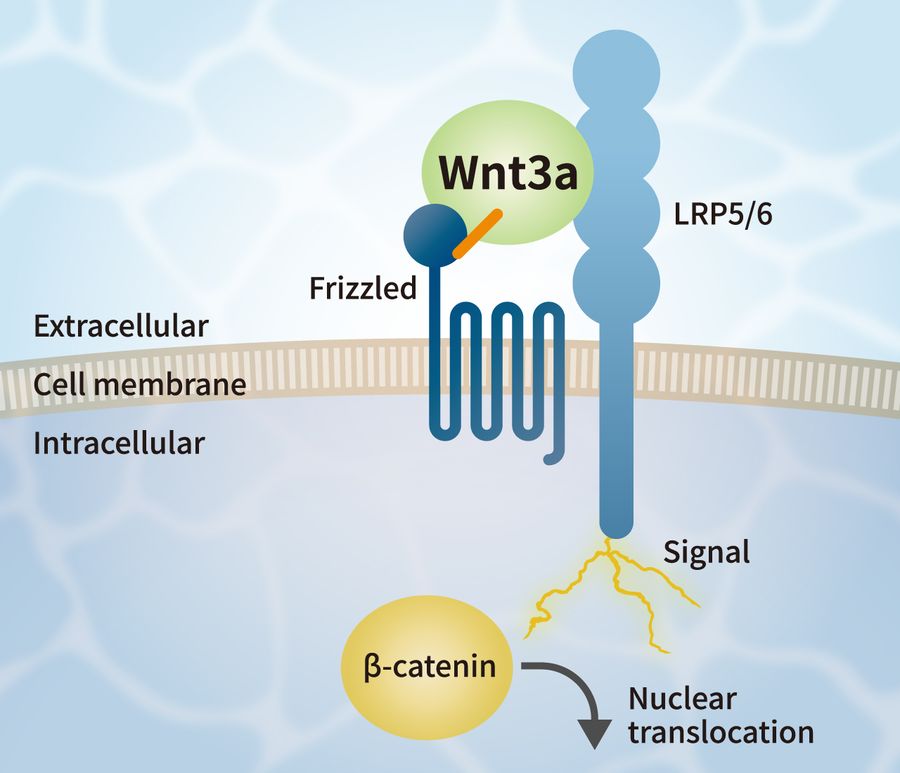
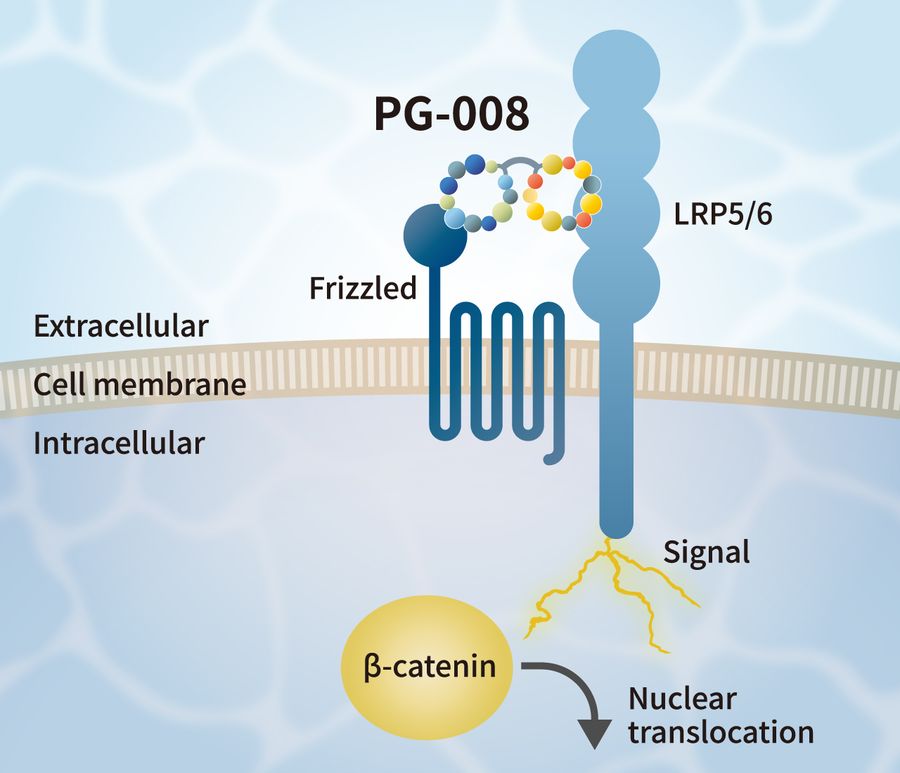
Manufacturer data: stronger agonism than recombinant Wnt3a
In a TCF-LEF reporter (luciferase) assay in HEK293 cells, PG-008 activated the reporter more strongly at lower concentrations, outperforming recombinant Wnt3a as an agonist. The information sheet gives an expected ED50 of about 0.3 ng/mL.
In differentiation of iPSCs into definitive endoderm, the manufacturer compared CHIR99021, recombinant Wnt3a and PG-008. Recombinant Wnt3a (50 ng/mL, about 1.3 nM) reached an efficiency of around 60%, while PG-008 and CHIR99021 both exceeded 98%. Notably, 1 nM PG-008 matched the induction efficiency of 3 µM CHIR99021, at a far lower concentration.
Stability: at least 80% remaining after 14 days at 37 °C
PeptiGrowth added PG-008 (100 nM final) to commercially available DMEM/F-12, held it at 37 °C for 14 days and measured relative concentration by LC/MS on days 0, 1, 3, 7 and 14: at least 80% remained after 14 days (N=3). The test measures peptide concentration, not biological activity; before extending feeding intervals in your own system, rely on activity readouts.
Published application: patient-derived colonic organoids
In the colonic organoid culture method published by Institute of Science Tokyo in Stem Cell Research & Therapy (2026), 20 ng/mL PG-008 replaced recombinant WNT3A, and PG-001, PG-004 and PG-009 replaced HGF, Noggin and EGF. The PG-008 used in the paper was not GMP grade; it can be manufactured in a GMP-compliant facility on request. In a separate PeptiGrowth application note, PG-007, PG-008 and PG-010 replaced VEGF, CHIR99021 and TPO to differentiate iPSCs into NKT cells through hematopoietic stem and progenitor cells (HSPCs) (see the PG-010 page).
Specifications
| Item | Details |
|---|---|
| Catalogue number | PG-008 |
| Replaces | Wnt3a |
| Target | Frizzled and LRP5/6 (β-catenin pathway agonist) |
| Pack sizes | 10 µg (equivalent to rWnt3a 500 µg), 100 µg (equivalent to rWnt3a 5 mg), 1 mg (equivalent to rWnt3a 50 mg) |
| Formulation | Lyophilized from 0.2 µm-filtered DMSO solution |
| Purity | ≥95% (HPLC) |
| Molecular weight | 5099.63 (acetate) |
| Storage | Unopened vial at −20 °C or below |
| Grade | Research use only (RUO); the manufacturer offers GMP-grade product and bulk supply on request |
Starting concentration and reconstitution
- The manufacturer expects PG-008 to match recombinant Wnt3a at 1/50–1/100 of its mass concentration. Start at 1/100 of rWnt3a and add at least two higher concentrations, such as 1/50 and 1/25.
- Without a reference rWnt3a concentration, test first within 1–10 ng/mL and, if feasible, also at 0.1 ng/mL and 50 ng/mL.
- Reconstitute at 100–200 µg/mL in DMSO: centrifuge the vial before opening and rinse the inside thoroughly with DMSO. For example, 10 µg in 100 µL DMSO gives 100 µg/mL. For further dilution use a buffered solution (such as PBS) with a carrier component, and use the peptide promptly after opening and reconstitution.
Where it fits
- Intestinal and other Wnt-dependent organoid cultures, especially where recombinant Wnt3a is to be replaced by chemically synthesized components
- Definitive-endoderm induction from iPSCs: a route that activates Wnt at the extracellular receptors, alongside CHIR99021
- Studies comparing extracellular Wnt-receptor agonism with intracellular GSK3 inhibition as ways to activate Wnt
Replacing Wnt3a in an organoid or differentiation protocol? Contact TechWave for concentration-design support, matching PG product combinations and a quotation.