
Products
StemFit Purotein™ VEGF
Recombinant human VEGF165, animal-origin-free and frozen in citric acid/GSSG, with VEGFR2/NFAT reporter activity comparisons.
Product information
- Brand
- Ajinomoto StemFit
- Catalog no.
- SP-VEGF-R-010UG / SP-VEGF-R-050UG / SP-VEGF-R-001MG
- Specification
- 0.1 mg/mL; 10 µg / 50 µg / 1 mg
VEGF165 for angiogenesis research
Vascular endothelial growth factor (VEGF) signals to neighbouring cells during new-vessel formation. It also contributes to vascular permeability, wound healing and embryonic development, and is implicated in cancer, diabetic retinopathy and cardiovascular disease. This VEGF165 product is a 38.2 kDa disulfide-linked homodimer comprising 2 chains of 165 amino-acid residues.
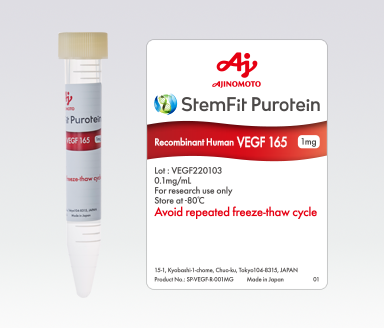
Pack sizes and grade selection
| Catalogue number | Protein amount | Volume | Concentration | Grade |
|---|---|---|---|---|
| SP-VEGF-R-010UG | 10 µg | 100 µL | 0.1 mg/mL | Research |
| SP-VEGF-R-050UG | 50 µg | 500 µL | 0.1 mg/mL | Research |
| SP-VEGF-R-001MG | 1 mg | 10 mL | 0.1 mg/mL | Research |
The GMP-compliant product is in preparation. The listed packs are for research use only.
The frozen-liquid presentation eliminates a lyophilized-protein reconstitution step. Ajinomoto positions the range for lower cell-manufacturing costs and a more continuous path from research into process development. These are product-format and development benefits, rather than a price quotation or a clinical indication.
Production platform and consistency
Corynebacterium glutamicum is a rapidly growing, non-spore-forming, Gram-positive soil bacterium first identified as a glutamate producer in 1957. It is described as non-pathogenic and non-endotoxic. Ajinomoto applies its food amino-acid manufacturing experience and a secretion-based system to reduce derivative impurities and support economical, high-grade protein supply with consistent lots. The finished-protein endotoxin limit is specified separately in the product table.
Formulation and comparative quality
VEGF165 is animal-origin-free and supplied frozen in 20 mM citric acid containing 20 mM oxidized glutathione (GSSG). Its activity specification uses a VEGFR2/NFAT reporter assay. Comparator ED50 ranges use HUVEC proliferation, so those numerical ranges describe different readouts.
| Specification comparison | AJINOMOTO | Company A | Company B |
|---|---|---|---|
| Host | C. glutamicum | E. coli | S. frugiperda |
| Endotoxin (LAL) | <0.1 EU/µg | <1 EU/µg | <0.01 EU/µg |
| Purity | ≥95% (SDS-PAGE) | ≥98% (SDS-PAGE, HPLC) | >97% (SDS-PAGE) |
| Activity | EC50 1–30 ng/mL | ED50 1.0–8.0 ng/mL | ED50 ≤1–6 ng/mL |
| Form | Frozen; 20 mM citric acid, 20 mM GSSG | Lyophilized | Lyophilized |
| N-terminus | Ala-Pro-Met | Not stated | Ala |
| Expiry | 2 years from manufacture | Not stated | 12 months from receipt |
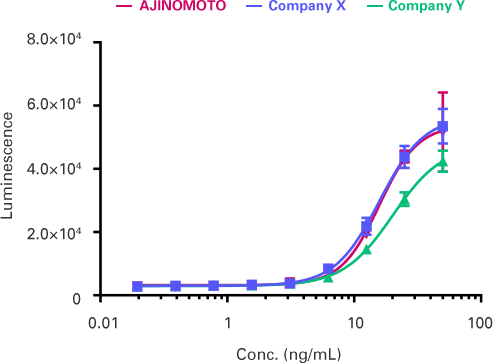
The VEGFR2/NFAT comparison graph evaluates Ajinomoto, Company X and Company Y using a common reporter readout. The dose-response curves support comparable biological activity in that experiment; the graph does not define new release limits.
Storage and stability
Store at −80 °C and avoid repeated freeze–thaw cycles. The April 2023 stability comparison gives Ajinomoto 2 years from manufacture at −80 °C, Company A 1 year after reconstitution at −80 °C, and Company B 3 months after reconstitution at −20 to −70 °C. Ajinomoto also reports up to 3 freeze–thaw cycles, expressly without a product-quality guarantee for that condition. Comparator cycle limits are not stated.
Amino-acid sequence
APMAEGGGQN HHEVVKFMDV YQRSYCHPIE TLVDIFQEYP DEIEYIFKPS CVPLMRCGGC CNDEGLECVP TEESNITMQI MRIKPHQGQH IGEMSFLQHN KCECRPKKDR ARQENPCGPC SERRKHLFVQ DPQTCKCSCK NTDSRCKARQ LELNERTCRC DKPRR
Product documents
- Lot-to-lot consistency data
- Frozen-liquid handling guide: no reconstitution
- Product information — 1 mg
- Product information — 10 µg
- Product information — 50 µg
- Safety data sheet — English
- Safety data sheet — Japanese