
Products
StemFit™ For Mesenchymal Stem Cell
Defined MSC medium for bone marrow, umbilical cord and adipose-derived cells, without serum or human platelet lysate; 500 mL frozen presentation.
Product information
- Brand
- Ajinomoto StemFit
- Catalog no.
- StemFit™ For Mesenchymal Stem Cell
- Specification
- 500 mL
Defined culture for mesenchymal stem cells
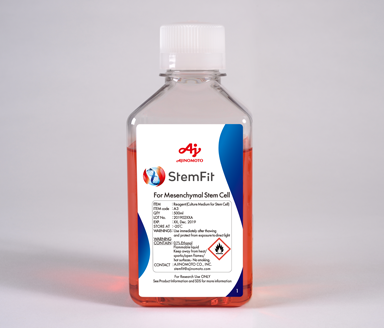
StemFit™ For Mesenchymal Stem Cell (StemFit™ For MSC) supports human bone marrow-derived MSCs (BM-MSC), umbilical cord-derived MSCs (UC-MSC) and adipose-derived stem cells (ADSC). Its catalogue identifier is StemFit™ For Mesenchymal Stem Cell. The defined formulation contains no serum, human platelet lysate or other ingredients of unknown composition. Here, “defined” means that every component and its concentration are known; it does not mean animal-origin-free.
Formulation, consistency and intended applications
| Item | Specification |
|---|---|
| Catalogue identifier | StemFit™ For Mesenchymal Stem Cell |
| Volume | 500 mL |
| Frozen storage | −20 °C |
| Serum / human platelet lysate | Not included |
| ECM | Not included |
Known composition reduces the lot variation associated with serum or lysates. StemFit For MSC is designed in accordance with the BSE/TSE guideline EMEA/410/01 Rev.3. Animal- and human-derived components undergo inactivation to minimize associated risks; the product is not presented as AOF. The manufacturer describes GMP medium as in preparation, rather than an available GMP version.
Expansion, phenotype and differentiation evidence
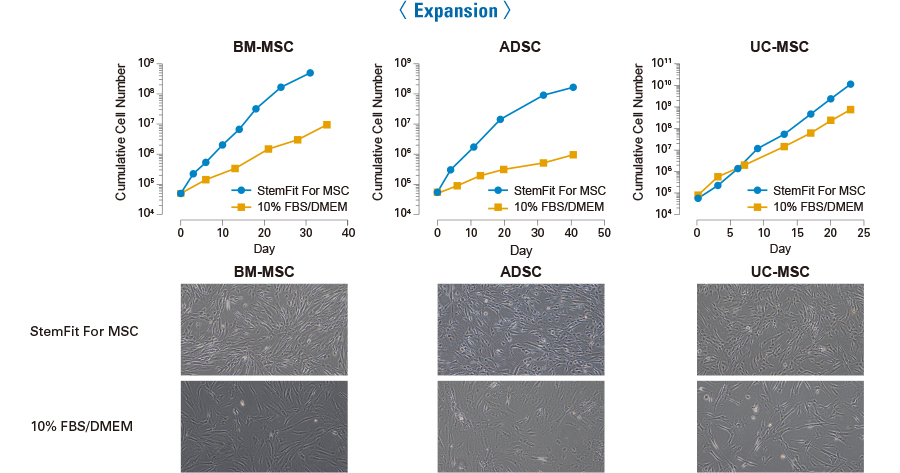
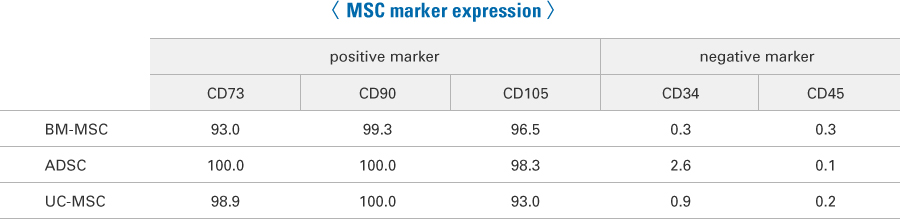
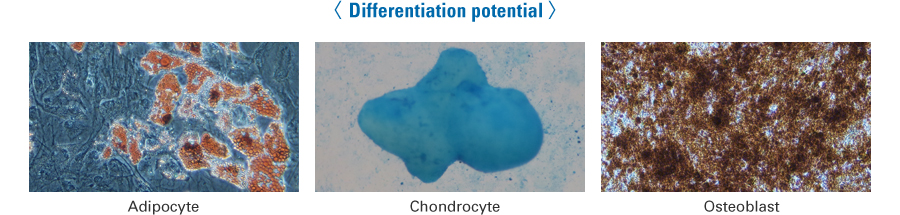
Compared with 10% FBS/DMEM, the displayed experiments show greater cumulative expansion of BM-MSC, ADSC and UC-MSC in StemFit For MSC. The product also maintains high expression of positive MSC markers, low expression of negative markers, and adipogenic, chondrogenic and osteogenic differentiation potential.
| Cell type | CD73 | CD90 | CD105 | CD34 | CD45 |
|---|---|---|---|---|---|
| BM-MSC | 93.0 | 99.3 | 96.5 | 0.3 | 0.3 |
| ADSC | 100.0 | 100.0 | 98.3 | 2.6 | 0.1 |
| UC-MSC | 98.9 | 100.0 | 93.0 | 0.9 | 0.2 |
The marker table reproduces the reported expression values. CD73, CD90 and CD105 are positive markers; CD34 and CD45 are negative markers. These observations characterize the evaluated cultures, not every donor or process.
Donor-dependent growth and scale-up comparisons
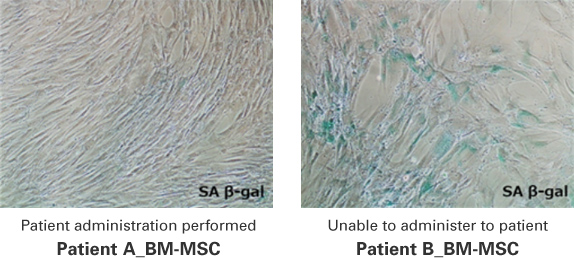
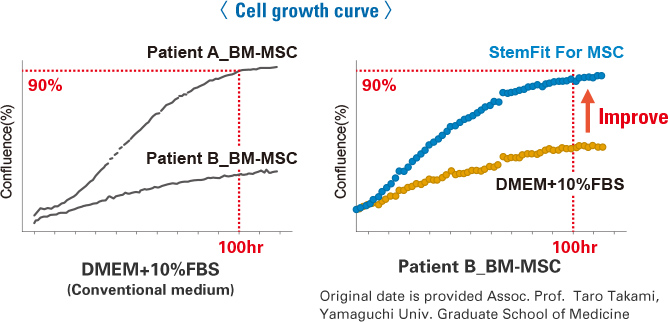
In a donor comparison, Patient B BM-MSC grew poorly in FBS-containing medium but expanded more efficiently in StemFit For MSC. The associated SA β-gal images distinguish Patient A and Patient B cultures; the historical administration labels describe that case and do not establish therapeutic efficacy or authorize this medium for patient treatment. The growth comparison marks 90% confluence at approximately 100 hours for the better-growing cultures. Original data are attributed to Associate Professor Taro Takami, Yamaguchi University Graduate School of Medicine.
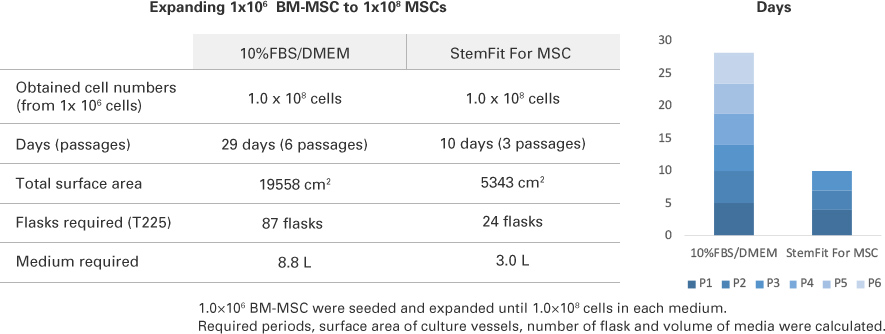
The large-scale comparison reports 29 days / 6 passages versus 10 days / 3 passages, 19558 versus 5343 cm² total culture surface, 87 versus 24 T225 flasks, and 8.8 versus 3.0 L of medium for 10% FBS/DMEM and StemFit For MSC respectively. The figure heading and output row use a 1E8-cell endpoint from 1E6 starting cells, whereas its footnote says 1E9 cells. The endpoint is therefore inconsistent; these resource figures are illustrative reported values, not a validated production estimate.
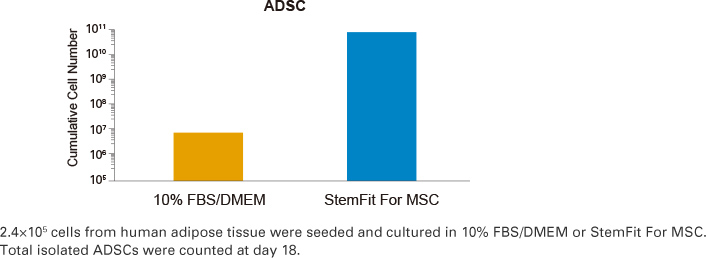
Isolation has been demonstrated from bone marrow and adipose tissue. The ADSC comparison starts with 2.4E5 cells from human adipose tissue and compares cumulative output at day 18; StemFit For MSC gives a higher output than 10% FBS/DMEM in that experiment.
Handling, substrate selection and troubleshooting
Thaw at 15–25 °C or overnight at 2–8 °C, mix thoroughly, and dissolve any precipitate at room temperature. Do not thaw at 37 °C. Thawed medium can be stored at 2–8 °C for up to 1 month, protected from light. Alternatively, aseptic aliquots can be kept at −20 °C until expiry; do not refreeze thawed aliquots. Bring working medium to room temperature and use immediately.
For attachment, add iMatrix-511 or use an ECM-coated plate such as vitronectin or fibronectin. Corning CellBIND Surface vessels are an alternative that does not require added iMatrix-511. The medium itself contains no ECM. When switching medium, the recommended starting point is thawing the cell stock into StemFit For MSC using the product protocol.
If cells fail to attach, check the substrate and complete removal of dissociation reagent after centrifugation. Residual reagent can inhibit attachment. Avoid overconfluence: at 90–100% confluence, detachment and single-cell recovery become difficult; the guidance recommends passage before 70% confluence. For incomplete dissociation, pipette in the Cell Detachment Solution as described in the cell-expansion protocol.




Product documents
- Product information and protocol
- Safety data sheet
- Brochure
- MSC isolation protocol