
Products
StemFit™ Basic03 (GMP)
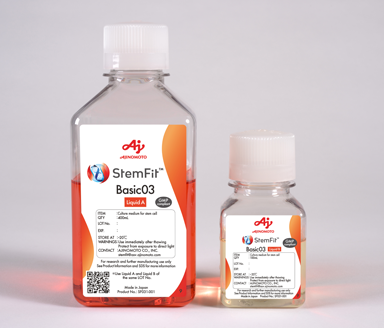
Animal-origin-free, defined human ES/iPS cell medium: 400 mL Liquid A plus 100 mL Liquid B, without bFGF, for research and further manufacturing.
Product information
- Brand
- Ajinomoto StemFit
- Catalog no.
- SF031-001
- Specification
- Two-component set, 500 mL total
Defined medium for human pluripotent stem cells
StemFit™ Basic03 (GMP) supports feeder-free culture of human embryonic stem (ES) and induced pluripotent stem (iPS) cells. Its animal-origin-free formulation excludes human- and animal-derived components. The catalogue number is SF031-001. A two-component presentation allows the bFGF supplement to be selected for the intended application rather than built into the medium.
Contents and formulation choices
| Item | Specification |
|---|---|
| Catalogue number | SF031-001 |
| Liquid A | 400 mL |
| Liquid B | 100 mL |
| Total medium volume | 500 mL |
| bFGF | Not included; separate supplementation required |
| Frozen storage | Below −20 °C |
Basic03 uses the A/B formulation of AK03N without its bFGF-containing Liquid C. AK03N is sold only in Japan, whereas Basic03 is the globally available counterpart. Basic03 can support iPSC establishment and expansion, and can also serve as a basal medium in a differentiation process. It is not an MSC or hematopoietic stem-cell expansion medium.
Expansion performance and handling flexibility
The medium is designed for single-cell expansion, with cell survival and reproducible growth as key performance objectives. A CGT Catapult comparison reported favourable performance for clinical hPSC expansion; the product information does not give a numerical advantage applicable to every cell line. Normal karyotype was observed after 20 passages in the reported evaluation. This is an observed result, not a guarantee for all cultures.
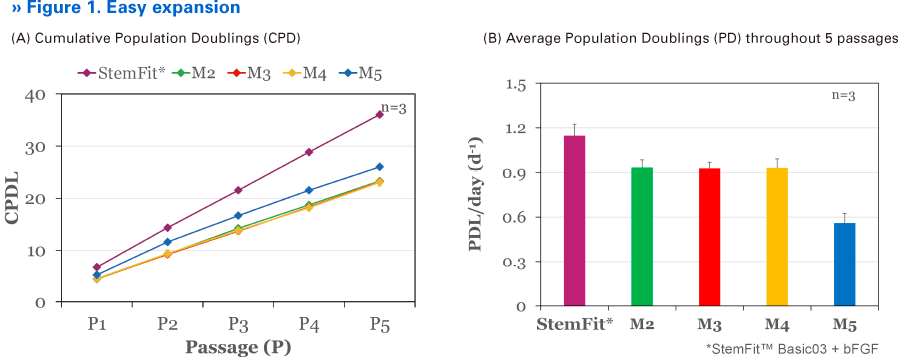
The comparative expansion data use Basic03 supplemented with bFGF and four comparator media (M2–M5), with n=3. At passage P5, the plotted cumulative population doubling level (CPDL) is approximately 36 for StemFit and 23–26 for the comparators; the daily population doubling level is approximately 1.15 versus 0.55–0.95. These are approximate readings from the plotted comparison, not raw batch specifications or a claim of statistical significance.
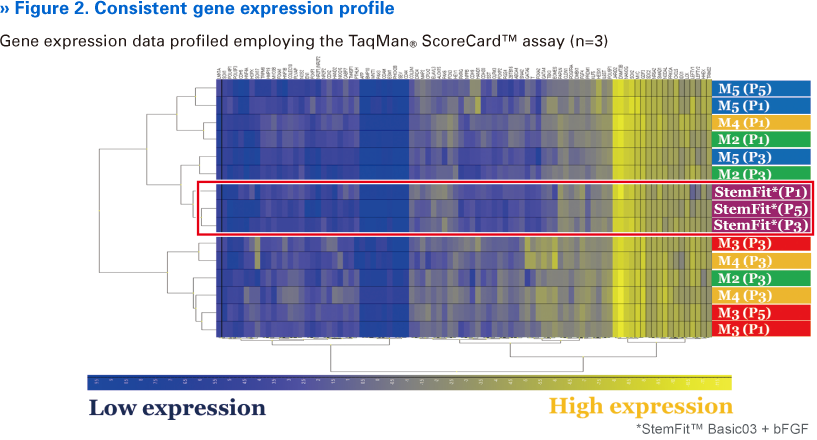
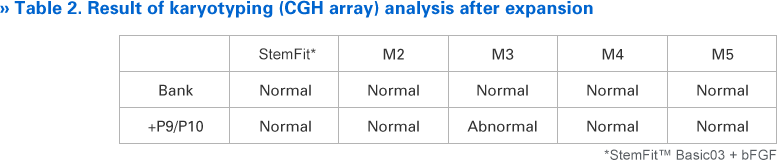
Gene-expression profiling with the TaqMan ScoreCard assay (n=3) shows the StemFit profiles at P1, P3 and P5 grouped together in the displayed heatmap. In the separate CGH-array karyotyping comparison, all media begin with normal bank results; at +P9/P10, StemFit, M2, M4 and M5 remain normal, while M3 is reported abnormal. This comparison is distinct from the 20-passage observation above.
Weekend-free feeding is supported in suitable culture conditions, offering flexibility in laboratory scheduling. Compatibility examples for hPSC extracellular matrices include iMatrix-511, Geltrex, VTN-N, LN521, Matrigel and Synthemax. Single-cell passaging is preferred. The medium was developed for human PSCs; published use with primate PSCs is not equivalent to a general non-human-cell specification.
An illustrated per-well medium-volume comparison shows 15–18 mL for a conventional schedule versus 7–9 mL for StemFit, labelled as a 40–60% reduction. This is the illustrated scheduling example, not a guaranteed reduction for every cell line, well format or process.

Quality system and intended use
The quality management system follows the Ajinomoto System of Quality Assurance (ASQUA). Manufacturing and release testing follow Ajinomoto's GMP standards for regenerative-medicine culture media, prepared with reference to ICH Q7 and PMDA guidance on aseptic manufacturing of regenerative-medicine products. The formulation and manufacturing process were also discussed with PMDA regarding suitability as ancillary materials for cell and gene therapy manufacturing.
For research and further manufacturing use only; not intended for human or animal diagnostic or therapeutic use.
Storage and preparation considerations
The supplied components are frozen. Thaw at 15–25 °C; do not thaw Liquid B at 37 °C because this accelerates ingredient degradation. Combine the full A/B components using sterile handling. The reference bFGF supplementation level is 80 ng/mL, with adjustment according to application. Thawed medium can be kept at 2–8 °C for up to two weeks and should be protected from light. Follow the current product instructions for aliquoting and use.




For an existing hPSC culture, the recommended medium transition is two days before passaging. Selection of a matrix, growth-factor source and feeding schedule should match the cell line and the intended process.