
Technical column
Six Pharma Case Studies in Organ-on-Chip ADME: How CN Bio PhysioMimix Links Gut Absorption, Hepatic First Pass and Antibody DDI Into One Drug Journey
Six case studies from GSK, Roche, Pharmaron and Amgen × MIT cover ASO cellular uptake, liver metabolism profiling with 15 drugs, an iPSC gut–liver first-pass model, in silico sampling design, IL-6/tocilizumab-mediated DDI and gut–liver metabolism of a prodrug. Key numbers: ignoring evaporation may underestimate CLint of low-clearance drugs by up to about 40%; the IL-6 EC50 for CYP3A4 suppression was about 463 pg/mL; the estimated membrane permeability of MPAG was more than 1000-fold lower than that of MPA.
Definition
Organ-on-chip ADME research uses microphysiological systems (MPS) that rebuild human gut, liver and other tissues with dynamic perfusion, 3D culture and multi-tissue connection, combined with mathematical modelling, to quantify drug absorption, metabolism, interactions, cellular uptake and distribution, estimate in vitro pharmacokinetic parameters and extrapolate them to humans.
Once a drug candidate shows activity, the next question arrives immediately: what happens to it inside the body? Does it cross the intestinal barrier? How much reaches the circulation? How much is left after the liver? Which metabolites form? Will it interact with co-medications? And for new modalities such as ASOs, does the drug actually get into its target cells? Together these questions make up the ADME and pharmacokinetic (PK) work that no drug program can skip.
Liver microsomes, suspended hepatocytes and Caco-2 remain useful for high-throughput screening. But once a project involves long-term metabolism, low-clearance drugs, combined gut–liver first-pass effects, complex DDI or tissue distribution, the question shifts from a single end point to the interplay of several physiological processes, and conventional models start to fall short. Microphysiological systems (MPS) fill that gap with dynamic perfusion, 3D culture, multi-tissue connection and mathematical modelling.
The six case studies below come from GSK, Roche, Pharmaron, Amgen and MIT and related teams. Built around CN Bio PhysioMimix and the perfused liver MPS approach, together they trace a drug's complete journey through the human body.
The six cases at a glance
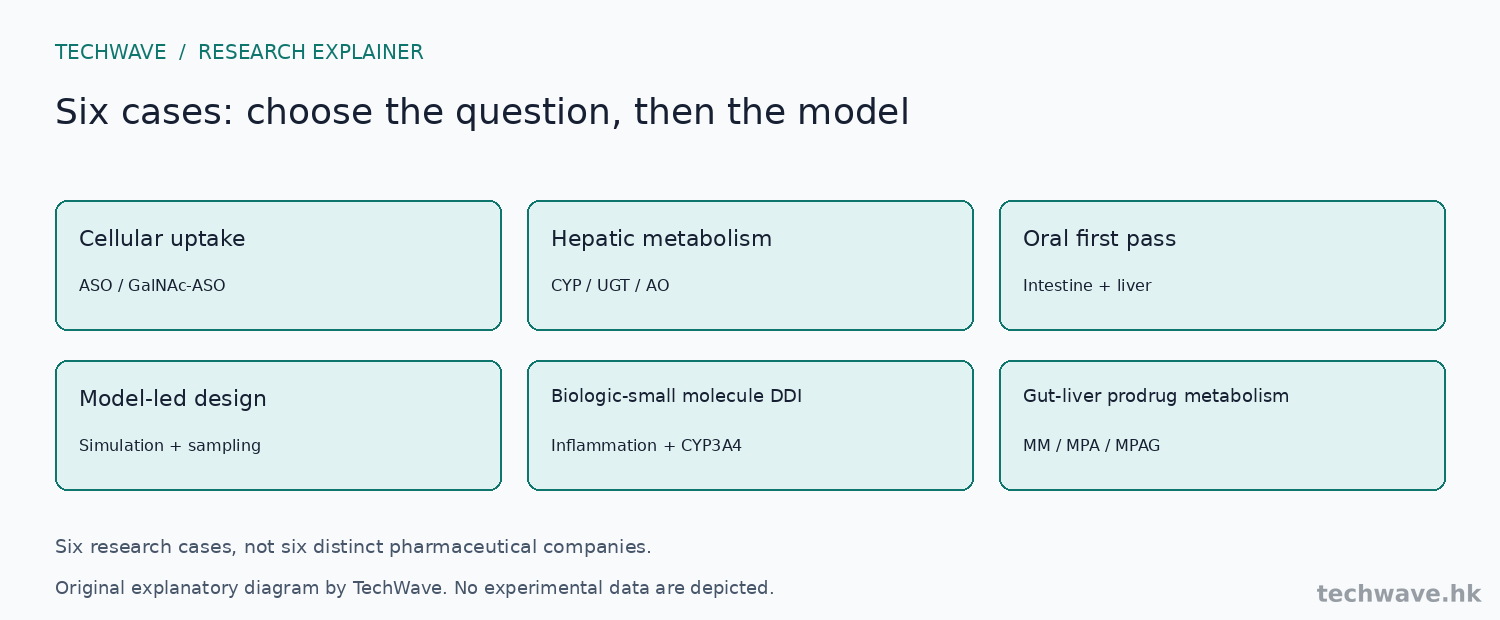
Six research cases address six ADME questions.
| Team | Focus | Representative drug | What you get from it |
|---|---|---|---|
| GSK | Hepatic uptake and distribution | ASO / GalNAc-ASO | Where ASOs go after entering cells in a 3D human liver model |
| Roche | Hepatic drug metabolism | 15 compounds | CYP, UGT and AO activity, clearance, metabolic pathways and metabolites |
| Pharmaron | Oral bioavailability | Midazolam | iPSC-derived enterocytes linked to PHH to model intestinal absorption and hepatic first pass |
| Roche | MPS + mathematical modelling | Multiple compounds | In silico models that guide experimental design and sampling strategy up front |
| Amgen × MIT | Biologic–small molecule DDI | Tocilizumab + Simvastatin | The dynamic link between inflammation, CYP3A4 and drug PK |
| Roche | Combined gut–liver metabolism | Mycophenolate mofetil | Prodrug absorption, gut and liver metabolism and metabolite formation in one run |
Case 1 | GSK × ASO: reaching the liver is not reaching the target cell
For oligonucleotide drugs, exposure is only the starting point. What decides success is which cells the drug enters, how much is taken up and where it goes next.
On 24 August 2026, GSK's hepatitis B ASO drug was approved in Japan; according to public information, the drug's early development used the CN Bio liver-on-a-chip. From 2018, teams from GSK, Cardiff University and the University of Illinois co-cultured primary human hepatocytes (PHH) and Kupffer cells at 10:1 in the PhysioMimix liver model and compared the uptake and intracellular distribution of a non-targeted ASO and a GalNAc-conjugated ASO. GalNAc binds ASGPR on the hepatocyte surface, which is why it is used to enhance ASO delivery to hepatocytes.
The study imaged A488-labelled ASOs in 3D by multiphoton fluorescence microscopy. At 2 μM, one hour after dosing, the mean fluorescence intensity of ASO-GalNAc was clearly higher than that of the non-targeted ASO; with longer time and higher concentration, however, the two showed different uptake kinetics, and at high concentrations the researchers also saw effects possibly linked to saturation of the ASGPR-mediated route. Going deeper into the scaffold, they analysed hepatocytes with a cuboidal morphology and observed that the ASO localized mainly to nucleus-associated regions.
What this means for you: DMPK evaluation can move beyond drug concentration to cellular uptake, spatial distribution and delivery mechanism, adding a key new dimension for ASO, GalNAc-ASO and other new modalities. TechWave has published a separate in-depth article on the full dose–time data and multimodal imaging of this study.
Case 2 | Roche × hepatic drug metabolism: how many DMPK questions can one liver MPS answer?
ADME is much more than one clearance value. Different compounds run through CYP, UGT, AO and other enzyme systems, and you still need the share of each metabolic pathway and the metabolites formed.
The Roche team systematically evaluated PhysioMimix Liver-on-a-Chip (LC12 plates) for DMPK. They characterized CYP, UGT and AO activity with 15 drugs and performed in vitro to in vivo extrapolation (IVIVE) for 12 of them; used quinidine and diclofenac to estimate the fraction metabolized (fm) by individual pathways, with the paper reporting a diclofenac fm,UGT of 0.64, highly comparable with values previously reported in the literature; and took on complex primary and secondary metabolite identification with efavirenz.
One finding is easy to miss but goes straight to data quality: drug concentrations in an MPS depend not only on cellular metabolism but also on the parameters of the culture system itself. Mathematical modelling showed that if medium evaporation is ignored, the intrinsic clearance (CLint) of low-clearance compounds may be underestimated by up to about 40%.
What this means for you: an MPS is not simply a way to keep hepatocytes alive a few days longer. It supports a complete DMPK framework around enzyme activity, CLint, fm and metabolite identification, with mathematical modelling to make sense of concentration changes in a complex system.
Case 3 | Pharmaron × oral bioavailability: from Caco-2 to absorption plus hepatic first pass
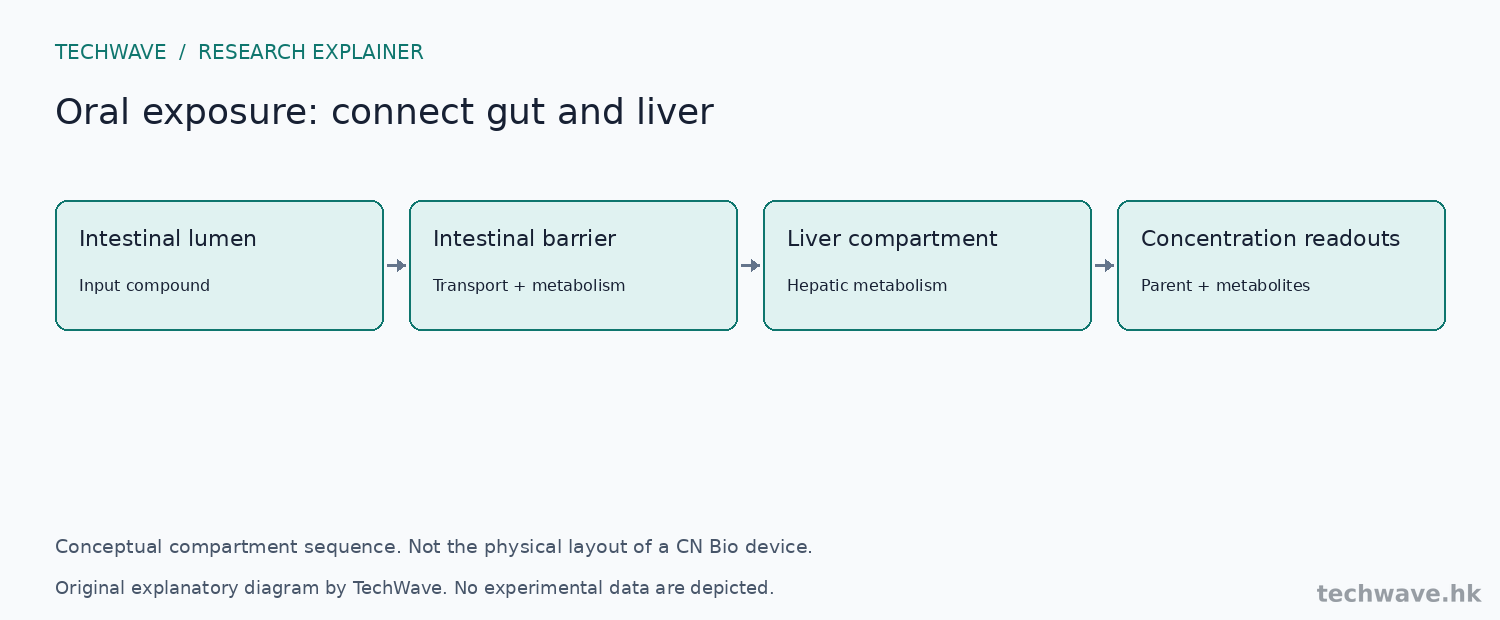
Conceptual absorption and metabolism links between intestinal lumen, intestinal barrier and liver.
Oral bioavailability (F) is not set by intestinal permeability alone; it is the combined result of intestinal absorption, gut first-pass metabolism and hepatic first-pass extraction.
The Pharmaron (Beijing) team connected iPSC-derived small intestinal epithelial cells (hiSIEC) to primary human hepatocytes in a CN Bio two-organ system to build a gut–liver MPS. According to the team's public materials:
- hiSIEC monolayers reached a TEER of 300–400 Ω·cm² and expressed markers of absorptive enterocytes, goblet cells, Paneth cells and enteroendocrine cells;
- drug-metabolizing enzyme and transporter function was detected for CYP3A4 and CES2 as well as P-gp, BCRP and PEPT1;
- in permeability testing of 10 small molecules, hiSIEC gave a better in vitro–in vivo correlation than conventional Caco-2;
- with midazolam dosed on the apical gut side and followed for 1–72 hours, the hiSIEC/Liver system showed a more pronounced first-pass effect than Caco-2/Liver, revealing absorption, gut metabolism and hepatic first pass together.
What this means for you: instead of measuring a single Papp, you can model the complete first-pass process of an oral drug in vitro, giving you another model option for human oral bioavailability studies of candidates.
Case 4 | Roche × in silico modelling: decide when to sample before the experiment starts
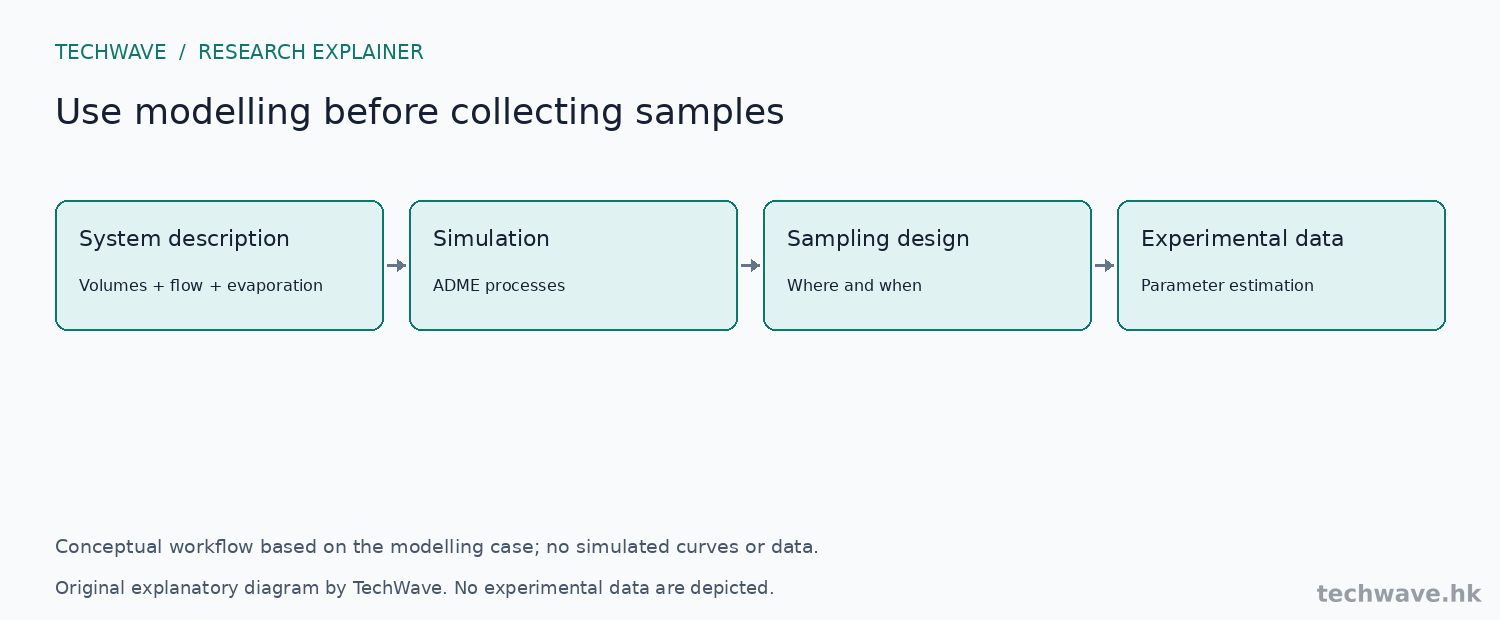
Model-guided workflow from system description through simulation and sampling design to experimental data.
An MPS delivers more information, and that makes data analysis harder. In a conventional single ADME assay one main process usually dominates the concentration curve; in a gut–liver MPS, a drug may simultaneously undergo membrane transport, cellular uptake, gut metabolism, liver metabolism, medium circulation, sampling and evaporation, while concentrations in each compartment keep changing over time.
The Roche and University of Manchester team therefore proposed moving in silico modelling and design of experiments (DOE) ahead of the bench work. A model is built from compartment volumes, flow rates, evaporation, the compound's ADME properties and the donor cell phenotype, and the simulations are then used to pick the more informative sampling sites and time points. This tutorial-style methods paper focuses on the gut–liver organ-on-chip, the most studied multi-organ setup for predicting oral drug PK, with midazolam as the worked example.
Its point is not an efficacy result for one drug but a methodological framework: simulate first, then design the experiment, then use the data to estimate ADME parameters.
What this means for you: as MPS work moves from one organ to several, mathematical models help you separate the processes behind a concentration change while optimizing experimental design and PK parameter estimation, saving time and samples.
Case 5 | Amgen × MIT: why would one antibody change the PK of a small-molecule drug?
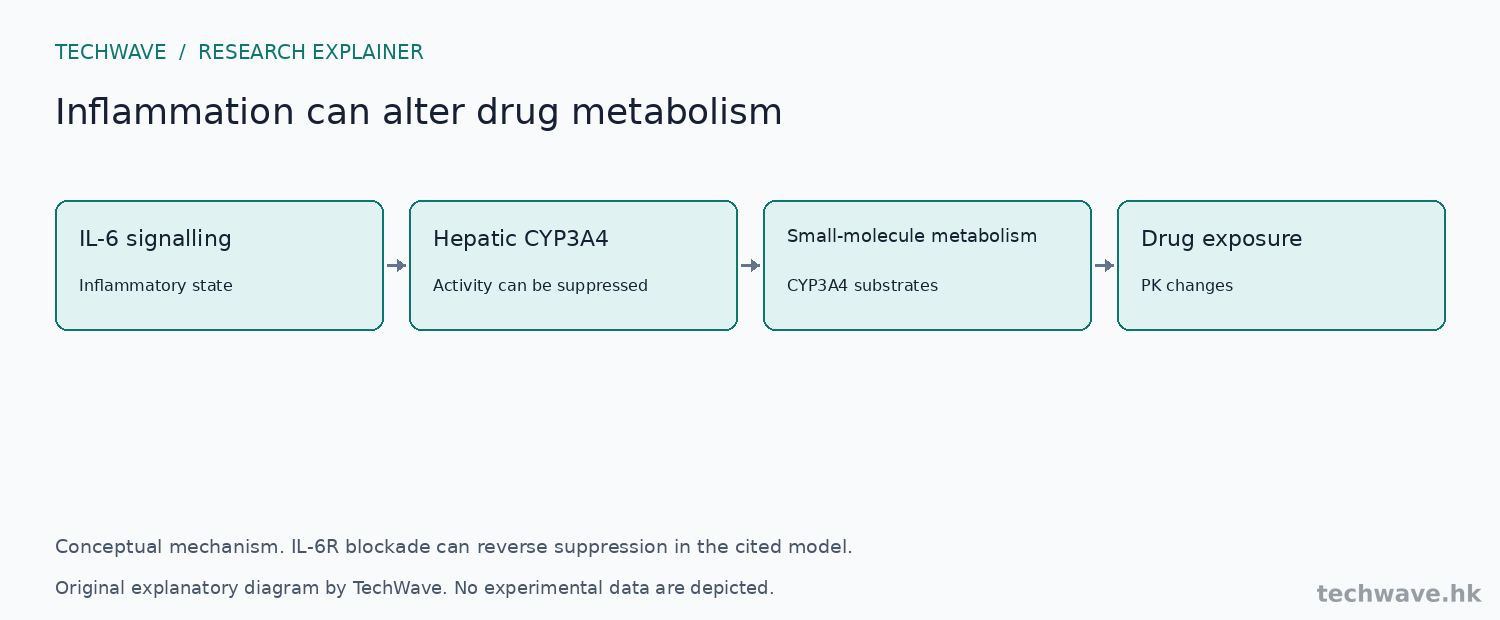
Conceptual link between inflammatory signalling, hepatic CYP3A4, small-molecule metabolism and exposure. In the cited model, IL-6R blockade can reverse CYP3A4 suppression.
Drug–drug interactions are not limited to pairs of small molecules. Inflammatory cytokines regulate hepatic CYP enzymes, so a biologic that targets an inflammatory pathway can indirectly change the metabolism of a co-administered drug.
The Amgen and MIT team studied this with a 3D perfused human liver coculture platform (cryopreserved primary human hepatocytes with Kupffer cells), in which albumin production stayed stable over 2 weeks:
- sustained IL-6 stimulation suppressed CYP3A4 activity in a dose-dependent way while raising CRP, and the study derived an IL-6 EC50 of about 463 pg/mL for CYP3A4 suppression;
- with the anti-IL-6R antibody tocilizumab added while IL-6 was still present, CYP3A4 suppression was lifted and CRP fell after 72 hours;
- with the CYP3A4 substrate simvastatin hydroxy acid, this change in enzyme activity translated into a real PK change: half-life and AUClast decreased, in the same direction as observed clinically, an effect not seen in conventional hepatocyte cultures.
What this means for you: the model links inflammatory state, biologic intervention, CYP enzyme activity and small-molecule PK into one chain, opening a human-relevant in vitro route to complex DDI between therapeutic antibodies and small molecules.
Case 6 | Roche × gut–liver: what combined gut and liver metabolism does an oral prodrug go through?
This case widens the view from one organ to the combined metabolism of the gut and the liver.
The Roche team chose the prodrug mycophenolate mofetil (MM) as the model compound. After oral dosing MM must first be converted to the active drug mycophenolic acid (MPA), which is then glucuronidated to MPAG, so both gut and liver take part. In the gut–liver MPS the researchers built the intestinal barrier from Caco-2/HT29 cells and connected it to single-donor primary human hepatocytes; after adding MM on the apical gut side, they followed MM, MPA and MPAG concentrations in the gut apical, gut basolateral and liver compartments at the same time.
- Both gut and liver contributed to the metabolism of MPA to MPAG; after 48 hours, MPA in the hepatocytes had been converted to MPAG;
- comparison with a gut-only setup further showed that, besides the liver, the gut also makes a clear contribution to MPA glucuronidation;
- with a mechanistic model, the researchers estimated gut and liver clearance, membrane permeability and efflux ratio; for example, the estimated membrane permeability of MPAG was more than 1000-fold lower than that of MPA, and identifiability and global sensitivity analyses of the model supported the experimental design.
What this means for you: intestinal permeability, gut metabolism and liver metabolism, usually measured separately, run in one dynamic system that comes closer to the continuous ADME process an oral drug goes through in the body.
Connecting the six cases: a drug's full journey through the body
If disease modelling asks how a disease develops, ADME and pharmacology ask a different question: what actually happens to a drug once it enters the body? Together the six cases form a complete research chain:
Intestinal absorption → gut first pass → hepatic first pass → drug metabolism and clearance → transport and metabolite formation → DDI → target-cell uptake and tissue distribution → PK parameters and extrapolation to humans
The value of MPS in ADME research is not to replace every conventional assay but to add a research tier after high-throughput screening for the harder questions: from measuring single ADME parameters to rebuilding the absorption, transport, metabolism and action that happen continuously across several tissues. For low-clearance compounds, complex first-pass metabolism, prodrugs, biologic–small molecule DDI and new modalities such as ASOs, it gives you an extra layer of human-relevant data before a candidate enters the clinic.
Where it fits and how to choose
- Single-organ liver metabolism only (CLint of low-clearance drugs, fm, metabolite identification, long-term metabolism): start with the PhysioMimix single-organ liver model and LC12 plates, and build evaporation and other system parameters into the mathematical model.
- Combined oral absorption and first pass, prodrugs or gut–liver metabolism: choose the two-organ gut–liver configuration (TL6 multi-organ plates), with Caco-2/HT29 or iPSC-derived intestinal epithelium on the gut side as the project requires.
- Multi-organ experiments: run in silico simulations first, then fix sampling points and times so key windows are not missed.
- Biologic-related DDI and nucleic acid drug uptake and distribution: focus on 3D perfused liver cocultures that include Kupffer cells, paired with imaging readouts.
- The numbers in each case depend on its cell source, donor, concentrations and time points; recalibrate in your own system before applying them to your compounds.
Let TechWave bring your ADME questions onto organ-on-chip
Whether you need CLint estimates for low-clearance drugs, the gut–liver first pass of an oral drug, antibody–small molecule DDI or ASO uptake in hepatocytes, TechWave can help you work out single-organ or gut–liver configurations, cell sources and sampling design around the CN Bio PhysioMimix system, LC12 liver plates and TL6 multi-organ plates, with application materials, selection advice and quotations. Contact the TechWave technical team today to talk through your next ADME project.
References
- Majer J, Alex A, Shi J, Chaney EJ, Mukherjee P, Spillman DR Jr, Marjanovic M, Newman CF, Groseclose RM, Watson PD, Boppart SA, Hood SR. Multimodal imaging of a liver-on-a-chip model using labelled and label-free optical microscopy techniques. Lab Chip. 2024;24(19):4594-4608. doi:10.1039/d4lc00504j
- Docci L, Milani N, Ramp T, Romeo AA, Godoy P, Franyuti DO, Krähenbühl S, Gertz M, Galetin A, Parrott N, Fowler S. Exploration and application of a liver-on-a-chip device in combination with modelling and simulation for quantitative drug metabolism studies. Lab Chip. 2022;22(6):1187-1205. doi:10.1039/d1lc01161h
- Milani N, Parrott N, Galetin A, Fowler S, Gertz M. In silico modeling and simulation of organ-on-a-chip systems to support data analysis and a priori experimental design. CPT Pharmacometrics Syst Pharmacol. 2024;13(4):524-543. Epub 2024 Feb 14. doi:10.1002/psp4.13110
- Long TJ, Cosgrove PA, Dunn RT 2nd, Stolz DB, Hamadeh H, Afshari C, McBride H, Griffith LG. Modeling therapeutic antibody–small molecule drug–drug interactions using a three-dimensional perfusable human liver coculture platform. Drug Metab Dispos. 2016;44(12):1940-1948. Epub 2016 Sep 12. doi:10.1124/dmd.116.071456
- Milani N, Parrott N, Ortiz Franyuti D, Godoy P, Galetin A, Gertz M, Fowler S. Application of a gut–liver-on-a-chip device and mechanistic modelling to the quantitative in vitro pharmacokinetic study of mycophenolate mofetil. Lab Chip. 2022;22(15):2853-2868. doi:10.1039/d2lc00276k
Uses and applicable scenarios
- Long-term hepatic metabolism, CLint estimation and IVIVE for low-clearance compounds
- Fraction metabolized (fm) by pathway and metabolite identification across CYP, UGT and AO enzymes
- Combined assessment of intestinal absorption, gut first-pass and hepatic first-pass metabolism for oral bioavailability
- Antibody–small molecule drug–drug interactions (DDI) driven by inflammatory pathways
- Prodrug conversion and metabolite formation across the gut and the liver
- Hepatocyte uptake and intracellular distribution of ASO, GalNAc-ASO and other nucleic acid drugs
Limitations
- In multi-organ systems drug concentrations are shaped at the same time by transport, metabolism, medium circulation, sampling and evaporation, so parameter estimation needs a matching mathematical model and sampling should be designed after simulation
- Each case's numbers come from its own cell source, donor, concentration and time points; recalibrate in your own model before comparing across systems