
Technical column
Solallis M101-AF chemically defined MSC medium: serum-free passaging to P14, over 100,000-fold primary expansion in two weeks, doubling time of about 20 hours
Serum-free MSC culture usually stalls on three problems: cells senesce, flasks need tedious coating and primary isolation is hard. Solallis Stem Design MSC Culture Medium AF (M101-AF-500) is a chemically defined, animal-origin-free, ready-to-use and EV-free MSC expansion medium. Manufacturer data show serum-free passaging of adipose MSCs to P14, attachment without coating, a doubling time of about 20 hours, a culture cycle cut from 9 to 6 days and about 50% lower medium consumption and manufacturing cost.
Definition
Stem Design MSC Culture Medium AF (M101-AF-500) is a chemically defined, animal-origin-free, ready-to-use and extracellular-vesicle-free (EVs-free) mesenchymal stem cell (MSC) expansion medium based on a Solallis formulation.
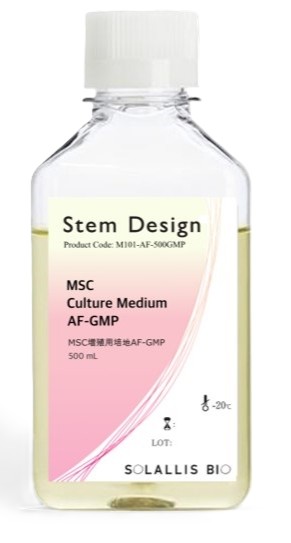
Stem Design M101-AF chemically defined MSC medium.
Many teams moving MSC culture to serum-free medium hit the same three obstacles: cells start to senesce after a few passages, flasks must be coated first, and primary isolation struggles to get started without serum. The result is either expansion that stalls or handling and consumable costs that stay high.
Solallis's Stem Design MSC Culture Medium AF (M101-AF-500) targets exactly these three problems. Manufacturer data show that it supports serum-free serial passaging of adipose-derived MSCs to P14, allows attachment in uncoated standard flasks, gives more than 100,000-fold expansion within two weeks of primary isolation, shortens doubling time to about 20 hours and can cut medium consumption and manufacturing cost by about 50%.
Positioning: Japanese formulation, GMP manufacturing in China
M101-AF-500 keeps the formulation developed by Solallis in Japan and is produced under contract by a leading Chinese GMP medium manufacturer — "imported quality, locally manufactured". It combines four attributes:
- Chemically defined: a defined formulation;
- Animal-origin-free (AOF): no animal-derived components;
- Ready-to-use: no in-house preparation needed;
- EVs-free: suited to upstream processes sensitive to EV background.
Six core performance points
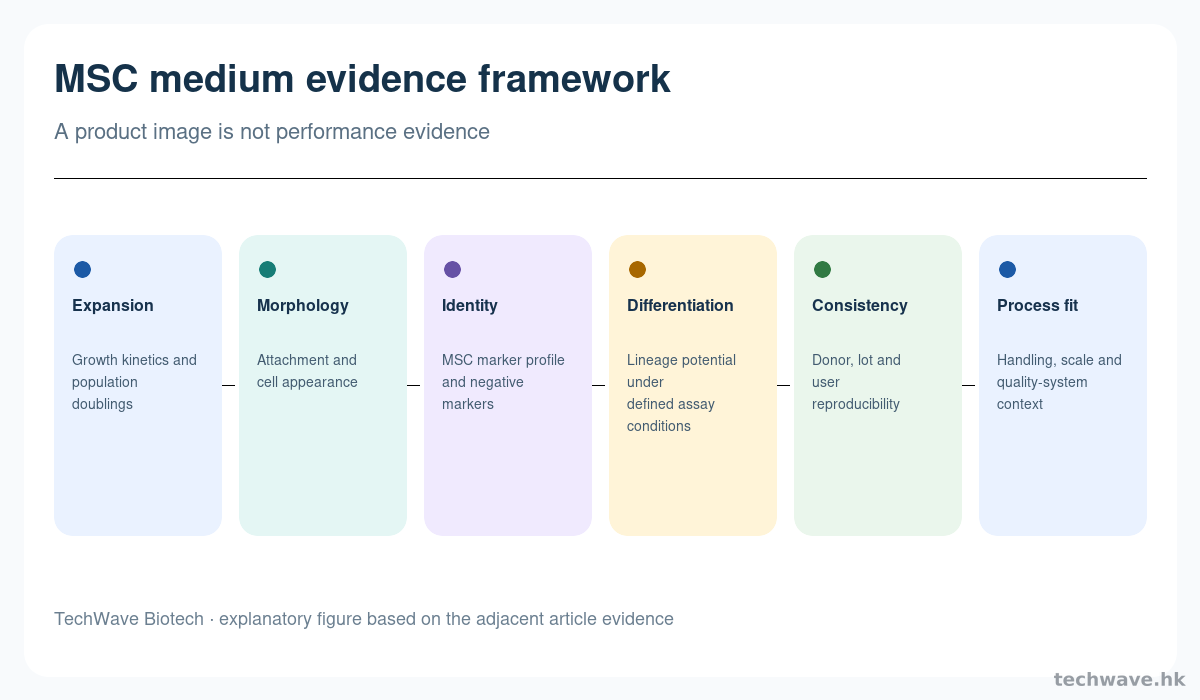
Published evidence should assess expansion, morphology, identity, differentiation, stability and process fit together.
According to Solallis, M101-AF-500 overcomes the limitations of conventional serum-free media with the following data:
- Prevents senescence and supports long-term passaging: specific anti-senescence components prevent MSC senescence and support serum-free serial expansion of adipose-derived MSCs to passage 14;
- Good attachment, no coating needed: attachment-promoting components give attachment and recovery rates in various uncoated standard flasks far above competing products, greatly lowering consumable and handling costs;
- Supports serum-free primary isolation: MSCs can be isolated from adipose tissue directly under fully serum-free conditions, with more than 100,000-fold effective expansion within two weeks of seeding;
- Maintains MSC phenotype and stemness: after long-term expansion, cells meet ISCT identification criteria — positive surface markers CD73, CD90 and CD105 > 99% and negative markers < 2% — and retain trilineage differentiation into adipocytes, osteocytes and chondrocytes;
- Stable through repeated freeze–thaw: after up to 10 freeze–thaw cycles (-30 °C to room temperature), the medium shows no marked decline in its support of cell growth as measured by population doubling time (PDT), simplifying daily handling and storage;
- Balances output and cost: doubling time falls to about 20 hours and the culture cycle from 9 to 6 days; combined with no medium change in specific workflows, total medium consumption and manufacturing cost can fall by about 50%.
GMP manufacturing and quality system
According to Solallis, contract manufacturers were strictly screened, and the Chinese production site for M101-AF-500 is a well-known cell-culture-medium supplier with a broadly certified quality management system:
- Certifications: the plant holds ISO 9001 (quality management), ISO 14001 (environmental management), ISO 45001 (occupational health and safety) and ISO 13485 (medical-device quality management) certification;
- Manufacturing standards: the manufacturer states that its GMP plant's production practices meet the cGMP standards of the FDA, EMEA and NMPA;
- Commercial-scale production: the manufacturer states that its strict quality control ensures high quality, stability and traceability in commercial production, addressing the needs of biopharmaceutical companies from IND filing and clinical stages to commercial manufacturing.
For a specific project, obtain valid certificates, specifications, raw-material sources, release tests, stability data, change notifications and traceability documents from the supplier, and confirm the fit with the actual research, IND, clinical or commercial use.
Validated by multiple users
Before launch, this chemically defined MSC medium completed a series of comparative tests at several Chinese research institutions and companies:
| Tester | Test design | Result |
|---|---|---|
| Customer 1 | Parallel experiments across donors, lots and seeding densities; 48-hour OD measurement and a continuous 96-hour growth curve | Proliferation support in the top tier of the market, outperforming several well-known commercial brands |
| Customer 2 | Long-term passaging test, P4 to P7 | Viability stable at 93.80%–96.60%, doubling time about 20.47 h; positive markers such as CD90 and CD73 at 99.61%–100.00%, with expression of impurity-cell markers such as CD79a falling over serial passaging |
| Customer 3 | Parallel comparison of P4 and P5 MSCs | Typical fibroblast-like growth with normal morphology; strong cell-particle output and anti-ageing status |
How to validate before adoption
Published data come from specific donors and workflows. For adoption, compare your current medium with M101-AF-500 in parallel using at least three donors, recording cell counts, viability, population doubling time, morphology, surface markers and trilineage differentiation; for EV processes, also measure medium background particles and the identity, size and potency of cell-derived EVs. Before scale-up, add coating-free stability, cryopreservation and recovery, culture-vessel changes and downstream harvest compatibility. Only data obtained under these conditions turn the published efficiency advantages into process conclusions for your own project.
Let TechWave help you evaluate M101-AF
If you are looking for a serum-free MSC expansion system that supports long-term passaging without coating at a sensible cost, or need an EV-free upstream medium for an MSC-EV process, contact TechWave. We can help you plan a comparison of Solallis M101-AF-500 against your current system, share product information and arrange a quotation.
Uses and applicable scenarios
- Long-term MSC expansion under fully serum-free conditions
- Serum-free primary isolation of adipose-derived MSCs
- Upstream process development for cell therapy and MSC-EVs
- MSC culture in uncoated standard culture flasks
Limitations
- Published performance data come from the manufacturer's and specific users' donors and workflows; validate in parallel with your own donors and process before adoption
- Manufacturing and certification information must be checked against current quality documents and matched to the actual research, IND, clinical or commercial use