
Technical column
Choosing an Exosome SEC Column Without Pitfalls: A Complete iZON qEV Selection Guide, 6 Column Sizes from 150 μL to 100 mL, 20/35/70 nm Pore Sizes, and 35 nm Gen 2 Averaging 4.6 Times the EV Particles per μg Protein of Legacy Columns
Faced with 6 standard qEV column sizes, 3 pore sizes, 2 resin generations and 2 compliance grades, column selection takes four steps: choose the column size by processed loading volume (qEVsingle ≤150 μL to qEV100 ≤100 mL); choose the pore size by purity needs (35 nm for broad recovery, 70 nm to reduce lipoprotein interference, with about 99% ApoB removal from plasma); choose the compliance grade by translational stage (GMP-Ready with CoA and RSF); and add AFC, DXter, Zenco or TFF automation by throughput. For Gen 2 resin, EV particles per μg total protein were on average 2.6 times those of legacy columns at 70 nm and 4.6 times at 35 nm. Four practical cases follow: milk EVs, viscous culture supernatant, plasma/serum and MSC-EV scale-up.
Definition
Size-exclusion chromatography (SEC) separates a sample by hydrodynamic volume: large particles such as exosomes cannot enter the pores of the porous agarose resin and elute first, while small proteins and other impurities enter the pores and elute later, giving a gentle separation of extracellular vesicles (EVs) from soluble proteins.
How deep your exosome research can go depends on separating the target particles from the proteins and lipoproteins that mask their signal. Size-exclusion chromatography (SEC) is a common separation method, but faced with 6 standard qEV column sizes, 3 pore sizes, 2 resin generations and 2 compliance grades, many researchers get stuck on the same question: which one should my experiment use?
This article sets out a complete selection framework, followed by four practical cases.
SEC Principle: The Logic of the "Molecular Sieve"
SEC separates by differences in hydrodynamic volume. When a mixed sample passes through a column packed with porous agarose resin, large particles such as exosomes and exosome–protein complexes cannot enter the resin pores and elute first through the gaps in the bed; small proteins and other impurities enter the pores, are retained and elute later.
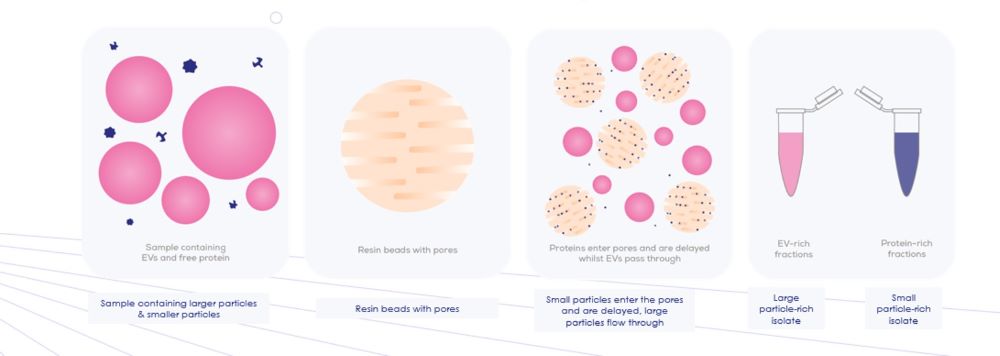
Figure 1. In SEC, larger particles elute first, while small proteins that enter the pores elute later.
This mechanism gives SEC four core features:
- Gentle conditions: no high-speed centrifugation or chemical precipitation, which helps preserve vesicle structure and biological activity;
- Fast and simple: a single separation takes about 15 minutes, compared with 4–6 hours for ultracentrifugation (UC), excluding all pre-processing time;
- Easy to standardize: it does not depend on operator experience, and a fixed workflow is easy to turn into an SOP;
- Broad sample compatibility: suitable for plasma, serum, urine, cell culture supernatant, cerebrospinal fluid (CSF) and saliva.
Step 1: Choose the Column Size by Loading Volume, from 150 μL to 100 mL
According to the source material, the iZON qEV series is one of the more complete SEC column ranges on the market, with six standard sizes defined by loading volume:
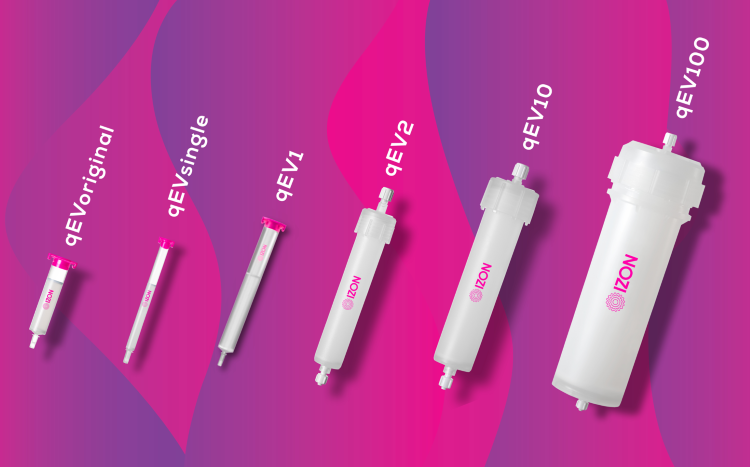
Figure 2. qEVsingle, qEVoriginal, qEV1, qEV2, qEV10 and qEV100 columns.
| Column | Loading volume | Recommended reuse (gravity) | Compatible automation | Manual gravity elution | Core positioning |
|---|---|---|---|---|---|
| qEVsingle | ≤150 μL | ≤5 times | AFC / DXter | Yes | Trace samples, clinical RT-PCR, no cross-contamination |
| qEVoriginal | ≤500 μL | ≤5 times | AFC / DXter | Yes | Common research use, AFC-compatible |
| qEV1 | ≤1 mL | ≤5 times | AFC | Yes | Plasma or small volumes of concentrated cell culture supernatant |
| qEV2 | ≤2 mL | ≤5 times | AFC / Zenco | Yes | Larger clinical samples and small volumes of concentrated cell culture supernatant |
| qEV10 | ≤10 mL | ≤5 times | AFC / Zenco | Yes | Medium-volume scenarios such as cell culture supernatant |
| qEV100 | ≤100 mL | ≤5 times | Zenco | Yes | Large-scale rapid separation, scalable to industrial level |
Gravity columns are currently recommended for no more than 5 uses; when qEV columns are connected to the Zenco chromatography system and cleaned thoroughly, they can be used more than 20 times. qEV100 is listed as supporting AFC/ZENCO automation, but the AFC V2 compatibility table covers only single/original/1/2/10; qEV100 follows the Zenco route.
Selection principle: loading volume is the main basis for choosing the column size. Plan the original harvest volume separately from the actual loading volume after clarification and TFF concentration.
Step 2: Choose the Pore Size by Sample and Purity Needs
Recommended pore sizes by sample type:
| Sample type | Recommended pore size | Notes |
|---|---|---|
| Plasma / serum | 70 nm | High lipoprotein content; 70 nm reduces ApoB interference |
| Cell culture supernatant | 35 nm | Large volume, mixed protein background |
| Urine | 35 nm | Low EV abundance; 35 nm improves recovery |
| Tissue digest | 70 nm | Complex sample with many impurities; 70 nm secures purity |
Why does the same column come in 20 nm, 35 nm and 70 nm versions? The essential difference is the separation range:
| Dimension | 20 nm | 35 nm | 70 nm |
|---|---|---|---|
| Main recovery range | 20–100 nm | 35–350 nm | 70–1000 nm |
| Core advantage | Fine separation of small molecules and small exosomes with high resolution, suited to research-grade trace-sample analysis | Balances recovery and resolution for routine separation of most standard exosomes and vesicles | Strong lipoprotein removal, designed for higher purity requirements |
| Small-EV (<110 nm) recovery | Higher (more complete capture) | Balances recovery and purity | Relatively lower |
| Lipoprotein (ApoB) contamination | More | Moderate | Trace |
| Recommended use | RT-PCR samples | Broad recovery, proteomics | High-purity needs, lipoprotein-sensitive downstream analysis |
| Suitable samples | Focus on exosomes and ultra-small extracellular vesicles (sEVs) below 50 nm, where trace protein impurities must be excluded | Routine cell culture supernatant (CCM), exosomes from all kinds of cell lines for mechanism and functional studies | Complex body fluids such as plasma, serum and CSF, separating exosomes from high-abundance interferents such as lipoproteins and albumin |
Recovery ranges are representative descriptions, not hard size cut-offs: the plasma case gives an effective separation interval of 70–2000 nm for 70 nm columns, while the selection table above gives 70–1000 nm; nor can particle size alone establish that a particle is an exosome. Note also that 20 nm separates small particles from trace soluble proteins, but that is not the same as removing ApoB-containing lipoproteins.
Rule of thumb: choose 35 nm to balance recovery and purity; choose 70 nm for a cleaner product with less lipoprotein interference.
Step 3: Gen 2 or Legacy? Choosing Between Two Resin Generations
iZON introduced second-generation qEV columns (Gen 2) in response to the rising demands of exosome research for separation purity, standardization and clinical translation. Gen 2 uses a proprietary new agarose resin that further improves separation purity and suits exosome proteomics and RNA analysis with high purity requirements. According to the source material, Gen 2 versions are available for qEVsingle, qEVoriginal, qEV2, qEV10 and qEV100.
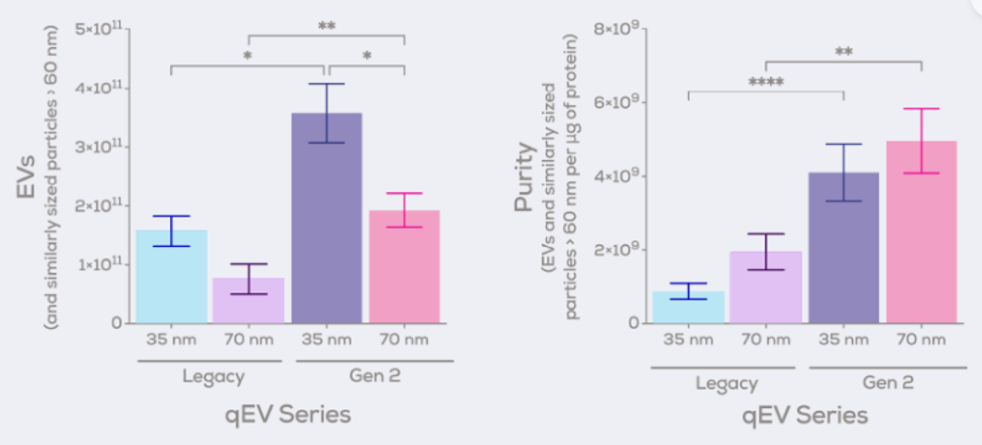
Figure 3. Legacy vs Gen 2: recovery of EVs and same-size particles larger than 60 nm, and particles per μg protein.
Measuring purity as the number of EV particles isolated per microgram of total protein, 70 nm Gen 2 columns averaged 2.6 times that of legacy columns and 35 nm Gen 2 columns 4.6 times, and Gen 2 recovery also improved. According to Izon's comparison [1], these results used human plasma, a 0.5 mL load, qEVoriginal with AFC collection, and TRPS particle measurement with BCA protein assay; the particle/protein ratio is not a percentage of particles proven to be EVs, and the matrix and pooled fraction volume both affect the result.
Step 4: Choose GMP-Ready for Clinical Translation
For in vivo studies, clinical diagnostics and therapeutic-grade applications, iZON offers qEV GMP-Ready columns: made to order in a controlled manufacturing environment, with rigorous bioburden and endotoxin testing for every lot, and supplied with a certificate of analysis (CoA) and a regulatory support file (RSF).
Their core advantage is process transfer: SEC process parameters established with qEV during method development can be carried through to clinical release manufacturing, reducing the need to change separation media for a compliance upgrade and lowering translation cost and timeline risk. The specific clinical process still needs validation as required.
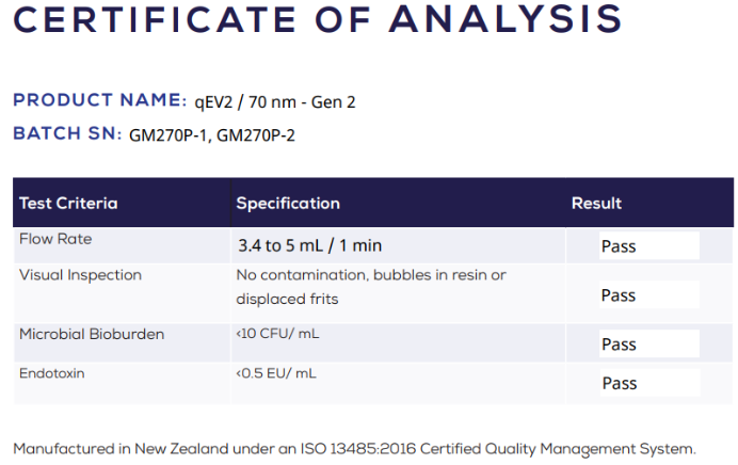
Figure 4. Example certificate of analysis for qEV2 / 70 nm Gen 2, lots GM270P-1 and GM270P-2. Visible specifications include a flow rate of 3.4–5 mL/min, visual inspection, bioburden below 10 CFU/mL and endotoxin below 0.5 EU/mL, with all four results marked "Pass"; the image also shows an ISO 13485:2016 certified quality management system. These are column specifications for the lots shown, not a release certificate for a purified EV product.
Step 5: Add Automation by Throughput
As sample throughput rises to pilot scale, iZON offers four automation systems that connect with qEV columns:
| Automation system | Compatible columns | Core function | Stage |
|---|---|---|---|
| AFC V2 | single / original / 1 / 2 / 10 | Gravimetric automatic collection, RFID recognition | Clinical cohorts, high-throughput screening |
| qEV DXter | single (×24) / original (×12) | Robotic arm, 12/24 samples in parallel | IVD testing, drug screening |
| qEV Zenco / BigZenco GMP | 2 / 10 / 100 and industrial columns | Flow rate ≤100 mL/min, UV/pH/conductivity monitoring | Pilot to GMP manufacturing |
| qEV TFF | Used with qEV | Tangential-flow concentration + SEC purification, >99% protein removal | Pilot to GMP manufacturing |
The >99% protein removal of TFF–SEC is a result under its test conditions; protein removal and EV recovery are two different performance measures.
Four-Step Selection Checklist
- Determine the sample volume and match the column size (qEVsingle to qEV100);
- Judge purity needs: 35 nm in general (broad recovery), 70 nm if lipoprotein-sensitive;
- Assess the compliance grade: choose GMP-Ready directly for clinical translation projects;
- Confirm throughput needs: add AFC, DXter, Zenco or TFF automation for high-throughput work.
Four Practical Cases
Case 1: Milk-Derived Extracellular Vesicles
- Sample features: a complex high-fat, high-protein matrix in which milk fat globules, casein micelles and whey proteins coexist, with high viscosity and a high background particle count;
- Pre-treatment: defatting, casein precipitation, about 25-fold qEV TFF concentration;
- Column: 70 nm series (column size set by loading volume);
- Rationale: the 70 nm series removes lipoproteins efficiently (about 99% ApoB removal in plasma) and suits high-fat samples; 20/35 nm retain lipoproteins poorly and are not recommended for high-fat samples. Note that plasma ApoB data do not represent removal performance in milk.
Case 2: High-Concentration, High-Viscosity Cell Culture Supernatant
- Sample features: supernatant from high-density cell fermentation/culture with high concentrations of secreted proteins, cell debris and metabolic impurities, and high viscosity; EV concentration is low and the original volume large;
- Pre-treatment: dilution, clarifying filtration, qEV TFF concentration;
- Column: 35 nm series (column size set by loading volume);
- Rationale: 35 nm is the common pore size in EV research, balancing recovery and purity.
Case 3: Serum/Plasma EV Isolation (Biomarker Research Grade)
- Sample features: a complex matrix with high-abundance albumin, globulins and lipoproteins (ApoA1, ApoB); lipoprotein particles overlap heavily with EVs in size, readily co-elute and seriously interfere with downstream experiments, and cannot be removed by centrifugation before SEC;
- Pre-treatment: low-speed centrifugation to remove cell debris;
- Column: qEV1 or qEV2 (by processed volume);
- Rationale: when ApoB residue is the key constraint, prefer 70 nm, which according to the source material removes about 99% of plasma ApoB; all qEV series also remove ApoA1 well (below the ELISA detection limit), effectively separating low- and high-density lipoproteins from extracellular vesicles in plasma and greatly lowering the background of contaminating particles. When small-particle recovery is the priority, 35 nm can be considered (the case uses qEV1/qEV2 35 nm, while the ApoB-removal rationale favours 70 nm; the two column choices differ). Co-elution and detection limits still affect interpretation.
Case 4: Large-Scale MSC Exosome Production in 3D Bioreactors (Pilot / Preclinical Scale-Up)
- Sample features: large volumes (10–100 L), with high requirements for purification throughput, batch stability and reproducibility;
- Pre-treatment: clarifying filtration, qEV TFF tangential-flow concentration and high-fold diafiltration;
- Column: 35 nm series (qEV100, qEV400 or larger);
- Rationale: 35 nm balances recovery and purity, fits the size distribution of bioreactor MSC-EVs, and stably removes soluble medium proteins at large scale, helping to keep EV critical quality attributes (CQAs) consistent across batches, with quality control built with reference to MISEV separation guidance. qEV100 handles a 100 mL load; with the qEV Zenco automation system, according to the source material, UV profiles were highly consistent over more than 20 runs; for larger scale, qEV400 or other sizes can be customized. The identity, recovery and critical quality attributes of the final EV preparation still need confirmation for the specific process.
Let TechWave Help You Choose the Right qEV Setup
If you are working on plasma liquid biopsy or cell culture supernatant exosome research, or planning pilot scale-up and GMP translation of MSC-EVs, contact TechWave. Based on your sample type, processed loading volume, downstream analysis and throughput, we can help you compare qEV column sizes, pore sizes, Gen 2 and GMP-Ready versions, and AFC, DXter, Zenco and TFF automation configurations, and arrange a quotation.
References
- Izon Science. Extracellular Vesicle Purity Enhanced by Gen 2 qEV Columns With Customised Resin. https://www.izon.com/news/gen-2-qev-columns-with-customised-proprietary-resin
Uses and applicable scenarios
- EV isolation from body fluids such as plasma, serum, urine, cerebrospinal fluid and saliva
- Purification and process scale-up of EVs from cell culture supernatant and 3D bioreactor MSC-EV production
- EV proteomics, RNA analysis and liquid-biopsy biomarker research
- Controlled EV separation for clinical translation and GMP manufacturing
Limitations
- Non-EV particles of similar size, such as lipoproteins, can still co-elute; pore-size choice must reflect the sample matrix and downstream analysis
- Pore-size recovery ranges are representative descriptions, not hard size cut-offs, and particle size alone cannot establish that a particle is an exosome
- Gen 2 purity gains come from specific comparison conditions, and GMP-Ready columns do not replace validation of a specific clinical process