
Technical column
Why choose Exoid: TRPS baseline-resolved all four populations of a quadrimodal standard and measures size and zeta potential particle by particle from 35 µL
Two things hurt EV, LNP and viral-vector characterization most: averages that hide subpopulations and optical methods that miss aggregates. IZON Exoid uses tunable resistive pulse sensing (TRPS) to measure particles one by one through physical impedance rather than light: with a quadrimodal standard it cleanly separated all four particle populations, while NTA missed one and MADLS could not resolve them. Four reasons explain Exoid's accuracy, particle-by-particle output, real-time analysis and tunable range, and how it is used for EVs, LNPs, viruses and nanomedicines.
Definition
Tunable resistive pulse sensing (TRPS) measures particle size, concentration and zeta potential from the ionic-current blockade each particle produces as it passes through a tunable nanopore, without relying on the optical properties of the particles or the dispersant.
In extracellular vesicle, lipid nanoparticle and viral-vector research, particle size, concentration and zeta potential are critical quality attributes that determine biological function and delivery efficiency. Yet "which technology should measure them" has long troubled researchers: one average size can hide aggregates, and an optical method can miss a whole subpopulation — exactly where immunogenicity risk and key biological information lie.
IZON Science has specialised in nanoparticle analysis since 2008. Its core product, Exoid, uses tunable resistive pulse sensing (TRPS), a single-particle physical measurement principle that directly determines particle size, concentration and zeta potential and overcomes the inherent limits of optical detection. In a comparison using a quadrimodal standard, TRPS baseline-separated all four particle populations, NTA missed one and MADLS only sensed them vaguely. Drawing on research data published by IZON, here are four reasons to choose Exoid.
How TRPS works: why it can measure one particle at a time
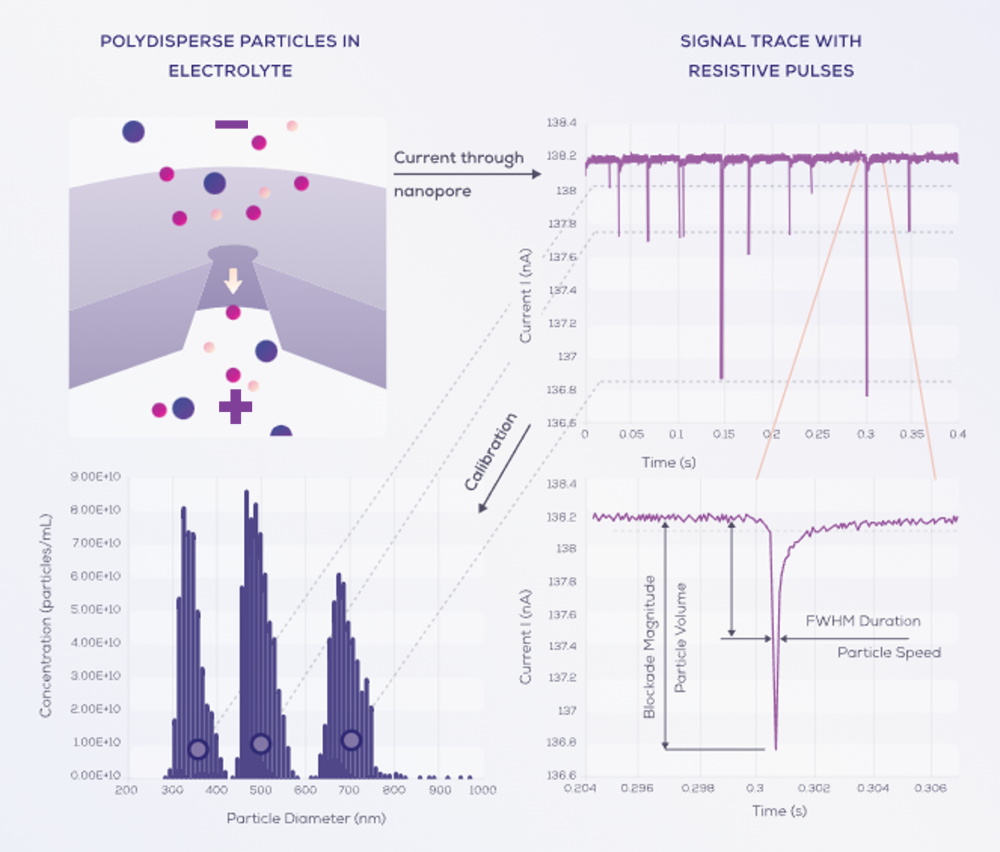
A particle transiting a tunable nanopore produces a resistive pulse.
TRPS is based on physical impedance changes rather than optical signals:
- Electrolyte: nanoparticles are suspended in an electrolyte such as PBS;
- Through the nanopore: driven by applied pressure, particles pass one by one through a nanopore of adjustable size;
- Blockade signal: as a particle passes, it displaces electrolyte and causes a transient blockade of the ionic current in the pore;
- Signal decoding: blockade magnitude is proportional to particle volume, giving size; blockade frequency gives particle concentration; blockade duration reflects particle speed, giving zeta potential;
- NIST-traceable calibration: every measurement is compared against standard particles traceable to the US National Institute of Standards and Technology (NIST), making data repeatable and comparable.
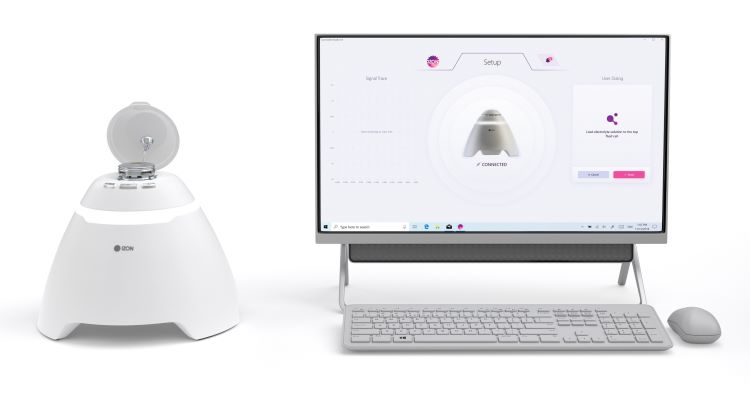
Exoid combines the measurement cell with automated instrument control and analysis.
TRPS needs no prior knowledge of the optical properties of the particles or dispersant: an unknown refractive index does not matter, and a slightly coloured solution is no obstacle.
Reason 1: high accuracy — Exoid sees clearly
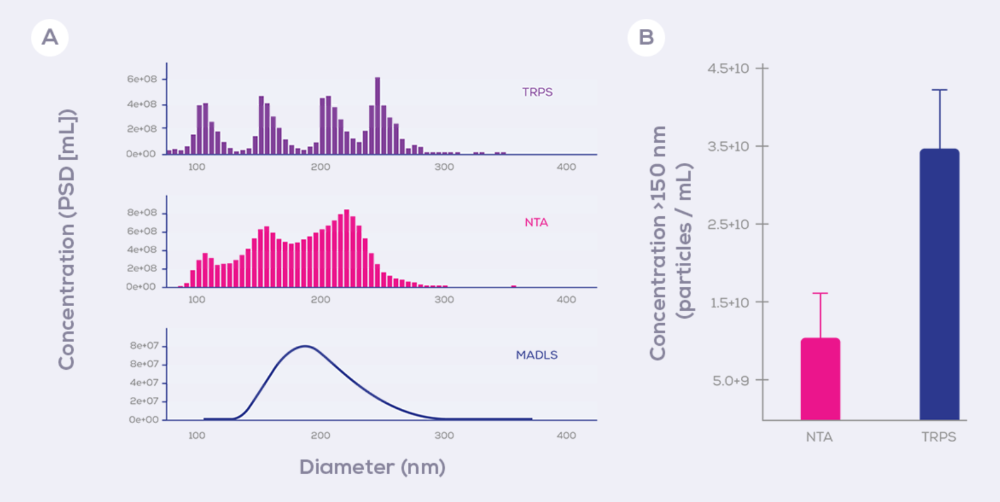
TRPS, NTA and MADLS give different distributions for the same multimodal particle sample.
Accuracy is the standard for nanoparticle characterization. A quadrimodal standard (a mixture of particles of four sizes) was used to compare TRPS, NTA and MADLS (multi-angle dynamic light scattering), with data adapted from Vogel et al. (Sci Rep, 2017):
- TRPS: all four populations clearly shown and baseline-separated, identifying every subpopulation accurately;
- NTA: missed one population and merged the others, with insufficient resolution;
- MADLS: only vaguely sensed that "something" lay among the four populations and could not resolve separate subpopulations.
In nanomedicine development, aggregates can trigger immunogenic responses; in EV marker research, missing a subpopulation can mean losing key biological information. Exoid's accuracy is not a nice-to-have — it is essential.
Reason 2: particle-by-particle measurement — from population averages to single-particle characterization
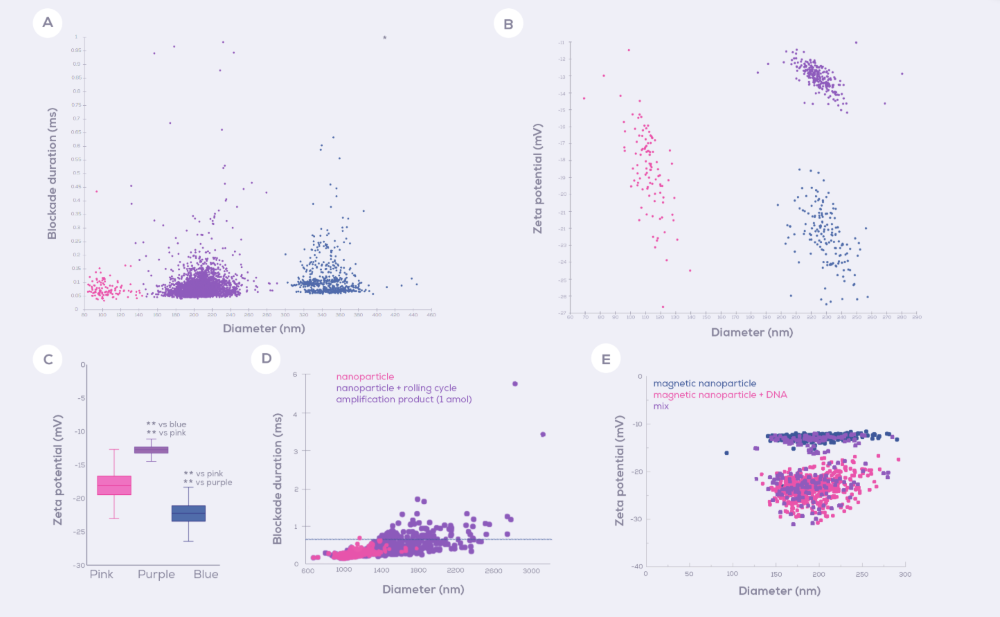
Event-level size and zeta-potential plots resolve particle subpopulations and nucleic-acid loading changes.
Exoid needs only 35 µL of sample for particle-by-particle size and zeta-potential analysis — and, more importantly, the raw data for every particle can be exported for statistical comparison. IZON's example data show a trimodal sample forming separate populations in both size-and-concentration measurement (a blockade-duration vs diameter scatter) and size-and-zeta-potential measurement, with the per-particle zeta potentials of the subpopulations compared directly (double-asterisk markers in the figure indicate p<0.01); the figure also compares the size change after particles bind rolling-circle amplification products (nucleic acid; adapted from Kühnemund and Nilsson, 2015) and the zeta-potential change after DNA loading onto magnetic nanoparticles (adapted from Vogel et al., 2017).
Particle-by-particle analysis has proved its value in many studies:
- Monitoring nano-drug loading: track size and concentration changes of every particle before and after drug loading to assess loading efficiency;
- Distinguishing heterogeneous subpopulations: in polydisperse EV samples, size–zeta-potential scatter plots visualise different subpopulations label-free, for example exosomes, microvesicles and lipoprotein particles;
- Statistical analysis: after exporting single-particle data, compare the whole sample or subpopulations within it statistically.
Reason 3: real-time dynamic analysis — see particles as they change
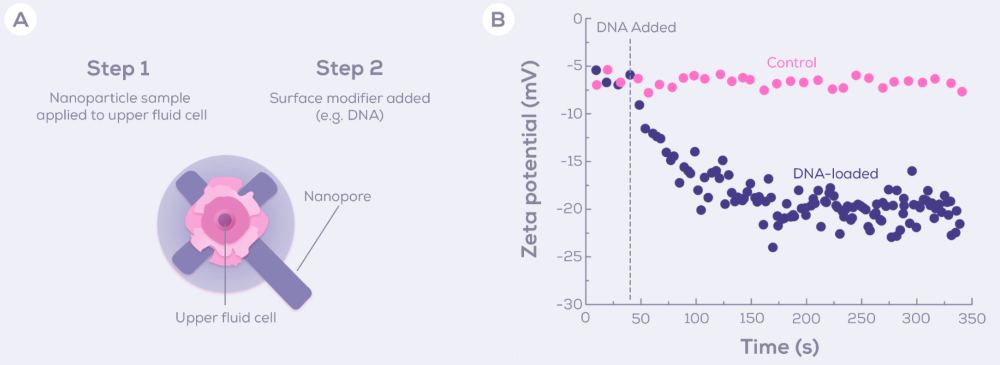
Open-cell addition allows zeta potential to be followed during DNA loading.
On Exoid the sample remains accessible during measurement: it sits in the upper fluid cell and can be reached as soon as the lid is opened. You can add surface-modifying agents or cargo directly to the sample in the measurement well and follow particle changes in real time.
A published example used this to monitor DNA loading onto magnetic nanoparticles in real time: zeta potential fell steadily as DNA loaded, allowing loading efficiency and the time window to be calculated (adapted from Vogel et al., 2017). Direct addition changes volume and ionic environment, so include blank, dilution and time controls.
Reason 4: tunability — from EVs to microorganisms across the full size scale
The "T" in TRPS stands for tunable — the core design principle that distinguishes Exoid from fixed-pore instruments. Tunability works at two levels:
Multiple nanopore sizes: Exoid supports several nanopore models covering a wide measurement range (selected models below):
| Nanopore | Typical measurement range | Example samples |
|---|---|---|
| NP100 | 50–330 nm | Exosomes, small EVs, AAV vectors |
| NP200 | 85–500 nm | Medium EVs, lentivirus, small LNPs |
| NP300 | 130–900 nm | Large EVs, microvesicles, medium LNPs |
| NP1000 | 490–2900 nm | Cells, micron-scale particles |
| NP4000 | 1990–11300 nm | Zoospores, microorganisms, large cells |
Nanopore stretching: once a nanopore is chosen, Exoid's automated system can stretch it to different widths, optimising conditions for particles of different sizes without changing the nanopore. One nanopore can therefore cover a size range spanning several-fold, adding flexibility and efficiency.
Literature examples cover both extremes: small lipid nanoparticles carrying SARS-CoV-2 siRNA (Idris et al., Mol Ther, 2021) and large zoospores (Lacalendola et al., Fungal Genet Biol, 2022). In practice, choose the nanopore for the target size, then establish stable blockade events with stretch, pressure and electrolyte settings.
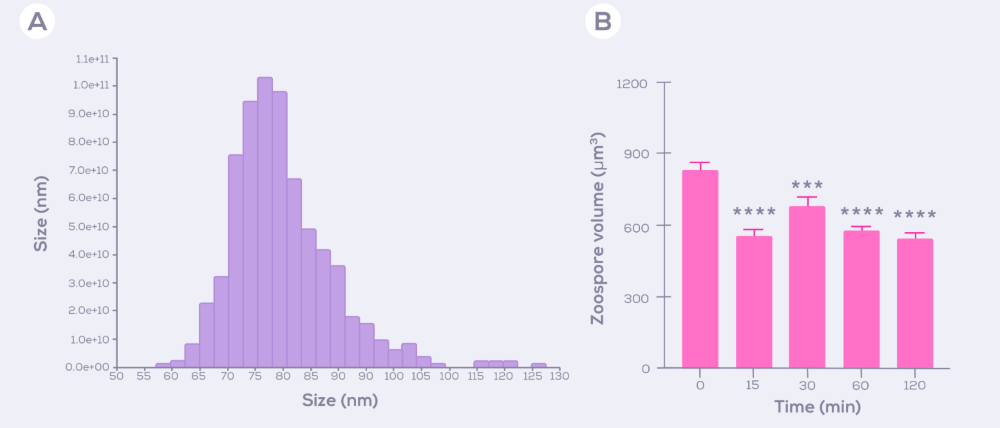
Tunable-nanopore examples at both extremes: size distribution of small LNPs carrying SARS-CoV-2 siRNA (A) and volume change of large zoospores under hyperosmotic stress (B).
Where Exoid is used
Extracellular vesicles (EVs)/exosomes:
- Obtain true EV concentration and size distribution as a reliable basis for marker discovery and liquid biopsy;
- Monitor the effect of disease progression or storage conditions on EV zeta potential;
- Identify heterogeneous EV subpopulations (exosomes, microvesicles, lipoproteins) at high resolution without fluorescent labels;
- Combine with qEV columns to close a standardised "isolation → characterization" loop that supports EV characterization in line with MISEV guidelines.
Lipid nanoparticles (LNPs)/liposomes:
- Capture small size changes of LNPs before and after mRNA/siRNA loading at high resolution;
- Assess aggregation and freeze–thaw stability of LNP formulations — Exoid can detect large aggregates.
Viruses and virus-like particles (VLPs):
- Quantify total viral particle titre faster than traditional methods such as TCID₅₀, providing standardised QC data for viral vectors in gene therapy and vaccine development;
- Detect defective interfering particles (DIPs), an often-overlooked particle subpopulation that affects viral-vector quality.
Nanomedicine delivery systems:
- Provide a three-in-one measurement of size, concentration and zeta potential for nanomedicines;
- Monitor drug loading efficiency in real time and shorten formulation screening.
One boundary is worth remembering: results depend on nanopore, calibrants, electrolyte and pressure settings; label-free gating suggests candidate subpopulations, and total particle titre answers a different question from infectivity measures such as TCID₅₀, so identity and function still need orthogonal methods.
Let TechWave help you set up your particle characterization
Whether you are analysing EV heterogeneity, assessing LNP loading and stability or running particle QC for viral vectors, contact TechWave. Based on your sample type and size range, we can help choose Exoid nanopore models and qEV isolation combinations, share application materials and arrange a quotation.
References
- Akers JC, Ramakrishnan V, Nolan JP, et al. Comparative Analysis of Technologies for Quantifying Extracellular Vesicles (EVs) in Clinical Cerebrospinal Fluids (CSF). PLOS ONE. 2016;11(2):e0149866. doi:10.1371/journal.pone.0149866
- Vestad B, Llorente A, Neurauter A, et al. Size and concentration analyses of extracellular vesicles by nanoparticle tracking analysis: a variation study. Journal of Extracellular Vesicles. 2017;6(1):1344087. doi:10.1080/20013078.2017.1344087
- Bachurski D, Schuldner M, Nguyen PH, et al. Extracellular vesicle measurements with nanoparticle tracking analysis—an accuracy and repeatability comparison between NanoSight NS300 and ZetaView. Journal of Extracellular Vesicles. 2019;8(1):1596016. doi:10.1080/20013078.2019.1596016
- Vogel R, Savage J, Muzard J, et al. Measuring particle concentration of multimodal synthetic reference materials and extracellular vesicles with orthogonal techniques: Who is up to the challenge? Journal of Extracellular Vesicles. 2021;10(3):e12052. doi:10.1002/jev2.12052
- Kühnemund M, Nilsson M. Digital quantification of rolling circle amplified single DNA molecules in a resistive pulse sensing nanopore. Biosensors and Bioelectronics. 2015;67:11-17. doi:10.1016/j.bios.2014.06.040
- Vogel R, Pal AK, Jambhrunkar S, et al. High-Resolution Single Particle Zeta Potential Characterisation of Biological Nanoparticles using Tunable Resistive Pulse Sensing. Scientific Reports. 2017;7:17479. doi:10.1038/s41598-017-14981-x
- Idris A, Davis A, Supramaniam A, et al. A SARS-CoV-2 targeted siRNA-nanoparticle therapy for COVID-19. Molecular Therapy. 2021;29(7):2219-2226. doi:10.1016/j.ymthe.2021.05.004
- Lacalendola N, Tayagui A, Ting M, et al. Biomechanical responses of encysted zoospores of the oomycete Achlya bisexualis to hyperosmotic stress are consistent with an ability to turgor regulate. Fungal Genetics and Biology. 2022;159:103676. doi:10.1016/j.fgb.2022.103676
- Timms K. 4 Reasons Why You Should Be Using the Exoid. IZON Science News, 28 November 2024.
Uses and applicable scenarios
- Concentration, size distribution and subpopulation analysis of EVs and exosomes
- Size, zeta-potential and aggregation assessment of LNPs and liposomes before and after loading
- Total particle titre of viruses and VLPs and detection of defective interfering particles
- Real-time monitoring of nanomedicine loading efficiency and formulation screening
Limitations
- Results depend on nanopore choice, calibrants, electrolyte and pressure settings; new samples need recovery, dilution-linearity and repeatability checks
- The technology comparisons come from specific standards and literature conditions; label-free gating and total particle counts cannot alone prove particle identity, infectivity or potency