
Technical column
Is pilot-scale CCM exosome purification stuck on viscosity and protein? qEV TFF + qEV220 SEC: about 15-fold purity gain, about 96% protein removal, consistent elution over 20 consecutive runs
Conditioned culture medium is high-volume, EV-dilute and protein-rich, and turns viscous once concentrated, so loading it straight onto a column either clogs or leaves purity short. An official IZON poster sets out a scalable route: dilute and clarify, concentrate and buffer-exchange with qEV TFF, remove protein with qEV220 SEC, and collect automatically with qEV Zenco. The result: about 15-fold purity improvement, about 96% protein removal and highly consistent elution profiles over 20 consecutive runs.
Definition
Combined SEC-TFF separates two jobs: tangential-flow filtration (TFF) concentrates and buffer-exchanges, and size-exclusion chromatography (SEC) separates free protein, bringing high-volume, protein-rich conditioned medium into a scalable, repeatable EV purification process.
When exosome drug development reaches pilot scale, the first bottleneck is often not upstream culture but downstream purification. Conditioned cell-culture medium (CCM) comes in litres or tens of litres, with low EV concentration, abundant residual free protein, and high viscosity once concentrated: loading it straight onto an SEC column is slow and inefficient, clogs easily, and makes recovery and lot consistency hard to guarantee.
An official IZON Science poster presents a validated route: dilute and clarify, pre-concentrate with qEV TFF, remove protein on a large-format qEV220 SEC column, and capture the EV peak with the qEV Zenco automated system. Processing pre-concentrated CCM gave about 15-fold purity improvement and about 96% protein removal, with highly consistent elution profiles over 20 consecutive runs — a scalable, repeatable, standardized process path for exosome therapeutics moving from pilot to industrial scale.
Why CCM is so hard to purify
Exosomes/extracellular vesicles (EVs) are next-generation drug-delivery vehicles and disease markers, and their clinical translation is being held back by downstream purification. CCM is one of the main sources for exosome drug development and scale-up — and precisely one of the most demanding for purity. The difficulties fall into three areas:
- High volume, low particle concentration: scaled culture reaches litres or tens of litres while EV concentration stays relatively low, so loading SEC directly is inefficient and slow;
- High protein load: serum-replacement components in the medium and cell-secreted proteins remain in CCM in large amounts; these free proteins overlap heavily with exosomes in size and are hard to remove with conventional ultracentrifugation or precipitation;
- High viscosity: concentrated CCM is often viscous, and loading it directly can clog the column bed and destabilize flow, affecting recovery and lot consistency.
Scaled CCM exosome purification therefore needs three things: concentrate first, then purify, and be able to scale.
The poster study: three biofluids, one scalable SEC-TFF workflow
The official IZON poster "Translating EV Isolation to Pilot Scale: A Validated SEC-TFF Workflow for High-Purity Processing Across Diverse Biofluids" presents a pilot-scale workflow combining qEV SEC columns from qEV10 to qEV500 with the qEV TFF tangential-flow filtration system.
The team chose three biofluids with very different physicochemical properties: fresh goat milk (rich in lipids and casein), highly concentrated, highly viscous CCM (the focus of this article), and frozen plasma. A standardized "pre-treatment and clarification → qEV TFF concentration/buffer exchange → SEC purification" workflow verified the system's general applicability and robustness. Particle concentration was measured by Exoid tunable resistive pulse sensing (TRPS), and particle-to-protein ratio was calculated from BCA protein quantification.
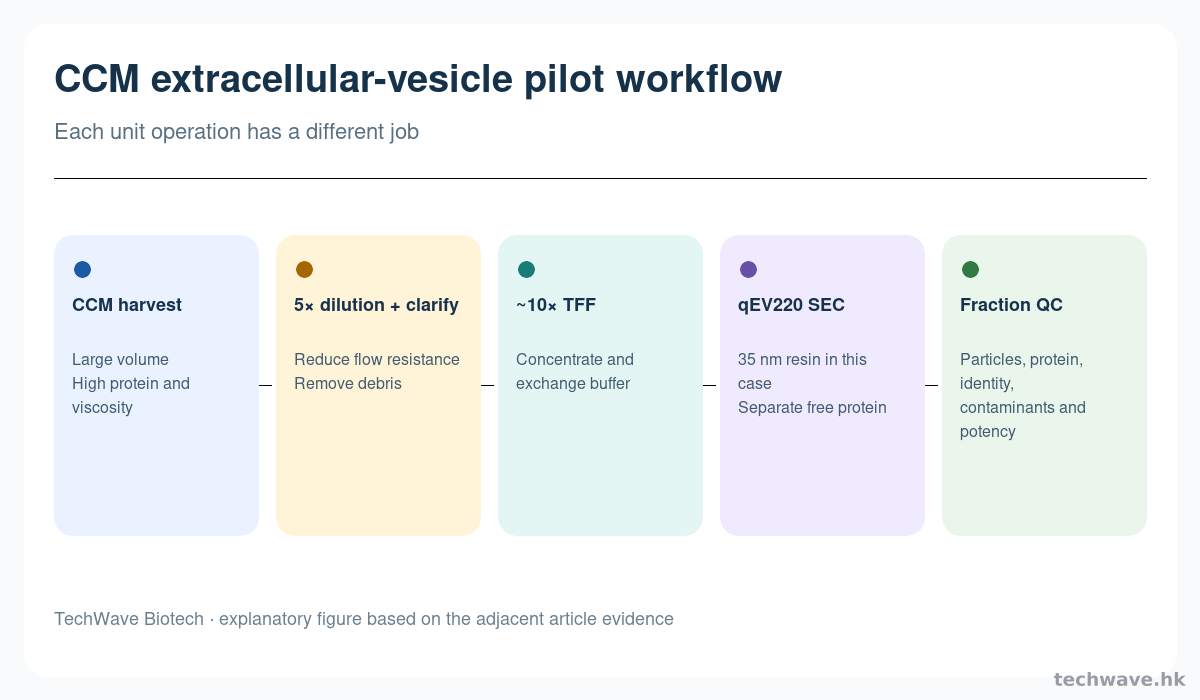
Dilution and clarification condition the feed, TFF controls volume and buffer, and SEC performs higher-resolution protein separation.
| Stage | Operation | Key equipment/consumables | Purpose |
|---|---|---|---|
| Pre-treatment | 5× dilution → clarification → 10× qEV TFF concentration | qEV TFF (300 kDa MWCO membrane recommended) | Lower viscosity, remove cell debris and large particles, enrich EVs, exchange buffer |
| SEC purification | qEV220 (35 nm or 70 nm resin) | Large-format qEV220 SEC column + qEV Zenco | Remove free protein and small-molecule impurities by size exclusion to obtain high-purity EVs |
| SEC purification | In-line UV monitoring + automated fraction collection | qEV Zenco automated chromatography system | Stable flow, automatic capture of the EV-rich peak, traceable process reports |
The process, step by step: each step solves one problem
Pre-treatment: dilution, clarification and qEV TFF pre-concentration
- 5× dilution: lowers CCM viscosity;
- Clarification: removes cell debris and large aggregates to prevent clogging;
- 10× qEV TFF concentration: brings high-volume CCM down to a volume suitable for qEV220 loading under low shear, while exchanging part of the small proteins and buffer.
qEV220 SEC: the key step from concentrate to high-purity EVs
qEV220 is IZON's large-format SEC column designed for pilot-scale work. The CCM sample in the poster used qEV220 35 nm resin (resin pore size is chosen for the target EV size and purity requirement). The separation principle is straightforward: large EVs cannot enter the agarose resin pores and pass quickly through the interstitial space, while small free proteins enter the pores and are retained longer. Through this molecular-sieve effect, qEV220 effectively separates target EVs from abundant contaminating protein.
In this study qEV220 processed CCM at a scale of 5.4 L (customer pre-concentrated sample) → 9.9 L (collected after purification), achieving about 15-fold purity improvement and about 96% protein removal. Note that the collected volume is larger than the load volume — which is exactly why concentration must not be read as total recovery, as discussed below.
Automation: qEV Zenco makes the process repeatable and traceable
Once sample volume reaches pilot or production scale, manual collection is no longer sustainable. The qEV Zenco automated chromatography system integrates in-line UV monitoring, flow control and automatic fraction collection. The poster describes the number of consecutive runs as both 22 and 20; the safe conclusion is that at least 20 consecutive runs produced highly consistent elution profiles, demonstrating the robustness of the column and the automated system.
Step-by-step data: TFF concentrates, SEC removes protein
The poster gives a complete data chain for CCM (qEV220) from crude to qEV-purified sample: particle concentration (TRPS), protein concentration (BCA) and particle-to-protein purity.
| Process step | Particle concentration (particles/mL) | Protein concentration (µg/mL) | Purity (particles/µg protein) |
|---|---|---|---|
| Raw | 1.30E13 | 15,300 | 8.5E8 |
| Clarified | 1.51E12 | 14,307 | 1.06E8 |
| Post-TFF | 1.81E13 | 86,619 | 2.09E8 |
| qEV purified | 8.68E12 | 6,000 | 1.29E9 |
Source: official IZON Science poster "Translating EV Isolation to Pilot Scale" (Li Y, et al.). Note: the purity of 1.29E9 in the qEV-purified row is the poster's value; dividing that row's particle concentration by its protein concentration gives about 1.45E9. This article keeps the poster's values and derives no new fold-changes from them.
Three readings:
- TFF enriches EVs but does not remove protein: Post-TFF raised particle concentration from 1.51E12 to 1.81E13 particles/mL (about 12-fold), and protein concentration rose too. TFF "concentrates" rather than "purifies": it brings dilute EVs into a volume SEC can handle without markedly changing the particle-to-protein ratio.
- Real protein removal happens in SEC: after qEV220, protein concentration fell to 6,000 µg/mL and the particle-to-protein ratio rose from 2.09E8 (Post-TFF) to 1.29E9. The poster's summary results are about 96% protein removal and about 15-fold purity improvement; because the table does not list full volumes and totals for each step, these two summary values cannot be recalculated from the concentrations alone, and any fold-change must state its baseline.
- EV recovery is substantial: after qEV purification, particle concentration was 8.68E12 particles/mL, lower than the 1.81E13 after TFF because SEC dilutes the sample with buffer; alongside high protein removal, recovery was in line with expectations for an SEC process.
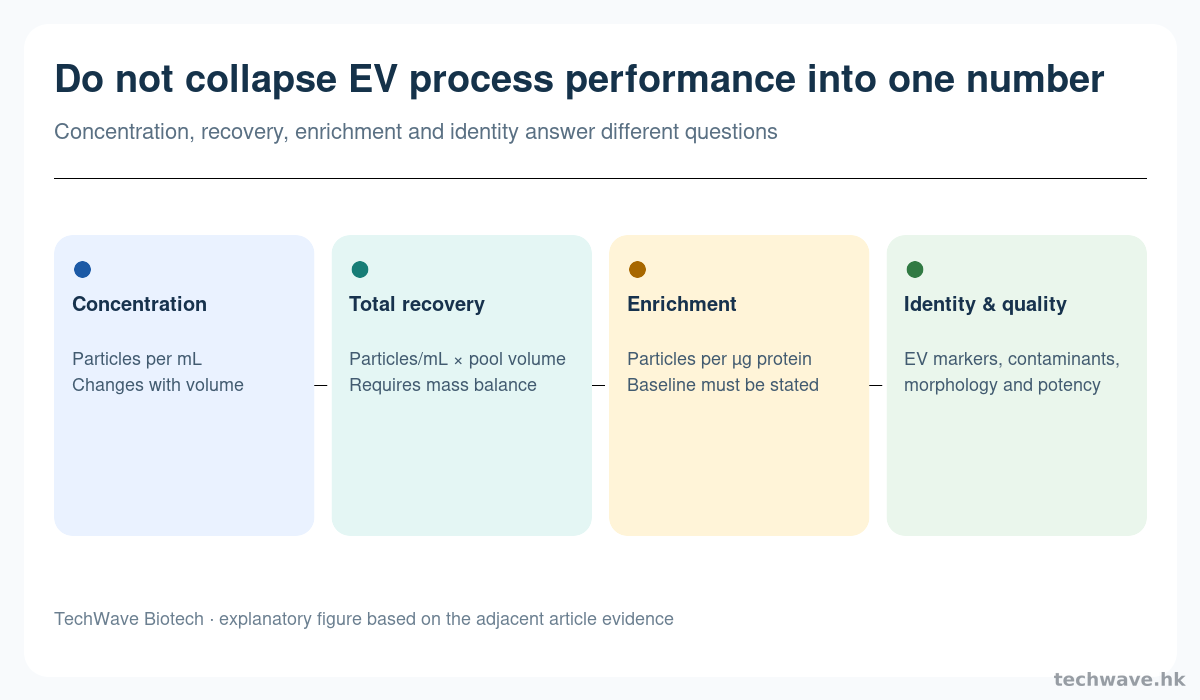
Particle concentration, total recovery, particle-to-protein enrichment and EV identity require separate measurements.
In process development, report concentration, total recovery and purity separately: SEC elution adds volume and TFF removes it, so a fall in particle concentration is not a loss of total particles. A reliable mass balance needs at least the load volume, collected volume, total particles and total protein for each step, plus uncollected flow-through and wash fractions. Particle-to-protein ratio shows relative enrichment but is not an EV identity marker; add EV-positive markers, non-EV contaminants, morphology or single-particle methods for orthogonal confirmation.
Robustness and scale: consecutive-run verification on qEV220
For exosome drug manufacturing, one good purification lot is not enough; the process has to survive repetition. Poster data show that qEV220 with the qEV Zenco automated system delivered stable elution profiles over 20 consecutive runs without obvious loss of column efficiency. This shows that large-format qEV220 SEC columns offer, in pilot-scale settings:
- Long-term reuse: lower cost per run;
- Automation compatibility: seamless connection to qEV Zenco, reducing human error;
- Scale coverage: from qEV10 (100 mL scale) to qEV220 (5 L scale and above) to qEV500 (larger scale), forming a linear scale-up path.
Conclusion: one system, scaled from bench upward
Based on the official IZON poster, four key conclusions follow:
- SEC-TFF is an effective strategy for scaled CCM exosome purification: TFF solves "too much volume" and "too dilute", SEC solves "too much protein" — they are complementary and both necessary;
- SEC can handle viscous, protein-rich pre-concentrated CCM: qEV220 still achieved about 15-fold purity improvement and about 96% protein removal;
- Automation is key to process robustness: qEV Zenco secured reproducibility over 20 consecutive runs, giving pilot and production work a traceable data basis;
- The workflow extends across matrices and scales linearly: the same qEV SEC-TFF workflow scales linearly from qEV10 to qEV220, so the process can grow step by step within one system.
For exosome drug developers, this means that moving from bench to pilot is no longer "developing a new process" but gradually scaling volume and adding automation within the same qEV system. One boundary matters: these data come from a specific CCM sample and workflow, so membrane cut-off, resin, load volume and elution window should be reconfirmed around your EV size, viscosity, protein load and quality attributes.
Let TechWave help you scale your purification process
If your CCM exosome project is moving from bench to pilot scale, or you are struggling with purity and repeatability on viscous, protein-rich samples, contact TechWave. Based on your sample volume, target EV size and scale-up plan, we can help map out a combination of qEV TFF, qEV SEC columns and qEV Zenco, share application materials and arrange a quotation.
References
- Li Y, Pal VK, Mauleon G, Marchioni M, Severi C, Xuan B. Translating EV Isolation to Pilot Scale: A Validated SEC-TFF Workflow for High-Purity Processing Across Diverse Biofluids [Poster]. Izon Science.
- Böing AN, van der Pol E, Grootemaat AE, Coumans FAW, Sturk A, Nieuwland R. Single-step isolation of extracellular vesicles by size-exclusion chromatography. Journal of Extracellular Vesicles. 2014;3:23430. doi:10.3402/jev.v3.23430
Uses and applicable scenarios
- Pilot-scale purification of exosomes/EVs from conditioned cell-culture medium
- SEC protein removal from viscous, protein-rich pre-concentrated samples
- qEV TFF concentration and buffer exchange
- Traceable processing with in-line UV monitoring and automated fraction collection
Limitations
- Data come from a specific CCM sample, membrane and qEV220 workflow; parameters must be reconfirmed for other cells, media or scales
- Per-step concentration is not total recovery, and particle-to-protein ratio alone does not prove EV identity or potency