
Technical column
StemFit Basic03, Basic04CT or Basic05? A Higher Number Is Not an Upgrade — Three Questions to Pick the Right Medium
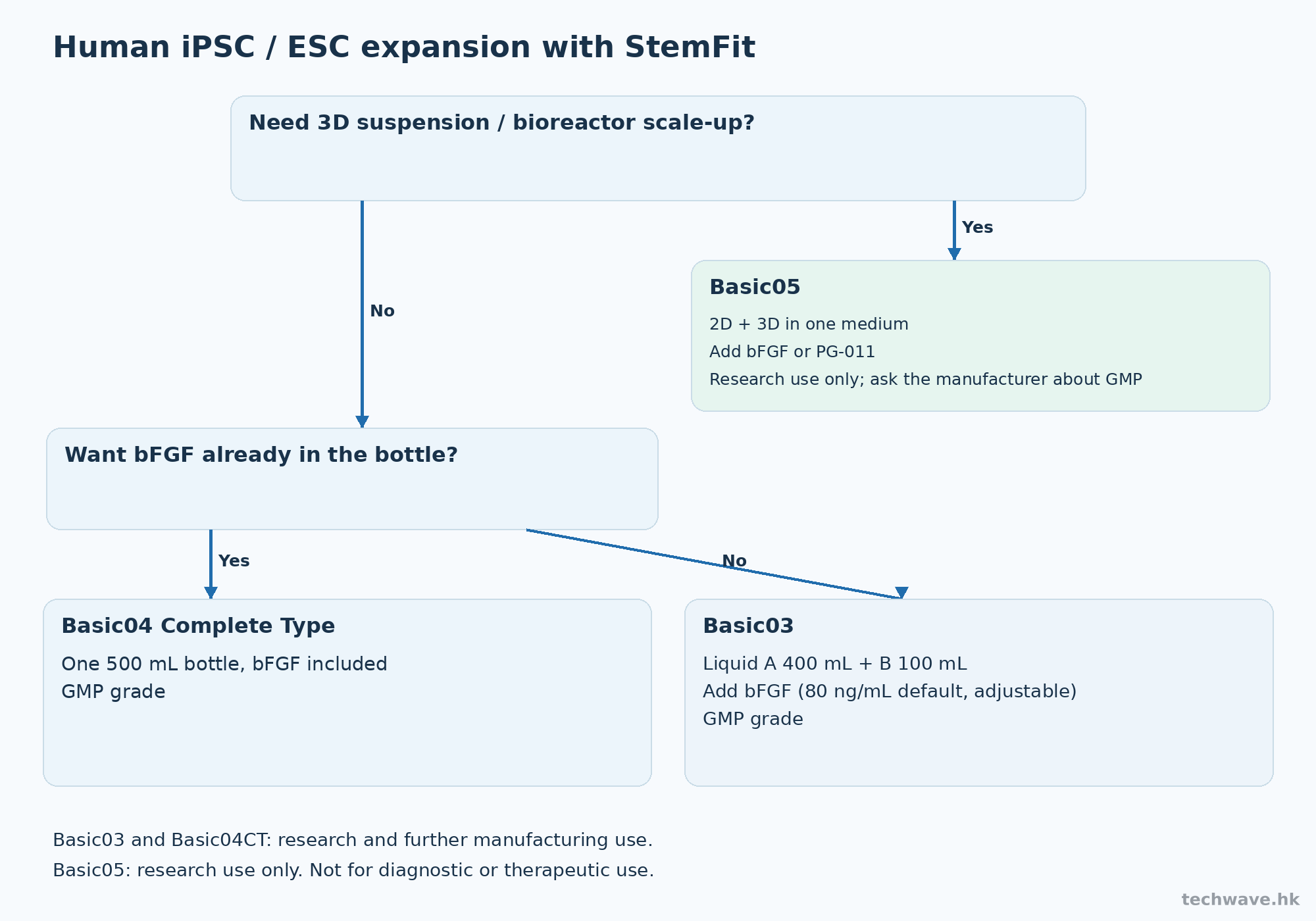
Ajinomoto's three StemFit media for human pluripotent stem cells — Basic03, Basic04 Complete Type (Basic04CT) and Basic05 — differ by a single digit, yet they are not successive generations replacing one another. Three lines actually separate them: whether you need 3D suspension culture and bioreactor scale-up; whether you need a GMP-grade medium; and whether you want to add bFGF yourself or have it already in the bottle. Basic03 is a GMP-grade two-component basal medium (liquids A and B) without bFGF, supplemented by default at 80 ng/mL and adjustable to the application. Basic04CT is a single 500 mL GMP-grade bottle with bFGF already included and ready to use. Basic05 supports both 2D adherent and 3D suspension culture, and the manufacturer's scale-up example grows cells from about 6 million to about 1.2 billion; it is currently labelled for research use only and contains no bFGF, so bFGF or the manufacturer-recommended FGF2-alternative peptide PG-011 must be added. This article puts the composition, bFGF supplementation, storage conditions and switching points of all three into one selection chart and two comparison tables, and unpacks the four most common misunderstandings.
Definition
StemFit is Ajinomoto's line of media for feeder-free culture of human pluripotent stem cells (hPSCs, including iPS and ES cells). This article compares the three globally available media in the line used for maintenance and expansion, all animal-origin-free (AOF) formulations: Basic03 (liquids A and B, no bFGF, GMP grade), Basic04 Complete Type (single bottle with bFGF, GMP grade) and Basic05 (2D and 3D suspension culture, no bFGF, research use only).
Basic03, Basic04CT, Basic05 — most people's first instinct on seeing these three names is that a higher number means newer, and the newest is the safe buy.
With StemFit, that instinct will get you the wrong bottle. The numbers run in sequence, but the manufacturer has never said that one replaces another. Each answers a different question: do your cells need to leave the plate and go into a bioreactor? Does your process need a GMP-grade medium? And bFGF, the most fragile growth factor in the medium — do you want to control it yourself, or have it already in the bottle?
Answer those three questions and the choice is made.
Video explainer
StemFit Basic03, 04CT or 05? A Higher Number Is Not an Upgrade
Watch on YouTube ↗Video transcript
Ajinomoto's StemFit line has three media for human pluripotent stem cells: Basic03, Basic04CT and Basic05. The numbers run in order, so most people's first instinct is that the highest number is the newest, and buying the newest cannot go wrong.
Here, that instinct will lead you to the wrong bottle. The numbers are consecutive, yet the manufacturer has never said that one replaces another. Each answers a different question. First, will your cells leave the plate and go into a bioreactor?
Second, does your process need a GMP-grade medium? Third, the most delicate growth factor, bFGF: do you want to control it yourself, or have it already in the bottle? Answer those three and the choice is made. Start with the first question, because only Basic05 can take it on: the same medium supports both 2D adherent and 3D suspension culture.
Moving a process from plates to reactors without changing media saves a round of re-optimisation. The manufacturer's scale-up example with one iPS cell line goes like this: start in 2D, then step through a shaker, a spinner flask and a vertical-wheel reactor, four passages over 20 days, up to 1.5 litres. Each passage expanded the cells three- to sevenfold, from about 6 million to about 1.2 billion, roughly 200 -fold, with uniform aggregates and pluripotency well maintained.
So the number has a precondition: it is one line's example, and with your own cells it has to be confirmed again. Can the cells still differentiate afterwards? The manufacturer says yes: dissociated first or started straight from intact aggregates, both routes confirmed three-germ-layer differentiation.
If you only work in 2D and have no near-term plan to scale up, Basic05 is not a must. If you already culture in 2D with StemFit and plan to move to 3D, the manufacturer's answer is short: you can switch. Just remember that Basic05 is currently for research use only.
The second question separates Basic05 from the other two. Basic03 and Basic04CT both have GMP versions, labelled for research and further manufacturing use. Production and release testing follow Ajinomoto's GMP standard for regenerative medicine media.
Basic05 is currently labelled for research use only; anyone who needs a GMP-compliant product has to ask the manufacturer directly. The manufacturer says it was designed to clinical-use requirements to support the move from research to clinical manufacturing — that is its design goal, not the scope of the bottle you can buy today.
No 3D, but GMP grade: that leaves Basic03 or Basic04CT, and bFGF decides it. It is the key signal that keeps human pluripotent stem cells undifferentiated, and the least stable: a published study measured it in stem cell culture at 37 °C and found more than half gone four hours after feeding.
Basic03 hands bFGF over to you. After mixing liquids A and B, you add bFGF at the manufacturer's default of 80 nanograms per millilitre, adjustable; Ajinomoto's bFGF and commercial bFGF both work. Choose it if you want to set the bFGF source and concentration yourself, or use it as the basal medium during differentiation.
Basic04CT puts everything in one bottle: bFGF is already inside, ready to use, with no mixing of supplements and one less contamination risk. The manufacturer's data run from line derivation through to expansion: in a collaborative study with Osaka University, human peripheral blood mononuclear cells reprogrammed with synthetic mRNA and cultured in this medium gave iPS cell colonies on day 14.
Basic05 also needs something added: either bFGF or the FGF2-alternative peptide PG-011. The manufacturer recommends PG-011, and the product information recommends a final concentration of 10 to 30 nanograms per millilitre.
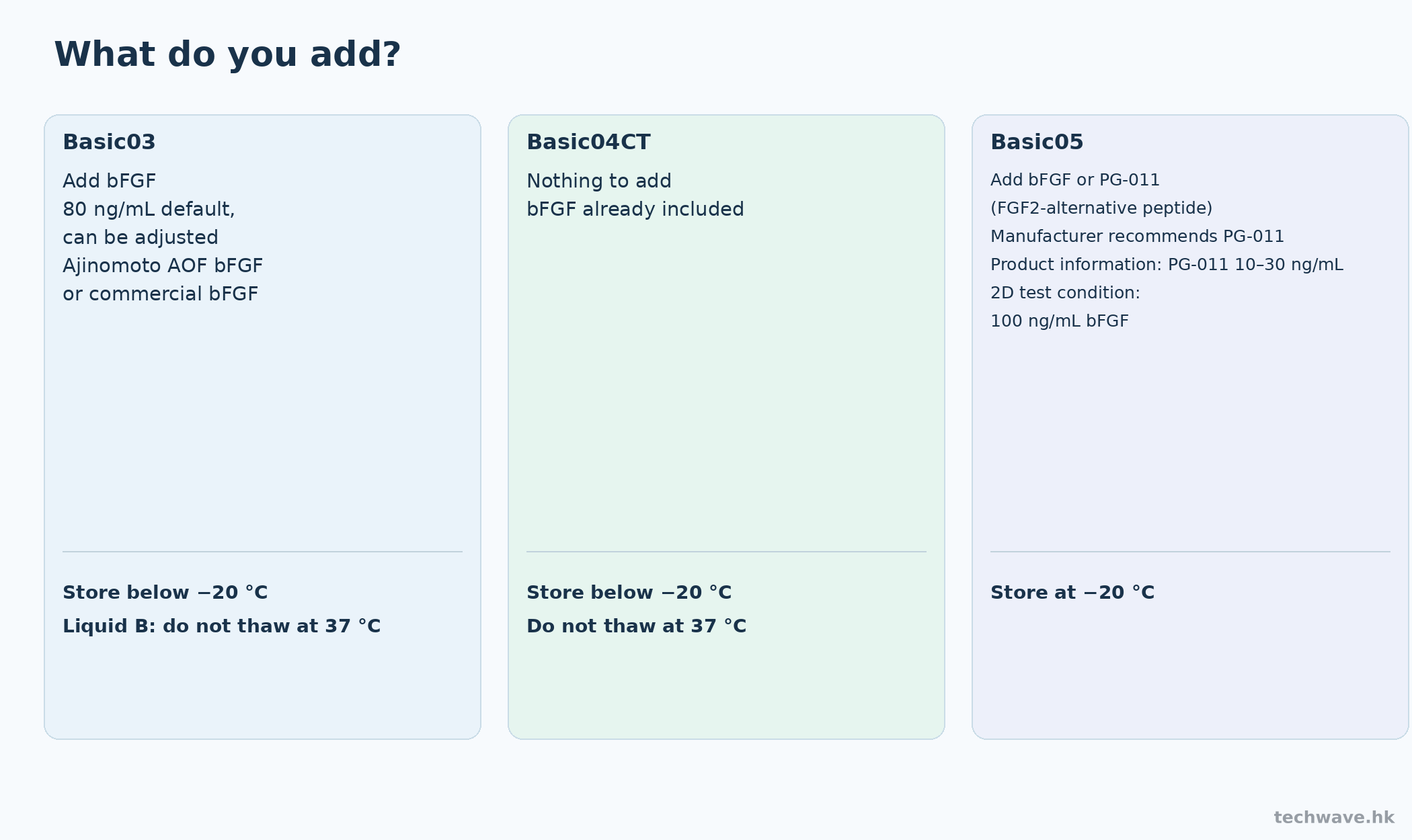
PG-011 is a heat-stable cyclic peptide; the manufacturer says Basic05 gives comparable expansion even when weekend feeds are skipped, partly thanks to it. One line covers all three: Basic03, add bFGF; Basic04CT, add nothing; Basic05, add bFGF or PG-011. And one detail is easy to misread: the 100 nanograms per millilitre of bFGF in the manufacturer's 2D test was an experimental condition, not a recommended concentration.
All three share two handling rules, both written in the manufacturer's instructions. First, never thaw in a 37 °C water bath; the manufacturer says that speeds up degradation of the components. All three are stored frozen and thawed at room temperature, 15 to 25 °C; Basic05 can also be thawed overnight at 2 to 8 °C.
Second, after thawing, keep it at 2 to 8 °C for no more than two weeks, and protecting it from light is recommended. Labs that use small volumes do better to aliquot right after thawing and freeze the aliquots. Misunderstanding one: Basic05 is an upgraded Basic03.
It is not. The manufacturer calls it next-generation because it works in both 2D and 3D; in 2D, across three iPS cell lines over four seven-day passages, it grew comparably to or better than Basic03. But it is research grade only, so for 2D -only GMP work, Basic03 and Basic04CT remain the right choice.
Misunderstanding two: Basic04CT is just Basic03 with bFGF pre-added. The manufacturer does not say so. What it says is that the Japan-only AK03N equals Basic03 plus a bFGF supplement, while Basic04CT corresponds to AK02N, with its human-derived components replaced by recombinant materials.
So neither stands in for the other; after switching, re-check your cells. Misunderstanding three: ordering AK03N or AK02N straight from an older paper. You cannot; both are sold only in Japan. One line converts them: AK03N corresponds to Basic03 plus bFGF, and the global counterpart of AK02N is Basic04CT.
Misunderstanding four: taking the manufacturer's numbers as what your own experiment will show. Basic04CT's expansion from 10,000 to 1 billion cells in three weeks used two specified iPS cell lines; the recovery data after single-cell sorting also used the cloning supplement CloneR2; and the claim of the lowest weekly cost per well among major AOF and research-use media is the manufacturer's estimate on 2025 U.S.
list prices, the feeding and passaging regime each supplier recommends, and single-well scale in a 6 -well plate. With your cells and your prices, recalculate. In the lab: translational teams that need GMP paperwork choose Basic03 or Basic04CT, the first if you manage your own bFGF, the second for one less mixing step.
Gene-editing teams cloning single cells every day will find Basic04CT simpler. Process-development teams heading for reactors choose Basic05, confirming cells in 2D before moving to 3D; it is for research use only, so ask the manufacturer about a GMP version early.
So ignore the numbers and look at the questions: 3D or not, GMP or not, bFGF added by you or already in the bottle. The full selection chart and comparison tables are in the article of the same name on our website.
StemFit 03, 04CT, 05: Is a Higher Number Better?
Watch on YouTube ↗Video transcript
StemFit has three stem cell media: Basic03, 04 CT and 05. The numbers run in order, so is each one an upgrade on the last? No. They answer three different questions. Question one: 3D suspension and bioreactors? If yes, choose Basic05, one medium for both 2D and 3D.
But it needs bFGF or PG-011 added, and it is for research use only. Question two: GMP grade? If yes, choose between Basic03 and Basic04CT; both have GMP versions. Question three: the delicate bFGF. To add it yourself, choose Basic03, 80 nanograms per millilitre by default and adjustable. To have it in the bottle, ready to use, choose Basic04CT.
One rule for all three: never thaw in a 37 °C water bath; after thawing, 2 to 8 °C for two weeks at most. Ignore the numbers, ask the questions. The full selection chart is in the article on our website.
Produced by TechWave. For research reference only; not medical advice.
The short answer: three questions, one medium
| Basic03 (GMP) | Basic04 Complete Type (GMP) | Basic05 | |
|---|---|---|---|
| Catalog number | SF031-001 | SF041-001 | SF070-001 |
| Format | Liquid A 400 mL + liquid B 100 mL | One 500 mL bottle | 500 mL |
| bFGF | Not included; add separately | Included | Not included; add bFGF or PG-011 |
| Culture mode | 2D feeder-free | 2D feeder-free | 2D adherent and 3D suspension |
| Grade and use | GMP grade; research and further manufacturing use | GMP grade; research and further manufacturing use | Research use only; ask the manufacturer about a GMP version |
| Best fit | GMP-grade maintenance, expansion and derivation where you want to control bFGF source and concentration | GMP-grade derivation, cloning and expansion without a preparation step | Process development moving from plates to shaker flasks, spinner flasks or bioreactors |
All three are animal-origin-free (AOF) formulations for expanding human pluripotent stem cells, and the manufacturer provides weekend-free feeding guidance or data for each [1][2][3]. Everything that separates them is in the rows above.
Question one: do you need 3D suspension and bioreactor scale-up?
This is the first cut, because only Basic05 covers this need.
The manufacturer positions Basic05 as a medium for scalable hPSC manufacturing, with one medium for both 2D adherent and 3D suspension culture. The point is that when a process moves from plates into shaker flasks and bioreactors, the medium stays the same, removing a round of re-development and optimization that a medium change would bring [3].
The manufacturer's scale-up example is easy to follow: starting from 2D culture and stepping through a shaker platform, a spinner flask and a vertical-wheel reactor over four passages and 20 days, the culture was scaled to 1.5 L with 3–7-fold expansion per passage, growing from about 6 million cells (6E6) to about 1.2 billion (1.2E9), roughly 200-fold, with uniform aggregates and high pluripotency maintained [3]. The manufacturer also lists reactor types used successfully: rotary shakers, stirred-tank reactors and vertical-wheel bioreactors [3].
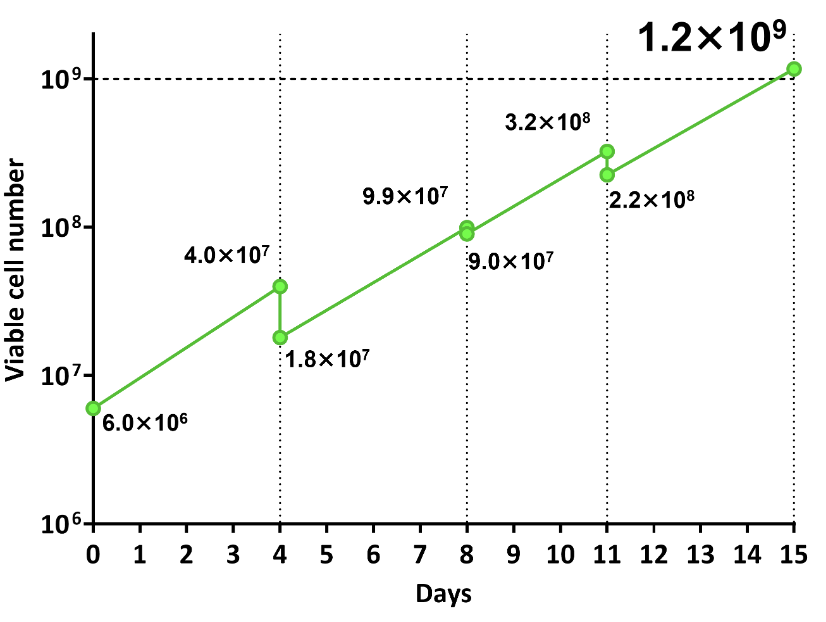
Figure: viable cell numbers in the Basic05 3D scale-up example (manufacturer data). Image source: Ajinomoto StemFit Basic05 product page, reproduced with permission.
Can cells still differentiate after 3D suspension culture? The manufacturer says yes: both dissociating spheroids before differentiation and differentiating directly from intact aggregates were evaluated, and differentiation into all three germ layers was confirmed with both; suspension aggregates were also differentiated directly into hematopoietic progenitor cells [3].
If you work only in 2D and have no near-term plan to scale up, Basic05 is not a must. But if you already culture in 2D with StemFit and are preparing to move to 3D, the manufacturer's FAQ answer is simple: yes, you can [3]. We will cover the full scale-up route in a later article in this series.
Question two: do you need GMP grade?
This cut separates Basic05 from the other two.
Basic03 and Basic04CT both have GMP versions, labelled for research and further manufacturing use. Their quality management system follows the Ajinomoto System of Quality Assurance (ASQUA), and manufacturing and release testing are managed under the GMP standards Ajinomoto formulated for regenerative-medicine culture media, prepared with reference to ICH Q7 and the Japanese PMDA guidance for aseptic manufacturing of regenerative medicine products [1][2].
Basic05 is currently labelled for research use only; for GMP-compliant products, the manufacturer asks users to contact it directly [3]. The manufacturer describes Basic05 as supporting the transition from research to clinical manufacturing and designed to meet the requirements of clinical applications — that is its design goal, not the permitted use of the bottle available today.
Two further manufacturer statements about Basic03 are worth noting. According to the manufacturer, the Japanese PMDA was consulted on Basic03's formulation and manufacturing process and found that it satisfies the requirements for ancillary materials in cell and gene therapy manufacturing; and CGT Catapult, the UK centre for advancing the cell and gene therapy industry, ran a comprehensive comparison of hPSC media in which, the manufacturer says, Basic03 showed the highest performance for clinical hPSC expansion [1]. Both statements concern Basic03 only.
Question three: add bFGF yourself, or have it in the bottle?
If you do not need 3D and do need GMP grade, the choice is between Basic03 and Basic04CT. One factor decides it: bFGF.
bFGF (FGF2) is the key signal that keeps human pluripotent stem cells undifferentiated, and also the least stable ingredient in the medium — published measurements show that in stem cell culture at 37 °C, more than half of it is gone within four hours of feeding (see the previous article in this series, "Down More Than Half in Four Hours: Why bFGF Is Not in the Bottle"). The two media answer this in two ways:
- Basic03: bFGF is in your hands. Basic03 is derived from the Japan-only AK03N with bFGF excluded. After mixing liquids A and B, bFGF is added at the manufacturer's default 80 ng/mL, and the concentration can be adjusted to your application [1]. Ajinomoto's own AOF bFGF can be used, and the manufacturer has confirmed that commercially available bFGF works as well [1]. It suits teams who want to choose their own bFGF source and concentration, or who need a basal medium for their differentiation workflow — the manufacturer states that Basic03 is used for iPSC derivation and expansion, and as a basal medium in differentiation processes [1].
- Basic04CT: everything in one bottle. bFGF is already in the bottle and the medium is ready to use, with no supplement mixing and one fewer contamination risk [2]. The manufacturer's data cover the workflow from derivation to expansion: human peripheral blood mononuclear cells (PBMCs) reprogrammed with synthetic mRNA and cultured in Basic04CT gave TRA-1-60-positive iPSC colonies on day 14, the established clones had a normal karyotype, and pluripotency and trilineage differentiation potential were confirmed by assessment (in a collaborative study with Masato Nakagawa, Ph.D., The University of Osaka) [2].
How bFGF is supplied in each medium
| Add anything? | What to add | Manufacturer's figure | |
|---|---|---|---|
| Basic03 | Yes | bFGF: Ajinomoto AOF bFGF or commercial bFGF | 80 ng/mL by default, adjustable to the application [1] |
| Basic04CT | No | — | bFGF already in the bottle [2] |
| Basic05 | Yes | bFGF, or the FGF2-alternative peptide PG-011 (manufacturer recommends PG-011) | Product information recommends adding PG-011 before use at 10–30 ng/mL final concentration [5]; the 100 ng/mL bFGF in the 2D experiment is an experimental condition, not a recommended concentration [3] |
The Basic05 row deserves a second look. The manufacturer's FAQ is explicit: bFGF signalling is required to maintain iPS cells in an undifferentiated state, so either bFGF or the FGF2 alternative PG-011 must be supplemented, and the manufacturer recommends PG-011 [3]; the product information recommends adding PG-011 before use at a final concentration of 10–30 ng/mL [5]. PG-011 is PeptiGrowth's FGF2-alternative peptide, built from cyclic peptides, which binds the FGFR1c receptor to deliver an FGF2-like signal. The manufacturer also notes that Basic05 achieved comparable expansion when weekend feeding was skipped, and that this is supported not only by the medium itself but also by the excellent thermal stability of PG-011 [3]. PG-011 is supplied by PeptiGrowth, which also offers bulk supply and GMP-grade products in addition to research grade; check suitability for your application directly with PeptiGrowth [3].
Storage and switching: each medium has its own rules
| Storage | Thawing | After thawing | Switching from another medium | |
|---|---|---|---|---|
| Basic03 | Liquids A and B below −20 °C | Thaw at room temperature (15–25 °C); do not thaw liquid B at 37 °C | After mixing, may be aseptically aliquoted and frozen; once thawed, 2–8 °C for no more than two weeks; protect from light recommended | Switch 2 days before passaging [1] |
| Basic04CT | Below −20 °C | Thaw at room temperature (15–25 °C); do not thaw at 37 °C | May be aseptically aliquoted and frozen; once thawed, 2–8 °C for up to two weeks; protect from light recommended | One-step transition per the manufacturer, with consistent cumulative expansion over 3 passages [2] |
| Basic05 | −20 °C | Thaw at room temperature (15–25 °C) or overnight at 2–8 °C; do not thaw at 37 °C | May be aseptically aliquoted and frozen; once thawed, 2–8 °C for up to two weeks; protect from light recommended [5] | Users already culturing in 2D with StemFit can move to 3D [3] |
The two most common handling mistakes are both covered in the manufacturer's instructions. First, do not thaw in a 37 °C water bath — the manufacturer says this accelerates degradation of medium ingredients. Second, the post-thaw window is only two weeks — for labs with modest usage, aliquoting and refreezing right after thawing is the better deal [1][2][5].
On matrices, the manufacturer says common hPSC matrices all work with Basic03, including iMatrix-511, Geltrex, VTN-N, LN521, Matrigel and Synthemax [1]; in the manufacturer's test with the blood-derived line 1210B2, Basic04CT also showed comparable fold expansion across substrates [2]. On passaging, the manufacturer recommends single-cell passaging; if you must passage as clumps, make them small and seed at low density [1].
Four common misunderstandings
Misunderstanding one: Basic05 is an upgraded Basic03 It is not. The manufacturer does call Basic05 a next-generation medium, but what is new is that it works in both 2D and 3D. In 2D, the manufacturer compared three iPSC lines (1383D2, 201B7 and 1210B2) over four passages of seven days each and concluded that Basic05 grew comparably to or better than Basic03 [3]. At the same time it is currently research grade only and still needs bFGF or PG-011 added. For 2D-only processes that require GMP grade, Basic03 and Basic04CT remain the right choice.
Misunderstanding two: Basic04CT is just Basic03 with bFGF pre-added The manufacturer does not say so. What it does describe is a different pair of correspondences: the Japan-only AK03N equals Basic03 plus a bFGF supplement liquid, while Basic04CT corresponds to the Japan-only AK02N — AK02N contains a human-derived ingredient and is categorised as xeno-free, and in Basic04CT those animal-derived ingredients are replaced with recombinant materials to achieve an animal-origin-free formulation [4]. Treating Basic03 plus bFGF as Basic04CT, or the reverse, is therefore not rigorous; when changing media, re-confirm how your own cells perform in the new one.
Misunderstanding three: ordering AK03N or AK02N straight from a paper You cannot. AK02N and AK03N are both sold only in Japan [4]. Convert older methods as follows: AK03N corresponds to Basic03 plus bFGF; the global counterpart of AK02N is Basic04CT [4].
Misunderstanding four: the manufacturer's numbers are what your experiment will give Every number has preconditions. Basic04CT's expansion from 10,000 cells (1E4) to 1 billion (1E9) within three weeks, more than 100,000-fold cumulatively, was shown with two iPSC lines, blood-derived 1210B2 and fibroblast-derived 201B7 [2]. In the recovery experiment after single-cell sorting into 384-well plates, the Basic04CT group also used the cloning supplement CloneR2, the comparison group was another major research-use medium plus CloneR2, and clone formation cannot be credited to the medium alone [2]. All clones expanded in Basic04CT had a normal karyotype (10/10) [2]. The manufacturer also states that, among the major AOF and research-use media, Basic04CT has the lowest weekly medium cost per well (at single-well scale in a 6-well plate), based on its own estimate using U.S. list prices for 2025 and the feeding and passaging regime each supplier recommends [2] — an estimate on U.S. prices; with local prices and your own feeding frequency, the result must be recalculated. Basic05's 1.5 L scale-up is an example with one iPSC line (1383D2) [3].
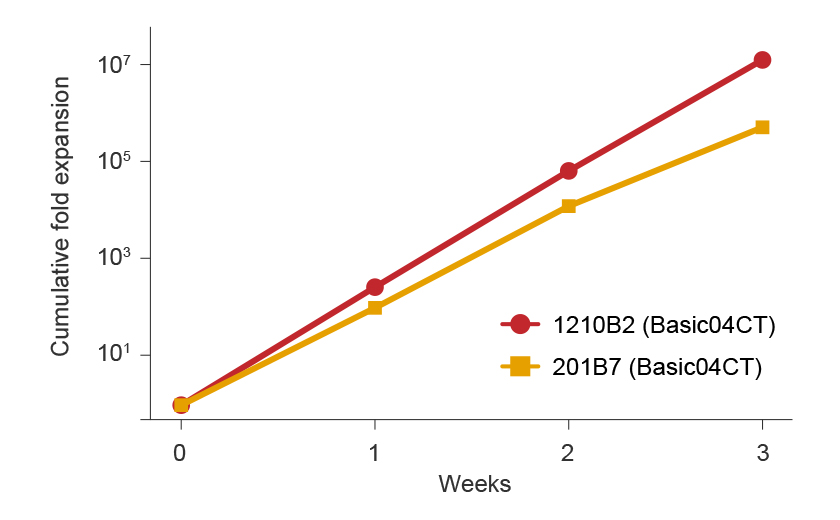
Figure: cumulative fold expansion of two iPSC lines over 3 weeks in Basic04CT (manufacturer data). Image source: Ajinomoto StemFit Basic04 Complete Type product page, reproduced with permission.
Three labs, three choices
- Regenerative medicine translation team building cell banks with GMP documentation: Basic03 or Basic04CT. If you prefer to control your own bFGF lots, or need the same basal medium in your differentiation workflow, choose Basic03; if you want one fewer preparation step and one fewer contamination risk, choose Basic04CT. Both come with a manufacturer GMP statement.
- Gene editing and disease modelling team doing single-cell passaging and cloning every day: Basic04CT is simpler — one bottle, ready to use — and the manufacturer provides single-cell sorting and clone karyotype data. Note that the sorting data also used CloneR2, so supporting reagents still belong in your cloning plan.
- Process development team preparing for shaker flasks and bioreactors: Basic05. Confirm cell status in 2D first, then move to 3D following the manufacturer's route, and decide early between bFGF and PG-011. At this stage it is research grade; confirm a GMP version with the manufacturer in advance.
StemFit Basic03 (GMP), Basic04 Complete Type (GMP) and Basic05, together with StemFit Purotein bFGF and PeptiGrowth PG-011, are all available for quotation from TechWave, and we can supply Product Information, SDS or GMP statement documents on request.
> Not sure which one fits? Tell us your cell source, passaging method and scale-up plans, and we will run through the three questions above with you.
References
- AJINOMOTO CO., INC. StemFit™ Basic03 (GMP) (product page and FAQ). https://www.ajitrade.com/stemfit/products/basic03/GMP.html
- AJINOMOTO CO., INC. StemFit™ Basic04 Complete Type (GMP) (product page). https://www.ajitrade.com/stemfit/products/basic04CT/GMP.html
- AJINOMOTO CO., INC. StemFit™ Basic05 (product page and FAQ). https://www.ajitrade.com/stemfit/products/basic05/
- AJINOMOTO CO., INC. StemFit AK03N / AK02N (product page and FAQ). https://www.ajitrade.com/stemfit/products/ak02n_03n.html
- AJINOMOTO CO., INC. StemFit Basic05 Product Information (version 1, August 2026). https://www.ajitrade.com/stemfit/pdf/StemFit_Basic05_product_information_20260730%20ver1.pdf
Uses and applicable scenarios
- Choosing a StemFit medium for a first purchase by three criteria: 2D or 3D process, GMP grade or not, and bFGF added by the user or already in the bottle
- Converting AK03N and AK02N from older methods sections into the globally available Basic03 plus bFGF or Basic04CT
- Assessing whether to adopt a single 2D/3D medium when planning scale-up from plates to shaker flasks, spinner flasks and vertical-wheel bioreactors
- Checking bFGF supplementation, thawing method and post-thaw storage window for each medium when writing preparation and storage SOPs
Limitations
- The Basic04CT expansion, single-cell sorting, karyotype, one-step transition and weekly-cost results, and the Basic05 scale-up, competitor comparison and 2D growth data, all come from Ajinomoto's product pages and carry their own preconditions — specified cell lines, a collaborative study, experimental conditions and a pricing basis. They are not independently verified third-party results
- The Basic04CT single-cell sorting recovery data were obtained together with the cloning supplement CloneR2 and cannot be attributed to the medium alone
- The 100 ng/mL bFGF used in the Basic05 2D experiment is the manufacturer's experimental condition, not a recommended concentration; the 10–30 ng/mL for PG-011 is the dose recommended in the Basic05 product information, and the working dose should still be confirmed in your own cells
- Basic03 and Basic04 Complete Type are labelled for research and further manufacturing use, and Basic05 for research use only; none of the three is intended for human or animal diagnostic or therapeutic use
- The PMDA consultation outcome and the CGT Catapult comparison are the manufacturer's statements about Basic03; they do not apply to Basic04CT or Basic05 and are not a product registration approval in any country
Frequently asked questions
I only do 2D iPSC expansion and need GMP grade — Basic03 or Basic04CT?
It depends on whether you want to manage bFGF yourself. Basic03 comes as liquids A and B without bFGF; you add bFGF at the manufacturer's default 80 ng/mL, adjustable to the application, choose your own bFGF source, and can also use it as a basal medium in differentiation workflows. Basic04CT is a single 500 mL bottle with bFGF already included and ready to use, removing a preparation step and one contamination risk. Both are GMP grade and labelled for research and further manufacturing use.
Can Basic05 be used directly for clinical cell manufacturing?
Not as it stands. Basic05 is labelled for research use only and is not intended for human or animal diagnostic or therapeutic use; the manufacturer asks users who need GMP-compliant products to contact it directly. Ajinomoto designed it to support the transition from research to clinical manufacturing, but that is a design goal, not the permitted use of the current product. For GMP-grade 2D processes today, choose Basic03 or Basic04CT.
With Basic05, how much bFGF should I add — and can I use PG-011 instead?
Basic05 contains no bFGF; the manufacturer requires bFGF or the FGF2-alternative peptide PG-011 to be added and recommends PG-011. Its 2D experiment used 100 ng/mL bFGF, which is an experimental condition rather than a recommended concentration; the Basic05 product information recommends adding PG-011 before use at 10–30 ng/mL final concentration, and the working dose should still be confirmed in your own cells. The manufacturer also notes that comparable expansion with weekend feeding skipped is supported in part by PG-011's thermal stability.
If I add bFGF to Basic03, do I get Basic04CT?
The manufacturer does not say so. Its stated correspondences are that Basic03 plus bFGF has the same composition as the Japan-only AK03N, while Basic04CT is the global counterpart of the Japan-only AK02N, with AK02N's animal-derived ingredients replaced by recombinant materials. The two should not be treated as the same formulation; when switching, re-confirm performance with your own cells.
What should I watch for when thawing StemFit?
Thaw at room temperature (15–25 °C) and do not use a 37 °C water bath — the manufacturer says this accelerates degradation of medium ingredients, and for Basic03 it specifically states that liquid B must not be thawed at 37 °C. After thawing, store at 2–8 °C for up to two weeks, protected from light as recommended; if usage is modest, aseptically aliquot and refreeze right after thawing. The Basic05 product information also allows thawing overnight at 2–8 °C.