
Technical column
Replacing FBS with hPL: lot-to-lot CV below 10%, no marked loss of growth factors after E-beam treatment, and higher expansion than FBS
Fetal bovine serum (FBS) brings unstable supply, opaque composition and large lot-to-lot variation, along with adventitious-contamination and ethical concerns. Human platelet lysate (hPL), produced by freeze-thaw lysis of human platelets, is rich in growth factors such as EGF, PDGF and TGF-β. Sexton treats it with an electron beam (E-beam) rather than gamma irradiation: in bone marrow-derived MSC experiments, key growth factors showed no marked decrease after treatment, cell expansion exceeded the FBS system with more uniform morphology, and multi-lot testing of pH, osmolality and total protein gave a CV below 10%.
Definition
Human platelet lysate (hPL) is produced by freeze-thaw lysis of human platelets and is rich in growth factors and cytokines such as EGF, PDGF and TGF-β, serving as a human-derived alternative to fetal bovine serum (FBS) in cell culture.
Cell culture has long relied on FBS as a nutritional supplement, but its drawbacks are increasingly hard to ignore: supply depends on animal sources and is not always stable, composition is complex and opaque with substantial lot-to-lot variation, and there are adventitious-contamination and ethical concerns.
Human platelet lysate (hPL) offers another route. Produced by freeze-thaw lysis of human platelets, it is rich in growth factors and cytokines including EGF, PDGF and TGF-β, supporting proliferation and stable culture, and is a human-derived alternative suited to stem-cell and immune-cell culture. In comparisons using bone marrow-derived mesenchymal stem cells (BM-MSCs), the hPL system gave higher cell expansion than the conventional FBS system, with lot-to-lot variation below 10% CV.
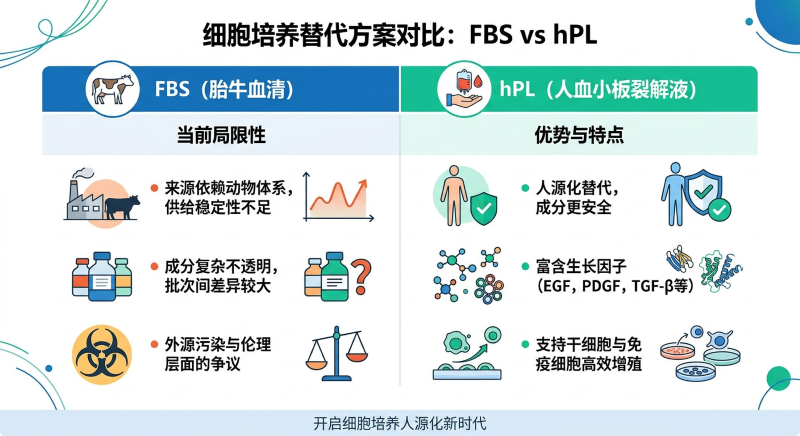
FBS and hPL differ in origin, composition and the process risks they introduce.
Manufacturing: why electron beam rather than gamma irradiation
Safety control of human-derived biological materials is a critical step, and the main treatments are gamma irradiation and electron-beam (E-beam) irradiation. Gamma irradiation reduces risk but can cause loss of growth factors and change solution properties, which in turn affects expansion performance.
Unlike conventional gamma irradiation, Sexton in the United States treats human platelet lysate with an electron beam: acting through water molecules, the beam generates reactive species such as hydroxyl radicals and reducing hydrated electrons, whose indirect oxidation-reduction action damages DNA or RNA and protein envelopes of microorganisms including viruses, reducing potential risk factors. According to the manufacturer, the process also offers three features:
- Relatively high processing efficiency;
- Less effect on the components of the formulation;
- Better maintenance of growth-factor levels and cell expansion capacity.
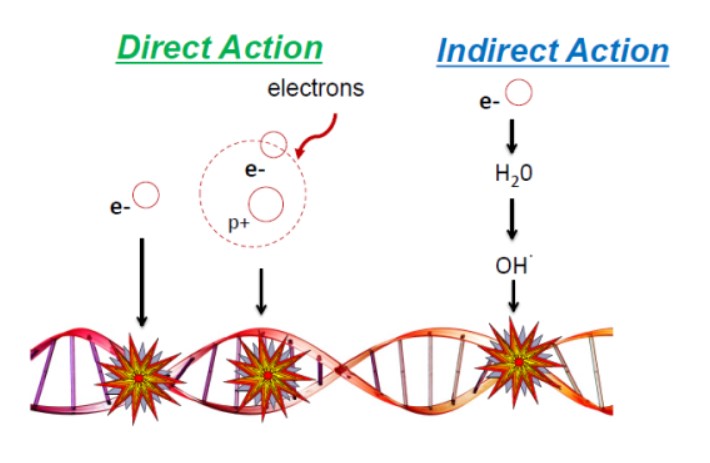
An electron beam can damage microbial nucleic acids through direct action and water-mediated reactions.
Culture performance: three sets of data
Using bone marrow-derived mesenchymal stem cells (BM-MSCs) as the model, hPL and FBS were compared:
| Assessment | Result |
|---|---|
| Growth-factor levels | Testing showed no marked decrease in key growth factors in hPL after electron-beam treatment, with improved stability for some factors |
| Cell expansion | Under hPL, cell expansion exceeded the conventional FBS system, with more uniform morphology and higher culture density |
| Lot-to-lot consistency | Multi-lot testing of pH, osmolality, total protein and other indicators gave a CV below 10%, indicating good system stability |
Where the value lies
Taken together, the data point to several advantages of an hPL system:
- Supports more stable cell expansion;
- A stable culture environment with uniform cell condition;
- Good lot-to-lot consistency and high experimental reproducibility;
- Suits stem cells, immune cells and other cell types;
- Combined with the electron-beam process, balances safety and functionality.
For stem-cell culture and scaled cell expansion, hPL offers a workable route to replacing conventional serum.
Frequently asked questions
Q1: Can hPL fully replace FBS? In most culture systems replacement is achievable; validate first for the specific cell type.
Q2: How does hPL affect expansion? Experimental data show higher expansion efficiency in some systems.
Q3: Does the treatment process affect hPL function? Under optimized conditions, electron-beam treatment has little effect on key functional factors.
Q4: Is hPL suitable for long-term culture? Multi-lot validation shows good stability and supports long-term culture studies.
Let TechWave help you make the serum switch
If you are planning to move MSC or immune-cell culture from FBS to a human-derived system, or need a more lot-consistent supplement for scaled expansion, contact TechWave. Based on your cell type and culture stage, we can help assess the suitability of Sexton human platelet lysate (including product lines such as Stemulate-CP, nLivenPR and T-LivenPR), provide technical documents such as specifications and certificates of analysis, and arrange a quotation.
Uses and applicable scenarios
- Expansion of mesenchymal stem cells from bone marrow and other sources
- Serum replacement in immune-cell culture
- Validating a switch from FBS to a human-derived culture system
- Scaled cell expansion that needs high lot-to-lot consistency
Limitations
- Whether hPL can fully replace FBS depends on the cell type, so validate in the target system first
- The expansion and consistency data come from a bone marrow-derived MSC model under the manufacturer's test conditions and should be reconfirmed with your own cells and process