
Technical column
From a tube of fat to a GMP “off-the-shelf” cell therapy: all 36 batches released and 91–94% viability after 24 months at −180 °C — the allogeneic adipose MSC chain built on 5% heparin-free hPL and closed reactors
Taking an allogeneic off-the-shelf MSC to the clinic hinges on turning donor tissue reliably into releasable, long-term-storable frozen doses. A GMP process study from the Cardiology Stem Cell Centre at Rigshospitalet, Denmark, shows a complete route: adipose tissue from 7 healthy donors was digested with GMP-grade collagenase NB6 and expanded in two stages in a closed Quantum hollow-fibre bioreactor with 5% heparin-free, fibrinogen-depleted human platelet lysate (hPL), giving an average of 6.02E8 cells per batch and two to nine treatment doses; all 36 batches met release criteria, mean post-freeze viability was 93%, viability after 24 months at −180 °C was 91–94% with proliferative capacity retained, and the product has been used in more than 200 study participants. The team then moved to pathogen-reduced, large-donor-pool Sexton nLiven PR and started an ICH Q5E raw-material comparability study.
Definition
This GMP case links adipose-derived stromal vascular fraction (SVF), 5% heparin-free fibrinogen-depleted human platelet lysate (hPL), two-stage expansion in a closed hollow-fibre bioreactor, CryoStor10 cryogenic filling and process-wide quality control into one manufacturing chain for an allogeneic off-the-shelf MSC product.
The appeal of an allogeneic off-the-shelf cell therapy is that it is ready when the patient is — provided one donor's tissue can be turned reliably into many doses that are releasable, storable for the long term and usable straight after thawing. A GMP process study from the Cardiology Stem Cell Centre at Rigshospitalet, Denmark, shows how the allogeneic adipose-derived stromal-cell product CSCC_ASC progressed from donor tissue through closed expansion and cryogenic filling to clinical use — with all 36 batches meeting release criteria and 91–94% viability after 24 months at −180 °C.
The key to this chain is not one material but an integrated system of donor control, 5% human platelet lysate (hPL), closed reactors, release testing and stability.
From a tube of fat to a frozen dose
Seven healthy donors aged 25–34 underwent screening and water-assisted liposuction. GMP-grade collagenase NB6 digestion yielded an average of 1.37E8 stromal vascular fraction (SVF) cells per donor.
Expansion ran in two stages in a closed Quantum hollow-fibre bioreactor:
- P0: 8–10 days of culture, yielding 4.95E8 cells on average and a frozen intermediate bank;
- P1: thawed intermediate re-expanded to an average of 6.02E8 cells per batch, ranging from 3.01E8 to 1.15E9 and supporting two to nine treatment doses.
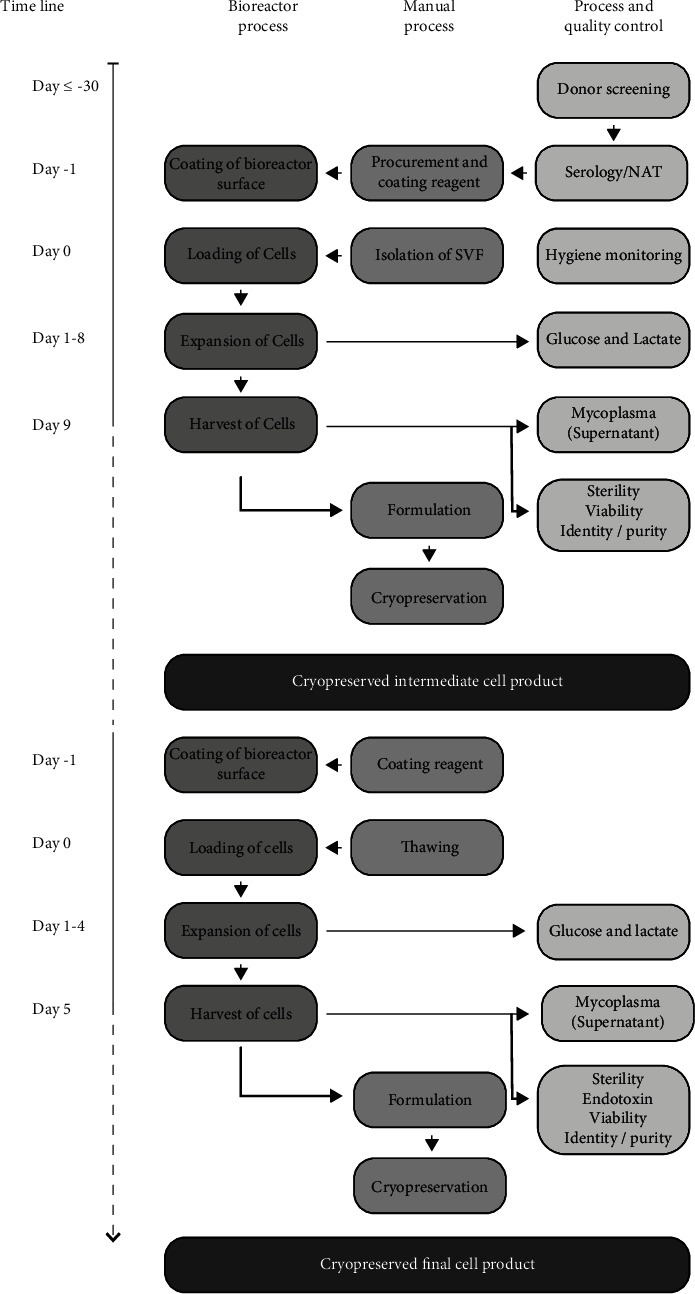
Figure 1. The published process timeline links donor screening, SVF isolation, P0 and P1 bioreactor expansion, harvest, formulation, release testing and cryopreservation.
The final product was suspended in CryoStor10, filled into CellSeal sealed cryogenic vials, radio-frequency sealed, controlled-rate frozen and stored in vapour-phase liquid nitrogen at no warmer than −180 °C. One dose contained 110E6 cells at 22E6 cells/mL × 5 mL. At clinical use, thawing, washing, quality control and injection took approximately 90 minutes in total — exactly the value an off-the-shelf product is meant to deliver.
Why 5% heparin-free hPL
The process replaced FBS with 5% heparin-free, fibrinogen-depleted hPL to support proliferation while avoiding animal-derived components. The heparin-free formulation also limits gel formation and its effect on the hollow-fibre surface coating — for a closed-reactor process, a raw-material choice that directly affects operation.
The initial custom hPL pool came from no more than 16 donors: a small pool simplifies source management but increases lot-to-lot variation. When pathogen-reduced, large-donor-pool nLiven PR became available, the team discontinued the earlier formulation and initiated an ICH Q5E raw-material comparability study. The transition shows that a raw-material upgrade is completed through quality, potency and safety bridging, not by swapping a product label.
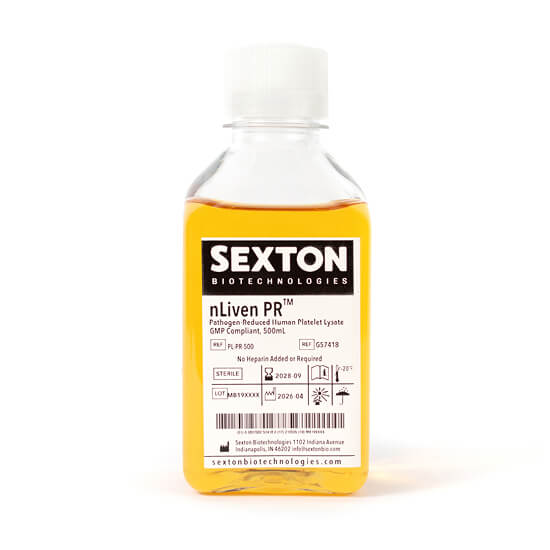
Figure 2. Official manufacturer image of Sexton Biotechnologies nLiven PR, the pathogen-reduced hPL discussed for raw-material transition.
Quality and stability: the data
| Attribute | Result |
|---|---|
| Manufacturing | All 36 batches met release criteria; overall manufacturing success was 92%, with unsuccessful runs mainly linked to reactor technical issues |
| Phenotype | CD73/CD90/CD105 ≥97%; CD45 0.35–2.94%; HLA-DR 0.04–0.83% |
| Viability | Mean 93% after freezing, against a >80% release criterion |
| Long-term storage | 91–94% viability and retained proliferative capacity after 24 months at −180 °C |
| Genetic stability | aCGH found no unbalanced chromosomal rearrangement |
| Clinical use | Used in more than 200 participants in ischaemic-heart-failure or dilated-cardiomyopathy studies; the paper reported no product-related adverse events |
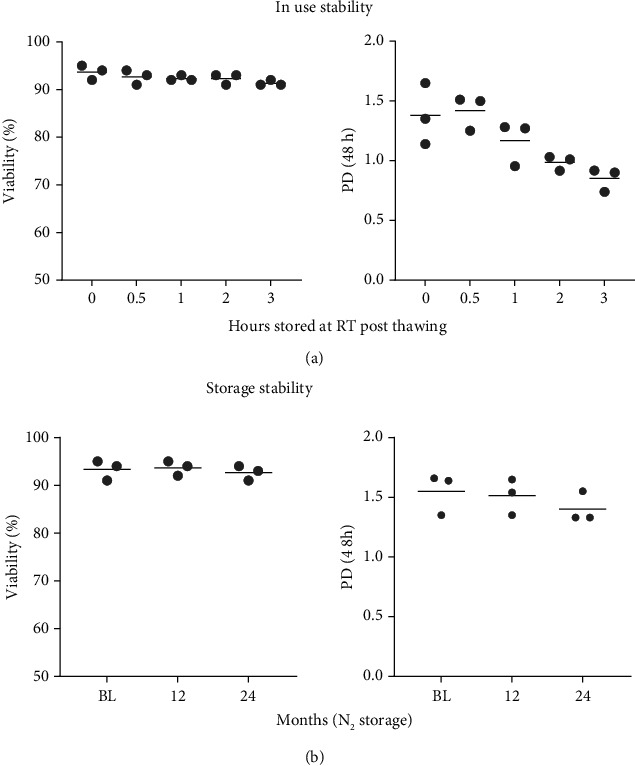
Figure 3. Source-study viability and population-doubling results during post-thaw room-temperature holding and up to 24 months of nitrogen storage.
“All 36 batches released” and “92% success” do not conflict: the first describes release quality, the second the proportion of complete manufacturing runs that succeeded, and the unsuccessful runs were mainly linked to reactor technical issues. Mean post-freeze viability of 93% sits well above the >80% release criterion, and after 24 months of storage viability was still 91–94% with proliferative capacity retained — for an allogeneic product that is banked and supplied in lots, the foundation of long-term, stable supply.
Quality control across the whole process
- Donor: serology and nucleic-acid testing covered risks including HIV, hepatitis B and C, syphilis and HTLV;
- Process: sterility and mycoplasma monitored during reactor operation and before harvest;
- Final product: viability, immunophenotype, sterility, endotoxin and mycoplasma;
- Long-term evidence: aCGH and time-series stability data.
hPL was classed as a high-risk raw material: suppliers need appropriate donor screening, viral testing and blood-bank quality qualifications, with incoming verification and continued monitoring. Pathogen-reduced, large-donor-pool hPL offers an option for managing this risk at the raw-material level.
Where it fits and how to choose
The study is an auditable process case, not a manufacturing recipe to copy. Adipose source, collagenase, reactor, hPL pool, seeding density, feed control and cryogenic container can all change the outcome; a process transfer should compare expansion, phenotype, potency, impurities, post-thaw recovery and stability in parallel using the same cell bank, and bring raw-material changes under formal change control. The clinical safety observations apply to this product, indication and study scale and cannot be extrapolated into a safety guarantee for other MSC products.
Let TechWave help plan your hPL raw material and comparability path
If you are developing an allogeneic MSC or other off-the-shelf cell product, planning to replace FBS with hPL, or evaluating a move from a small-pool hPL to a pathogen-reduced, large-donor-pool product, contact TechWave. We can help compile product information for hPL such as Sexton Biotechnologies nLiven PR together with the literature behind this case, discuss a comparability study design around your closed expansion and cryopreservation process, and arrange a quotation.
Reference
- Haack-Sørensen M, Johansen EM, Højgaard LD, Kastrup J, Ekblond A. GMP Compliant Production of a Cryopreserved Adipose-Derived Stromal Cell Product for Feasible and Allogeneic Clinical Use. Stem Cells International. 2022;2022:4664917. doi:10.1155/2022/4664917.
Uses and applicable scenarios
- GMP process development for allogeneic MSC and off-the-shelf cell products
- Animal-free expansion replacing FBS with hPL, and raw-material comparability
- Closed-bioreactor expansion and cryogenic fill design
- Long-term cryostability and release-testing strategy
Limitations
- Results apply to this product, process and study scale; changing raw materials, equipment or containers requires bridging
- Clinical observations belong to this product and indication and are not a safety guarantee for other MSC products