
Technical column
FDA Finalizes Its Potency Assurance Guidance for Cell and Gene Therapy: Potency Rests on Five Layers of Control, Not One Assay. What Changed From the Draft, and What It Means for MSC and iPSC-Derived Cell Products
On 3 November 2026 the US FDA announced in the Federal Register that its guidance for industry, Potency Assurance for Cellular and Gene Therapy Products, is final. It supersedes the January 2011 guidance on potency tests for cellular and gene therapy products and closes out the December 2023 draft. The core idea fits in one sentence: the goal is that every lot released has the specific ability or capacity to achieve its intended therapeutic effect. That is achieved not by a final test alone, but by five complementary layers: manufacturing process design, process control, material control, in-process testing and potency testing for lot release. We compared the final text with the draft line by line to find what actually changed. The final guidance states that its approach does not increase sponsor requirements and that potency assurance can be integrated into the existing quality system. It gives more specific risk assessment examples, adds an adjustable number of cell expansion steps as a way to accommodate donor differences, says acceptable ranges for critical process parameters should be set before a BLA is submitted, and adds microphysiological systems and other human biology-based methods to the nonclinical toolbox. We also set out, stage by stage from the first IND to the BLA, how far MSC and iPSC-derived cell programs should take their potency work.
Definition
Under the US biologics regulations (21 CFR 600.3(s)), potency is the specific ability or capacity of a product to effect a given result, as shown by suitable laboratory tests or by adequately controlled clinical data from use of the product as intended. For cell and gene therapy products, potency assurance is a comprehensive strategy that mitigates risks to potency through five elements: manufacturing process design, process control, material control, in-process testing and potency testing for lot release. Its goal is that every lot released has the specific ability or capacity to achieve its intended therapeutic effect. Potency assays are a key part of that strategy, but lot release testing alone cannot adequately assure potency.
On 3 November 2026 the US Food and Drug Administration (FDA) announced in the Federal Register that its guidance for industry, Potency Assurance for Cellular and Gene Therapy Products, is final [1][2].
The guidance supersedes Potency Tests for Cellular and Gene Therapy Products, issued in January 2011, and finalizes the draft of the same name published on 28 December 2023 [1][2]. The change of wording in the title, from tests to assurance, is the point of the whole document: potency is not something a final test measures into a product. It is protected all the way from process design to the vial.
The stated goal is plain: every lot released should have the specific ability or capacity to achieve its intended therapeutic effect [1]. For MSC and iPSC-derived cell programs this carries real weight. The guidance reminds sponsors that FDA may place an investigation on clinical hold at any phase, for example if inadequately assured potency would expose subjects to an unreasonable and significant risk, or if the IND lacks the potency information needed to assess risks to subjects. For phase 2 and 3 investigations, the regulations also allow a hold when the plan is clearly deficient in design, and trials run with lots of unknown or inadequately controlled potency may fail to show whether the licensed product will match the lots tested. So if an IND does not provide adequate assurance of potency, a trial meant to supply substantial evidence of effectiveness for a marketing application may be judged clearly deficient in design and placed on clinical hold [1].
Who the guidance applies to
The guidance covers human cell therapy and gene therapy products that FDA regulates as biologics under section 351 of the Public Health Service Act, tissue-engineered medical products included [1]. Vaccines for infectious disease indications, phage products, live biotherapeutic products, fecal microbiota for transplantation products and allergenic products are outside its scope [1].
Like all FDA guidance, it does not establish legally enforceable responsibilities, and the word should means recommended, not required [1]. The regulations it cites are requirements, however. For example, every lot of a licensed product must be tested for potency, with samples taken after all manufacturing steps that could affect potency; under 21 CFR 610.9, CBER may permit an alternative approach to this lot release requirement only if the sponsor shows that it provides assurance of potency no lower than the method or process in the applicable standards. Before introducing a change to the manufacture or testing of an approved biologic, the sponsor must assess its effects and demonstrate that it does not adversely affect potency as it may relate to safety or effectiveness; for a licensed product, the corresponding assessments and studies are required before the post-change product is distributed [1].
Potency assurance is not the same as a potency assay
The guidance defines potency assurance as a multifaceted, adaptable strategy that mitigates risks to potency through five elements [1][2]:
- Manufacturing process design: designing a process that consistently yields potent product is the foundation of the strategy;
- Process control: identifying critical process parameters (CPPs) that affect potency-related critical quality attributes (CQAs), and controlling or monitoring them;
- Material control: placing a material attribute in the material specification when it is known or suspected to be related to product potency;
- In-process testing: testing attributes that affect or predict potency at key stages of manufacture;
- Potency testing for lot release: assays and acceptance criteria set appropriately for each phase.
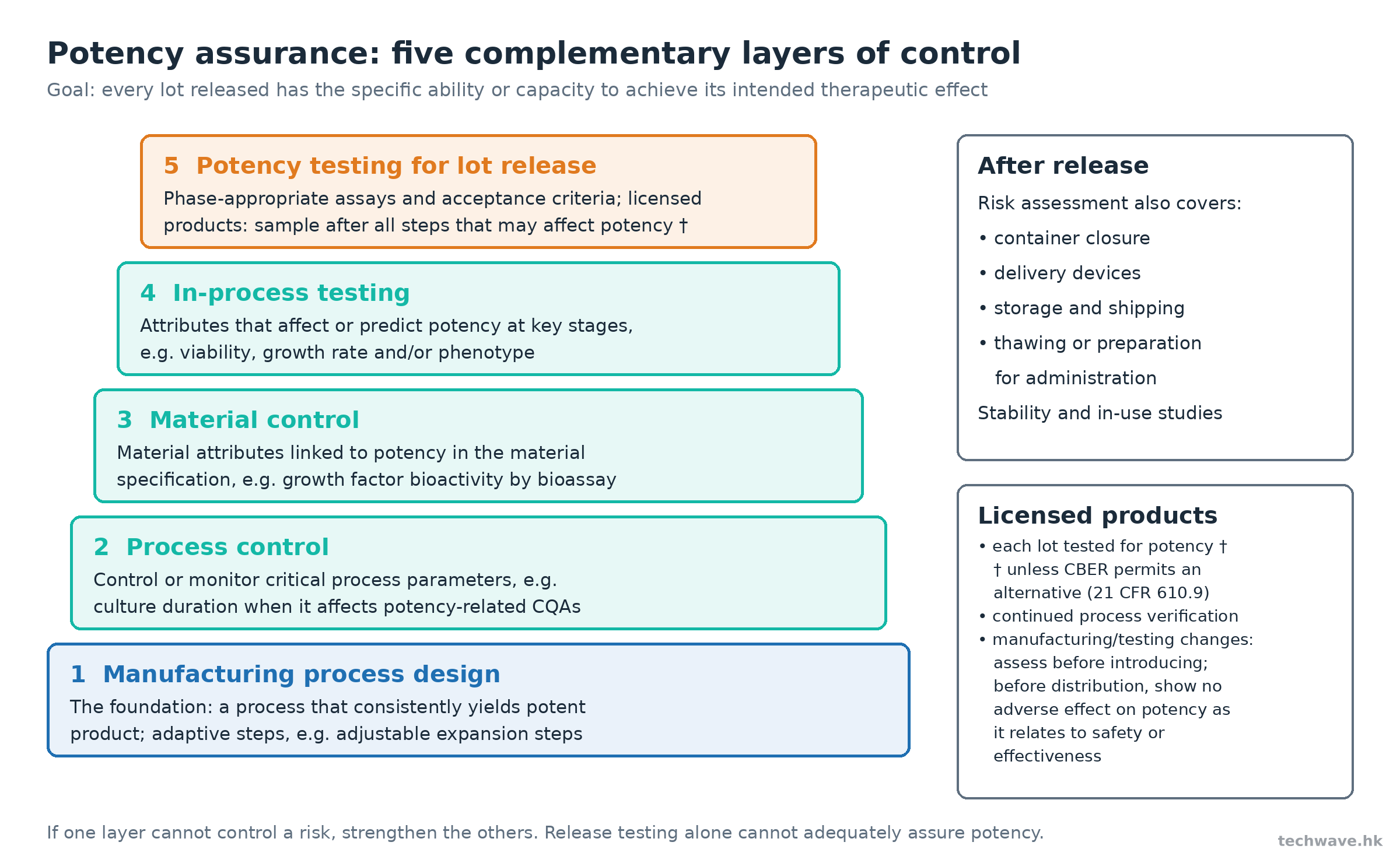
The five layers complement one another. The guidance is explicit that lot release testing alone cannot adequately assure potency, but that release testing should be a key component of the strategy [1]. Where one layer cannot control a given risk, the others should be strengthened [1]. If potency-related attributes are poorly understood or difficult to quantify, for example, or if a product's shelf life is too short to complete a bioassay before release, process design and process control should be more stringent and comprehensive [1].
The guidance gives examples for each layer. Several apply directly to stem cell processes:
- Materials: if a cellular manufacturing process includes a growth factor, its potential influence on product potency should be assessed. If necessary, the growth factor's biological activity should be controlled in the material specification with a bioassay and an appropriate acceptance criterion [1]. The guidance notes that for materials it uses the terms biological activity and bioassay; potency applies only to drug substance and drug product [1].
- Process parameters: in some cell products, longer culture leads to more cell death or differentiation and may lower potency. Culture duration is then a CPP, and limits for it should be set at the appropriate phase of development [1].
- In-process testing: for cell products, the guidance suggests testing viability, growth rate and/or phenotype at relevant stages of manufacture [1].
- Release sampling: if cryopreservation poses a high risk to a cell product's potency, potency testing should be performed on samples taken after cryopreservation [1].
Risk assessment also has to look beyond the moment of release. The guidance recommends including post-release factors: container closures, delivery devices, storage and shipping conditions, and the conditions of thawing or preparation for administration [1].
What changed between the draft and the final guidance
In the Federal Register FDA only summarizes its changes: recommendations to integrate potency assurance into existing quality systems, expanded guidance on risk assessment, additional pathways for engaging with the agency, and more examples with refined terminology [2]. Comparing the two versions line by line, the changes fall here [1][3]:
| Topic | December 2023 draft | November 2026 final |
|---|---|---|
| Framing | Potency assays remain important, with complementary approaches | States that this comprehensive strategy does not increase sponsor requirements; potency assurance should be integrated into overall quality risk management, and a separate quality system specific to potency is not necessary |
| Risk assessment | Already recommended formal risk assessment tools to assess risks to potency comprehensively, and listed post-release factors such as container closures and delivery devices | Adds product-specific examples: for cell products, risks to viability, functionality and phenotype; for gene therapy products, transduction capacity, adsorption to surfaces, aggregation or degradation. Where appropriate, especially when test material is limited, surrogate materials or in silico modeling may be used if adequately justified in the risk assessment |
| Variability in starting material | Adaptive steps can compensate for variation in materials | New example: making the number of cell expansion steps adjustable, so the process can absorb differences in growth rate between donors |
| Critical process parameters | Limits for parameters such as culture duration | Limits are set at the appropriate phase; new sentence: acceptable ranges for CPPs should be established prior to submitting a BLA |
| Nonclinical studies | Nonclinical studies to understand the mechanism of action | New: these may include animal-based methods or human biology-based methods such as cell-based assays, microphysiological systems, bioprinted systems and computational methods. A footnote states support for new approach methodologies (NAMs) and the 3Rs of reducing, refining and replacing animal use |
| Knowledge relied on | Published information when identifying potency attributes; published scientific studies when the mechanism is complex; peer-reviewed literature as an example of prior knowledge; already noted that a statistical relationship alone cannot establish a mechanistic one | The first two become generally accepted (or recognized) scientific knowledge, meaning published medical or scientific information generally accepted by qualified experts, including FDA experts; the peer-reviewed literature example is removed; now says a statistical relationship might be difficult to demonstrate and, even if demonstrated, might not reflect a causal relationship |
| Products not amenable to destructive sampling, such as tissue-engineered products | Manufacture an additional unit in parallel for potency release testing | New: if generating an additional unit in parallel is not feasible, a representative surrogate sample from the lot may be tested |
| Very short shelf-life products | When a bioassay cannot be completed before release, physicochemical release assays; bioassays initiated immediately after manufacture, with results evaluated after release; the appropriateness and frequency of such post-release testing based on a risk assessment | New sentence: a bioassay may enhance potency assurance even if it cannot be used for lot release |
| Assay management | Already recommended a separate control material; for assay transfer, a risk assessment, a prospectively designed study with sufficient statistical power, and equivalence testing | Where a control material is used (it may be omitted if risk assessment shows it is not needed), it should be a different lot from any reference material used as a calibrator. When changing a validated assay, a risk assessment decides on partial or full revalidation; a replacement assay should be validated. New for transfer: a single representative lot is generally sufficient as the test article, and besides equivalence testing, other approaches such as evaluating accuracy and precision at the new laboratory may be appropriate. Qualification is framed as applying to potency release assays |
| Engaging FDA | Consult CBER before making major changes to the potency assurance strategy | Prior consultation is recommended for changes classified as higher risk based on the sponsor's risk assessment. Sponsors can use pre-IND and other meeting types, ask their Regulatory Project Manager when unsure which type to request, or request the type they think fits, which FDA may convert if necessary |
One deletion deserves attention. In its discussion of products with multiple active ingredients, the draft had a footnote saying that a complex mixture of cell types, where the contribution of each type is unknown or intertwined with the others, would be considered a single active ingredient [3]. The final guidance does not keep that footnote [1]. It still says that for some products with multiple active ingredients a single bioassay may be sufficient to assess the potency of all of them together, in which case physicochemical assays should also measure the concentration of each active ingredient [1]. How to define the active ingredients of a heterogeneous cell product is best raised directly with FDA.
It is equally important to be clear about what is not new. Several points often presented as new requirements were already in the draft and were confirmed or lightly adjusted in the final text. Lot release testing for most CGT products should include at least one bioassay (the final adds the qualifier phase-appropriate). Acceptance criteria of report or for information only are not recommended for release assays. Products with a shelf life too short to complete a bioassay before release may be released on physicochemical assays, with bioassays started right after the drug product is manufactured and evaluated after release, their appropriateness and frequency based on a risk assessment. For licensed products, such post-release bioassays should also be part of potency assurance if they add value to continued process verification and reduce risks to potency. And a clinical hold is possible when potency assurance is inadequate [1][3].
Applying it to MSC and iPSC-derived cells
The guidance does not name specific cell types, but the problems it discusses are the ones MSC and iPSC-derived cell teams face every day.
When the mechanism of action is unclear, how do you choose potency attributes?
The guidance acknowledges that CGT products often have multiple activities, and that the activity most relevant to efficacy may depend on the target disease. The intended clinical indication should therefore be considered when deciding which attributes are related to the mechanism of action and critical for potency [1]. For cellular products whose mechanism is complex or poorly defined, the guidance recommends using nonclinical data and generally accepted scientific knowledge to select candidate attributes and assessing a broad range of attributes in early characterization studies. An attribute shown to be mechanistically linked to the product's biological activity may be a potency-related CQA [1].
One caution: a statistical relationship between an attribute and a nonclinical or clinical outcome might be difficult to demonstrate and, even if demonstrated, might not reflect a causal relationship. Further experiments may be needed to confirm whether there is a mechanistic link [1].
A common misconception is that a bioassay must reproduce the mechanism of action. The guidance says plainly that the central purpose of a bioassay is to quantitate a potency-related CQA that is at risk, and that it is not essential for the bioassay to mimic the product's mechanism. Understanding of the mechanism should instead drive the choice of attributes [1].
Absorbing donor variability through process design
The guidance names inherent variability in cellular starting material as a major source of variability in cell products, and accepts that for many products some variability in potency-related attributes cannot be avoided [1]. The final text recommends, where feasible, building adaptive steps into the process to compensate. Its example is letting the number of cell expansion steps vary so that donors whose cells grow at different rates can still be processed to a consistent product [1]. For autologous products, a patient's disease and treatment history may also affect the starting cells and, in turn, product potency [1].
This is very real for MSCs. Donor age, tissue source and passage number all change how cells grow and function. Population doubling level (PDL) management, covered elsewhere on this site, is one concrete way to bring this risk under process control.
Materials: lot-to-lot activity of growth factors
As noted above, the guidance uses growth factors to show how material attributes enter the control strategy. If an attribute is known or suspected to affect potency, it is controlled in the material specification, either by reviewing the supplier's test results or by acceptance testing of each lot, and if necessary with a bioassay and acceptance criterion [1].
In practice, when choosing growth factors and cytokines it is worth checking, alongside purity and endotoxin, whether the supplier can provide per-lot bioactivity data and the method used. That information can feed directly into the material specification.
Cryopreservation, thawing and administration are potency risks too
For cryopreserved MSCs and iPSC-derived cells, three points need separate attention:
- Release sampling point: if cryopreservation poses a high risk to potency, samples should be taken after cryopreservation [1];
- Stability: identify potency-related attributes that indicate stability where possible, and set shelf life from potency data under long-term storage conditions. If justified, stability acceptance criteria may differ from release criteria, but should still reflect the range of potency needed for the intended therapeutic effect [1];
- In-use studies: assess whether potency remains acceptable during preparation and administration through delivery devices. Where several devices or conditions are expected, the studies should cover or bracket the full range, including worst-case conditions [1].
Bioassays: precision, reference materials and controls
Bioassays for cell products are often variable. The guidance suggests reporting potency relative to a reference material to improve the precision of reported values. If a redesign still cannot deliver adequate precision, the guidance recommends routinely performing multiple independent runs for each sample and reporting the mean, with the number of runs pre-specified in the assay protocol or specification [1].
When no pharmacopoeial or generally recognized standard exists, sponsors should build their own reference material, often by setting aside a representative lot of drug substance or drug product that has been well characterized. If limited batch size or short shelf life make that infeasible, a separate reference material that can be produced and stored in larger quantities should be developed [1]. Before replacing a reference lot, the new lot should be compared with the current one over multiple independent runs and assigned a value using a pre-specified statistical approach [1]. The guidance also recommends a control material in each run as a system suitability check, unless risk assessment shows it is not needed; the control should be a different lot from any reference material used as a calibrator [1].
New methods: microphysiological systems enter the toolbox
The final guidance adds a sentence to its nonclinical section: in addition to animal-based methods, sponsors may use human biology-based methods, including cell-based assays, microphysiological systems, bioprinted systems and computational methods [1]. In the potency assay section, the guidance also encourages in vitro bioassays in place of animal assays where this does not compromise potency assurance [1].
For teams building a platform for mechanism-of-action studies, this means that microphysiological systems, a class of human in vitro models that includes organ-on-a-chip platforms, now appear in FDA's list of nonclinical methods that can inform the selection of potency attributes.
Stage-by-stage roadmap: how far to go at each phase
The guidance does not expect a complete potency assurance system on day one. It does recommend a defined strategy at every stage, strengthened progressively as experience and data accumulate [1].
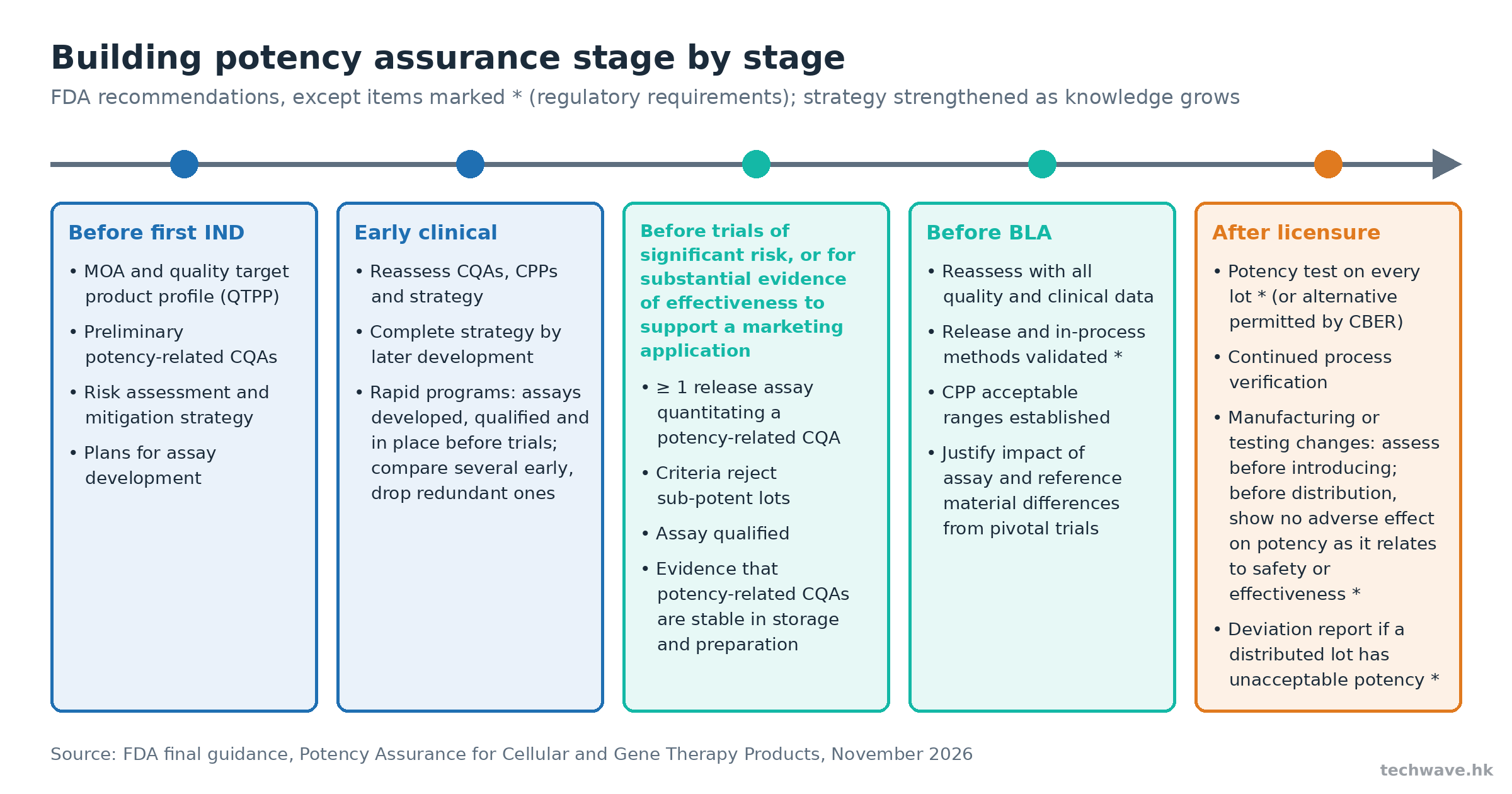
- Before the first IND: identify preliminary potency-related CQAs, assess risks and develop a strategy to mitigate them. The guidance recommends describing in CTD Module 3, and summarizing in Module 2, the product's mechanism of action and quality target product profile (QTPP); the list of preliminary CQAs and how they were identified; the potency assurance strategy and its justification, including the risk assessment; if a potency assay is part of release, the method, its performance and the basis for acceptance criteria; if not, how process design and other controls provide adequate assurance for early trials; and preliminary plans for further characterization, assay development and strengthening the strategy [1].
- During early clinical development: continue to reassess the QTPP, CQAs, CPPs and potency assurance strategy. By later development, the strategy should be complete, including potency assays and acceptance criteria [1].
- Before trials that involve significant risk, or that are meant to supply substantial evidence of effectiveness for a marketing application: the control strategy should include at least one physicochemical assay or bioassay, performed on appropriate samples and used for release, that quantitates a potency-related CQA. Acceptance criteria should be appropriate to the phase and able to exclude lots with insufficient potency, the potency assay should be qualified, and there should be evidence that potency-related attributes remain stable through storage and preparation for administration [1]. Qualification of potency release assays should happen as soon as feasible, and at the latest when the trials meant to supply substantial evidence of safety and effectiveness for a marketing application begin [1].
- Before the BLA: reassess the strategy using all quality and clinical data. Release and in-process methods must be validated. Describe the potency assays and reference materials to be used for the licensed product and explain and justify the impact of any differences from the assays and reference materials used in the trials that provide the primary evidence of effectiveness [1]. The guidance recommends establishing acceptable CPP ranges before the BLA is submitted [1]. Final drug substance and drug product acceptance criteria are not expected to be fixed before the end of clinical development [1].
- After licensure: every lot must be tested for potency, unless CBER has permitted an alternative under 21 CFR 610.9. Run continued process verification, collecting and analyzing product and process data periodically. Assess manufacturing or testing changes before introducing them, and complete the corresponding assessments and studies before the post-change product is distributed, demonstrating no adverse effect on potency as it may relate to safety or effectiveness. If a distributed lot is found to have unacceptable potency, a biological product deviation report must be submitted to CBER [1].
For programs in rapid clinical development, the guidance suggests turning the sequence around: characterize the product and process thoroughly as early as possible, and develop, qualify and implement potency assays before clinical trials begin. Several assays measuring known or potential potency attributes can be developed and evaluated in parallel during early trials, with redundant ones discontinued later [1].
Acceptance criteria: a lower limit, and an upper limit when needed
The guidance's recommendations on acceptance criteria come down to four points [1]:
- Specifications for potency-related attributes should include quantitative acceptance criteria. Report or for information only is not recommended for release assays, because such criteria do not contribute to potency assurance;
- There should be an appropriate quantitative lower limit to confirm that each lot has sufficient capacity for the intended therapeutic effect. If the product's biological activity itself carries a potential safety risk, or if it is unknown whether high potency is safe, a quantitative upper limit should also be set;
- For highly variable cell products, acceptance criteria in early development may be relatively wide if justified in the IND, but they should still exclude lots whose potency falls outside the expected range;
- Acceptance criteria for a licensed product should ensure that distributed lots are consistent in potency with the lots used in the trials that provided the primary evidence of effectiveness, tying release criteria to clinical evidence.
What to prepare when engaging FDA
The guidance recommends discussing the potency assurance strategy and assay development plans with CBER early in development, with specific rather than general or open-ended questions [1]. When seeking feedback on a potency assay, the package should include [1]:
- How the attribute measured by the assay relates to the product's mechanism of action and intended therapeutic effect, with any supporting data;
- A clear description of the assay, such as reagents, reference material, number of replicates, controls and analysis method, and the rationale for its design. Full assay protocols are not recommended in meeting packages unless FDA requests them;
- Available information on assay performance, with qualification or validation reports where available;
- The assay's limitations, and why it is still suitable for its intended use despite them.
One-page checklist: eight questions to ask against the final guidance
- Are the mechanism of action, QTPP and preliminary potency-related CQAs written down, and were the attributes chosen with the intended indication in mind?
- Does the potency risk assessment cover what happens after release: container, delivery device, shipping and storage, thawing and preparation?
- Does the process design leave room to adjust for donor or starting material variability?
- Which attributes of growth factors and other materials could affect potency, and does the material specification control their bioactivity?
- Have CPPs such as culture duration been identified, and at what stage will their acceptable ranges be set?
- Is the potency release sample taken after every step that could affect potency, for example after cryopreservation? For licensed products this is the default regulatory requirement.
- If you use a control material, is it a different lot from the reference material used for calibration, and are plans for reference lot replacement and assay transfer ready?
- Do the acceptance criteria include a quantitative lower limit, and an upper limit where needed, and avoid for information only?
References
- U.S. Food and Drug Administration, Center for Biologics Evaluation and Research. Potency Assurance for Cellular and Gene Therapy Products: Guidance for Industry. November 2026. https://www.fda.gov/media/196183/download
- Food and Drug Administration. Potency Assurance for Cellular and Gene Therapy Products; Guidance for Industry; Availability. Federal Register. 2026;91(211):69259–69261. FR Doc. 2026-22427. https://www.federalregister.gov/documents/2026/11/03/2026-22427/potency-assurance-for-cellular-and-gene-therapy-products-guidance-for-industry-availability
- U.S. Food and Drug Administration, Center for Biologics Evaluation and Research. Potency Assurance for Cellular and Gene Therapy Products: Draft Guidance for Industry. December 2023. https://www.fda.gov/media/175132/download
Uses and applicable scenarios
- Setting out the mechanism of action, quality target product profile (QTPP), preliminary critical quality attributes and potency assurance strategy for an MSC or iPSC-derived cell therapy before the first IND
- Confirming, before trials that involve significant risk or are meant to supply substantial evidence of effectiveness to support a marketing application, that at least one release assay quantitating a potency-related CQA is in place, that its acceptance criteria can exclude lots with insufficient potency, that the assay has been qualified and that there is evidence potency-related CQAs stay stable through storage and preparation
- Assessing how lot-to-lot variation in growth factors, cytokines and other materials could affect product potency, and deciding whether to add a bioactivity test to the material specification
- Choosing the release sampling point for cryopreserved cell products and designing stability studies and in-use studies covering thawing, preparation and administration
- Building in-house reference and control materials, and planning reference lot replacement, assay changes and assay transfer
- Preparing a meeting package for FDA that explains how a potency assay relates to the mechanism of action and describes the method, its performance and its limitations
Limitations
- This article is based on the final FDA guidance of November 2026, the December 2023 draft and the Federal Register notice. It covers only cell and gene therapy products regulated as biological products under section 351 of the US Public Health Service Act and does not address requirements in other countries or regions
- FDA guidance is not legally binding; where this article says a sponsor should do something, it reflects a recommendation in the guidance. Specific regulations and statutory requirements cited in the guidance remain binding, and the guidance text and regulations themselves prevail
- The differences between the final guidance and the draft were identified by our own line-by-line comparison; the Federal Register notice only summarizes the changes. What a specific deletion or revision means for a given product should be confirmed with FDA
- This article does not propose specific potency assays or numerical acceptance criteria. The guidance itself notes that, because CGT products are so diverse, its recommendations on assay selection and design can only be general
Frequently asked questions
How does FDA's potency assurance guidance relate to the 2011 guidance on potency tests?
Potency Assurance for Cellular and Gene Therapy Products, finalized in November 2026, supersedes Potency Tests for Cellular and Gene Therapy Products from January 2011. The focus widens from which tests to run to how potency is assured: besides potency testing for lot release, process design, process control, material control and in-process testing all reduce risks to potency. The guidance itself is not legally binding, but the regulations it cites are requirements.
Does the final guidance add requirements for sponsors compared with the 2023 draft?
The guidance states that its comprehensive strategy does not increase sponsor requirements. The main changes in the final text are that potency assurance can be integrated into existing quality risk management without a separate potency quality system; risk assessment examples are more specific; examples such as adjustable expansion steps and human biology-based methods like microphysiological systems are added; and it recommends setting acceptable ranges for critical process parameters before a BLA is submitted, along with describing ways to engage FDA.
Do I need a potency release assay at the first IND?
Not necessarily. For the first IND the guidance recommends describing preliminary potency-related critical quality attributes, a risk assessment and a potency assurance strategy; if release does not yet include a potency assay, explain how process design and other controls give adequate assurance for early trials. The guidance recommends that, before trials that involve significant risk or are intended to provide substantial evidence of effectiveness to support a marketing application, at least one qualified release assay quantitates a potency-related CQA, with evidence that potency-related CQAs are stable through storage and preparation. For programs in rapid development, it suggests developing, qualifying and implementing potency assays even earlier, before clinical trials begin.
The mechanism of action of my MSC product is not fully understood. Does the bioassay have to mimic it?
No. The guidance says the central purpose of a bioassay is to quantitate a potency-related CQA that is at risk, and it does not need to mimic the product's mechanism of action; understanding of the mechanism should guide which attributes to choose. For cellular products with a complex or poorly defined mechanism, the guidance recommends using nonclinical data and generally accepted scientific knowledge to select candidate attributes and assessing a broad range of attributes in early characterization. A statistical relationship might be difficult to demonstrate and, even if demonstrated, might not reflect a causal relationship, so further experiments may be needed to confirm a mechanistic link.
For a cryopreserved cell product, should potency samples be taken before or after cryopreservation?
The regulations require potency samples for licensed products to be taken after all manufacturing steps that could affect potency (under 21 CFR 610.9, CBER may permit an alternative that provides assurance of potency no lower than the method or process in the applicable standards). The guidance gives the example that if cryopreservation poses a high risk to a cell product's potency, samples should be taken after cryopreservation. The guidance also recommends using stability studies to set shelf life and in-use studies to confirm that potency remains acceptable through thawing, preparation and administration through delivery devices.