
Technical column
CAR-NK expansion that won't scale and static cultures that vary batch to batch? PBS vertical-wheel bioreactors: matching growth kinetics from 0.1 L to 3 L, ATF perfusion with 2.6-fold higher cell yield than fed-batch, and killing potency 2.56 times that of G-Rex
Bringing NK cell therapy to the clinic depends on stable, scalable clinical-grade expansion, yet static culture is laborious, contamination-prone and inconsistent between batches. A PBS Biotech and GeneFab white paper systematically tested batch, fed-batch and ATF perfusion expansion of human peripheral-blood CAR-NK cells in PBS vertical-wheel bioreactors: the 0.1 L scale-down model fixed 30–50 rpm and a 1E5 cells/mL seeding density; the 3 L run matched the small-scale growth kinetics; ATF perfusion increased cell yield 2.6-fold over fed-batch, reaching 5E6 viable cells/mL and 1.5E10 total viable cells per batch; and on day 8 relative killing potency was 2.56 times that of G-Rex.
Definition
A PBS vertical-wheel bioreactor is a single-use bioreactor whose vertically rotating impeller gives gentle, uniform mixing suited to shear-sensitive immune cells and stem cells; in this study it was used for batch, fed-batch and ATF perfusion expansion of CAR-NK cells, scaled linearly from 0.1 L to 3 L.
As NK cell immunotherapy advances in cancer, autoimmune disease and other areas, achieving stable, scalable clinical-grade cell expansion has become a core concern for the field. Conventional static culture is laborious, carries a high contamination risk, gives poor batch-to-batch consistency and is hard to scale, so it struggles to meet commercial manufacturing needs.
A dedicated white paper from PBS Biotech and GeneFab offers a set of measured answers. Using human peripheral-blood-derived CAR-NK cells, it systematically tested batch, fed-batch and ATF perfusion strategies in PBS vertical-wheel bioreactors and validated the whole process from 0.1 L small scale to 3 L pilot scale. The results: ATF perfusion increased cell yield 2.6-fold over fed-batch, with 1.5E10 total viable cells per batch, and on day 8 the relative killing potency of reactor-expanded cells reached 2.56 times that of the static G-Rex system.
Batch, fed-batch and ATF perfusion: all three processes tested
PBS Biotech, GeneFab and Repligen study material; cell expansion results are not a guarantee of clinical efficacy.
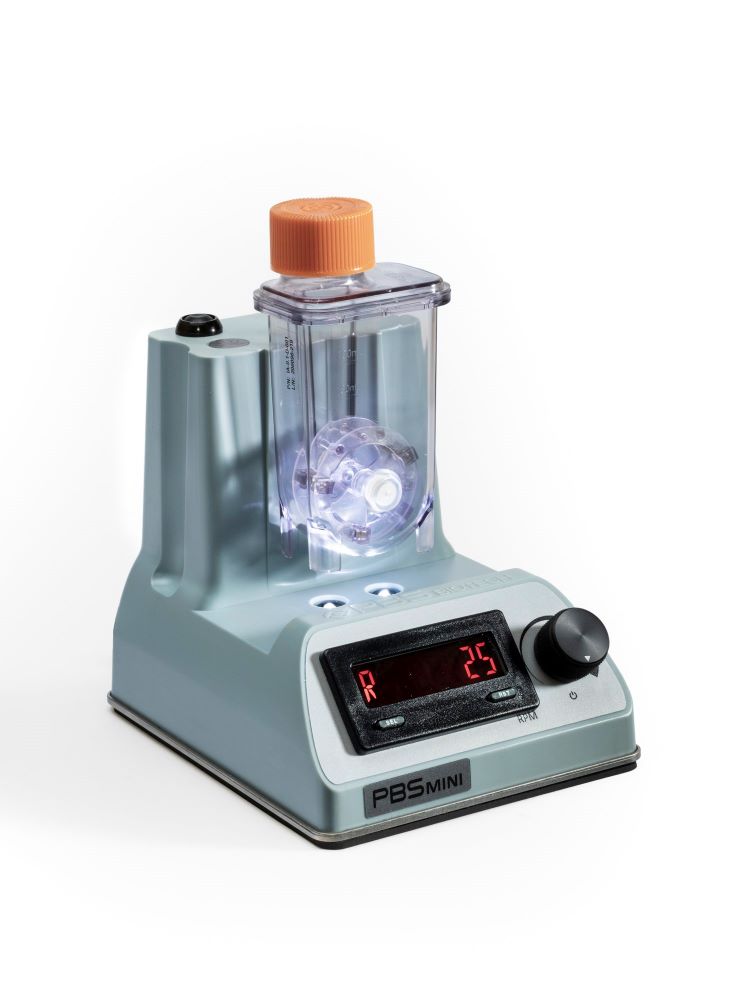
Figure 1. The PBS Mini vertical-wheel bioreactor range, consisting of the PBS Mini base (reusable) and single-use consumables, available in 0.1 L and 0.5 L sizes.
Study design: validation from small scale to pilot scale
The study used CAR-NK cells activated with irradiated K562 feeder cells and transduced with a retrovirus, cultured in PBS-0.1 Mini (100 mL working volume) and PBS-3 (3 L working volume) vertical-wheel bioreactors. The core assessments were:
- Optimization of key process parameters such as agitation speed and seeding density;
- Comparison of expansion efficiency across batch, fed-batch and perfusion modes;
- Quality attributes including viability, apoptosis, CAR expression and killing potency;
- Consistency of scale-up from small scale to pilot scale.
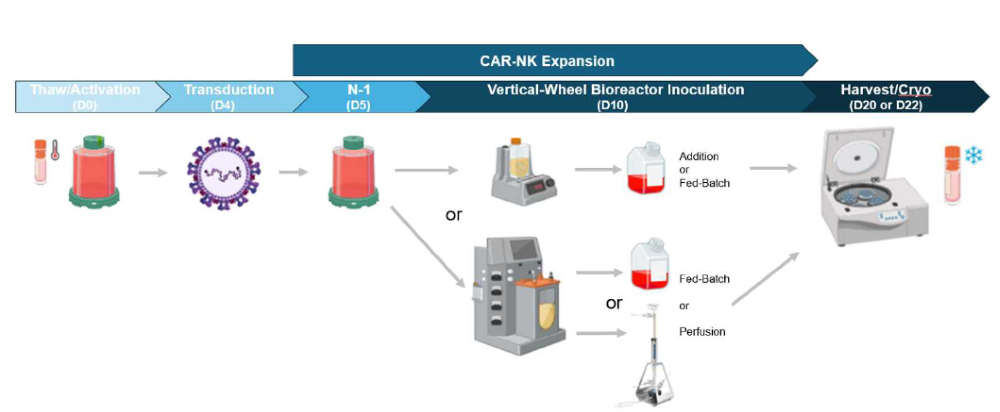
Figure 2. Process flow of NK cells from activation and expansion to cryopreservation under fed-batch and perfusion culture.
PBS Mini 0.1 L: fixing the core parameters in a scale-down model
As a low-cost scale-down model, the PBS Mini 0.1 L allows rapid screening of process parameters and reduces pilot-scale development risk. The study systematically optimized two core variables: agitation speed and seeding density.
Agitation speed: 30–50 rpm is the better range
Four speeds were tested — 10, 30, 50 and 100 rpm:
- 10 rpm: insufficient mixing, with visible cell settling and clumping that limited expansion;
- 100 rpm: higher shear stress and a greater proportion of apoptotic cells, affecting cell health;
- 30/50 rpm: robust expansion, with 36-fold expansion in 12 days in batch mode at 30 rpm, better than the 10 rpm group.
Seeding density: lower density gives higher fold expansion
Four seeding densities — 5E4, 1E5, 2.5E5 and 4E5 cells/mL — were tested in fed-batch mode:
- 5E4 cells/mL: the better fold expansion, reaching 50-fold in 10 days;
- As density increased, fold expansion fell progressively; nutrients were consumed faster at high seeding densities and the growth plateau came earlier;
- Pilot baseline: weighing total cell yield against process efficiency, 1E5 cells/mL was chosen as the baseline seeding density for scale-up.
In addition, adding 1 g/L Pluronic F-68 to the medium as a shear protectant further reduced cell damage during agitation and improved culture stability.
| Figure | Donor | Culture days | Feeding strategy | Seeding density (cells/mL) | Agitation speed | Total viable cells (D10) | Fold expansion |
|---|---|---|---|---|---|---|---|
| 3A/B | DA | 12 | Batch | 100E3 | 10 RPM | 1.2E8 | 17 |
| 3A/B | DA | 12 | Batch | 100E3 | 30 RPM | 3.1E8 | 36 |
| 3A/B | DA | 12 | Batch | 100E3 | 50 RPM | 2.9E8 | 30 |
| 3C/D | DB | 10 | Batch | 50E3 | 50 RPM | 1.5E8 | 31 |
| 3C/D | DB | 10 | Batch | 50E3 | 100 RPM | 1.2E8 | 24 |
| 3C/D | DB | 10 | Batch | 50E3 | 50 ➜ 100 RPM shift | 1.2E8 | 25 |
| 3E/F | DB | 10 | Fed-batch | 50E3 | 50 RPM | 2.5E8 | 50 |
| 3E/F | DB | 10 | Fed-batch | 100E3 | 50 RPM | 1.9E8 | 19 |
| 3E/F | DB | 10 | Fed-batch | 250E3 | 50 RPM | 4.5E8 | 18 |
| 3E/F | DB | 10 | Fed-batch | 400E3 | 50 RPM | 2.5E8 | 13 |
Table 1. Parameter evaluation and expansion results in PBS-0.1.
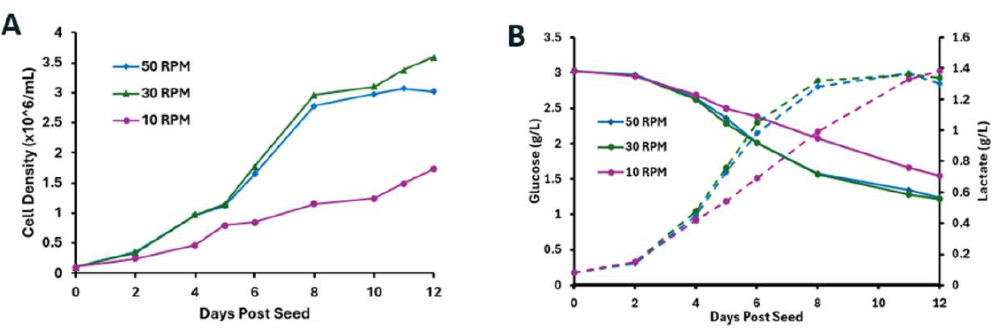
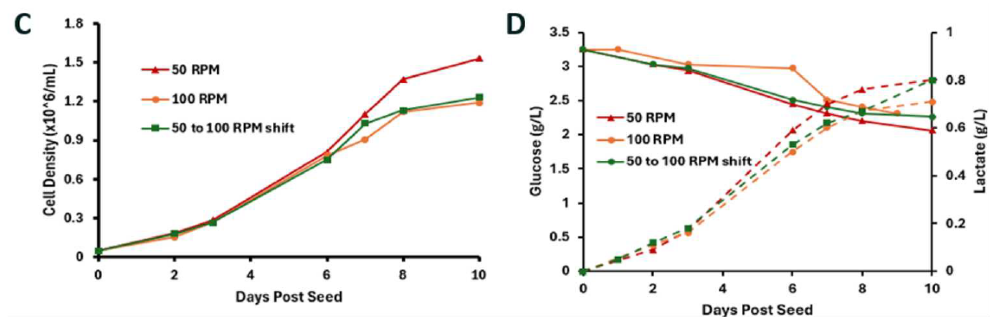
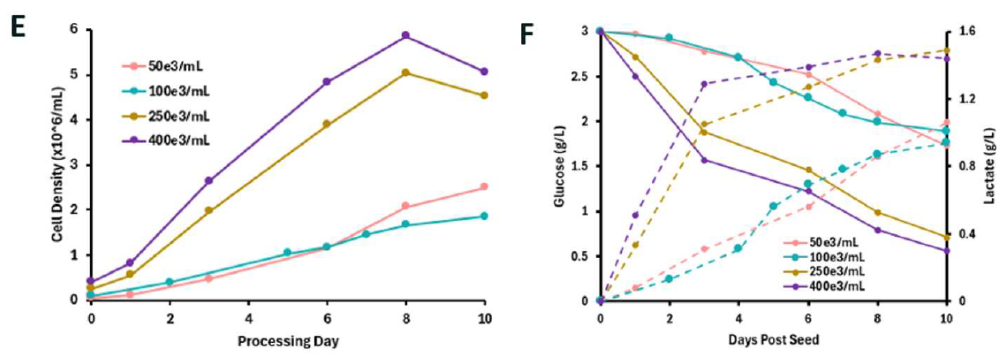
Figure 3. A–B: fold expansion at 30 rpm and 50 rpm was about twice that at 10 rpm; after 12 days, glucose fell to about 1.5 g/L and lactate rose to about 1.4 g/L. C–D: final cell densities were similar under constant 100 rpm and a 50→100 rpm shift, while constant 50 rpm gave better expansion; at the end of 10 days, glucose fell to about 2 g/L and lactate rose to about 0.8 g/L, and cell growth usually enters a plateau at this metabolic level, consistent with the cell-density trend. E–F: the lower seeding density of 50E3 cells/mL gave higher fold expansion; at the end of 10 days, the 50E3 and 100E3 cells/mL groups had similar metabolic profiles.
PBS-3 at 3 L: fed-batch clearly increases cell yield
Using the optimized small-scale parameters, the process was scaled to 3 L and two strategies were compared:
- Batch: culture started at the full 3 L volume with no medium added during the run;
- Fed-batch: culture started at 2 L, with 1 L of fresh medium added on day 3 after seeding to reach full volume.
Fed-batch culture, by replenishing nutrients and diluting metabolic waste, effectively delayed the growth plateau and gave a higher total cell yield than batch culture. The 0.1 L and 3 L runs also showed closely matching growth kinetics and metabolic trends. According to the white paper, this confirms the linear scale-up of PBS vertical-wheel bioreactors: process parameters transfer directly, substantially reducing scale-up risk.
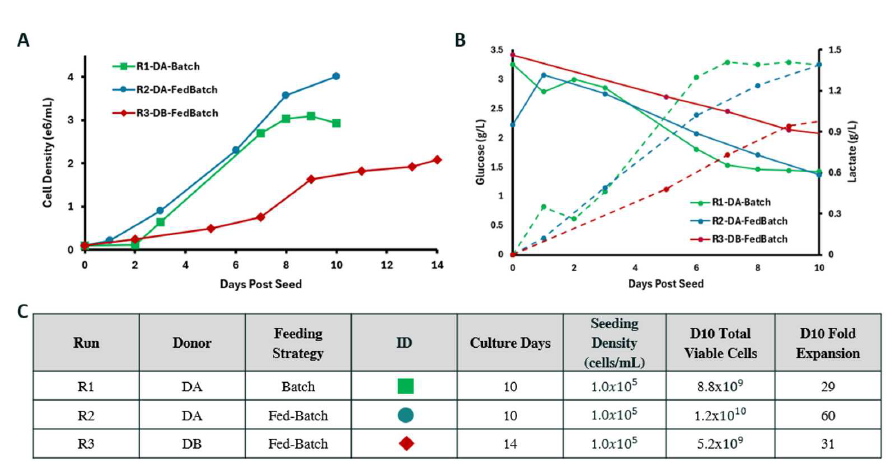
Figure 4. Analysis of cell expansion results. (A) Cell-density curves of non-perfused culture batches; (B) glucose and lactate concentrations measured with a FLEX2 metabolic analyser (solid lines glucose, dashed lines lactate); (C) cell counts and fold expansion for three culture batches. The results confirm that the fed-batch medium strategy gives a higher cell yield than batch mode.
The metabolic data show that cell growth begins to plateau when glucose falls to about 2.0 g/L and lactate exceeds 1.0 g/L, a threshold that also informs when to start perfusion.
ATF perfusion: a further 2.6-fold increase in cell yield
To intensify the process further, the study coupled the 3 L reactor with a Repligen ATF2 system to develop perfusion culture at a perfusion rate of 1.5 L/day (0.5 VVD).
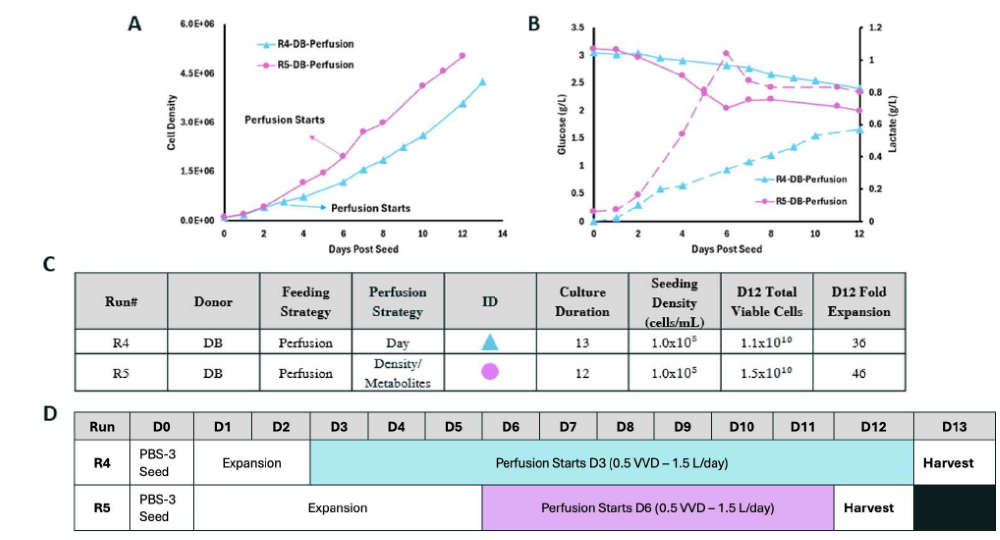
Figure 5. Perfusion process profile. (A) Cell-density curves of batch 4 (R4-DB-perfusion) and batch 5 (R5-DB-perfusion), with the start of each perfusion phase marked; (B) glucose and lactate curves (solid lines glucose, dashed lines lactate); (C) total cells harvested and fold expansion, with both batches seeded at 1.0E5 cells/mL; (D) perfusion schedule (VVD: vessel working volumes exchanged per day).
- Much higher cell yield: compared with fed-batch culture of the same donor, perfusion increased cell yield 2.6-fold, reached a viable-cell density of 5E6 cells/mL and gave up to 1.5E10 total viable cells per 3 L batch.
- No apparent effect on cell quality: apoptosis testing showed no clear difference in cell health before and after perfusion started, with healthy cells stable above 60%; according to the white paper's analysis, the gentle vertical-wheel flow together with ATF's low-shear retention does not cause additional damage to NK cells.
- A more stable metabolic environment: perfusion continuously supplies fresh nutrients and removes waste such as lactate, keeping glucose and lactate in a stable range and avoiding the growth inhibition caused by waste accumulation in batch culture.
- A more economical start point: the study also notes that starting perfusion based on cell density or metabolic level is more economical than starting on a fixed day and improves medium utilization.
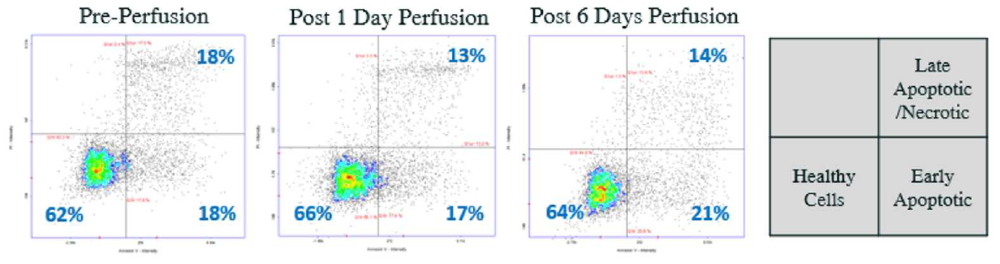
Figure 6. Cell-health assessment of perfusion batch 5 (R5-DB-Perfusion): overall cell health was essentially the same before and after perfusion started.
Functional validation: reactor-expanded cells kill more strongly
Beyond cell numbers, functional activity is what matters clinically. Using an LDH killing assay, the study compared the potency of CAR-NK cells expanded in the PBS reactor and in the static G-Rex system:
- Day 7: relative killing potency of the PBS group was 1.77 times that of the G-Rex group;
- Day 8: relative killing potency of the PBS group rose to 2.56 times that of the G-Rex group.
The results indicate that the dynamic environment of the vertical-wheel reactor not only increases cell yield but also helps maintain or even enhance the tumour-killing function of CAR-NK cells. The expanded cells also showed normal CAR expression and acceptable post-thaw activity, fitting the full clinical manufacturing workflow.
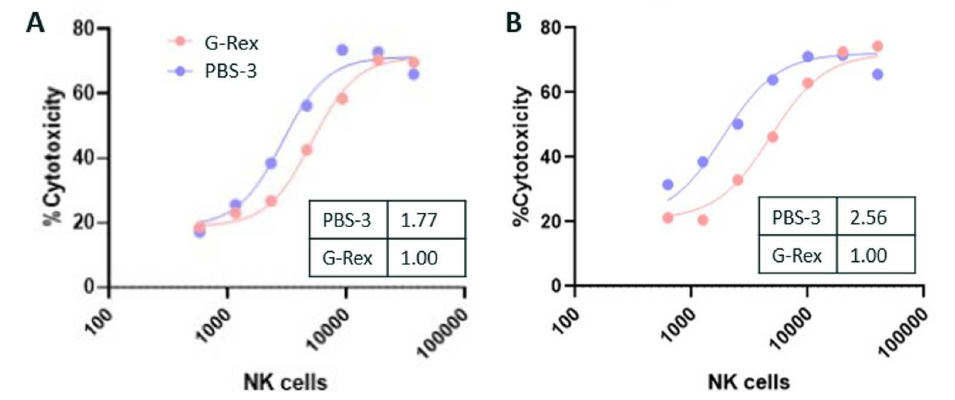
Figure 7. Relative potency (RP) of cells from the static G-Rex system and perfusion batch 5 (R5-DB-Perfusion). (A) Day 7 after seeding, PBS-3 reactor versus G-Rex; (B) day 8 after seeding.
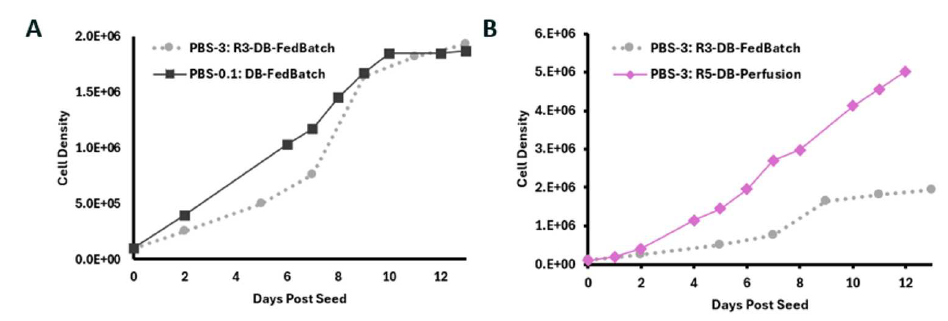
Figure 8. Cell-density profiles of CAR-NK cells from a single donor (donor B) in vertical-wheel bioreactors (VWB). (A) Fed-batch results in PBS-3 and PBS-0.1 show matching growth kinetics, confirming consistent linear scale-up; (B) comparison of fed-batch and perfusion culture in PBS-3 shows that the perfusion medium strategy effectively increases cell yield.
Summary: four conclusions
- A low-shear environment suited to immune cells: gentle flow maintains high viability and functional activity;
- Linear scale-up lowers development cost: process parameters from the 0.1 L Mini model transfer directly to 3 L and larger scales;
- Perfusion intensifies output: with ATF perfusion, cell yield was 2.6-fold higher than with fed-batch;
- Towards clinical-grade manufacturing: the white paper extrapolates from the experimental data that 80 L perfusion culture could theoretically yield 4E11 total cells, enough for clinical doses for multiple patients (NK cell therapy doses in the literature are typically 5E6–1E8 NK cells per kilogram of body weight).
The white paper also notes that the current process has not reached the system's limit: with further parameter optimization and feedback perfusion based on real-time metabolism, cell density and yield could rise further. Note that the 2.6-fold yield advantage and the relative-potency data should be read together with the donors, seeding, agitation, feeding, retention and harvest conditions tested, and are not fixed multiples independent of platform and process.
Let TechWave help you plan scaled CAR-NK expansion
If your NK or CAR-NK project is held back by static culture that will not scale or varies between batches, or you are moving from small-scale screening towards perfusion intensification and clinical-grade manufacturing, contact TechWave. Based on your cell type, target yield and development stage, we can help evaluate combinations of PBS Mini, PBS-3 and other vertical-wheel bioreactors, provide technical documents and arrange a quotation.
References
- Mace EM. Human natural killer cells: Form, function, and development. Journal of Allergy and Clinical Immunology. 2023;151(2):371-385. doi:10.1016/j.jaci.2022.09.022
- Liu S, Galat V, Galat Y, et al. NK cell-based cancer immunotherapy: from basic biology to clinical development. Journal of Hematology & Oncology. 2021;14:7. doi:10.1186/s13045-020-01014-w
- Davis BM, Loghin ER, Conway KR, Zhang X. Automated Closed-System Expansion of Pluripotent Stem Cell Aggregates in a Rocking-Motion Bioreactor. SLAS Technology. 2018;23(4):364-373. doi:10.1177/2472630318760745
- Jenkins MJ, Farid SS. Human pluripotent stem cell-derived products: Advances towards robust, scalable and cost-effective manufacturing strategies. Biotechnology Journal. 2015;10(1):83-95. doi:10.1002/biot.201400348
- Francis N, Aho J, Ben-Nun IF, et al. Scaling up pluripotent stem cell-based therapies—considerations, current challenges and emerging technologies: perspectives from the ISCT Emerging Regenerative Medicine Working Group. Cytotherapy. 2025;27(9):1031-1042. doi:10.1016/j.jcyt.2025.04.058
- Granzin M, Soltenborn S, Müller S, et al. Fully automated expansion and activation of clinical-grade natural killer cells for adoptive immunotherapy. Cytotherapy. 2015;17(5):621-632. doi:10.1016/j.jcyt.2015.03.611
- Xu S, Hoshan L, Arias E, et al. Effects of Pluronic F-68 on the growth and metabolism of mammalian cell lines in suspension culture. Biotechnology Progress. 2017;33(1):229-239.
- Iliopoulou EG, Kountourakis P, Kafasi N, et al. A short-term ex vivo NK cell expansion protocol with pH-controlled culture conditions enhances NK cell cytotoxicity against tumor targets. Journal of Translational Medicine. 2010;8:32.
- Voigt A, et al. Impact of ammonia and lactate on CHO cell culture performance and quality of monoclonal antibodies. Biotechnology Progress. 2012;28(3):721-733.
- Lamers-Kok N, Panella D, Georgoudaki AM, et al. Natural killer cells in clinical development as non-engineered, engineered, and combination therapies. Journal of Hematology & Oncology. 2022;15:164. doi:10.1186/s13045-022-01382-5
Uses and applicable scenarios
- Clinical-grade scaled expansion of CAR-NK and other immune cells
- Rapid screening of agitation speed and seeding density in the PBS Mini 0.1 L scale-down model
- Development and intensification of fed-batch and ATF perfusion processes
- Verifying linear scale-up from small scale to pilot scale
Limitations
- The 2.6-fold yield increase and the 1.77- and 2.56-fold relative potencies come from specific donors and seeding, agitation, feeding and perfusion conditions and are not fixed multiples independent of platform and process
- The theoretical yield at 80 L is the white paper's extrapolation from experimental data; cell expansion results are not a guarantee of clinical efficacy