
Technical column
No Lab on the Weekend, Colonies Still Compact: A Reading of Weekend-Free iPSC Culture with Thermostable FGF2-G3 and TGF-β1 PLUS
Qkine points out that FGF-2 has an effective half-life of less than 10 hours in culture medium at 37 °C, one important reason iPSCs need frequent medium changes. In its application note, Qkine puts thermostable FGF2-G3 (Qk053) and animal-origin-free TGF-β1 PLUS (Qk010) into an E8-type medium on vitronectin-coated plates and passages cells on a Monday and Thursday rhythm, with a medium change the day after each passage and no medium change on Wednesday or over the whole weekend. Over three passages in 14 days, colony morphology stayed compact and regular; in a separate immunostaining set that ran across a weekend without medium change, NANOG, OCT-4 and SOX2 were highly expressed. This article explains what the scheme means, the evidence the manufacturer gives, and where it applies.
Definition
Weekend-free iPSC culture is a maintenance schedule for feeder-free iPSCs that compresses routine work to two passages and two medium changes a week, with no medium change on Wednesday or at the weekend. Qkine's application note achieves it with thermostable FGF2-G3 (Qk053) and animal-origin-free TGF-β1 PLUS (Qk010) in an E8-type medium on vitronectin, and offers colony morphology and NANOG, OCT-4 and SOX2 immunofluorescence as the manufacturer's evidence.
Feeding iPSCs once a day means 365 lid-openings and 365 portions of medium a year. That is bearable for one or two lines, but for a platform maintaining a dozen or several dozen lines, weekend duty, medium cost and operator-to-operator variation all stack up. One key reason is that FGF-2, which pluripotency maintenance depends on, loses activity quickly at culture temperature. The idea in Qkine's application note is to replace it: pair thermostable FGF2-G3 with animal-origin-free TGF-β1 PLUS and compress the week's work to two passages and two medium changes, leaving the weekend entirely free. The manufacturer's results are that iPSCs kept compact colonies with clear edges over 14 days and three passages, and that cells left without a medium change across a weekend still expressed pluripotency markers at a high level.
Video explainer
Weekend-Free iPSC Culture? What Qkine's FGF2-G3 + TGF-β1 PLUS App Note Shows, and Its Limits
Watch on YouTube ↗Video transcript
Daily feeding is 365 openings a year. Skip the weekend: will iPSCs hold up? The catch is FGF-2. Qkine notes its effective half-life in medium is under 10 hours. As levels drop, signaling wobbles: one major reason for daily feeding.
Qkine's app note uses two factors we sell: thermostable FGF2-G3, with a functional half-life over 7 days per the manufacturer, and animal-origin-free TGF-β1 PLUS. Weekend-free means a weekly schedule: passaging Monday and Thursday, feeding the next day, and no feeding on Wednesday or over the weekend. Cells get fresh medium four times a week.
The manufacturer reports compact colonies with clear edges over 14 days and 3 passages under these conditions. Another set, after a no-feed weekend, showed high NANOG, OCT-4 and SOX2. Know the limits: these are qualitative images, with no flow quantification, karyotype or longer-term data.
The app note gives no data on daily-feeding comparisons or differentiation. It's a package deal. Swapping FGF2-G3 into your current medium and feeding less won't necessarily give the same result; a new matrix is a new combination too.
The full schedule, factor specs and an independent study: the technical column at techwave.hk.
Produced by TechWave. For research reference only; not medical advice.
The Pain Point: Why iPSCs "Have to" Be Fed Every Day
Feeder-free iPSC culture is a highly repetitive routine job, and its cost falls mainly on medium and feeding frequency. Two core growth factors must be held at the right concentration in the medium: FGF-2 (bFGF) and TGF-β1, which together hold up iPSC pluripotency.
The difficulty lies in FGF-2. Qkine notes that FGF-2 is intrinsically unstable, is easily degraded by proteases and aggregates, with an effective half-life in culture medium of less than 10 hours. When the concentration drops, the pluripotency signal becomes unstable, which is an important reason conventional protocols supply fresh medium every day. FGF-2 is not the only variable: Kuo et al. (2020) point out that some existing medium formulations are said not to need daily feeding, possibly helped by better buffering, by stabilising FGF-2 with heparin or similar means, or by including albumin with an antioxidant effect. For teams that must expand a single line in volume or maintain several lines at once, daily feeding means rising cost and labour and also more colony variation caused by inconsistent handling.
The Core of the Scheme: Two Growth Factors That "Hold Up"
FGF2-G3 (Qk053): Engineered Thermostable FGF-2
FGF2-G3 (also called FGF2-STAB®) comes from the hyperstable FGF-2 designed with computer-assisted protein engineering by Dvorak et al. at Masaryk University; Qkine licensed the technology and produces it itself. According to Qkine's product information:
- Qk053 is the 154-amino-acid form of FGF-2 with nine stabilising amino acid substitutions, a molecular weight of 17 kDa, SDS-PAGE purity above 98% and endotoxin below 0.05 EU/μg;
- It is expressed in E. coli, animal-origin-free and carrier-protein-free, with the His tag of the academic construct removed;
- Functional half-life is extended from under 10 hours for wild type to more than 7 days. Qkine's thermostable FGF-2 page also states that in the study by Dvorak et al., FGF2-G3 incubated in medium at 37 °C for up to 20 days showed no significant loss of biological activity, and matched wild-type FGF-2 in maintaining human embryonic stem cell pluripotency and Oct-4 and nanog expression;
- According to the same page, Koledova et al. (2019) compared receptor specificity in a BaF3 cell proliferation assay: FGF2-G3 matched wild type, activating FGFR1c, FGFR2c, FGFR3c and FGFR1b and not activating FGFR2b or FGFR3b.
An independent laboratory saw similar stability: Kuo et al. (2020) used their own FGF2-G3 in a phosphorylated-ERK assay, and medium kept at 37 °C for 7 days could still activate signalling, whereas the commercial FGF-2 they used as a control could not after 2 days.
Qkine also supplies a 145-amino-acid FGF2-G3 (Qk052). The first nine N-terminal amino acids of the 154 aa form are not required for biological activity; both lengths are offered so that they can be compared directly with the wild-type FGF-2 a lab is already using.
TGF-β1 PLUS (Qk010): Animal-Origin-Free TGF-β1
Qkine describes TGF-β1 PLUS as the first fully animal-origin-free recombinant human TGF-β1, made of an optimised mature TGF-β1 domain, a 24 kDa dimer with purity above 98%, expressed in E. coli, carrier-protein-free and with endotoxin below 0.05 EU/μg. Qkine notes that recombinant human TGF-β1 has mostly been expressed in mammalian cells such as HEK or CHO, where endogenous protein contamination, cost and animal-origin-free status were all problems.
The manufacturer's reasoning is that high-purity growth factors carry low levels of impurities such as endotoxin, and thermostable factors let cells keep seeing stable levels of the essential factors, which lowers the risk of losing pluripotency during routine maintenance.
How "Weekend-Free" Is Actually Scheduled
The "weekend-free" in this application note does not mean touching the cells once a week; it is a very specific weekly schedule:
| Day | Action |
|---|---|
| Monday | Passage |
| Tuesday | Medium change |
| Wednesday | No medium change |
| Thursday | Passage |
| Friday | Medium change |
| Saturday | No medium change |
| Sunday | No medium change |
That is two passages a week, with cells seeded into fresh E8-type medium at passage; the day after passage the old medium is replaced with fresh medium (5 mL per well of a 6-well plate), and no medium change is made on the other three days. Cells meet fresh medium four times a week (two passages, two medium changes). Hands-on days are Monday, Tuesday, Thursday and Friday, with Wednesday and the whole weekend free; the longest stretch runs from the Friday medium change to the Monday passage.
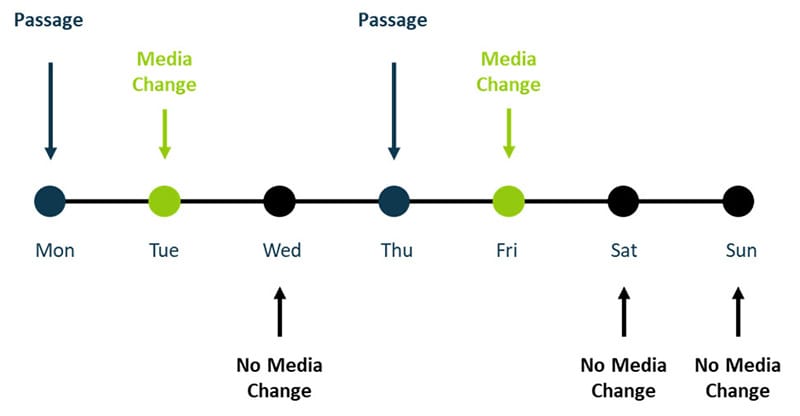
The key conditions of the culture system are:
- Matrix: Qkine vitronectin (Qk120) at 5 µg/mL coating 6-well plates;
- Passaging: dissociation with 0.5 mM EDTA at a 1:6 split;
- Medium: a chemically defined E8-type medium based on DMEM/F12 with sodium bicarbonate, sodium chloride, L-ascorbic acid and insulin-transferrin-selenium (ITS-G), with the growth factors FGF2-G3 (Qk053) at 40 ng/mL and TGF-β1 PLUS (Qk010) at 2 ng/mL; components are added sterile and the medium is filter-sterilised before use. The experiments in the application note used ITS-G; Qkine notes in the recipe table that it now supplies the animal-origin-free HiDef® ITS cell culture supplement.
The manufacturer stresses that E8-type medium has few undefined components, which reduces culture variation within a cell line or between lines, improves reproducibility and supports more consistent scale-up.
Evidence the Manufacturer Gives
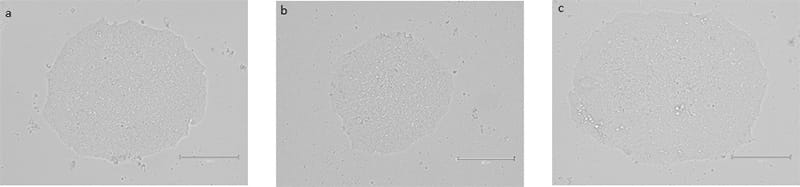
Three Passages over 14 Days, Colony Morphology Stays Compact
Qkine reports that in E8-type medium containing FGF2-G3 and TGF-β1 PLUS on a vitronectin matrix, iPSCs stayed at high confluence throughout with no spontaneous differentiation. The application note gives brightfield images at three time points: 3 days of culture after the first seeding, 7 days of culture after one passage, and 14 days of culture after three passages (scale bar 150 µm). Colonies at all three time points have a rounded, intact shape with clear edges and tightly packed cells.
Pluripotency Markers: High NANOG, OCT-4 and SOX2 Expression
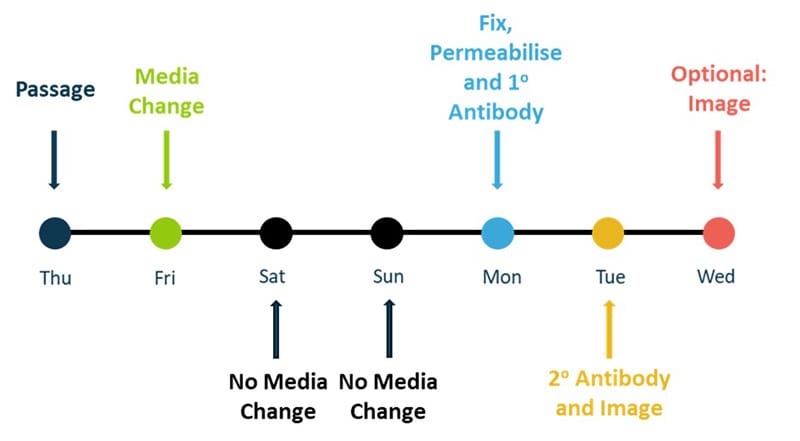
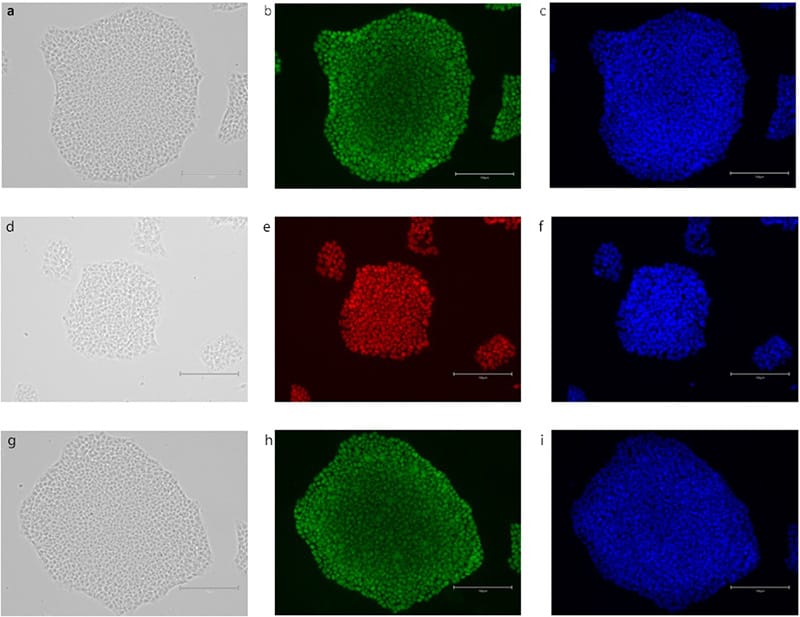
The pluripotency markers come from a different experiment: cells were seeded at low density into a vitronectin-coated 96-well plate on a test schedule of seeding on Thursday, medium change on Friday, no medium change on Saturday and Sunday, and fixation on Monday for OCT-4, NANOG and SOX2 immunofluorescence. In other words, the stained colonies themselves had been through a weekend without a medium change. All three markers were expressed at a high level (NANOG and SOX2 in green fluorescence, OCT-4 in red fluorescence, scale bar 150 µm). The note does not say how long these cells had previously been kept under this condition, so this is evidence independent of the 14-day morphology observation above.
Results the Manufacturer Adds (Data Not Published in the Application Note)
Qkine also states that:
- iPSCs cultured under this weekend-free condition were later differentiated into a variety of germ layers and cell types, which the manufacturer takes as further indication that pluripotency was maintained;
- Compared with iPSCs cultured in conventional E8-type medium, proliferation rates were similar, but the latter showed more spontaneous differentiation and lower colony quality, and needed daily feeding at higher maintenance cost and time.
Neither part comes with data in the application note; for the comparison with E8-type culture, Qkine notes that data are available on request.
Where It Applies and What to Weigh When Choosing
What these data show: under one defined combination (a self-prepared E8-type medium, FGF2-G3 at 40 ng/mL, TGF-β1 PLUS at 2 ng/mL, vitronectin coating, two 1:6 passages a week), iPSCs kept typical undifferentiated colony morphology over 14 days and three passages, and a separate immunostaining set that went through a weekend without a medium change showed NANOG, OCT-4 and SOX2 expression; at the same time daily feeding was reduced to two medium changes a week (plus two passages).
What it does not cover: the application note shows qualitative morphology and immunofluorescence images, with no flow cytometry quantification, karyotype or genomic stability data and no longer serial-passage results; the comparison with daily-fed E8-type culture and the differentiation data are not public. The manufacturer mentions that high-purity growth factors "reduce effects on genotypic stability", which is the manufacturer's reason for choosing such factors, not a result this study tested. If a project needs karyotype, genetic stability or downstream differentiation efficiency after long-term passaging, add your own validation in your own line and endpoints.
Three points worth considering when choosing:
- The formulation is a whole, not a single-factor swap. This study changed the FGF-2 source and the feeding rhythm together and paired them with a specific matrix. Swapping FGF-2 for FGF2-G3 in an existing commercial medium and then changing the feeding frequency cannot be assumed to give the same result. Switching to another matrix such as laminin is likewise a new combination of conditions.
- The same idea has independent academic work behind it, but with a different formulation. The chemically defined B8 medium developed by Kuo et al. (2020) also uses FGF2-G3 and tested a similar weekend-free schedule: passaging about every 3.5 days with a single medium change 24 hours after passage. That schedule worked over 25 passages, giving 90 population doublings against 102 in the daily-feeding group; a scheme with passaging only and no medium change in between did worse. The authors also caution that without daily feeding, L-glutamine in the medium degrades gradually at 37 °C, lactate and ammonia produced by the cells lower the pH, and cell-secreted factors accumulate, and whether these effects cause adverse consequences remains to be tested. B8 as a whole differs from the E8-type medium in this application note, so their results cannot be applied to each other directly, but they can serve as different starting points for method development.
- Scale-up and translation path. FGF2-G3 and TGF-β1 PLUS are both E. coli-expressed, animal-origin-free and carrier-protein-free, and both also have cell-therapy-grade versions, which eases the move from a research-grade protocol to process development.
Getting the Weekend Back
If your platform is spending a lot of medium and weekend labour on routine maintenance of many iPSC lines, thermostable FGF2-G3 with TGF-β1 PLUS is a combination worth evaluating first. TechWave can help you compare the 145 aa (Qk052) and 154 aa (Qk053) forms of Qkine FGF2-G3, TGF-β1 PLUS (Qk010) and the cell-therapy-grade versions of both, provide application data, and prepare a quotation or samples for your cell line and culture scale.
References
- Qkine. Weekend-free human induced pluripotent stem cell culture using thermostable FGF-2 (bFGF) and animal origin-free TGF-β1 and vitronectin for improved colony homogeneity. Application note, 2025.
- Dvorak P, Bednar D, Vanacek P, et al. Computer-assisted engineering of hyperstable fibroblast growth factor 2. Biotechnology and Bioengineering. 2018;115(4):850-862. DOI: 10.1002/bit.26531
- Koledova Z, Sumbal J, Rabata A, et al. Fibroblast growth factor 2 protein stability provides decreased dependence on heparin for induction of FGFR signaling and alters ERK signaling dynamics. Frontiers in Cell and Developmental Biology. 2019;7:331. DOI: 10.3389/fcell.2019.00331
- Kuo HH, Gao X, DeKeyser JM, et al. Negligible-cost and weekend-free chemically defined human iPSC culture. Stem Cell Reports. 2020;14(2):256-270. DOI: 10.1016/j.stemcr.2019.12.007
Uses and applicable scenarios
- Culture platforms maintaining many iPSC lines that want to cut weekend duty and daily medium-change workload
- Evaluating whether thermostable FGF-2 (FGF2-G3) in place of conventional FGF-2 can lower medium-change frequency
- Method development and cost assessment for animal-origin-free, chemically defined iPSC culture
- Reading a manufacturer application note alongside independent academic work (such as Kuo et al., 2020) on weekend-free schedules
Limitations
- The note shows brightfield morphology and immunofluorescence images, with no flow cytometry quantification, karyotype or genomic stability data
- The longest culture shown is 14 days and three passages; there are no results from longer serial passaging
- The comparison with conventional daily-feed E8-type culture and the differentiation data are not published; the manufacturer says they are available on request
- The protocol is a whole formulation (FGF-2 source, feeding rhythm and matrix changed together), not a single-factor swap into an existing medium
- Karyotype, genetic stability and downstream differentiation efficiency after long-term passaging need to be validated in your own line and endpoints