
Technical column
Switching from mTeSR or E8 to StemFit: Do You Need a Gradual Transition? The Manufacturer Says Switch Directly — but Re-Validate Differentiation
When moving human iPS cells from mTeSR, Essential 8 (E8) or similar media to Ajinomoto StemFit, many labs habitually step through 25%, 50% and 75% mixtures. Ajinomoto's instruction manual is simpler: passage once in the original culture system, then switch directly to StemFit with bFGF 2–3 days before the next passage, and seed more than 100,000 cells per 6-well-plate well for the first few passages. Ajinomoto's product page adds a comparison: cells switched directly from mTeSR Plus to Basic04 Complete Type, with no adaptation period, showed cumulative expansion over three passages comparable to a control kept in mTeSR Plus. A smooth switch, however, does not mean downstream differentiation stays the same. A 2025 CiRA Foundation study compared StemFit, mTeSR Plus and E8 pre-culture of a single iPS cell line: in StemFit and mTeSR Plus the cells stayed pluripotent with normal karyotypes, yet with one commercial cardiomyocyte differentiation kit the TNNT2-positive rates were 54.6%, 85.4% and 88.6%. This article gives five steps for a direct switch, six things to verify afterwards, and when to go back and adjust your differentiation protocol.
Definition
A medium switch means moving human pluripotent stem cells that are stably passaged in one feeder-free medium (such as mTeSR Plus or Essential 8) into another medium for continued maintenance and expansion. There are two common approaches: a gradual transition that blends in the new medium step by step, and a direct switch that changes to the new medium in one go at a defined feeding or passaging point. Ajinomoto's StemFit manual recommends the latter.
Many labs have a time-honoured "safe" way to change media: 25% new medium first, 50% a few days later, then 75%, and finally a full change. The reasoning is simple enough — stem cells are delicate, and an abrupt change might be too much for them.
If you are moving to Ajinomoto's StemFit, the manufacturer's answer is that you don't need to go to that trouble. Switch directly.
But there is a second half to the story, and it matters more: cells that switch over smoothly will not necessarily give you the same results from the differentiation protocol you tuned before.
Video explainer
Switching to StemFit: Gradual Transition or Direct Switch?
Watch on YouTube ↗Video transcript
Many labs have an old routine for changing media: a quarter new medium first, half a few days later, then three quarters, and finally a full change. The reasoning is simple: stem cells are delicate, and an abrupt change might be too much for the cells.
If you are moving to Ajinomoto's StemFit, the manufacturer's answer is: no need for all that, switch directly. But the story has a second half, and the second half matters more. Cells that switch over smoothly will not necessarily give you the same results from the differentiation protocol you tuned before. This episode covers both halves.
Ajinomoto's StemFit instruction manual, which covers Basic03 and Basic04CT, has a section on transferring cells from other culture systems. It contains just two points. Point one: passage with your original culture system, then, two to three days before the next passage, change in one go to StemFit with bFGF.
The manual's timeline: after passaging, the first and second medium changes still use the original medium, the third and fourth use StemFit, and the cells are then passaged in StemFit. There is no blending step. Point two: seed more densely for the first few passages; more than 100,000 cells per well of a 6-well plate may help.
The timing has another advantage: the change comes in the second half of a passage, when the cells are attached and growing as colonies, so by the next passage they have already had two or three days in the new medium. When the manufacturer says cells can switch in one step, which medium is the comparison?
The answer is on the Basic04CT product page: mTeSR Plus. Ajinomoto switched one group of cells directly from mTeSR Plus to Basic04CT, kept another group in mTeSR Plus, and grew both for three passages. The two groups' cumulative expansion was almost identical, both passing a million-fold by passage 3.
In the manufacturer's words: no adaptation needed, equivalent growth over three passages, no change of substrate or passaging conditions. Two caveats: these are Ajinomoto's own experiments, and the product page does not say which cell line was used; and the comparison covers expansion, not differentiation.
What about E8? The manufacturer gives no dedicated data for E8. The manual's procedure is written for "other culture systems" in general, so follow it for E8 too, and verify afterwards just the same. You may have heard different advice.
Thermo Fisher's application note for StemFlex Medium recommends at least two passages in StemFlex for full adaptation when cells come from mTeSR1 or a feeder-dependent system. The two positions don't contradict each other; each is the recommended procedure for its own medium.
The rule is simple: follow the instructions of the medium you are switching to. For StemFit, switch directly; no need to invent your own blending ratios. The real work is in the second half. In 2025 the CiRA Foundation published a study that maintained the same iPS cell line under three conditions: the Japanese version of StemFit with iMatrix-511, mTeSR Plus with LN521, and mTeSR Plus with LN521 switched to E8 on the last day before differentiation.
The Japanese StemFit's liquids A and B are identical to Basic03. First, maintenance: in both the StemFit and mTeSR Plus groups the cells stayed pluripotent with normal karyotypes. On the question of whether the switch worked, both pass.
But after differentiation with the same commercial cardiomyocyte kit, the cardiac-marker-positive rates were far apart. The StemFit group reached 54.6%, the mTeSR Plus group 85.4%, and the group switched to E8 on the last day 88.6%.
But don't jump to conclusions: in the same paper, with the researchers' own differentiation medium, StemFit-pre-cultured cells reached 84%, and with StemFit's component ratios adjusted, as high as 95%. So the conclusion: differentiation efficiency depends on how the maintenance medium pairs with the differentiation protocol.
A protocol optimised in one medium may no longer be optimal after a medium change. The study also has limits: one cell line, medium and matrix changed together, and these efficiency figures are for cardiomyocytes. In practice, five steps.
One, prepare StemFit: thaw at room temperature or in the fridge, never in a 37-degree water bath; Basic03 takes bFGF at 80 nanograms per millilitre by default, adjustable, while Basic04CT already contains bFGF. Two, passage once more in the original system.
Three, switch directly two to three days before the next passage, without blending. Four, passage into StemFit, seeding densely at first. Five, keep some cells in the original medium as a control. After switching, verify six things: colony morphology; expansion over at least three passages; pluripotency markers; karyotype or copy number, as the ISSCR recommends evaluating genetic changes after modifying culture conditions; your actual differentiation protocol, side by side with cells from the original medium; and, if growth or differentiation clearly changes, check for recurrent variants such as 20q11.21 even with a normal karyotype.
The fifth is the one most often skipped, and the one most worth doing. If differentiation drops, check genetic stability, and also check how your protocol pairs with the maintenance medium, such as starting cell density, inducer concentrations and timing.
Coming from mTeSR or E8 for 2D expansion, StemFit offers two GMP-grade options. For the simplest switch, choose Basic04CT: one bottle, bFGF included, with the manufacturer's direct-switch data from mTeSR Plus. To control bFGF yourself, or to reproduce papers that used the Japanese StemFit, choose Basic03.
So: switching to StemFit, no need to blend step by step; after switching, run your own differentiation protocol again. The full steps and checklist are in the article of the same name on our website.
Switching to StemFit: Do You Need to Blend?
Watch on YouTube ↗Video transcript
Changing media: a quarter first, then half, bit by bit? If the new medium is StemFit, the manufacturer says no need. Ajinomoto's manual says: passage once in your original system, then switch directly to StemFit with bFGF two to three days before the next passage, and seed densely for the first few passages.
The manufacturer has data too: switched directly from mTeSR Plus to Basic04CT, cells expanded over three passages as well as those left unchanged. These are manufacturer data, cell line not stated, covering expansion only; there are no dedicated data for E8.
But switching over is not the same as differentiating the same. In a CiRA Foundation study, one cell line maintained on different medium-and-matrix combinations and differentiated with the same cardiomyocyte kit gave 85.4% positive cells in the mTeSR Plus group, but only 54.6% in the StemFit group.
With a different differentiation protocol, the StemFit group reached 84%. So after switching media, run your own differentiation protocol again. The five steps and six checks are in the article on our website.
Produced by TechWave. For research reference only; not medical advice.
The short answer
- No gradual transition needed. Ajinomoto's manual says: passage once in your original culture system, then change directly to StemFit with bFGF 2–3 days before the next passage, and seed at a higher density for the first few passages [1].
- The manufacturer has comparison data. Cells switched directly from mTeSR Plus to Basic04 Complete Type (Basic04CT), with no adaptation period, showed cumulative expansion over three passages comparable to a control kept in mTeSR Plus [2].
- Differentiation is what needs re-validating. In a 2025 CiRA Foundation study, the same iPS cell line maintained in different media and then differentiated with the same cardiomyocyte kit gave cardiac-marker-positive rates more than 30 percentage points apart [3]. After changing media, run your differentiation protocol again with your own cells.
What the manufacturer says: passage once, then switch
Ajinomoto's StemFit instruction manual (which covers Basic03 and Basic04CT) has a dedicated section on transferring cells from other culture systems. It contains just two points [1]:
- Passage with the original culture system, then switch the medium to StemFit supplemented with bFGF 2–3 days before the next passage.
- Seeding at a higher density — more than 100,000 (1E5) cells per well of a 6-well plate — may help for the first few passages.
The manual illustrates this with a timeline: after passaging, the first and second medium changes still use the original medium, the third and fourth use StemFit, and the cells are then passaged in StemFit. There is no blending step. Basic03's FAQ says the same thing: switch to Basic03 two days before passaging [4].
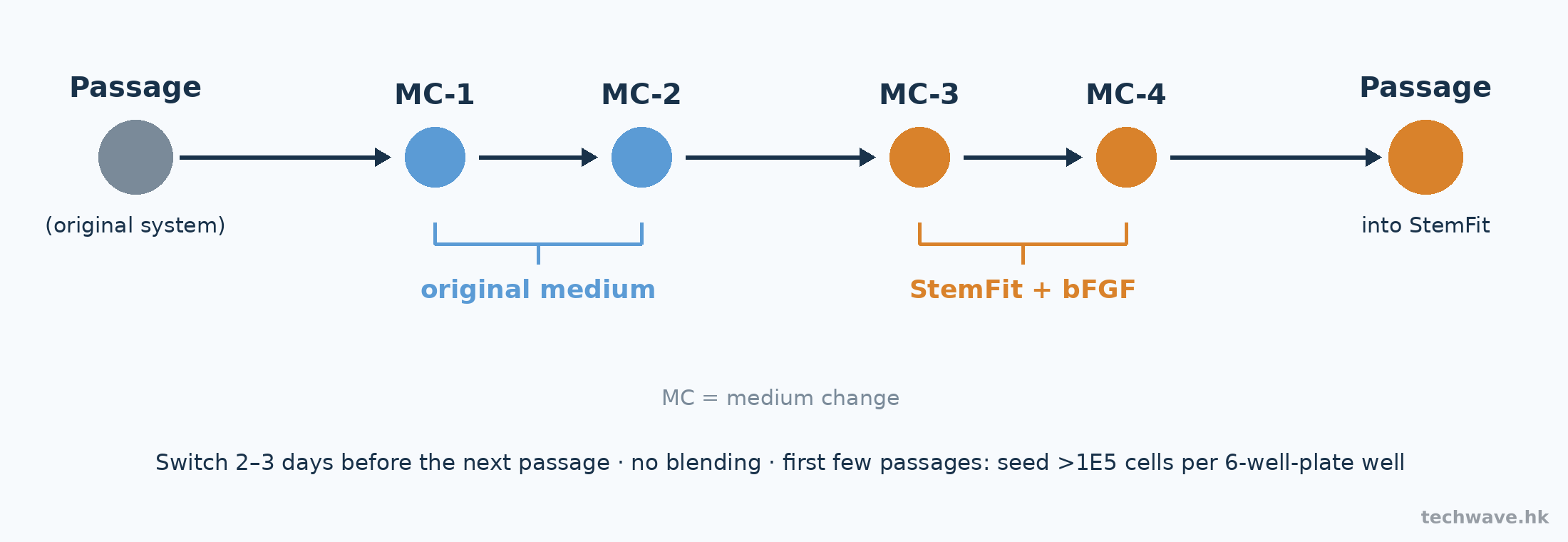
Figure: Timeline for a direct switch to StemFit (drawn from Ajinomoto's instruction manual).
The timing has a practical logic. The switch happens in the second half of a passage, when the cells are well attached and growing as colonies. By the next passage they have already had two or three days in StemFit, so their recovery after passaging takes place in the new system.
The manufacturer's data: mTeSR Plus straight to Basic04CT, comparable over three passages
When Ajinomoto says Basic04CT supports a one-step switch from existing media, which medium is the comparison? The answer is in the transition chart on the Basic04CT product page: mTeSR Plus [2].
Ajinomoto switched one group of cells directly from mTeSR Plus to Basic04CT, kept another group in mTeSR Plus, and compared cumulative expansion over three passages. The two curves almost overlap, and both pass the million-fold mark by passage 3 [2]. Ajinomoto sums the data up in three lines: a direct transition from mTeSR Plus with no adaptation; equivalent growth over three passages; and no change of substrate or passaging conditions [2].
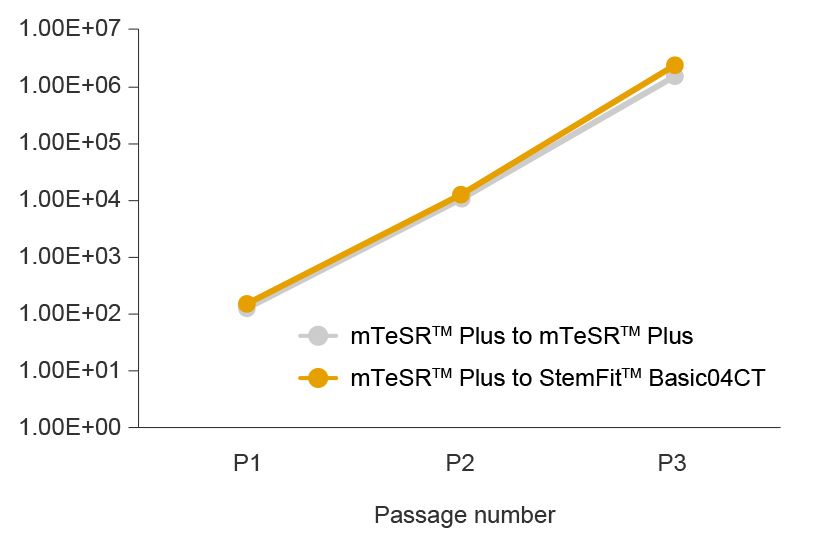
Figure: Cumulative expansion over three passages after switching from mTeSR Plus to Basic04CT (manufacturer data). Image source: Ajinomoto StemFit Basic04 Complete Type product page, reproduced with permission.
Keep two caveats in mind. These are Ajinomoto's own experiments, and the product page does not say which cell line was used. And the comparison covers expansion, not differentiation.
What about E8? Ajinomoto gives no dedicated data for switching from E8. The manual's procedure is written for "other culture systems" in general [1], so follow it for E8 as well — and do the same checks described below.
Why do other suppliers talk about "two passages of adaptation"?
You may have seen different advice. Thermo Fisher's application note for StemFlex Medium, for example, recommends at least two passages in StemFlex for full adaptation when cells come from mTeSR1 or a feeder-dependent system [5].
The two positions do not contradict each other. Each is the recommended procedure for its own medium. Whether you switch directly or in steps, and how many passages of adaptation you need, depends on the medium you are moving into and whether its manufacturer has validation data. So the rule is simple: follow the instructions of the medium you are switching to. For StemFit, that means a direct switch per the StemFit manual — there is no need to invent your own blending ratios.
Switching over is not the same as differentiating the same
This is where the real work is.
In 2025 the CiRA Foundation's Research and Development Center published a study in Scientific Reports that looked specifically at whether the medium used to maintain iPS cells before differentiation (which the authors call "pre-culture") affects subsequent cardiomyocyte differentiation [3]. They used a peripheral-blood-derived iPS cell line (CFiS-S01), generated with the same protocol as clinical-grade iPS cells, under three conditions:
- StemFit AK03N with iMatrix-511;
- mTeSR Plus (cGMP grade) with LN521;
- mTeSR Plus with LN521, switched to E8 on the last day before differentiation.
Start with maintenance itself. The researchers compared the first two conditions: both groups were classed as pluripotent stem cells, both had more than 85% OCT3/4-positive cells, and karyotype and genome copy-number analysis found no abnormalities in either [3]. On the narrow question of whether the switch worked, both groups pass.
Look closer and differences appear. Even before differentiation, the mTeSR Plus group expressed higher mRNA levels of the mesoderm marker Brachyury (T) and the endoderm marker SOX17, while the StemFit group expressed more of the ectoderm marker PAX6 [3]. The authors' summary: changing the combination of medium and matrix maintained pluripotency but altered the cells' tendency to differentiate [3].
Now the differentiation itself. After differentiation with STEMCELL Technologies' STEMdiff Ventricular Cardiomyocyte Differentiation Kit, the TNNT2-positive rates were [3]:
| Pre-culture condition | TNNT2-positive rate |
|---|---|
| StemFit AK03N + iMatrix-511 | 54.6% |
| mTeSR Plus + LN521 | 85.4% |
| mTeSR Plus + LN521, E8 on the last day | 88.6% |
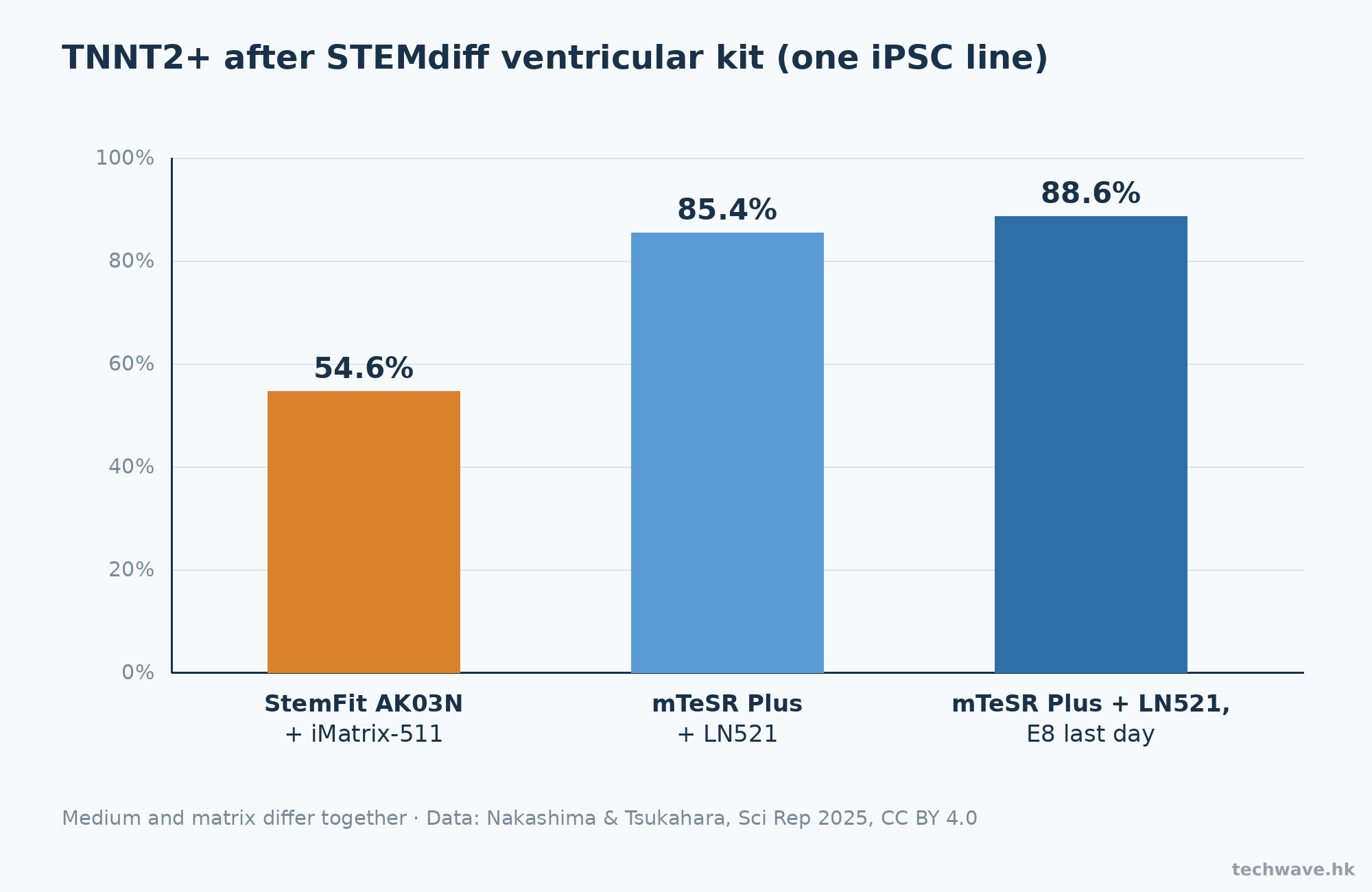
Figure: Cardiomyocyte differentiation efficiency after three pre-culture conditions (drawn from data in the 2025 CiRA Foundation paper, CC BY 4.0).
Same cells, different medium-and-matrix combinations before differentiation — and results more than 30 percentage points apart.
But these numbers should not be read as "StemFit is unsuitable for cardiomyocytes". The same paper contains another experiment. With their own cardiomyocyte differentiation medium made from defined components, cells pre-cultured in commercial StemFit AK03 reached 84% TNNT2-positive. When the researchers adjusted the component ratios of StemFit AK03 to approximate E8 or an embryoid-body formation medium, the rate rose to 89%, 91% and 95% [3].
Put the two experiments together and the conclusion is clear: differentiation efficiency depends on the pairing of maintenance medium and differentiation protocol. A protocol optimised in one medium may no longer be optimal once the maintenance medium changes. One explanation the authors offer in their discussion is that mTeSR and StemFit both contain recombinant human albumin while E8 does not, and that albumin influences the extracellular matrix the cells secrete and, through it, FGF2 signalling [3]. This is the authors' interpretation; the paper does not test it directly.
The study also has clear limits. It used one cell line. The StemFit group was on iMatrix-511 while the other two were on LN521, so medium and matrix changed together and the difference cannot be attributed to the medium alone. And the differentiation efficiencies cited here are for cardiomyocytes; they cannot be extended to all lineages. The StemFit AK03N used in the study is sold only in Japan; its liquids A and B are identical to the globally available Basic03, with bFGF added [4].
A direct switch in five steps
Here is the manual's procedure as a single checklist, for Basic03 and Basic04CT [1][2][4]:
- Prepare StemFit. Thaw at room temperature (15–25 °C) or in a 2–8 °C refrigerator, never in a 37 °C water bath — Ajinomoto says heat accelerates degradation of medium ingredients. For Basic03, add all of liquid B to liquid A, mix, then add bFGF at the default final concentration of 80 ng/mL, adjustable to your cell line. Basic04CT already contains bFGF and is used as thawed. Thawed medium keeps for up to two weeks at 2–8 °C [1].
- Passage one last time in the original system. Use your current medium, matrix and passaging method as usual.
- Switch directly 2–3 days before the next passage. Change to StemFit in one go, without blending. On the manual's timeline, this is from the third medium change of the passage [1].
- Passage into StemFit, seeding densely for the first few passages. Seed more than 100,000 (1E5) cells per 6-well-plate well [1]. The manual recommends single-cell passaging, with Y-27632 in the medium on passage day and a change to StemFit without Y-27632 the next day [1]. Basic03's FAQ notes that common matrices work with StemFit, including iMatrix-511, Geltrex, VTN-N, LN521, Matrigel and Synthemax [4]; Ajinomoto's Basic04CT switch data were obtained without changing substrate or passaging conditions [2].
- Keep a control. As you switch, keep some cells in the original medium and freeze down a batch from the original system. Ajinomoto's switch data used the same kind of control: one group switched, one group not [2].
Six things to verify after the switch
| What to check | How | When |
|---|---|---|
| Colony morphology | Compare with the original-medium control; colonies after single-cell passaging in StemFit may look different from what you are used to | At every feed |
| Growth and expansion | Record cells seeded and harvested each passage, calculate cumulative fold expansion, compare with the control | For at least three consecutive passages (matching the manufacturer's data) |
| Pluripotency markers | Expression of markers such as OCT4, NANOG and TRA-1-60 | Once passaging is stable |
| Genetic stability | Karyotype or copy-number analysis | After switching and stable passaging; ISSCR recommends evaluating genetic changes after modifying culture conditions [6] |
| Differentiation capacity | Run the differentiation protocol you actually use, side by side with cells from the original medium | Before formal experiments |
| Follow-up on anomalies | If growth or differentiation clearly changes, check for recurrent copy-number variants (such as 20q11.21) and point mutations (such as in TP53) even if the karyotype is normal | When an anomaly appears [6] |
The genetic-stability and follow-up rows follow the International Society for Stem Cell Research (ISSCR) Standards for Human Stem Cell Use in Research (2023). The Standards call for genetic evaluation of any new line or derivative obtained under changed culture conditions, and recommend testing for culture-acquired genetic variants whenever growth or differentiation behaviour shifts during culture [6].
The fifth row is the one most often skipped, and the one most worth doing. If differentiation efficiency drops noticeably, check genetic stability as in the table above, and also look at how your differentiation protocol pairs with the maintenance medium — for example cell density at the start of differentiation, inducer concentrations or timing. The CiRA study shows that the same cells can give very different results under a different differentiation protocol.
Which StemFit to switch to?
For 2D maintenance and expansion, coming from mTeSR or E8, StemFit offers two GMP-grade options:
- Basic04 Complete Type: a single 500 mL bottle with bFGF included, ready to use, and backed by Ajinomoto's direct-switch data from mTeSR Plus [2]. Choose it if you want the simplest switch.
- Basic03: liquid A 400 mL plus liquid B 100 mL, without bFGF, which you add at a default 80 ng/mL, adjustable [4]. Choose it if you want to control bFGF source and concentration yourself, or to reproduce published methods based on AK03N.
For a detailed comparison, see part 2 of this series, "StemFit Basic03, Basic04CT or Basic05?". On the matrix side, both the manual and the CiRA study used iMatrix-511 [1][3].
StemFit Basic03 (GMP), Basic04 Complete Type (GMP), StemFit Purotein bFGF and iMatrix-511 are all available for quotation from TechWave, and we can also send instruction manuals, Product Information or GMP statements on request.
> Planning a medium switch? Tell us your current medium, matrix, passaging method and downstream differentiation, and we will help you lay out the switch timing and the verification plan together.
References
- AJINOMOTO CO., INC. Instruction Manual: Maintenance and expansion of human ES/iPS cells with StemFit medium (version 5, February 2022). https://www.ahs.ajinomoto.com/products/bio/pdf/StemFit_Instruction-manual_v5.pdf
- AJINOMOTO CO., INC. StemFit™ Basic04 Complete Type (GMP) (product page). https://www.ajitrade.com/stemfit/products/basic04CT/GMP.html
- Nakashima Y, Tsukahara M. Effect of iPS cell culture medium on the differentiation potential of induced cardiac tissues. Scientific Reports. 2025;15:28301. https://doi.org/10.1038/s41598-025-13259-x
- AJINOMOTO CO., INC. StemFit™ Basic03 (GMP) (product page and FAQ). https://www.ajitrade.com/stemfit/products/basic03/GMP.html
- Thermo Fisher Scientific. Adaptation of pluripotent stem cells to StemFlex Medium (application note). https://documents.thermofisher.com/TFS-Assets/BID/Application-Notes/adaptation-psc-stemflex-medium-app-note.pdf
- International Society for Stem Cell Research. Standards for Human Stem Cell Use in Research (June 2023), Recommendations 3.2.2–3.2.3. https://www.isscr.org/basic-research-standards
Uses and applicable scenarios
- Moving iPS cells from mTeSR Plus, mTeSR1 or E8 into StemFit Basic03 or Basic04 Complete Type for expansion or banking
- Reproducing published methods that used StemFit AK03N, which first requires switching your own cells to the corresponding medium
- Planning side-by-side checks of morphology, growth, pluripotency, karyotype and differentiation after a medium change
- Deciding whether a differentiation protocol optimised in the original medium needs re-optimising after the switch to StemFit
Limitations
- The direct-switch method comes from Ajinomoto's instruction manual and product page; the comparable three-passage expansion after switching from mTeSR Plus to Basic04CT is manufacturer data under its own conditions, not independent third-party validation, and does not cover every cell line
- Ajinomoto's documents give no dedicated data for switching from E8 to StemFit; the E8 advice here follows the manual's general procedure
- The 2025 CiRA Foundation study used a single iPS cell line, and medium and matrix differed together (StemFit with iMatrix-511; mTeSR Plus and E8 with LN521); the E8 group was switched to E8 only on the last day before differentiation. Its numbers show that pre-culture conditions affect differentiation, but they cannot be extended to all cell lines or all lineages, nor attributed to the medium alone
- The study used StemFit AK03N, sold only in Japan; its liquids A and B are identical to Basic03, with bFGF added, and it is not the same formulation as Basic04 Complete Type
- This article covers medium switching in research and process development only; none of the products mentioned is intended for human or animal diagnostic or therapeutic use
Frequently asked questions
Can I blend media half-and-half when switching to StemFit?
The manufacturer's manual has no blending step; it recommends a direct switch. Passage once in your original culture system, then change in one go to StemFit with bFGF 2–3 days before the next passage. On the manual's timeline, the first and second medium changes after passaging use the original medium, StemFit is used from the third change, and the cells are then passaged in StemFit. Follow that procedure; there is no need to design your own blending ratios.
Can I also switch directly from E8 to StemFit?
Ajinomoto gives no dedicated data for switching from E8; its comparison data cover a direct switch from mTeSR Plus to Basic04 Complete Type. The manual's direct-switch procedure is written for "other culture systems" in general, so apply it to E8 as well, and afterwards compare morphology, expansion, pluripotency, karyotype and the differentiation protocol you actually use.
Should I change seeding density for the first few passages in StemFit?
The manual suggests seeding more densely for the first few passages — more than 100,000 (1E5) cells per 6-well-plate well may help. It recommends single-cell passaging, with Y-27632 in the medium on passage day and a change to StemFit without Y-27632 the next day. Once the cells are stable in StemFit, adjust seeding numbers to your own expansion rate and passaging schedule.
After switching to StemFit my differentiation efficiency dropped. Is something wrong with the cells?
Not necessarily. In a 2025 CiRA Foundation study, one iPS cell line stayed pluripotent with a normal karyotype in both StemFit and mTeSR Plus, yet with the same cardiomyocyte differentiation kit the TNNT2-positive rates were 54.6% versus 85.4%; with the researchers' own differentiation medium, StemFit-pre-cultured cells reached 84%. So one thing to check is how your differentiation protocol pairs with the maintenance medium — starting cell density, inducer concentrations and timing. If growth or differentiation clearly changes, the ISSCR standards also recommend checking genetic stability, including recurrent copy-number variants such as 20q11.21 when the karyotype is normal.
Coming from mTeSR Plus, should I choose Basic03 or Basic04CT?
For the simplest switch, choose Basic04 Complete Type: a single 500 mL bottle with bFGF included, for which Ajinomoto shows a direct switch from mTeSR Plus with expansion comparable to the control over three passages, keeping the original matrix and passaging conditions. If you want to control bFGF source and concentration yourself, or to reproduce published methods that used AK03N, choose Basic03: liquids A and B, with bFGF added at a default 80 ng/mL, adjustable. Both are GMP grade.