
Technical column
Down More Than Half in Four Hours: Why bFGF Is Not in the Bottle — and Why the Bacterium That Makes MSG Now Makes Growth Factor
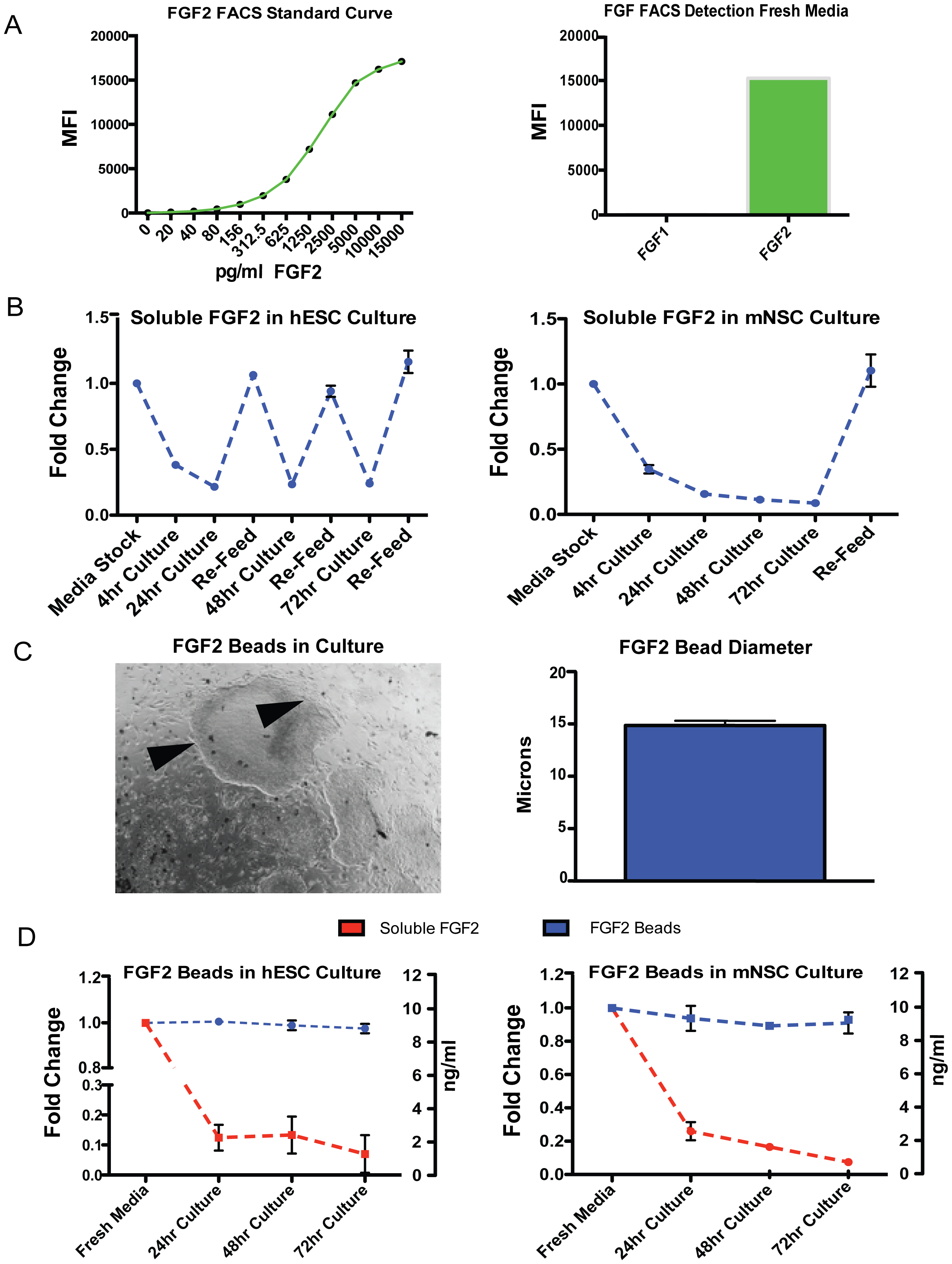
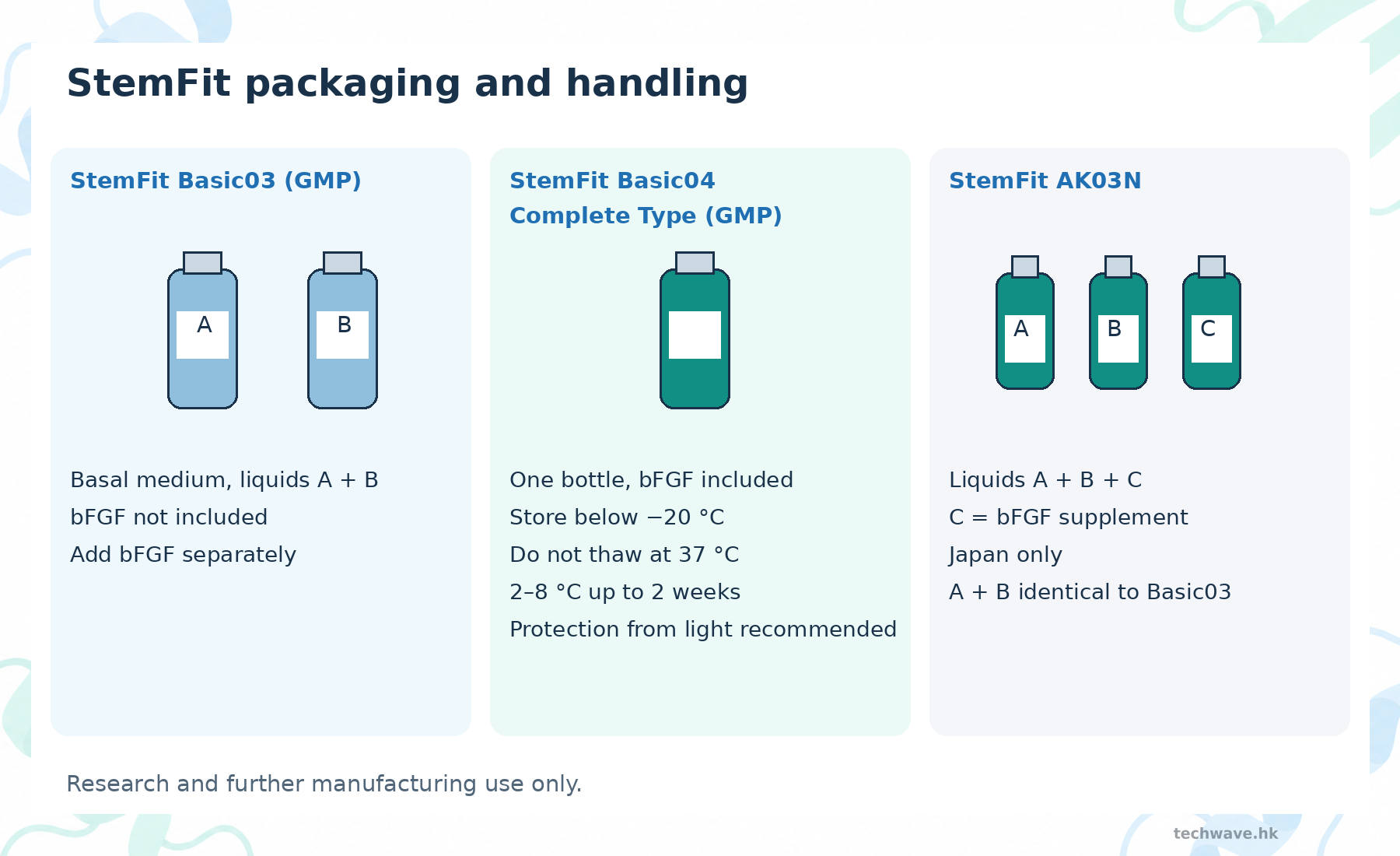
bFGF (FGF2) is the growth factor that keeps human pluripotent stem cells undifferentiated, and it is also the most fragile ingredient in an iPSC medium. An open-access study published in 2013 measured it directly: in stem cell culture, FGF2 levels had already fallen by more than 50% four hours after feeding, and little remained after 24 hours. Set that against how the media themselves are packaged and it becomes clear why premium iPSC media either leave bFGF out of the bottle for the user to add (StemFit Basic03, and the Japan-only three-liquid AK03N), or — like StemFit Basic04 Complete Type — put everything in one bottle but require storage below −20 °C, prohibit thawing at 37 °C, cap post-thaw storage at 2–8 °C for two weeks, and recommend protection from light. The other half of the story is upstream: the recombinant human bFGF Ajinomoto supplies for StemFit (catalog number SP-FGF2-G-001MG) is not made in E. coli. It is made in Corynebacterium glutamicum — the bacterium industry domesticated in the 1950s to produce glutamic acid, the stuff of monosodium glutamate. This Gram-positive host produces no LPS endotoxin, and the protein is secreted directly into the culture medium in correctly folded, active form: no cell lysis, no refolding, and no dedicated endotoxin-removal step. This article follows that chain from the thermal instability of a single molecule to the fermenter, and back to the handful of specification lines that reach the user.
Definition
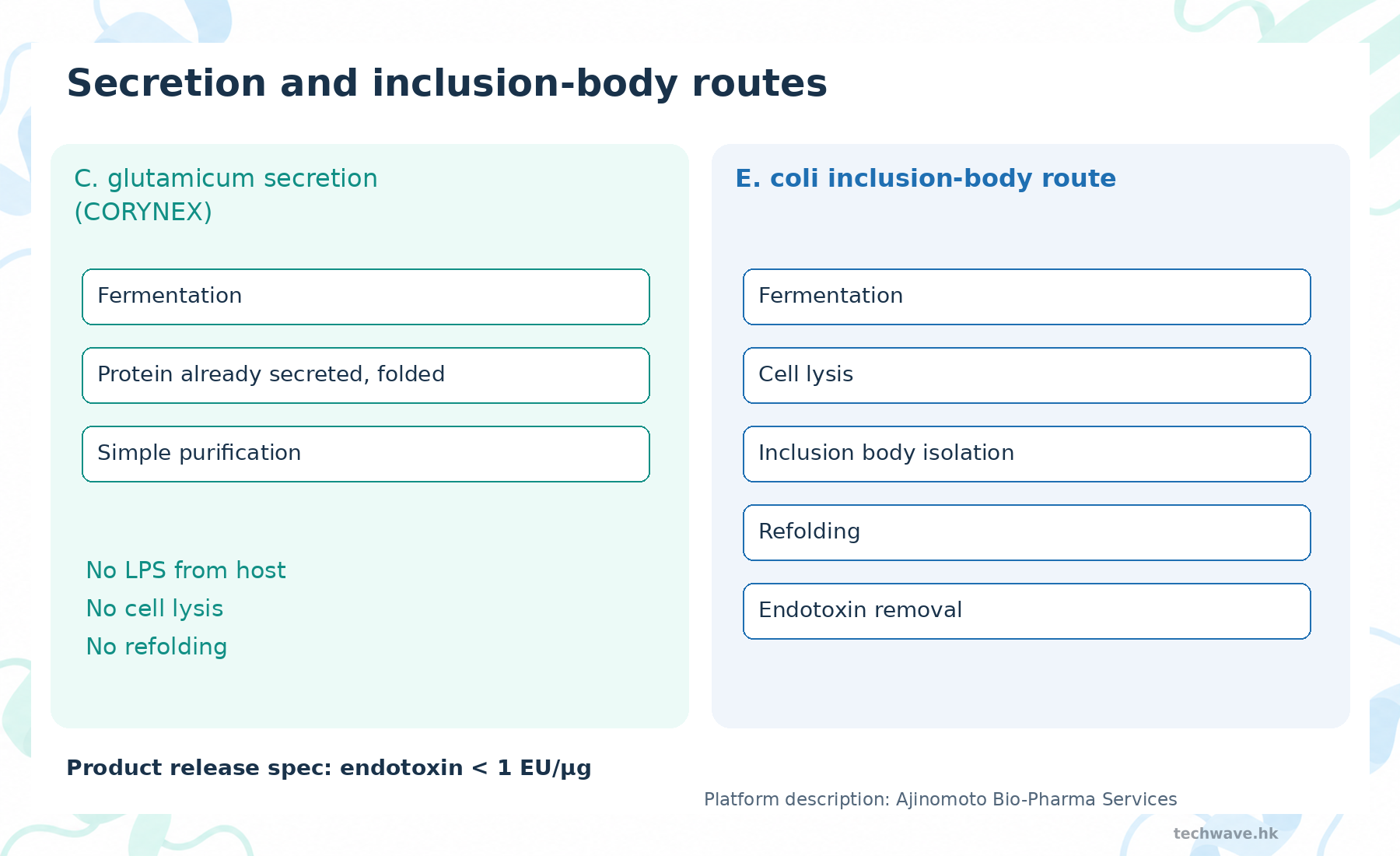
Secretory expression means engineering a production strain to export the target protein directly into the extracellular culture medium instead of accumulating it inside the cell. Compared with the intracellular inclusion-body route common in E. coli, a secreted protein is usually already correctly folded and active, so downstream processing does not require cell disruption, inclusion-body isolation, or denaturation and refolding. Ajinomoto's CORYNEX platform uses the Gram-positive bacterium Corynebacterium glutamicum as the secretion host; because this organism does not produce LPS endotoxin, the endotoxin-removal burden inherent to E. coli systems is avoided.
If you have a bottle of StemFit™ Basic03 (GMP) on the bench, the datasheet says something slightly startling: this premium human pluripotent stem cell medium, used across Japan's regenerative medicine field, does not contain bFGF. The growth factor you need for expansion has to be added separately [6].
That is not an oversight, and it is not a stripped-down configuration. The most critical ingredient is kept out of the bottle, and the most straightforward explanation is that the molecule does not last a day in a 37 °C incubator — 24 hours after a feed, little of it remains in the medium.
Video explainer
Half Gone in Four Hours: Why the Key Ingredient Is Not in the Bottle
Watch on YouTube ↗Video transcript
Premium human pluripotent stem cell media often surprise people: the most critical ingredient is not in the bottle. The growth factor you need for expansion has to be added separately. Not an oversight, and not a stripped-down product.
The most direct explanation is that this molecule cannot survive a day in a 37-degree incubator. And the organism that supplies it also makes monosodium glutamate. First, the molecule. bFGF, also written FGF2, is the core signal that keeps human pluripotent stem cells undifferentiated.
Right after a medium change, its concentration is at its highest. Then it starts to fall. An open-access study measured this quantitatively: in stem cell culture, FGF2 levels had already dropped by more than 50% just four hours after feeding.
After 24 hours, little remains. Adding heparin improves its signalling but does not prevent daily degradation. That is why maintaining stem cells has long been a job with no days off. Since the ingredient is this fragile, one maker answers it in three ways — three media from the same company.
To be clear, the manufacturer has never publicly explained why bFGF is left out of the bottle; the explanation that follows is inferred from published measurements and the company's own handling conditions. First: a basal medium without bFGF, added fresh at the point of use.
The manufacturer states that bFGF is added for expansion, and both its own animal-origin-free bFGF and commercially available bFGF have been confirmed to work. Second: one ready-to-use bottle with bFGF inside. The price is written in the handling conditions — stored below minus 20 degrees, thawed at room temperature, 15 to 25 degrees, never at 37 degrees because that accelerates degradation of the medium, held at 2 to 8 degrees for up to two weeks after thawing, and protection from light is recommended.
Third: split into liquids A, B and C, where liquid C is the bFGF supplement. That one is sold only in Japan, and its liquids A and B are completely the same as the basal medium — so adding bFGF to the basal medium gives the same composition.
If bFGF has to be supplied separately, where does the bFGF itself come from? The source line on the product page does not say E. coli. It says Corynebacterium glutamicum. This organism has a famous history. In 1957 a glutamate-producing bacterium was discovered and named; today we call it Corynebacterium glutamicum.
Fermentation is still the most economical route to glutamate — the amino acid behind monosodium glutamate. Ajinomoto has worked with this strain for more than sixty years. Then it did something entirely logical: if the organism is naturally good at exporting things into the medium, why not have it export proteins?
The bacterium that makes MSG now makes growth factor. Changing the host changes the steps, not the story. This organism is Gram-positive, and the target protein is secreted straight into the culture medium, where it folds correctly and appears in active form.
No cell disruption, no inclusion-body isolation, no refolding. For comparison, E. coli is a very widely used industrial host, but when expressing human proteins it often accumulates intracellular inclusion bodies — aggregates of incorrectly folded protein.
So the cells must be lysed, the inclusion bodies isolated, and the protein denatured and refolded. Being Gram-negative, it also carries LPS, that is endotoxin, in its outer membrane, which takes extra work to remove. Corynebacterium glutamicum produces no LPS, which removes the endotoxin-removal burden inherent to E. coli systems.
Purification therefore starts from a much cleaner baseline. This is not about one being nobler; the two routes simply have different numbers of steps. Process differences do not arrive on your bench as a story. They arrive as specifications.
These are the published specifications: purity not less than 95%, endotoxin below 1 EU per microgram, 17.1 kilodaltons with 154 amino acid residues, frozen in PBS buffer containing 1 millimolar DTT, no reconstitution required, animal origin free, produced in compliance with GMP.
One sentence must be stated clearly, because it is routinely overstated: a host that produces no LPS is not a product with zero endotoxin. The release specification is below 1 EU per microgram — a numerical limit, not an absence.
The value of secretory expression is a cleaner starting point and one fewer dedicated endotoxin-removal step. Finally, honesty is required. Secretory expression solves a production and purification problem. It does not make the bFGF molecule more heat-stable — that four-hour curve looks the same whoever supplied the protein.
Extending effective signalling time in the incubator is a different route: more frequent feeding, controlled-release formulations of FGF2, or bypassing the protein altogether with structurally more stable FGFR agonist peptides.
Each carries its own validation burden, and none of them is about the expression host. So this episode is about the same molecule made in a cleaner way, not a stronger molecule. Keeping those two apart is the most useful habit when reading product literature.
The full article is in the technical column on our site.
This transcript is adapted from the published video subtitles and follows them. One point to add: the line "that four-hour curve looks the same whoever supplied the protein" refers to wild-type bFGF. Sequence-engineered thermostable variants are a separate case — for example Qkine’s FGF2-G3 (Qk053), which the manufacturer states has a functional half-life extended beyond 7 days.
Why bFGF Is Not in the Medium Bottle: Half Gone in Four Hours
Watch on YouTube ↗Video transcript
In premium stem cell media, the most critical ingredient is not in the bottle. The most direct explanation is that bFGF is highly unstable at 37 degrees. A study measured this in stem cell culture: it falls more than 50% four hours after feeding, with little left at 24 hours.
So there are two common approaches: a basal medium without it, added fresh at use; or one ready-to-use bottle, kept frozen and dark, and never thawed at 37 degrees. And who makes that bFGF? Corynebacterium glutamicum — the strain discovered in 1957 for producing glutamate, the bacterium behind monosodium glutamate.
It is Gram-positive: the protein is secreted into the medium already correctly folded, with no lysis and no refolding. It also produces no LPS, removing the endotoxin-removal burden. But note: no LPS is not zero endotoxin — the release specification is below 1 EU per microgram.
The point: changing the host changes how it is made, not how heat-stable the molecule is. The same molecule, made in a cleaner way. Full article on our site.
Produced by TechWave. For research reference only; not medical advice.
More than half gone in four hours
bFGF, also written FGF2, is the core signal that holds human pluripotent stem cells in an undifferentiated state. Its problem is heat.
An open-access study published in PLoS ONE in 2013 (CC BY) measured this directly. Using a bead-based, flow-cytometric quantitative assay, the authors tracked actual FGF2 concentrations in stem cell culture medium over three days. In the authors' words, "just 4 hours after feeding, FGF2 levels had already decreased by more than 50% and 24 hours after the initial feed, little FGF2 remained" (Lotz et al., 2013). With daily medium changes, the concentration profile becomes a sawtooth — sharp spikes at each feed separated by extended periods of low FGF2 [1]. The same paper notes that adding heparin can improve FGF2 signalling but does not prevent its daily degradation [1].
This is why maintaining human pluripotent stem cells has long been a job with no days off. The cells are not hungry — the signal molecule is quietly disappearing.
The handling conditions are the explanation
Ajinomoto has never published a reason for leaving bFGF out of the Basic03 bottle. But put the three formats and their handling conditions side by side, and the answer is effectively printed on the labels.
| Product | Format | bFGF | Key conditions | Availability |
|---|---|---|---|---|
| StemFit™ Basic03 (GMP) | Basal medium (liquids A and B) | Not included; add for expansion | Ajinomoto's own animal-origin-free (AOF) bFGF, or commercially available bFGF, which has been confirmed to work; the recommended supplementation level is 80 ng/ml, adjustable for the application [6] | Global [8] |
| StemFit™ Basic04 Complete Type (GMP) | One ready-to-use bottle | Included | Store below −20 °C; thaw at room temperature (15–25 °C) and do not thaw at 37 °C, as this accelerates degradation of medium ingredients; after thawing, store at 2–8 °C for up to two weeks; protection from light recommended [7] | Global [8] |
| StemFit™ AK03N | Liquids A, B and C | Included (liquid C is the bFGF supplement) | Liquids A and B are completely the same as Basic03; jointly developed with CiRA, Kyoto University [8] | Japan only [8] |
Three formats, three answers to the same problem. Basic03 leaves the unstable component to the user, to be added immediately before use. AK03N packages it as a separate liquid C to be mixed in at the point of use. Basic04 Complete Type is willing to put bFGF in the same bottle — and pays for it by requiring the whole bottle to stay frozen, stay dark, and never meet a 37 °C water bath [7].
This also clears up a trap many groups have fallen into: the AK02N and AK03N catalog numbers are sold only in Japan [8]. The AK03N that appears throughout older literature corresponds globally to Basic03 plus bFGF — because AK03N's liquids A and B are completely the same as Basic03, and liquid C is simply a bFGF supplement, so adding bFGF to Basic03 gives the same composition as AK03N [8]. AK02N contains a human-derived ingredient and is categorised as xeno-free; its global counterpart is the ready-to-use single bottle Basic04 Complete Type, in which the animal-derived ingredients of AK02N have been replaced with recombinant materials to achieve an animal-origin-free formulation [8]. Order straight from a ten-year-old methods section and you will order the wrong thing.
That bottle of bFGF is made by the MSG bacterium
Now move upstream. If bFGF has to be supplied separately, where does the bFGF itself come from?
On the product page for the recombinant human bFGF Ajinomoto supplies alongside StemFit (catalog number SP-FGF2-G-001MG), the line marked "SOURCE" does not say E. coli. It says Corynebacterium glutamicum [2]. The North American product page is more explicit still: produced in Corynebacterium glutamicum [3].
The history of that organism is the history of the company. In 1957 a glutamate-producing bacterium was discovered and named Micrococcus glutamicus — known today as Corynebacterium glutamicum [9]; fermentation remains the most economical route to glutamate [9]. Ajinomoto has worked with this strain for more than sixty years, accumulating industrial-scale fermentation expertise [4]. The company then did something entirely logical: if this organism is naturally good at exporting things into the culture medium, why not have it export proteins?
That is the CORYNEX™ platform — which Ajinomoto's own material describes as an expression system engineered from amino acid-producing bacteria [5]. The bacterium that makes MSG now makes growth factor.
Why this is not just a brand story
Switching the expression host from E. coli to C. glutamicum changes real steps in downstream processing, not the marketing copy.
E. coli is Gram-negative and carries LPS — endotoxin — in its outer membrane. Expressing human proteins in it also frequently yields intracellular inclusion bodies: aggregates of incorrectly folded protein. Hence the classic route: ferment, lyse the cells, isolate the inclusion bodies, denature and refold, then work hard to remove endotoxin.
C. glutamicum is Gram-positive. Ajinomoto's technology page states the differences plainly: the organism produces no LPS, which eliminates the endotoxin-removal burden inherent to E. coli systems; the target protein is secreted directly into the culture medium, folds correctly there, and appears in active form, so no cell lysis, no inclusion-body isolation and no refolding are required [4][5]. Purification therefore starts from a clean baseline [4].
At platform level, Ajinomoto states that CORYNEX achieves titres of 10 g/L and higher, has reached approximately 15 kL scale in a GMP run, holds 11 patents, and has Phase II clinical trial experience [4]. Those are platform figures, not manufacturing parameters for this one bFGF product — but they establish that this is a commercial-scale process, not a laboratory curiosity.
What actually reaches the user is a specification table
Process differences do not arrive on your bench as a story. They arrive as specifications. The published specification for Ajinomoto's bFGF is [2]:
| Item | Specification |
|---|---|
| Catalog number and size | SP-FGF2-G-001MG, 1 mg (0.3 mg/ml) |
| Expression host | Corynebacterium glutamicum |
| Format | Frozen in PBS buffer containing 1 mM DTT; no reconstitution required |
| Purity | ≥ 95% by SDS-PAGE |
| Endotoxin | < 1 EU/µg |
| Molecular weight | 17.1 kDa, 154 amino acid residues |
| Quality | Animal origin free (AOF); produced in compliance with GMP |
One sentence needs stating clearly, because it is routinely overstated: a host that produces no LPS is not a product with zero endotoxin. The release specification is < 1 EU/µg — a numerical limit, not an absence [2]. The value of secretory expression is a clean starting point and one fewer dedicated endotoxin-removal step, not the disappearance of endotoxin from the certificate of analysis.
Two other lines deserve attention. "No reconstitution required" sounds minor, but in a GMP suite every opening, weighing and dissolving step is an extra operation and a contamination risk; the North American page lists the ready-to-use frozen format as a benefit in its own right for good reason [3]. And animal origin free status is one of the quality attributes the manufacturer states [2]; programmes heading toward the clinic generally prefer AOF ancillary materials to reduce the sourcing and risk-control explanations required later. The specific requirements depend on the submission route and the jurisdiction.
What changing the host does not fix
Here honesty is required.
Secretory expression solves a production and purification problem. It does not make the bFGF molecule more heat-stable: the four-hour figure was measured under particular stem cell culture conditions, while the high instability of FGF2 at 37 °C is a property of the molecule itself, which changing the expression host does not alter [1]. Extending effective signalling time inside the incubator is a different technical route: controlled-release formats [1], or bypassing the protein altogether with a structurally more stable FGFR agonist peptide — the PG-011 peptide in Ajinomoto's own StemFit Basic05 belongs to that second route. Each of those carries its own validation burden, and none of them is about the expression host.
In other words, this article is about the same molecule made in a cleaner way, not about a stronger molecule. Conflating the two is the most common mistake made when reading product literature.
Who the single bottle is really saving work for
Put the two ends together and the product logic of Basic04 Complete Type becomes obvious: if the company can supply bFGF itself, from its own organism, under AOF and GMP conditions, there is no reason for every customer to repeat the same addition and the same record at every medium change.
The performance and cost data the manufacturer's page gives are [7]:
- single-cell expansion from 10,000 to 1,000,000,000 cells within three weeks, with over 10⁵-fold cumulative expansion for both blood-derived (1210B2) and fibroblast-derived (201B7) iPSCs;
- of clones sorted singly into 384-well plates and expanded in Basic04CT with CloneR2, 10 out of 10 had a normal karyotype;
- human PBMCs reprogrammed with synthetic mRNA and cultured in Basic04CT gave TRA-1-60-positive iPSC colonies by day 14; pluripotency and trilineage differentiation potential were assessed with TaqMan®-based assays. This came from a collaborative study with Dr Masato Nakagawa of the iPS Cell Core Facility, WPI-PRIMe, at The University of Osaka;
- one bottle, eliminating supplement mixing and reducing contamination risk; weekend-free feeding;
- the lowest estimated weekly medium cost per well at 1/6-well scale among the major AOF and RUO media; the estimate uses 2025 United States catalog list prices together with the feeding and passaging schedule each manufacturer recommends;
- consistent cumulative expansion through a one-step transition from existing media over three passages.
These are the manufacturer's own page data, with explicit cell lines and a specific pricing basis as preconditions, and are not independent third-party verification — cite them together with their conditions. On quality systems, Basic04CT sits inside the Ajinomoto System of Quality Assurance (ASQUA). Its manufacturing and release testing follow the GMP standards Ajinomoto wrote for regenerative-medicine culture media, and those standards were drawn up with reference to ICH Q7 and to PMDA guidance on aseptic manufacturing for regenerative medicine products [7].
Note the product positioning: StemFit products are labelled for research and further manufacturing use only, and are not intended for human or animal diagnostic or therapeutic uses [7][8]. The statement that PMDA has confirmed eligibility for use in the manufacture of cell therapy products applies to AK03N, in the Japanese context [8]; it cannot be extended into a regulatory approval of Basic03 or Basic04CT in any country.
How to use this article
If you are doing any of the following, take the above straight to work:
- Reproducing a method from older literature. Convert the catalog numbers first. AK03N in a paper = Basic03 + bFGF. The global counterpart of AK02N is Basic04 Complete Type (with a higher degree of animal-origin-free formulation). Both AK numbers are sold only in Japan; do not order directly from the paper.
- Writing an ancillary-material quality agreement. Put the expression host, the need for refolding, the endotoxin limit (< 1 EU/µg), the AOF declaration and the reconstitution-free format into the specification table. These are verifiable, which is more than can be said for adjectives like "high purity".
- Estimating weekly cost. Do not compare unit prices alone. The real cost of Basic03 includes separately purchased bFGF, the labour and records for each addition, and the contamination risk of mixing; the cost of Basic04CT includes freezer space and a two-week post-thaw window.
- Planning long-term maintenance culture. Accept daily bFGF decay as a given, then decide whether to cover it with feeding frequency or with a more stable alternative molecule. Keep two things apart: a ready-to-use bottle removes mixing and handling work, it does not extend how long bFGF stays active in the incubator.
TechWave Biotech supplies the Ajinomoto StemFit range in mainland China. Basic03 (GMP), Basic04 Complete Type (GMP), StemFit For Differentiation, StemFit For MSC and the accompanying recombinant proteins (bFGF, Activin A, SCF, KGF, VEGF, BMP-4, DLL4-Fc) are all available for quotation; GMP statements, Product Information sheets and SDS documents can be requested directly from us.
> Already running an AK03N or AK02N protocol? Tell us your cell line, passaging method and development stage, and we will convert it into globally available catalog numbers and specifications using the correspondences above.
References
- Lotz S, Goderie S, Tokas N, et al. Sustained Levels of FGF2 Maintain Undifferentiated Stem Cell Cultures with Biweekly Feeding. PLoS ONE. 2013;8(2):e56289. doi:10.1371/journal.pone.0056289 (CC BY)
- AJINOMOTO CO., INC. Human bFGF recombinant (StemFit™ recombinant protein product page, catalog number SP-FGF2-G-001MG). https://www.ajitrade.com/stemfit/products/growthfactor/bfgf.html
- Ajinomoto Health & Nutrition North America, Inc. StemFit Purotein™ bFGF (product page). https://www.ajihealthandnutrition.com/product/stemfit-purotein-bfgf-vegf-kgf-scf-bmp4-activin-a/
- Ajinomoto Bio-Pharma Services. CORYNEX™ Microbial Protein and Peptide Expression Platform (technology page). https://ajibio-pharma.ajinomoto.com/protein-expression/corynex-technology/
- AJINOMOTO CO., INC. A Novel Microbial Protein Expression System: An Innovative Expression System Engineered from Amino Acid-Producing Bacteria, Corynebacterium glutamicum (Japan Bioindustry Association member material). https://www.jba.or.jp/link_file/member_directory/Ajinomoto_info_4.pdf
- AJINOMOTO CO., INC. StemFit™ Basic03 (GMP) (product page and FAQ). https://www.ajitrade.com/stemfit/products/basic03/GMP.html
- AJINOMOTO CO., INC. StemFit™ Basic04 Complete Type (GMP) (product page). https://www.ajitrade.com/stemfit/products/basic04CT/GMP.html
- AJINOMOTO CO., INC. StemFit AK03N / AK02N (product page and FAQ). https://www.ajitrade.com/stemfit/products/ak02n_03n.html
- Fahimitabar A, Razavian SMH, Rezaei SA. Application of RSM for optimization of glutamic acid production by Corynebacterium glutamicum in bath culture. Heliyon. 2021;7(6):e07359. doi:10.1016/j.heliyon.2021.e07359 (CC BY)
Uses and applicable scenarios
- Understanding why iPSC/ESC media come in two forms — a basal medium with bFGF added separately, or a ready-to-use single bottle containing bFGF — and what each form costs you in handling and storage
- Assessing recombinant growth factor risk for cell therapy processes by expression host, need for refolding, endotoxin release specification, and reconstitution-free format
- Mapping the composition and catalog-number relationships between StemFit Basic03, Basic04 Complete Type, and the Japan-only AK03N/AK02N so that older literature does not lead to the wrong order
- Writing ancillary-material quality agreements or change-control documents that state which verifiable specification lines actually change when the expression system changes
Limitations
- Ajinomoto does not publicly state why bFGF is excluded from the Basic03 bottle. The thermal-instability explanation offered here is our reading of published measurements of FGF2 instability at 37 °C together with the manufacturer's own frozen, light-protected, do-not-thaw-at-37 °C handling conditions; it is not a reason given by the manufacturer
- Changing the expression host does not change the thermal instability of the bFGF molecule itself. Secretory expression addresses production and purification, not half-life in the incubator, and is not equivalent to controlled-release carriers or FGFR agonist peptides
- A host that produces no LPS is not the same as a product with zero endotoxin: the release specification for this product is endotoxin < 1 EU/µg, not endotoxin-free
- The expansion folds, clone karyotype frequency, one-step transition, and weekly-cost conclusions for Basic04 Complete Type are taken from the manufacturer's product page, with its own cell lines, collaborative study, and pricing basis as preconditions; they are not independent third-party verification
- StemFit products are labelled for research and further manufacturing use only, and are not intended for human or animal diagnostic or therapeutic uses
Frequently asked questions
Is Ajinomoto's bFGF the same molecule as Qkine's thermostable FGF2-G3?
No. Ajinomoto's SP-FGF2-G-001MG is wild-type human bFGF (17.1 kDa, 154 amino acids). What changed is the expression host — secretory expression in Corynebacterium glutamicum — which benefits the production and purification route; the molecule's instability at 37 °C is unchanged. FGF2-G3 (Qk053) is a sequence-engineered thermostable variant: Qkine states that wild-type FGF-2 has an effective half-life of less than 10 hours in medium at 37 °C, while FGF2-G3 extends the functional half-life to more than 7 days. Changing the host and engineering the molecule are two different routes, and the first does not deliver the heat stability of the second. To extend effective signalling time in the incubator, consider more frequent feeding, controlled-release formulations, or alternatives such as thermostable variants and FGFR agonist peptides — each with its own validation burden.