
Technical column
Get results from SB431542: ALK5 IC₅₀ of 94 nM, full inhibition of endogenous TGF-β at about 2 μM — concentration, timing and controls explained
Two teams add SB431542 to a differentiation protocol: one gets consistently better lineage enrichment, the other gets toxicity, failed differentiation or a phenotype nobody can attribute. The difference is whether ALK4/5/7 selectivity, Smad2/3 readouts, a concentration series, dosing and withdrawal windows and solvent controls were designed as one closed loop. This article takes you from mechanism and applications to an experiment matrix you can use directly.
Definition
SB431542 is an ATP-competitive small-molecule inhibitor that selectively blocks ALK4-, ALK5- and ALK7-mediated TGF-β, Activin and Nodal signalling, without appreciable inhibition of the BMP-branch receptors ALK1/2/3/6.
Two labs add SB431542 to a differentiation protocol. One gets stable lineage enrichment; the other sees abnormal cell states, failed differentiation or a phenotype whose origin nobody can explain. The problem is rarely the compound. It is usually that nobody first answered: in which cells, in which time window, which signal branch is being blocked — and which readout proves it really was blocked?
SB431542's value comes from systematically characterized selectivity: it inhibits ALK4/5/7 with an in-vitro ALK5 IC₅₀ of 94 nM, fully inhibits endogenous TGF-β signalling at about 2 μM, shows no appreciable ERK, JNK or p38 MAPK interference at a 10 μM working concentration, and does not block the BMP branch. Turning that selectivity into reproducible results depends on a closed loop of concentration, timing, controls and readouts.
Why a selective TGF-β inhibitor matters
The transforming growth factor-β (TGF-β) superfamily is a key signalling family regulating proliferation, differentiation, migration and fate decisions, and acts in embryonic development, tissue homeostasis and disease. Signals pass through complexes of type II and type I serine/threonine kinase receptors. The type I receptors (ALKs, activin receptor-like kinases) comprise seven subtypes in two branches:
- ALK4, ALK5 and ALK7 mediate TGF-β, Activin and Nodal signalling;
- ALK1, ALK2, ALK3 and ALK6 mediate BMP signalling.
In stem-cell differentiation, fibrosis and tumour biology, blocking a defined branch is key to understanding pathway function. Non-selective inhibitors easily interfere with several pathways and make results hard to attribute, so subtype-selective ALK inhibitors have become important tools. SB431542 was one of the first ALK4/5/7-selective small-molecule inhibitors to be systematically validated; since its full characterization in 2002 it has become a routine tool reagent for TGF-β pathway research and stem-cell experiments.
Mechanism: occupy the ATP pocket and cut Smad2/3 off upstream
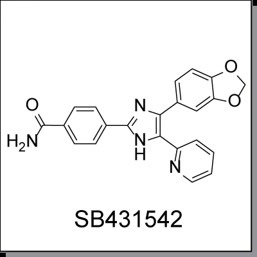
Chemical structure of SB431542.
SB431542 is 4-(4-(benzo[d][1,3]dioxol-5-yl)-5-(pyridin-2-yl)-1H-imidazol-2-yl)benzamide, molecular formula C₂₂H₁₆N₄O₃, molecular weight 384.39, an ATP-competitive kinase inhibitor.
Inside the cell, TGF-β/Activin/Nodal ligands bind their receptors and ALK4/5/7 phosphorylate and activate Smad2/3; activated Smad2/3 form a complex with Smad4, enter the nucleus and regulate target-gene transcription. SB431542 occupies the ATP-binding pocket of the ALK kinase, blocks receptor kinase activity and thereby inhibits Smad2/3 phosphorylation and nuclear translocation, cutting off this branch's output upstream.
The classic 2002 study by Inman et al. in Molecular Pharmacology provides the key selectivity data:
- Targets: effective inhibition of the three type I receptor kinases ALK4, ALK5 and ALK7, with an in-vitro kinase IC₅₀ of 94 nM for ALK5;
- BMP branch untouched: no appreciable inhibition of ALK1, ALK2, ALK3 and ALK6, whose kinase domains share lower homology, so BMP-mediated signalling is not disturbed;
- Off-target check: in-vitro kinase screening and cell-level validation showed no appreciable effect on ERK, JNK, p38 MAPK and other common pathways, and no non-specific pathway interference at a 10 μM working concentration;
- Cellular potency: about 2 μM fully inhibits endogenous TGF-β signalling; Activin-induced ALK4 signalling is also clearly blocked, with good dose dependence.
These data make SB431542 a reliable tool for pathway dissection, with one caution: the 94 nM in-vitro IC₅₀ is not a working concentration for every cell, because membrane permeability, receptor expression, ligand levels and medium proteins all change effective exposure.
Where to use it: three core scenarios
Pluripotency, reprogramming and directed differentiation
In embryonic stem cell (ESC) and induced pluripotent stem cell (iPSC) research, the TGF-β/Activin/Nodal pathway takes part in both pluripotency maintenance and lineage decisions. Adding SB431542 at defined stages steers differentiation toward specific directions: tuning signal strength at different stages of mesoderm and endoderm differentiation, or combining with other small molecules to optimize efficiency. The key word is "staged": the same dose added on a different differentiation day can give a completely different result.
The core of somatic-cell reprogramming is the mesenchymal-to-epithelial transition (MET), whereas the TGF-β pathway induces the epithelial-to-mesenchymal transition (EMT) and hinders reprogramming. In reprogramming studies, SB431542 combined with MEK inhibitors and others can influence reprogramming efficiency by regulating MET/EMT.
TGF-β pathway mechanism and disease research
In fibrosis, tumour metastasis and angiogenesis research, SB431542 is commonly used to test the functional contribution of the TGF-β pathway: comparing proliferation, migration, extracellular-matrix secretion and other phenotypes with and without drug clarifies the role of TGF-β signalling in a given pathological process, and can also help screen downstream target genes and effectors. Because pathways cross-talk, drug phenotypes are best interpreted together with p-Smad2/3, target genes and, where needed, genetic evidence rather than a single endpoint.
Protein expression, organoids and cell engineering
In recombinant protein expression and organoid systems, SB431542 can regulate differentiation state and matrix secretion to improve the structural stability and functional maturity of 3D culture. It is not a universal maturation agent: cell composition, treatment stage, the medium's signalling background and withdrawal timing can all change the direction of the effect, so confirm with target structural and functional readouts.
Experiment design: build concentration, time and controls into a matrix
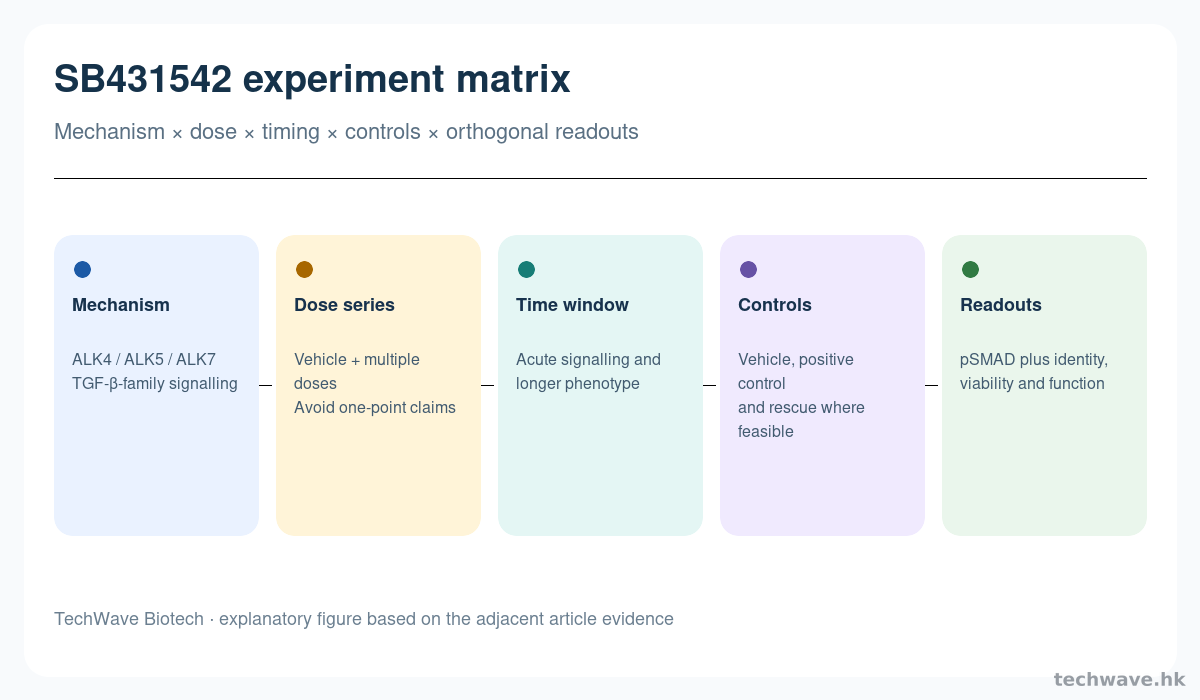
A concentration × time design with appropriate controls separates pathway inhibition from toxicity or non-specific phenotypic change.
- Concentration series and working concentration: routine cell experiments mostly use 1–10 μM, and endogenous pathway inhibition commonly 2–5 μM. Cell lines differ in sensitivity, so run a pilot measuring p-Smad2/3 to find the effective inhibitory concentration rather than copying the highest literature value.
- Treatment window: short treatment (1–4 h) is used to detect Smad phosphorylation and rapid target-gene responses; long treatment (days to weeks) for differentiation induction and phenotype observation. In stem-cell differentiation, control dosing and withdrawal time points strictly to avoid abnormal cell states from continuous inhibition.
- Controls: include both a solvent control and a pathway-activation control, and verify inhibition by Western blot of p-Smad2/3 to rule out false negatives or positives caused by system variation.
- Storage and preparation: store SB431542 powder dry and sealed at 4 °C; aliquot DMSO stock solutions and freeze at -20 °C, avoiding repeated freeze–thaw. Keep the final DMSO concentration usually below 0.1% to limit solvent effects, and equal across all groups.
Two further steps make the matrix truly usable:
- Plot both "drug concentration vs p-Smad2/3 inhibition" and "drug concentration vs cell viability", and choose a dose in the range that gives the intended pathway inhibition without obvious non-specific toxicity;
- Add readouts for the research aim: lineage-relevant downstream genes when studying Activin or Nodal; E-cadherin, Vimentin, migration and morphology when studying TGF-β-induced EMT.
For records, keep cell density, passage number, pre-treatment culture time, ligand concentration, stock-solution lot, number of thaws and the actual DMSO fraction. Rapid-signalling experiments can add early time points such as 15, 30 and 60 min to capture phosphorylation dynamics; multi-day differentiation should be sampled at key fate-decision points to distinguish transient signal shut-off from terminal lineage change.
The three most common troubleshooting questions
p-Smad2/3 did not fall after dosing? First confirm stock concentration, storage and cell exposure, then check ligand stimulation strength, sampling time and antibody performance. If BMP-branch readouts change while Smad2/3 does not, investigate the culture system or other drugs rather than concluding that SB431542 directly inhibited ALK1/2/3/6.
Effective short term, but worse differentiation long term — a contradiction? No. Short-term target engagement only shows that the pathway was switched off; long-term differentiation also depends on signal timing, cell survival and pathway compensation. Compare withdrawal points instead of continually raising the dose.
Can one concentration be reused across cell lines? Not recommended. The literature provides mechanism and a starting range; ESCs, iPSCs, tumour cells, fibroblasts and organoids can respond very differently to TGF-β background and drug exposure.
One boundary is worth remembering: SB431542 shuts down the ALK4/5/7 branch, not the whole TGF-β superfamily; cell background, dose and exposure time together determine the outcome. When toxicity, failed differentiation or a phenotype opposite to the literature appears, recheck solvent, cell state, compound stability and p-Smad2/3 before invoking pathway compensation.
Let TechWave help you complete your small-molecule toolkit
Whether you are building a directed iPSC differentiation protocol, optimizing reprogramming efficiency or need a well-characterized selective tool for TGF-β pathway attribution, contact TechWave. Based on your cell type and experimental stage, we can provide selection advice, specification documents and quotations for SB431542 and complementary small molecules.
References
- Inman GJ, Nicolás FJ, Callahan JF, et al. SB-431542 is a potent and specific inhibitor of transforming growth factor-beta superfamily type I activin receptor-like kinase (ALK) receptors ALK4, ALK5, and ALK7. Molecular Pharmacology. 2002;62(1):65–74. doi:10.1124/mol.62.1.65
Uses and applicable scenarios
- Pluripotency maintenance studies and directed differentiation of iPSCs and ESCs
- Modulating the MET/EMT balance in somatic-cell reprogramming
- Attributing TGF-β pathway function in fibrosis, tumour metastasis and angiogenesis
- Cell-engineering optimization in recombinant protein expression, organoids and 3D culture
Limitations
- Sensitivity differs between cell lines; determine the effective concentration independently with a concentration series and p-Smad2/3 readouts
- Prolonged continuous inhibition can alter cell state, so differentiation experiments must control dosing and withdrawal time points