
Technical column
A Caco-2 Permeability Number Alone Misses Regional Differences, Metabolism and Efflux: Altis RepliGut Planar Human Intestinal Model Matures in 7–8 Days and Drops Straight into Existing Transwell Workflows
Drug teams that rely only on Caco-2 often get a familiar permeability number but cannot also answer questions about intestinal region, phase I/II metabolism, efflux transport and barrier injury. Altis Biosystems' RepliGut Planar kit is built on human donor intestinal stem cells and includes cells, plates and media in 12-, 24- and 96-well formats, covering six regions from duodenum to descending colon; within 7–8 days it forms a mature, polarized, high-TEER epithelial monolayer that fits existing Caco-2 workflows. According to Altis, the model separates low- and high-passive-permeability compounds, shows clear P-gp and BCRP efflux activity, has stronger phase I/II metabolism and a PXR/RXR pathway responsive to rifampicin, and suits ADME, DDI, inflammatory bowel disease, GI toxicity, host–microbe interaction and gut hormone studies such as GLP-1.
Definition
RepliGut Planar is a polarized intestinal epithelial monolayer model differentiated from human donor intestinal stem cells on a porous-membrane scaffold, with separate access to apical and basal sides, used for studies of drug absorption, metabolism, transport, barrier function and intestinal disease.
Drug teams that rely only on Caco-2 often get a familiar permeability number without being able to answer, at the same time, questions about intestinal region, phase I/II metabolism, efflux transport and barrier injury. The value of RepliGut Planar is not simply swapping one plate for another; it brings a cell composition closer to the human intestinal epithelium into existing Transwell workflows, making screening results easier to use in candidate decisions.
1. What the RepliGut Planar Kit Is
Altis Biosystems' RepliGut Planar kit is an easy-to-use, cell-based human intestinal model kit containing every component needed to build the RepliGut model: cells, culture plates and media. The kit is single-use and requires no separate licence fee.
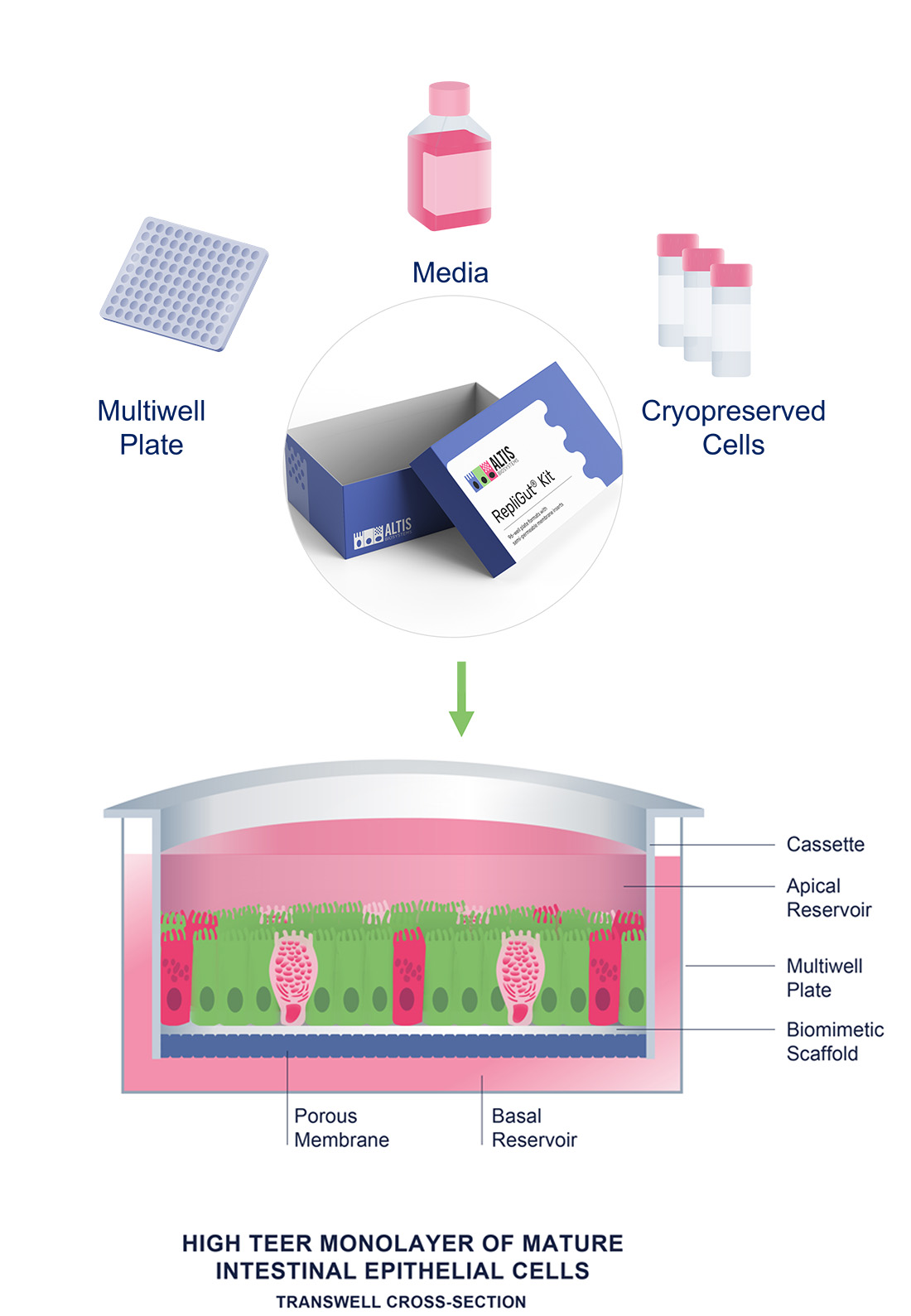
Figure 1. RepliGut Planar comprises cells, media and porous-membrane plates, building a polarized intestinal epithelial monolayer with separately accessible apical and basal sides.
The model consists of mature, differentiated intestinal epithelial cells forming a uniform polarized monolayer and a tight, high-TEER barrier on a porous membrane and biomimetic scaffold with apical and basal reservoirs, mimicking the mature intestinal barrier with a focus on drug absorption, metabolism and transport.
2. Four Features of the Kit
- Flexible formats: available in 12-, 24- and 96-well formats for high-throughput compatibility.
- Full intestinal coverage: kits can contain stem cells from different intestinal regions — duodenum, jejunum and ileum in the small intestine, and ascending, transverse and descending colon — chosen by research question rather than treating "the intestine" as one tissue.
- Ready to use: fully functional intestinal epithelial cells on permeable supports (Transwell) in 7–8 days, in classic assay formats, supporting new assay development and basic research.
- Complete documentation: besides cell information, the CoA includes epithelial barrier function data measured by TEER (transepithelial electrical resistance). Exact kit configurations and current supply terms should be confirmed per project.
Purchasing the RepliGut Planar kit includes support: a one-hour scientific consultation, a detailed user manual, protocol videos and after-sales service.
3. Four Model Advantages (According to Altis)
- Seamless fit with existing workflows: drops straight into existing Caco-2 assay workflows, clearly separating low- and high-passive-permeability compounds, with clearly distinguishable activity and specificity of P-gp and BCRP efflux transporters;
- Stronger metabolism than Caco-2: stronger phase I and II metabolic activity with rapid conversion of metabolic substrates, and an active PXR/RXR pathway responsive to rifampicin for drug–drug interaction (DDI) studies — extending "how much crosses" to "how it is metabolized, whether it induces, and how it is transported";
- Suited to NAMs and MPS/organ-on-chip: gut–liver microphysiological systems (MPS) that include RepliGut can improve bioavailability prediction accuracy;
- Reproducible results: RepliGut permeability performance reproduces in independent experiments, with standardized design and scaled manufacturing built on reproducibility.
Note that these capabilities still need verification on your target compound set; manufacturer descriptions should not be treated as fixed predictive performance.
4. Five Featured Application Areas
ADME
According to Altis, RepliGut is closer to the human intestine than Caco-2, more functionally complete, and connects with existing workflows — a next-generation in vitro intestinal model for ADME research.
Inflammatory Bowel Disease (IBD)
Chronic GI inflammation is associated with many conditions including IBD: over time, inflammation disrupts the epithelial tight junctions that maintain barrier integrity, leading to increased intestinal permeability, systemic inflammation and other adverse effects. RepliGut can be stimulated with pro-inflammatory cytokines such as TNF-α and IFN-γ to induce an inflammatory response and evaluate barrier responses and the efficacy of anti-inflammatory drugs, with TEER, permeability and cell state as combined endpoints.
Altis' RepliGut Crypt model contains both proliferative-zone stem cells and differentiated mature cells, mimicking the intestinal stem cell niche for stem cell research and disease modelling; it is currently offered as a service rather than a kit, and its availability should be confirmed separately from the Planar kit.
Gastrointestinal Toxicity
GI toxicity is one of the common adverse events in phase I clinical trials. In vitro cytotoxicity assays used to predict drug-induced GI toxicity usually rely on Caco-2 cells, which do not represent human intestinal biology. RepliGut Planar is a human stem cell-derived model that, unlike spherical organoids, allows independent access to apical and basal surfaces and direct measurement of barrier disruption.
Host–Microbe Interaction
Evidence shows that human health depends heavily on a balanced relationship with microbes, and disrupting that balance can lead to infection and disease; a healthy intestinal epithelium forms a protective barrier between microbes and host. RepliGut can be used in microbiome research, for example testing supernatants from different microbial communities to assess local effects on the intestinal epithelium. Microbial supernatant studies are not the same as a validated infection model.
Gut Hormone and Metabolism Research
RepliGut reproduces the structure and function of human intestinal epithelium, making it a useful in vitro tool for gut hormone biology, including GLP-1. Researchers are applying it to diabetes, obesity and gut–brain axis research. Key advantages include:
- A human intestinal monolayer that supports hormone activity assessment;
- An in vitro system for studying secretion, stability and transport mechanisms;
- A scalable format for drug discovery and mechanistic research.
These uses are mechanistic research and do not imply clinical metabolic efficacy.
5. Define the Question Before Choosing
- Permeability projects: confirm intestinal region, donor, culture days, TEER window, sampling direction and quality control;
- Metabolism projects: add enzyme activity, metabolite recovery and mass balance;
- DDI studies: include inducers, inhibitors and negative and positive controls;
- When multi-organ PK information is needed: evaluate connecting to a liver MPS rather than assuming a single-organ model can explain systemic exposure.
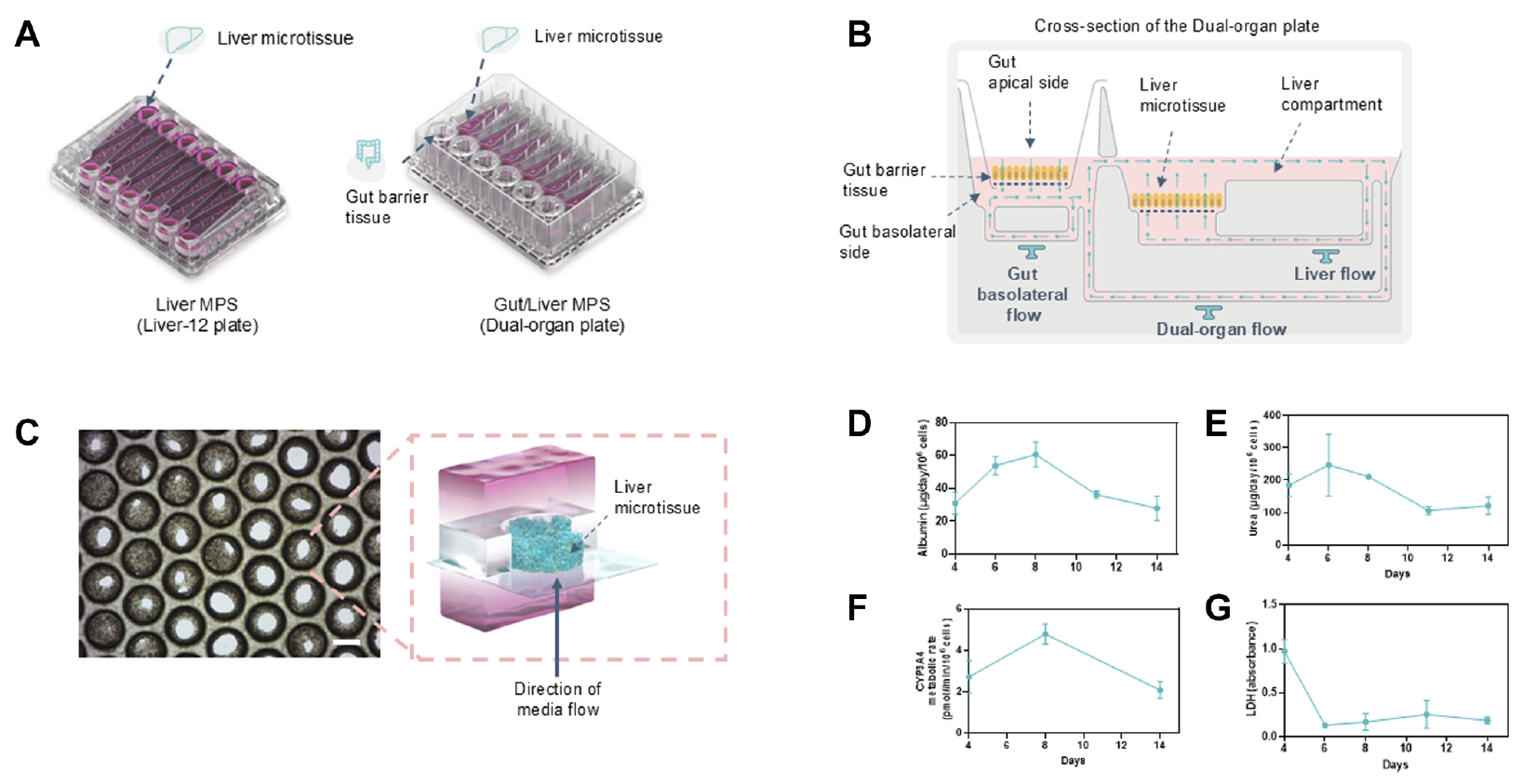
Figure 3. CN Bio liver and gut–liver MPS: plate structure, liver microtissues and albumin, urea, CYP3A4 and LDH readouts. These are liver-module observations, not performance data for a standalone RepliGut model.
A standardized kit in 12- to 96-well formats makes it easier to scale from mechanistic experiments to screening and reduces the upfront work of isolating, expanding and assembling primary models yourself; richer tissue function may also expose metabolic or barrier risks that Caco-2 misses earlier. Donor differences, culture batches and lab-to-lab transfer still need to be quantified, and project decisions should rest on local reproducibility and fit-for-purpose validation.
About Altis Biosystems
Founded in 2015 and headquartered in North Carolina, USA, Altis Biosystems counts pharmaceutical companies such as AstraZeneca and Genentech among its customers, according to the source material. The company focuses on in vitro model development and has built the stem cell-based RepliGut series of intestinal models for preclinical drug discovery, covering different intestinal regions and applicable to compound screening, intestinal disease modelling, drug disposition analysis, toxicity assessment, efficacy research and basic biology, while helping reduce animal testing. Its flagship RepliGut Planar model uses human donor intestinal stem cells and, by controlling proliferation and differentiation, rebuilds the key cell types of the human GI epithelium.
Let TechWave Help You Start with One Validation Plate
If your team wants more human-relevant intestinal data beyond Caco-2, or needs to compare model formats and endpoints for ADME, DDI, IBD, GI toxicity or gut hormone research, contact TechWave. We can help compare RepliGut Planar intestinal regions, plate formats and documentation, as well as multi-organ options connecting to the CN Bio liver MPS; a good start is one small validation plate with known reference compounds before deciding whether to scale to screening, and we can arrange a quotation.
Uses and applicable scenarios
- Drug absorption, metabolism and transport (ADME) studies and DDI assessment
- Barrier perturbation and anti-inflammatory drug evaluation in inflammatory bowel disease (IBD)
- Prediction of gastrointestinal toxicity
- Host–microbe interaction and gut hormone research such as GLP-1
Limitations
- Metabolism and permeability performance must be verified on your target compound set; manufacturer descriptions are not fixed predictive performance
- Donor differences, culture batches and lab-to-lab transfer need to be quantified
- A single-organ intestinal model cannot explain systemic exposure alone; multi-organ PK needs separate evaluation