
Technical column
Over a hundred conditions screened in one run: digital-microfluidic cell-free synthesis takes phytoglobins to a 200 μL scale-up at 0.69 and 0.77 mg/mL with 72% and 93% monomer
Cys-to-Ala substitutions, redox additives and solubility tags were compared in a single digital-microfluidic cell-free screen. GSSG and PDI/GSSG together made up 48% of the selected reaction conditions, tag-free conditions 40% and 3C-protease conditions 19%, while the P17, CUSF and FH8 tags, all below 10 kDa, clearly outperformed SUMO, TRX, ZZ and SNUT. Selected conditions scaled straight to 200 μL: P17-AsPgb 1.5 reached 0.69 mg/mL (22 μM) and CUSF-BvPgb 1.2 reached 0.77 mg/mL (20 μM), with mass-photometry peaks at 41 kDa and 43 kDa, monomer fractions of 72% and 93%, and a BvPgb melting temperature of 55 °C.
Definition
Digital-microfluidic cell-free protein synthesis (DMF-CFPS) runs protein variants, fusion tags and reaction additives in individually addressable nanolitre droplets, so a single experiment compares over a hundred soluble-expression and on-chip purification conditions at very low template and reagent consumption.
Phytoglobins are hard to express because three things go wrong at once: conserved thiols oxidise and aggregate in vitro, a slightly misaligned redox environment ruins folding, and a fusion tag that rescues one homolog suppresses the next. The classical answer is one tube per condition, which turns a few dozen combinations into weeks of work and a lot of template. This study pushed all three variables into nanolitre droplets on a digital-microfluidic cell-free protein synthesis (DMF-CFPS) platform, ran over a hundred conditions in one pass, and scaled the selected ones directly to 200 μL: P17-AsPgb 1.5 came out at 0.69 mg/mL (22 μM) and CUSF-BvPgb 1.2 at 0.77 mg/mL (20 μM), with mass-photometry monomer fractions of 72% and 93%.
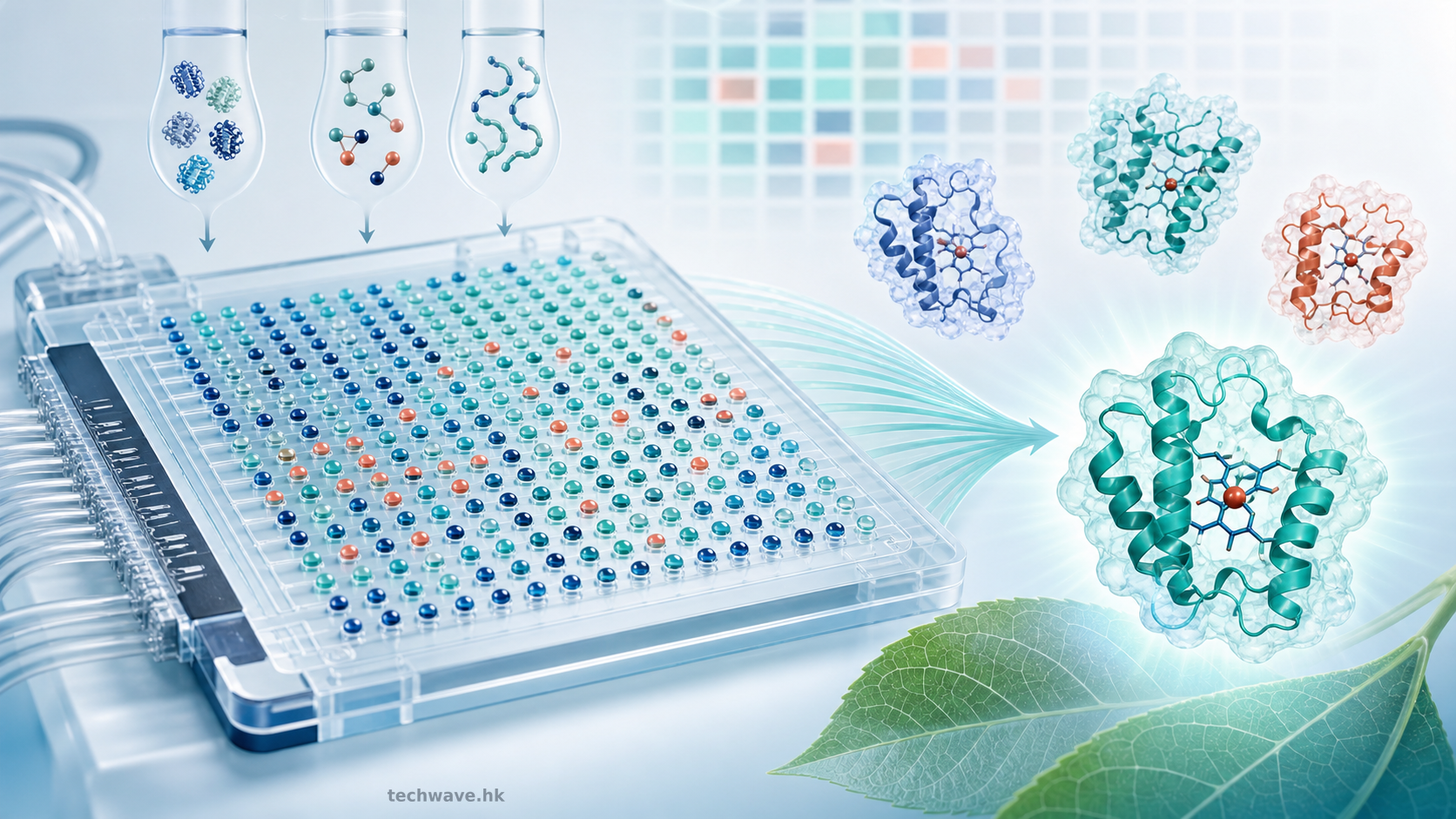
One matrix, three questions
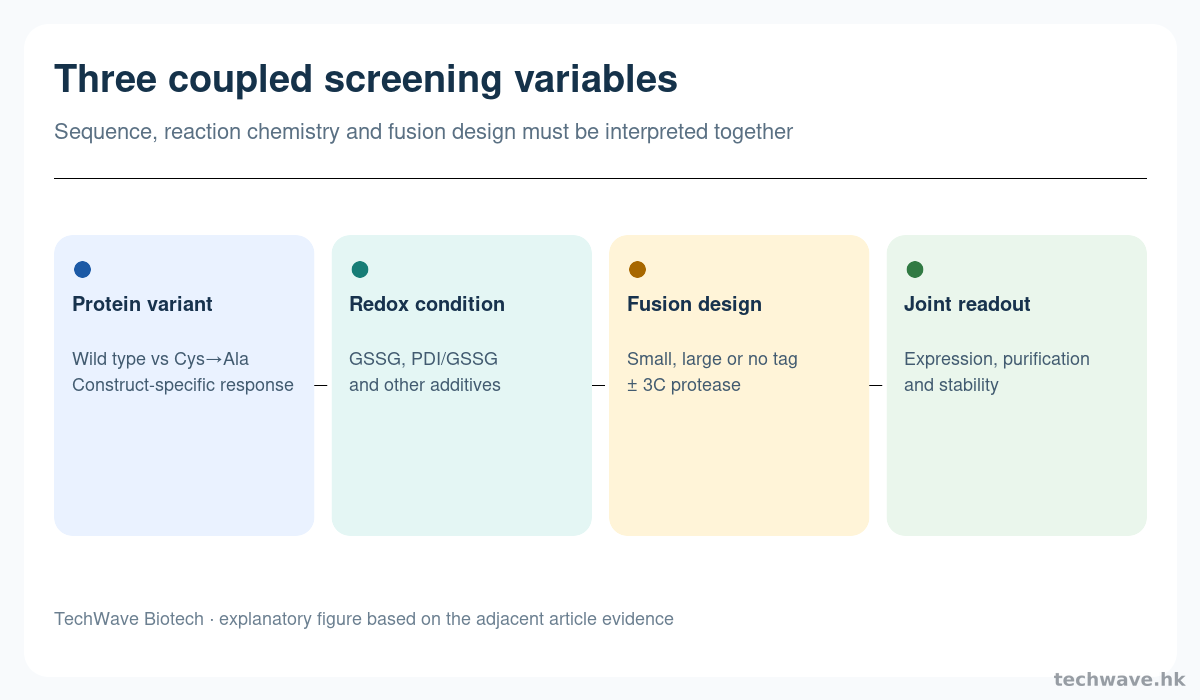
The panel covered beet BvPgb 1.2 and three oat phytoglobins, AsPgb 1.1, 1.5 and 3.1, each paired with an alanine substitution at a conserved cysteine: AsPgb 1.1 C70A, AsPgb 1.5 C84A, AsPgb 3.1 C161A and BvPgb 1.2 C86A, with wild types written as rWT. The BvPgb constructs were benchmarked against all seven solubility tags (P17, CUSF, FH8, TRX, ZZ, SUMO, SNUT) plus an untagged arm, while the AsPgb constructs were screened against P17, CUSF, FH8 and an untagged arm, each crossed with eight reaction conditions (3C protease, buffer, cofactor mix, DnaK mix, GSSG, PDI/GSSG, TRXB1, Zn²⁺). That matrix answers three questions in one experiment: does removing the thiol reduce aggregation, which redox environment favours soluble protein, and is a tag an asset or a liability for this particular construct.
Conserved cysteines: substitute them, and most constructs purify better
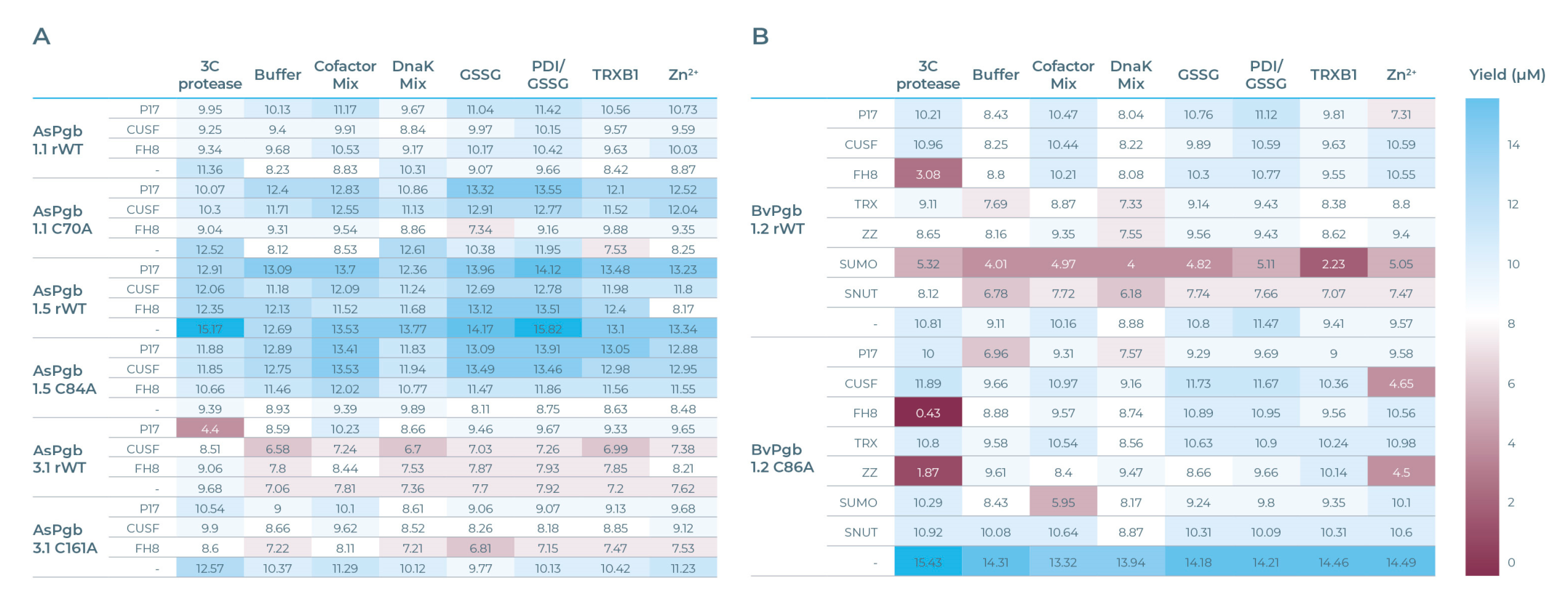
Beet BvPgb C86A gave higher total fluorescent expression than wild type at a comparable total purified yield, and the more useful change was in tag behaviour: SUMO strongly suppressed expression of the BvPgb wild type but had almost no negative effect on C86A. The oat series was construct-specific in the same way. AsPgb 1.1 C70A purified at a higher yield than wild type, AsPgb 1.5 C84A visibly changed its tag dependence, and AsPgb 3.1 C161A showed a clear gain in purification efficiency.
The pattern is consistent: removing a conserved thiol relieves oxidative aggregation, and most of these phytoglobins gained solubility and total yield after substitution, which makes the conserved cysteine an important negative determinant of expression stability. The effect carries real protein-to-protein variation, so it belongs in the screening matrix as a row to test, not as a fixed engineering rule to copy across targets.
Oxidising conditions and small tags dominate the selected combinations
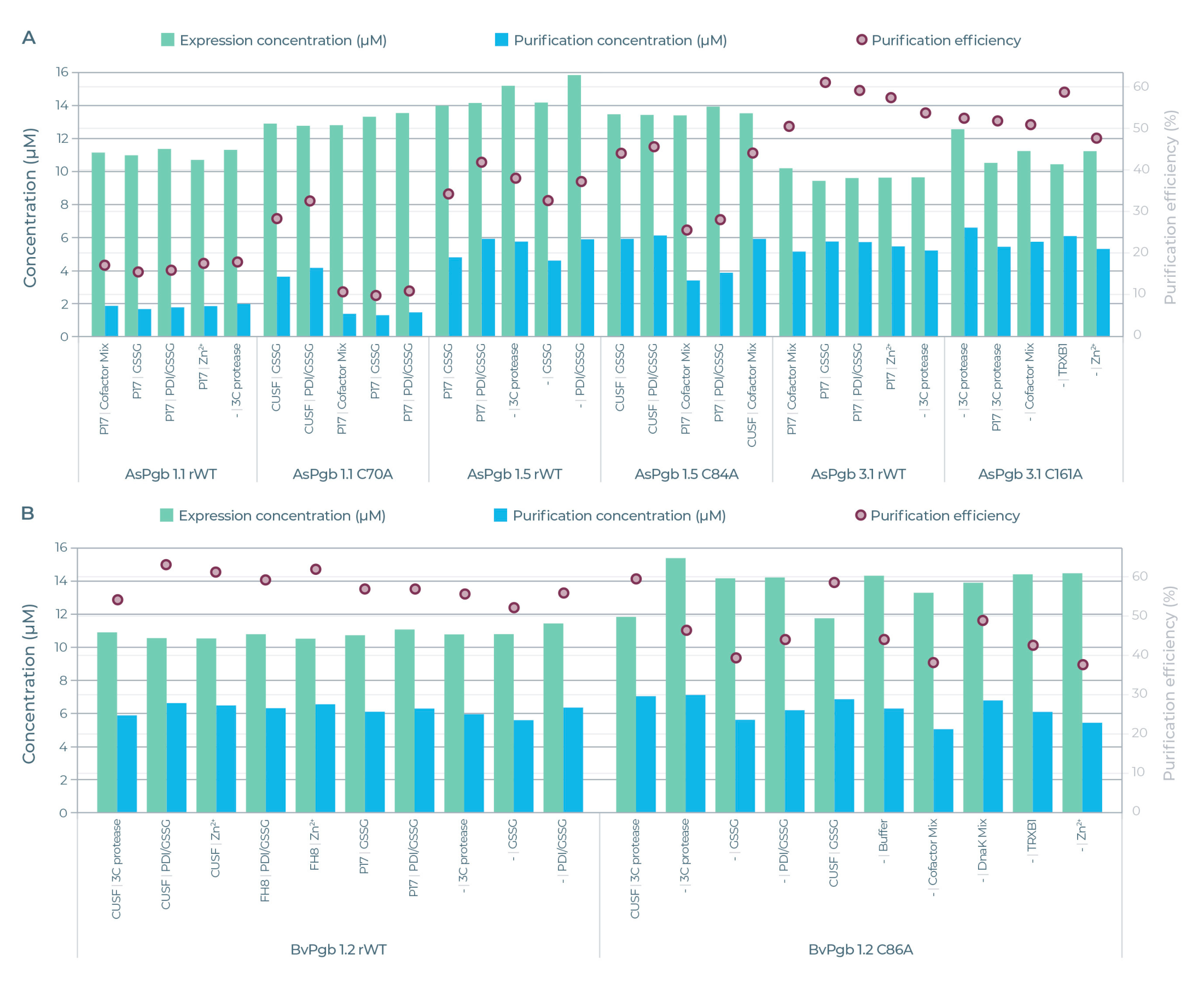
The selected reaction systems cluster hard. GSSG and PDI/GSSG together accounted for 48%, clearly ahead of the DnaK and TRXB1 chaperone conditions. An oxidising microenvironment suppresses spontaneous thiol oxidation and aggregation by shifting the redox balance, and that makes it the central condition for stable phytoglobin synthesis. Judging by the PDI-containing groups, the benefit does not rest on promoting correct disulphide formation alone, and the chaperone DnaK and the reductase TRXB1 delivered comparatively weak gains. Metal-cofactor mixtures and Zn²⁺ ranked next, contributing positively to folding.
The tag result translates directly into a selection rule. The better-performing tags sit below 10 kDa — P17, CUSF and FH8 — while the larger SUMO, TRX, ZZ and SNUT tags added little overall and suppressed expression in some combinations. More striking, tag-free conditions made up 40% of the selected set and 3C-protease conditions 19%: a tag is not a requirement, and for some phytoglobins it is itself the folding obstacle. Species fit also differs — CUSF suits the beet BvPgb wild type, while P17 suits oat AsPgb 1.5.
| Screening dimension | Result in this study | What it means for selection |
|---|---|---|
| Cys-to-Ala substitution | Soluble expression or purification improved for several constructs | Treat conserved thiols as first-line engineering positions, verified per protein |
| GSSG, PDI/GSSG | 48% of selected reaction systems | Put oxidising conditions first in the matrix |
| DnaK, TRXB1 | Lower share than the oxidising combinations | Do not default to DnaK or TRXB1 |
| Tag-free | 40% of selected conditions | Always include a tag-free arm |
| 3C protease | 19% of selected conditions | Keep a cleavable-tag design available |
| P17, CUSF, FH8 (below 10 kDa) | More frequent in the stronger combinations | Screen small tags first, large tags only on demand |
Scale-up: read concentration, monomer fraction and stability together
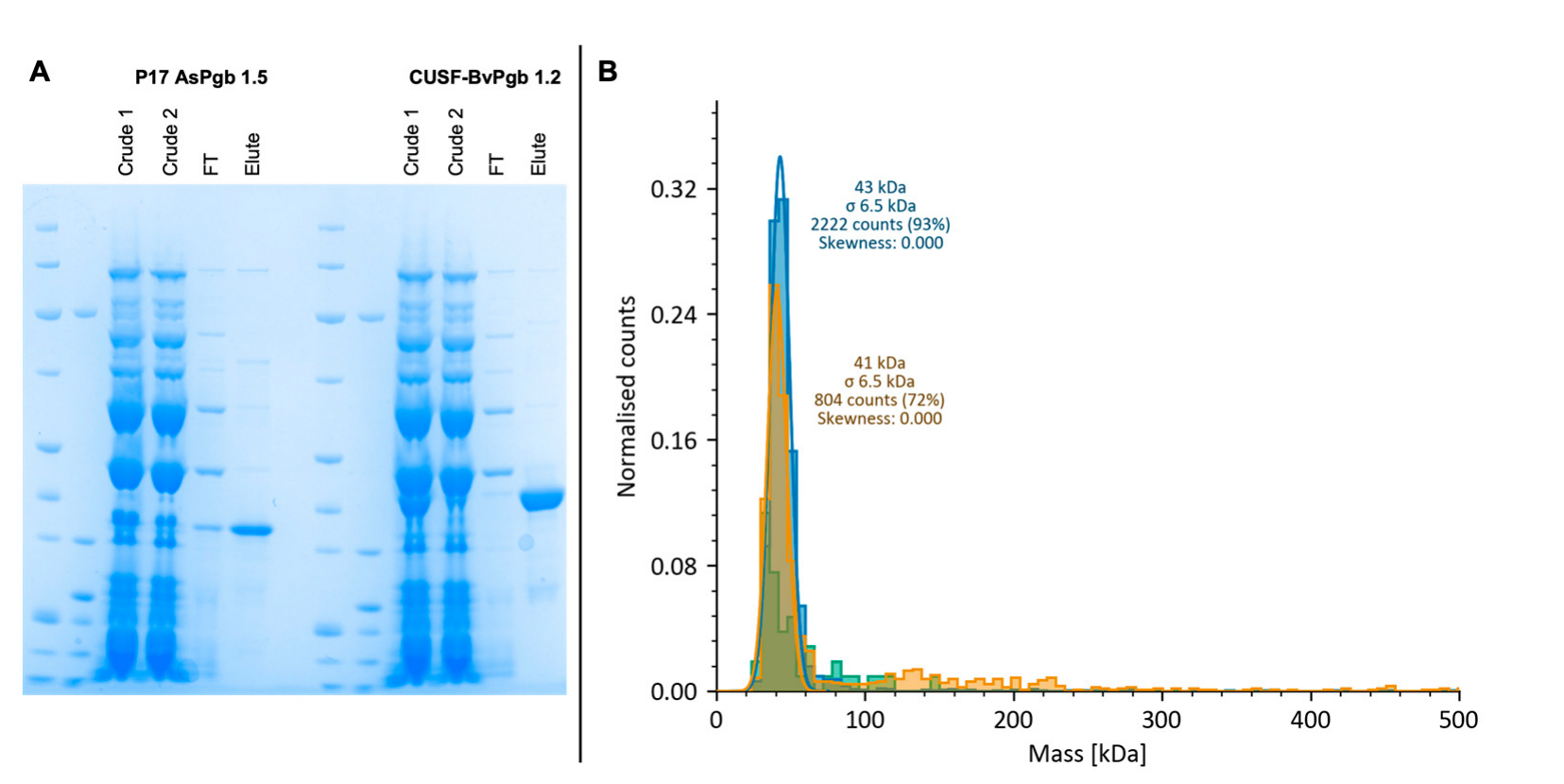
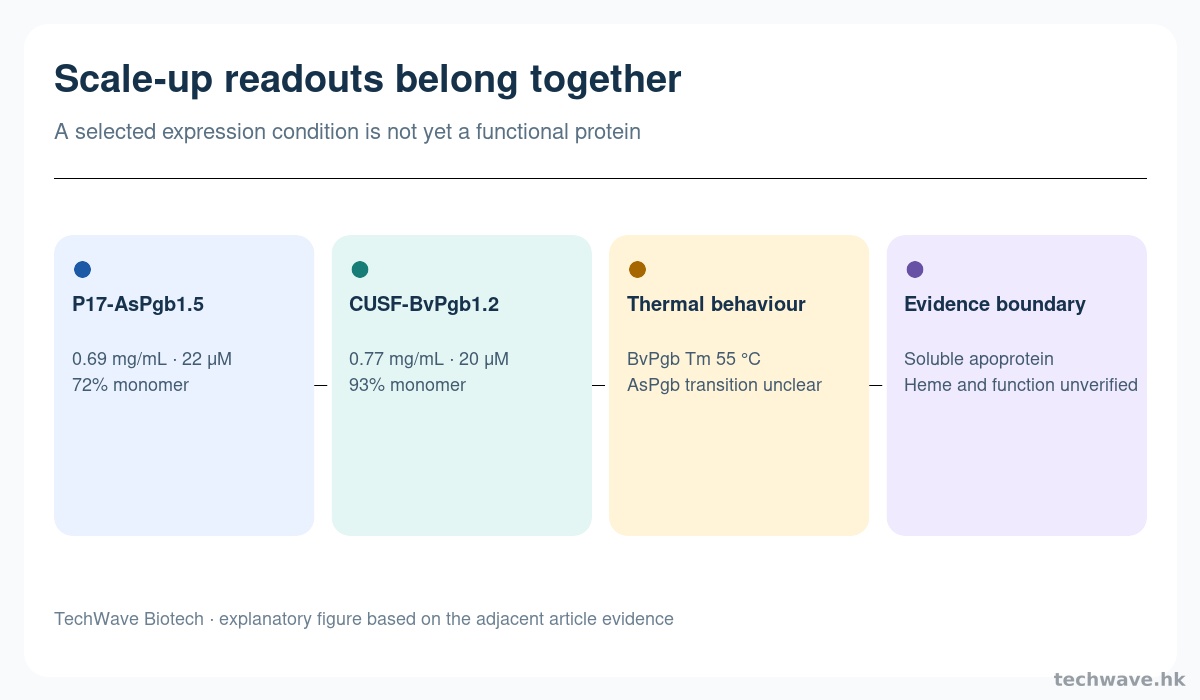
The two closely homologous proteins AsPgb 1.5 and BvPgb 1.2 were taken forward: AsPgb 1.5 with the P17 tag, BvPgb 1.2 with the CUSF tag, both in the PDI/GSSG reaction system, expressed at 200 μL and purified by Strep affinity. P17-AsPgb 1.5 reached 0.69 mg/mL (22 μM) and CUSF-BvPgb 1.2 reached 0.77 mg/mL (20 μM), each with a single clean band after purification.
| Scaled construct | Purified concentration | Molar concentration | Mass-photometry peak | Monomer fraction |
|---|---|---|---|---|
| P17-AsPgb 1.5 | 0.69 mg/mL | 22 μM | 41 kDa | 72% |
| CUSF-BvPgb 1.2 | 0.77 mg/mL | 20 μM | 43 kDa | 93% |
Both scaled preparations were predominantly monomeric by mass photometry, 93% for BvPgb and 72% for AsPgb 1.5. Given the reaction conditions, the products were inferred to be soluble apo-globins, and heme binding was not demonstrated. NanoDSF put the beet BvPgb melting temperature at 55 °C with a tendency to aggregate at higher temperature, while oat AsPgb 1.5 gave no clear thermal transition, so no defined Tm can be read for it, and it is the less stable of the two. That contrast is exactly why classical expression protocols do not transfer between species: the fold is conserved, the physicochemical behaviour is not.
Where it fits
- Strongest fit: locking tag, additive and mutant combinations at small volume before committing to scale-up, especially for thiol-rich, aggregation-prone targets and for projects comparing several homologs side by side.
- What the platform delivered here is soluble apo-globin. Under these conditions the product is the apo form, heme incorporation was not demonstrated, and no NO-scavenging or antioxidant activity assay was run. Projects that need mature, fully functional holo-Pgb must add the corresponding chaperones and cofactor delivery, then run the functional readouts.
- The 48%, 40% and 19% figures describe how this set of phytoglobin constructs distributed across this condition matrix. They are not a platform-wide success rate for arbitrary targets; a new target needs its own tags, additives, temperature and reaction time.
- Thermal data are per protein: the BvPgb Tm of 55 °C can inform downstream process temperature, whereas AsPgb 1.5 produced no clear transition and cannot be assigned a Tm.
- Mutagenesis addressed single conserved cysteines. Combined substitutions and other stability positions were not covered and would require a fresh screening round.
From a screening hit to usable protein
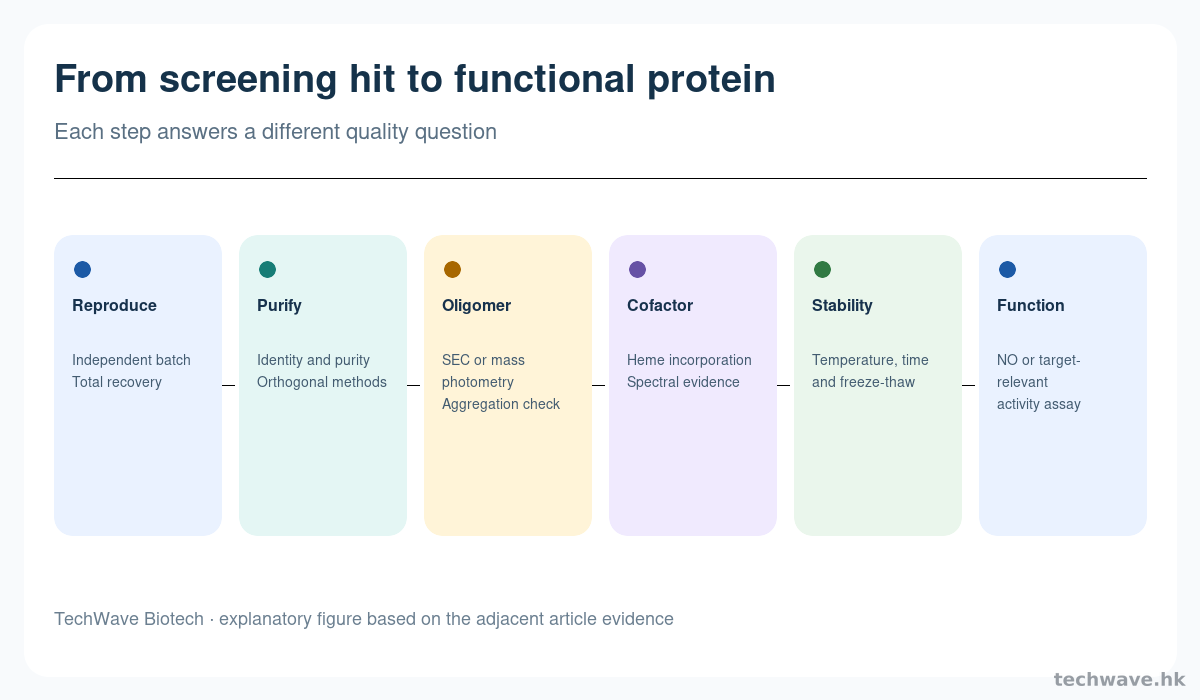
Keep the screen's multiple readouts when you convert a hit into material. Reproduce expression and purification in an independent batch and calculate total recovery rather than comparing concentration alone. Confirm oligomeric state by SEC, mass photometry or another orthogonal method, and test heme binding and spectral identity at the same time. Challenge stability across temperature, freeze-thaw, time and buffer. Then add the target-relevant functional assay, such as NO scavenging or oxidative-stress readouts. The same screening logic transfers to membrane proteins, heme enzymes and host-toxic recombinant proteins, which is where this workflow earns its place in heme-protein engineering.
Bring this screening workflow into your lab
If you are looking for a condition-optimisation route for heme proteins, phytoglobins or any aggregation-prone difficult target, talk to TechWave. We can map the tag matrix and additive distribution in this study onto your project, help you define the construct list, tag panel and redox conditions for digital-microfluidic cell-free screening, supply the relevant literature and product documentation, and arrange sample trials, technical consultation and quotation.
References
- Groth L, Bülow L. Digital Microfluidics-Driven Cell-Free Protein Synthesis Platform Reveals Expression and Stability Determinants for Phytoglobins and Cysteine-to-Alanine Substituted Variants. Antioxidants. 2025;14(11):1317. doi:10.3390/antiox14111317
Uses and applicable scenarios
- Parallel tag and additive screening for difficult-to-express proteins
- Side-by-side expression and purification-efficiency comparison of point mutants and wild type
- Locking in conditions at small volume before scale-up
- Preparing soluble apo forms of heme-binding globins
Limitations
- Scaled products were inferred to be soluble apo-globins; heme incorporation was not demonstrated
- No NO-scavenging, antioxidant or other biological activity assay was performed
- Selection frequencies come from this phytoglobin construct set, not a general platform success rate
- Mutagenesis covered single conserved cysteines, not combined substitutions