
Technical column
PEI MAX, Transporter 5 or MAXgene GMP: Three-Lot Transfection Consistency and >90% MAXgene GMP Viability
Three lots of Polysciences PEI showed no significant difference in transfection efficiency, three tested MAXgene GMP lots kept cell viability above 90%, and Polysciences comparison data show higher B72-3 antibody expression than a competitor PEI in HEK293 and CHO cells. Choose the grade and format that fits your project.
Definition
PEI is a cationic polymer that can form positively charged complexes with nucleic acids for non-viral delivery and protein-expression research.
Moving a project from research toward clinical development raises a practical reagent question: which grade and format to use at each stage, and how much a new lot can shift results. Polysciences offers a fully hydrolyzed PEI family in research and cGMP grades and in powder and liquid formats — PEI MAX, Transporter 5 and MAXgene GMP. Its data put numbers on the criteria teams weigh: three lots of Polysciences PEI showed no significant difference in transfection efficiency, three tested MAXgene GMP lots kept cell viability above 90%, and Polysciences comparison data show higher B72-3 antibody expression than a competitor PEI in both HEK293 and CHO cells.
Why the transfection reagent shapes delivery outcomes
Efficient nucleic-acid delivery is a core step in cell and gene therapy research. Gene therapy introduces genetic material for a therapeutic purpose, while cell therapy uses cells with specific functions. Alongside viral tools such as AAV and lentiviral vectors, PEI gives teams a non-viral polymer route. Polyethylenimine (PEI) is a cationic polymer that forms positively charged complexes with nucleic acids; these complexes enter cells through endocytosis, and intracellular transport and nucleic-acid release then influence expression — so cellular entry and successful expression are distinct stages, and the outcome depends on the cell system. That is why teams judge a reagent on expression, cell tolerance and lot consistency.
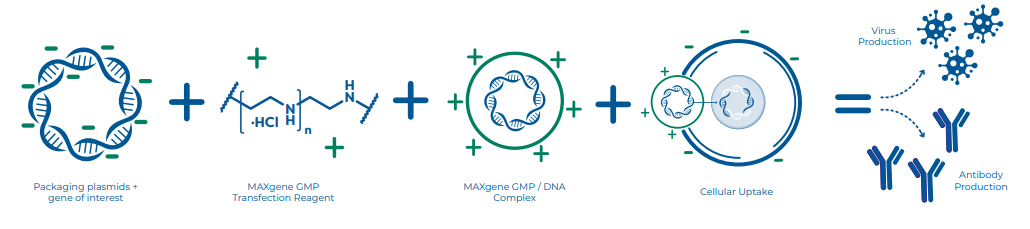
Conceptual illustration of PEI–nucleic-acid complexes and cellular delivery.
One PEI family, matched to your grade and format
Founded in 1961, Polysciences has a long history in specialty chemical manufacturing, and its linear PEI has a long record of research and industrial use. PEI MAX, Transporter 5 and MAXgene GMP are all fully hydrolyzed PEI products, made from US-sourced materials under ISO 13485 quality-system standards, and the family covers adherent and suspension culture and both stable and transient transfection.
- PEI MAX — research grade, powder. Near-complete deacetylation, more than a decade of use in academic and industrial research, and widely cited.
- Transporter 5 — research grade, liquid. Introduced as the liquid version of PEI MAX, with an emphasis on convenience.
- MAXgene GMP — cGMP grade, powder and solution. Launched in 2019 with quality-control support; Polysciences positions it for clinical development and commercialization.
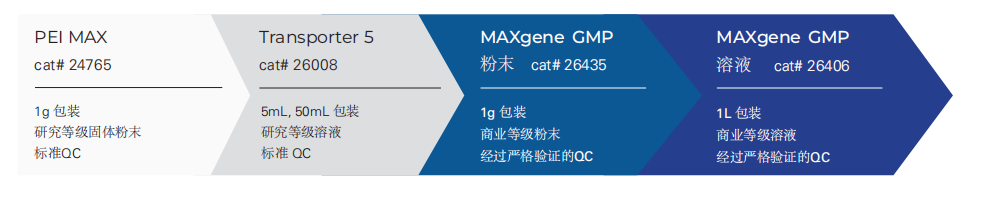
Product formats and grades of PEI MAX, Transporter 5 and MAXgene GMP.
Evidence 1: three lots, no significant difference in transfection efficiency
Polysciences compared three lots of its PEI in a GFP reporter study in suspension HEK-293T cells; the source does not name which PEI product was tested. Flow cytometry 48 hours after transfection showed no significant difference in the proportion of GFP-positive cells among the three lots — direct evidence of functional consistency for the tested lots, in line with Polysciences' statement that its PEI products maintain high lot-to-lot consistency.
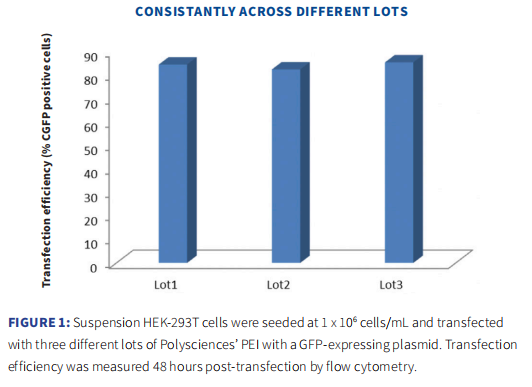
Comparison of GFP-positive cell proportions across three Polysciences PEI lots.
Evidence 2: above 90% viability across three MAXgene GMP lots
In a monoclonal-antibody expression study in suspension HEK-293T cells, three lots kept cell viability above 90% at both 24 and 48 hours after transfection, measured with a VI-CELL cell counter. The corresponding chart identifies the product as MAXgene GMP and the expressed antibody as adalimumab. The result shows low cytotoxicity and similar cell compatibility across the tested lots in this expression system.
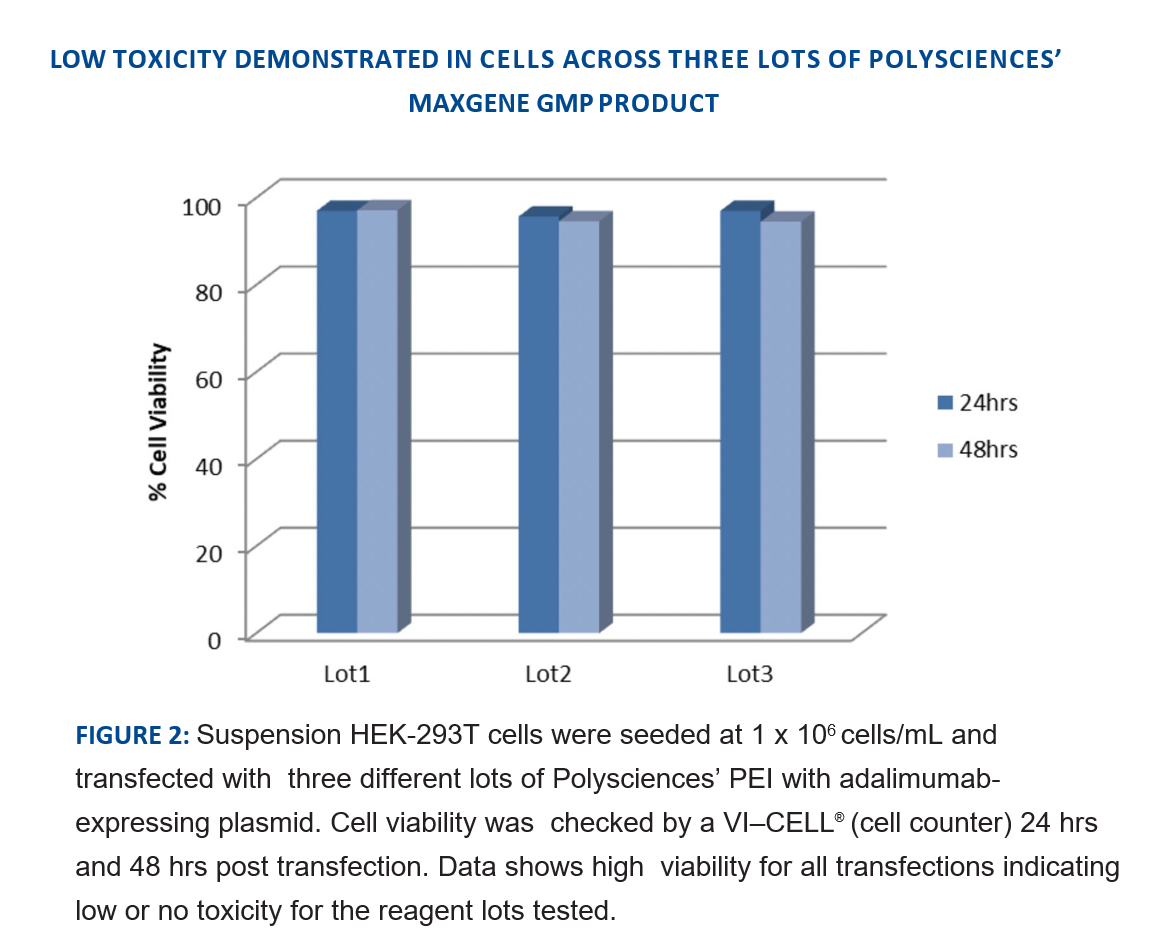
Cell-viability comparison for three tested MAXgene GMP lots in antibody-expression research.
Evidence 3: manufacturer data show higher antibody expression than a competitor PEI in HEK and CHO cells
Because many manufacturing processes use HEK293 and CHO cells, Polysciences provides comparison data for its PEI and a competitor PEI in both. In the B72-3 monoclonal-antibody comparison shown here, Polysciences PEI produced higher antibody expression than the competitor PEI in both cell backgrounds. Related literature: Delafosse, Xu and Durocher (2016), a comparative study of polyethylenimines for transient expression in HEK293 and CHO cells.
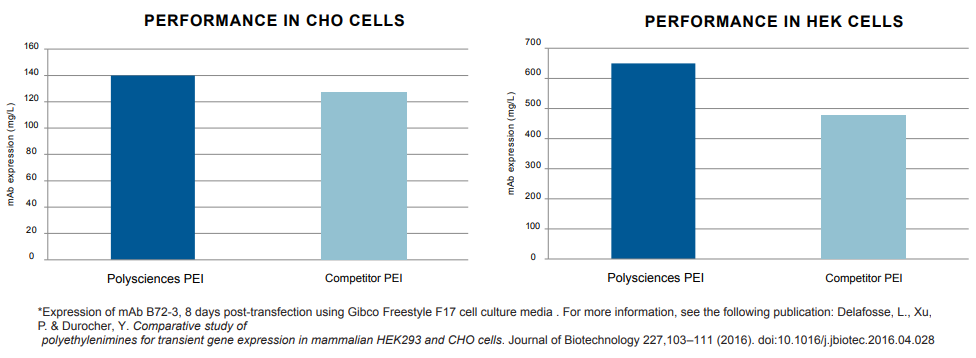
Comparison of B72-3 monoclonal-antibody expression in CHO and HEK cells.
Where each product fits
- cGMP-grade material for clinical development or commercialization: MAXgene GMP, in powder or solution, as positioned by Polysciences — the product identified in the three-lot viability data.
- Research-grade work with a preference for powder: PEI MAX.
- Research-grade work with a preference for liquid: Transporter 5.
These results apply to the tested lots, HEK-293T, HEK293 and CHO cells, the listed antibodies and endpoints; expression across other products, cells or scales is evaluated project by project.
Plan your PEI selection with TechWave
Tell TechWave about your expression-research application, target product, preferred format and quality-documentation needs. Our team will help you compare PEI MAX, Transporter 5 and MAXgene GMP and arrange product information and technical consultation for the Polysciences PEI line that fits your project.
References
- Aravindan, L., Bicknell, K. A., Brooks, G., Khutoryanskiy, V. V., & Williams, A. C. (2009). Effect of acyl chain length on transfection efficiency and toxicity of polyethylenimine. International journal of pharmaceutics, 378(1-2), 201-210.
- Dai, Z., Gjetting, T., Mattebjerg, M. A., Wu, C., & Andresen, T. L. (2011). Elucidating the interplay between DNA-condensing and free polycations in gene transfection through a mechanistic study of linear and branched PEI. Biomaterials, 32(33), 8626-8634.
- Daya, S., & Berns, K. I. (2008). Gene therapy using adeno-associated virus vectors. Clinical microbiology reviews, 21(4), 583-593.
- Delafosse, L., Xu, P., & Durocher, Y. (2016). Comparative study of polyethylenimines for transient gene expression in mammalian HEK293 and CHO cells. Journal of biotechnology, 227, 103-111. https://doi.org/10.1016/j.jbiotec.2016.04.028
- Durymanov, M., & Reineke, J. (2018). Non-viral delivery of nucleic acids: Insight into mechanisms of overcoming intracellular barriers. Frontiers in pharmacology, 9, 971.
- Milone, M. C., & O’Doherty, U. (2018). Clinical use of lentiviral vectors. Leukemia, 32(7), 1529-1541.
- Naso, M. F., Tomkowicz, B., Perry, W. L., & Strohl, W. R. (2017). Adeno-associated virus (AAV) as a vector for gene therapy. BioDrugs, 31(4), 317-334.
- Sawant, R. R., Sriraman, S. K., Navarro, G., Biswas, S., Dalvi, R. A., & Torchilin, V. P. (2012). Polyethyleneimine-lipid conjugate-based pH-sensitive micellar carrier for gene delivery. Biomaterials, 33(15), 3942-3951.
- Sun, W., Zheng, W., & Simeonov, A. (2017). Drug discovery and development for rare genetic disorders. American Journal of Medical Genetics Part A, 173(9), 2307-2322.
- Zakeri, A., Kouhbanani, M. A. J., Beheshtkhoo, N., Beigi, V., Mousavi, S. M., Hashemi, S. A. R., ... & Movahedpour, A. (2018). Polyethylenimine-based nanocarriers in co-delivery of drug and gene: a developing horizon. Nano reviews & experiments, 9(1), 1488497.
Uses and applicable scenarios
- Non-viral nucleic-acid delivery research
- Recombinant-protein and antibody-expression research
- Lot-consistency and cell-compatibility evaluation
- Research-grade and cGMP-grade material comparison
Limitations
- Viability findings apply to the tested lots, HEK-293T cells and 24/48-hour observations
- Antibody-expression comparisons concern a particular antibody and study system
- Expression performance requires separate evaluation across products, cells or scales
Related brands
Related products
- Amplifect Transfection Enhancer – 1mL GMP
- Amplifect Transfection Enhancer – 1000mL GMP
- Amplifect Transfection Enhancer – 5mL GMP
- Fast Blue (FB) 1 mg
- Fast Blue (FB) 5 mg
- PEI 25K™ Transfection Reagent
- PEI MAX® Transfection Reagent
- MAXgene GMP Transfection Reagent, Solution
- MAXgene GMP Transfection Reagent, Powder 1 g
- MAXgene GMP Transfection Reagent, Powder 25 mg
- BioMag®Plus Concanavalin A 86057-10
- BioMag®Plus Concanavalin A 86057-3
- Transporter 5 Transfection Reagent 1 ml
- Transporter 5 Transfection Reagent 5ml
- Transporter 5 Transfection Reagent 50ml
- Aqua-Poly/Mount Aqueous Mounting Medium, 5×20 mL
- Aqua-Poly/Mount Aqueous Mounting Medium, 20 mL
- Aqua-Poly/Mount Aqueous Mounting Medium, 100 mL