
Technical column
Efficiency drops when you move to suspension? Don't change the reagent first: one linear PEI catalogue number covers both adherent and suspension culture, but five parameter families have to be recalibrated
A single bottle of linear PEI — for example Polysciences PEI MAX, catalogue number 24765 — is specified by the manufacturer for both adherent and suspension culture of common cell lines including HEK293 and CHO, and the manual lists two separate workflows under that same catalogue number, sharing one stock concentration and one complex-formation principle. That works because endocytic uptake and proton-sponge-mediated endosomal escape do not depend on how the cells grow. What does change is the measurement basis of five parameter families: the cell-state anchor shifts from 70-80% confluence to a viable-cell concentration of 1E6-2E6 cells/mL at 95% or higher viability, the dosing basis shifts from per-well volume to per 1E6 cells, and complex-formation conditions, addition and mixing, and the expression window (24-72 hours for adherent, 6-7 days for secreted protein in suspension) all differ. Four mechanisms explain why the suspension window is narrower: under the cell density effect, accumulated extracellular vesicles change local ionic strength and aggregate the complexes; polyplex size depends strongly on ionic strength, with aggregates above 1000 nm forming at physiological salt and giving higher gene expression, while roughly 40 nm particles at low ionic strength can be 10-100 times less efficient; anionic medium components such as dextran sulfate, heparin and ferric ammonium citrate neutralise the polyplex charge and release DNA prematurely; and suspension cells additionally experience shear and only brief collisional contact. This article covers the mechanisms and the selection decision; exact amounts and timings follow the manufacturer's manual and your own calibration.
Definition
Linear PEI is a cationic-polymer transfection reagent widely used for plasmid transfection, recombinant protein expression and transient expression systems, and is also widely used for viral-vector packaging. One catalogue number typically supports both adherent and suspension transfection, but cell density, dosing basis, complex-formation conditions and harvest windows are measured differently in the two culture modes and must be calibrated separately.
The same bottle of linear PEI gives stable transfection efficiency in a 96-well adherent plate, then loses efficiency and gains batch-to-batch variability as soon as you move to suspension HEK293 cells in a shake flask. The usual first reaction is to blame the reagent: change the catalogue number, change the brand, run compatibility testing again. In most cases the reagent is not the variable. The variable is that the measurement basis of the transfection parameters did not change when the culture mode did.
Getting this straight saves a whole round of reagent-swapping trial and error: first confirm whether the reagent really is mode-agnostic, then recalibrate five parameter families, and finally use four mechanisms to explain why suspension is the harder system to tune.
1. At reagent level, one catalogue number covers both adherent and suspension culture
Chemically and in terms of product positioning, the same bottle of linear PEI can serve both culture modes. Taking Polysciences PEI MAX (catalogue number 24765) as the example, the manufacturer's product documentation states that it is suitable for adherent and suspension culture of a range of common cell lines including HEK293 and CHO. Its official manual lists two separate workflows, adherent cell transfection and suspension cell transfection, under that single catalogue number, while both use the same stock concentration and the same complex-formation principle.
The mechanism supports this. Linear PEI relies on a high density of protonatable amine groups to form electrostatic interactions with negatively charged plasmid DNA, assembling nanoscale complexes. Those complexes are taken up by endocytosis, escape the endosome through the proton-sponge effect, and release DNA into the cytoplasm for onward transport into the nucleus. None of these steps depends on whether a cell is spread on a surface or growing in suspension: uptake and endosomal escape follow the same route.
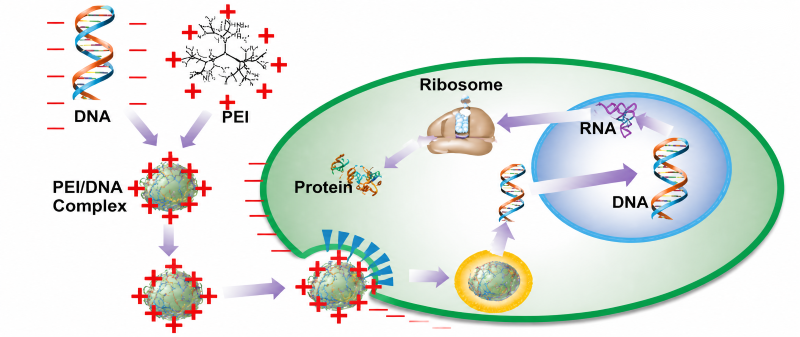
Figure 1. Mechanism of action of PEI transfection reagents: electrostatic complexation, endocytosis, proton-sponge-mediated endosomal escape and nuclear entry
This is also why PEI scales continuously: from adherent screening in a 96-well plate to suspension scale-up in shake flasks and bioreactors, the governing chemistry does not change — which is also why linear PEI is so widely used for large-scale protein expression and viral-vector packaging. For selection, that has practical value. Changing culture mode does not force you to introduce a new reagent and repeat compatibility and quality assessment; you recalibrate the parameters of the same catalogue number.
2. The measurement basis of five parameter families changes with culture mode
A mode-agnostic reagent does not mean transferable parameters. Adherent and suspension cells differ in growth state, in how they meet the complexes, and in their microenvironment. At least five parameter families need separate calibration per culture mode — and what changes is the measurement basis, not simply the numbers.
| Parameter family | Adherent basis | Suspension basis | What happens if you transfer it directly |
|---|---|---|---|
| Cell-state anchor | Confluence, typically held at 70-80%, judged by the fraction of the growth surface covered, which keeps the cells in log phase with room to grow | Viable-cell concentration, typically held at 1E6-2E6 cells/mL at transfection, with viability of 95% or higher and low clumping | The two use different dimensions and cannot be converted into one another |
| Dosing basis | Allocated per well, per growth area or per volume of medium | Allocated per 1E6 cells; suspension needs more plasmid and more PEI per cell than adherent culture; a generic 25 kDa linear PEI and PEI MAX do not share the same dosing window | Scaling by medium volume leaves each cell exposed to a very different amount of complex |
| Complex-formation environment | Formed in low-serum or serum-free medium, with reasonable tolerance for ionic strength and standing time | More sensitive to aggregation; diluent and ionic strength need tighter control | Over-aggregated complexes and falling transfection efficiency |
| Addition and mixing | Added slowly down the well wall in a static environment, with complexes settling onto the cells by gravity | Added under continuous agitation so the complexes disperse rather than concentrate locally | Local over-concentration causes particle aggregation and poor uniformity |
| Expression peak and harvest window | Expression generally peaks at 24-72 hours, suiting reporter assays and small-scale protein production | Secreted protein generally peaks 6-7 days after transfection, suiting scale-up of recombinant proteins and antibodies | Harvesting on the adherent schedule misses the suspension yield window |
The second family is where most errors happen. Teams with a long adherent history remember a mass ratio and an amount per well, then scale that by medium volume after moving to suspension. The correct path is to convert the good adherent condition into an amount of plasmid and PEI per 1E6 cells, use the suspension cell count to derive a starting point, and optimise around it. The exact values come from the manufacturer's manual and your own small-scale calibration — there is no universal recipe, because cell line, plasmid size and medium all move the window.
3. Why the suspension window is narrower: four mechanisms
Suspension transfection is harder to tune for concrete reasons, not folklore: the microenvironment and the way complexes reach cells are both different. Knowing these four mechanisms lets you locate an efficiency problem instead of sweeping parameters blindly.
3.1 The cell density effect
In high-density suspension culture, extracellular vesicles (EVs) secreted by the cells accumulate in the medium, change local ionic strength and cause PEI-DNA complexes to aggregate so that they no longer bind the cell membrane effectively. Research confirms that exchanging for fresh medium before transfection, removing the accumulated EVs, can partially restore transfection efficiency. The cell density effect has been studied in transient expression systems for years, and it is the standard explanation for the most common complaint: the same parameters work at small scale and then lose efficiency after scale-up or at higher cell density.
3.2 Polyplex size directly affects expression efficiency
PEI-DNA complex size depends closely on ionic strength. At physiological salt concentration, large aggregates above 1000 nm can form and give higher levels of gene expression; at low ionic strength, particles of roughly 40 nm form and expression efficiency can fall by a factor of 10 to 100.
That difference explains the tolerance gap between the two culture modes. In adherent culture, complexes remain in contact with the cell surface through gravitational settling and tolerance for particle size is correspondingly higher. Suspension cells depend on Brownian motion and collisional contact: complexes that are too large aggregate and sediment, while complexes that are too small bind poorly. Control of ionic strength and complex-formation conditions therefore has to be considerably tighter.
3.3 Interference from medium components
Some commercial serum-free suspension media contain anionic components such as dextran sulfate, heparin and ferric ammonium citrate, which neutralise the positive charge of PEI complexes, release DNA prematurely and directly inhibit transfection. This is the common reason that established PEI parameters stop working after a change of medium brand or cell line: suspension systems are markedly more sensitive to medium composition than adherent systems. Medium and transfection reagent should therefore be evaluated as a pair, rather than sourced separately and assumed compatible.
3.4 Contact mode and shear
Adherent culture is a static environment in which complexes stay in contact with the cell surface for extended periods. Suspension culture depends on collisional contact driven by shaking or stirring: contact is brief, uniformity depends on agitation rate, and the cells experience shear at the same time. In a suspension system, complex-formation time, addition rate and agitation rate are themselves high-sensitivity parameters, while in an adherent workflow they rarely need dedicated optimisation.
4. Where it fits and how to choose
Choose the culture mode from the objective
To validate a promoter, a reporter gene or a small amount of protein quickly, an adherent system returns results within 24-72 hours with simple handling and low consumption. For milligram-scale and larger recombinant protein or antibody work, and for anything heading towards production, the 6-7 day secreted-expression window and the scalability of a suspension system are the right fit. The two are not substitutes; they are consecutive stages of the same development chain.
What to recalibrate when switching
The basis for judging cell state (from confluence to viable-cell concentration and viability), the dosing basis (from volume to per 1E6 cells), complex-formation conditions and standing time, addition and mixing, and the harvest time point. The reagent itself and the complex-formation principle are not on that list.
Work back from the failure signature
Normal at small scale but weaker after scale-up or at higher cell density points first to the cell density effect and to a medium exchange before transfection. Sudden failure after a change of medium brand or cell line points first to anionic medium components. Large batch-to-batch variability and poor repeatability at a fixed parameter set points first to ionic strength, complex-formation time and mixing conditions.
Three things to check in supplier documentation
Whether the catalogue number is explicitly specified for both adherent and suspension culture; whether the manual lists two separate workflows; and whether the cell line and medium you intend to use fall within the manufacturer's validated range. Together these determine whether your adherent experience can be carried directly into the suspension stage.
Let TechWave help you carry adherent experience into suspension
If you are moving HEK293 or CHO transient expression from well plates towards shake flasks and bioreactors, talk to TechWave. We can supply manufacturer documentation and manuals for linear PEI products including Polysciences PEI MAX (catalogue number 24765), review which parameters need recalibration for your cell line, plasmid and medium, help diagnose efficiency variability in suspension, and arrange samples, technical discussion and quotation.
The generality of linear PEI sits at the reagent level; the expertise sits in calibrating parameters for the system in front of you. One bottle can support adherent screening in a well plate and scale-up expression in a bioreactor — provided that what you change when you switch systems is the measurement basis, not the reagent.
Uses and applicable scenarios
- Planning parameter recalibration before moving from adherent screening to shake-flask or bioreactor suspension scale-up
- Choosing culture mode and transfection reagent for HEK293 and CHO transient protein expression and antibody production
- Diagnosing unstable or scale-dependent suspension transfection efficiency
- Assessing compatibility between serum-free suspension media and transfection reagents
- Checking manufacturer documentation for a catalogue number that covers multiple culture modes
Limitations
- The optimal conditions reported in the source material come from specific cell lines (HEK293, HEK293T), plasmids and media; the parameter window shifts with a different cell line, plasmid size or medium brand
- The expression differences attributed to polyplex size and ionic strength reflect the research conditions cited in the source material, and the magnitude differs between culture systems
- This article does not replace the workflows in the manufacturer's manual; amounts and timings must be calibrated in the target system
Related brands
Related products
- Amplifect Transfection Enhancer – 1mL GMP
- Amplifect Transfection Enhancer – 1000mL GMP
- Amplifect Transfection Enhancer – 5mL GMP
- Fast Blue (FB) 1 mg
- Fast Blue (FB) 5 mg
- PEI 25K™ Transfection Reagent
- PEI MAX® Transfection Reagent
- MAXgene GMP Transfection Reagent, Solution
- MAXgene GMP Transfection Reagent, Powder 1 g
- MAXgene GMP Transfection Reagent, Powder 25 mg
- BioMag®Plus Concanavalin A 86057-10
- BioMag®Plus Concanavalin A 86057-3
- Transporter 5 Transfection Reagent 1 ml
- Transporter 5 Transfection Reagent 5ml
- Transporter 5 Transfection Reagent 50ml
- Aqua-Poly/Mount Aqueous Mounting Medium, 5×20 mL
- Aqua-Poly/Mount Aqueous Mounting Medium, 20 mL
- Aqua-Poly/Mount Aqueous Mounting Medium, 100 mL