
Technical column
Thaw MSCs straight into a stirred tank—no 2D seed train: RoosterNourish xeno-free medium reaches 4E5–5E5 cells/mL in 5–8 days, with 0.2 L-to-2 L scale-up and closed harvest
A 2026 BMC Biotechnology study inoculated thawed adipose-derived MSCs directly into stirred-tank bioreactors, eliminating 2D seed expansion and medium exchange during the initial direct expansion. Using RoosterBio RoosterNourish xeno-free medium and synthetic peptide-coated microcarriers, the study evaluated 0.2 L and 2 L scales: three donors and eight independent runs reached 4E5–5E5 cells/mL in 5–8 days, averaging 20–25-fold expansion. Lactate predicted cell density with R² of 0.98–0.99. Bead-to-bead transfer and single-cell reseeding were compared as subsequent expansion routes; filtration bags and counterflow centrifugation enabled closed harvest while retaining viability, surface markers and immunosuppressive function. This article examines inoculation, scale-up, harvest and quality, and identifies the questions still unanswered.
Definition
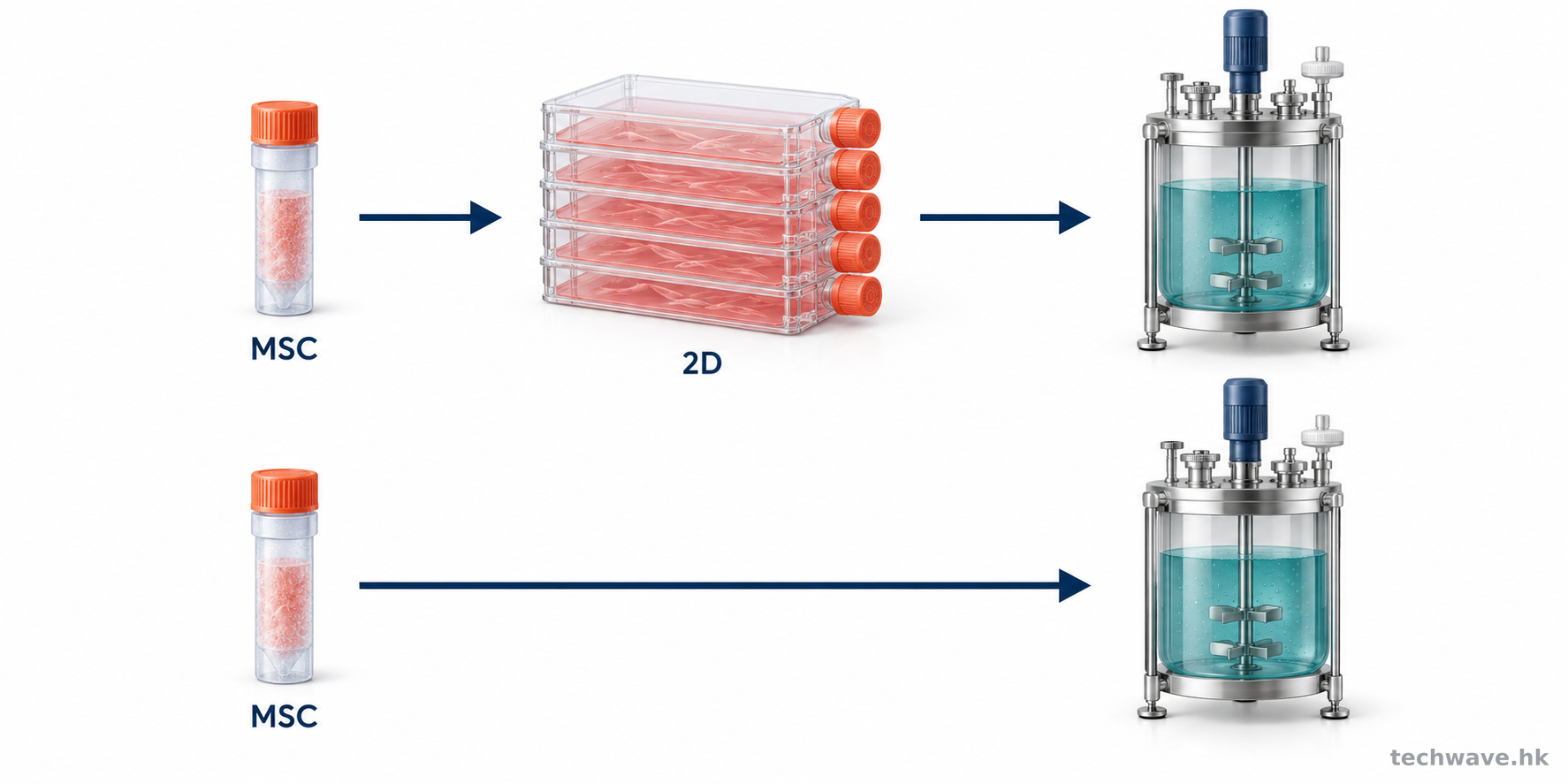
No-seed-train direct inoculation means thawing cryopreserved mesenchymal stromal cells (MSCs) and inoculating them directly into a bioreactor for expansion, without prior 2D expansion in flasks or cell factories, to reduce open handling and shorten manufacturing time.
Off-the-shelf allogeneic MSC therapies must supply hundreds or thousands of patients each year. Two-dimensional flasks soon reach their limit: extensive manual handling, open steps, large footprints and difficult batch control. Stirred-tank bioreactors are the recognized scale-up direction, yet most MSC reactor workflows retain a tail—an initial round of 2D seed expansion in flasks.
A study published in BMC Biotechnology in 2026 cut off that tail [1]. Adipose-derived MSCs (ASCs) were thawed from liquid nitrogen and inoculated into stirred tanks without any 2D pre-expansion or medium adaptation. RoosterBio RoosterNourish xeno-free medium and synthetic peptide-coated microcarriers supported 4E5–5E5 cells/mL within 5–8 days, without a single medium exchange. Downstream microcarrier separation and cell concentration were then integrated into a closed workflow.
Here are the key data, organized around inoculation, scale-up, harvest and quality.
Study at a glance
| Item | Details |
|---|---|
| Cells | Human adipose-derived MSCs (ASCs); three healthy adult female donors aged 33–44; passage-2 bank |
| Medium | 0.2 L: RoosterNourish xeno-free medium; 2 L: GMP pathogen-reduced prcRoosterNourish |
| Microcarriers | Uncoated polystyrene versus Corning Synthemax II synthetic vitronectin peptide-coated microcarriers, low-concentration type (SL), 16 g/L, 5760 cm²/L |
| Reactors | 0.2 L single-use stirred tank (Eppendorf BioBLU 0.3c); 2 L single-use stirred tank (Sartorius Univessel SU) |
| Culture conditions | 37 °C, pH 7.2, dissolved oxygen at 40% air saturation (approximately 8.4% O₂, mild hypoxia), no antibiotics throughout |
| Downstream | TrypLE Select detachment, Harvestainer bag microcarrier separation, CTS Rotea counterflow concentration |
Step 1: direct thaw inoculation—what makes attachment work?
Without a seed train, freshly thawed cells must attach to microcarriers under stirring before they have recovered. The study separated this challenge into two variables: microcarrier surface and agitation during attachment.
Microcarrier surface: synthetic peptide coating wins clearly
Immediately after thawing, cells were inoculated into the 0.2 L reactor at 4E3 cells/cm² (approximately 2.3E4 cells/mL at the final 200 mL working volume), without adaptation from the banking medium containing 10% fetal bovine serum [1].
| Metric (time points specified by row) | Synthemax II-coated microcarriers (SL) | Uncoated plastic microcarriers |
|---|---|---|
| Cell attachment (24 hours after inoculation) | 90±17% | 24±13% |
| Microcarrier occupancy (24 hours after inoculation) | 70±4% | 30±2% |
| Cell density at harvest | 4.1E5±1.1E5 cells/mL, day 5 | 2.3E5±0.4E5 cells/mL, extended to day 6 |
SL microcarriers carry synthetic vitronectin peptides without animal-derived components. Attachment of thawed cells was nearly four times that on uncoated carriers, with approximately 80% higher harvest density and harvest one day earlier [1]. All subsequent experiments used SL microcarriers.
Attachment-phase agitation: continuous stirring is enough
Many MSC microcarrier processes use intermittent agitation during attachment—for example, two minutes each hour—to encourage attachment. Here, intermittent agitation was compared with continuous stirring at 60 rpm. At six hours, attachment was slightly higher with intermittent agitation; by 24 hours there was no statistically significant difference, and occupancy and subsequent expansion profiles were similar [1].
That matters for scale-up. Larger reactors need continuous stirring for mass and heat transfer and accurate temperature, pH and dissolved-oxygen monitoring. Approximately 80% attachment and microcarrier occupancy were obtained without relying on intermittent stirring [1].
Stirring speed: setting the limit by eddy scale
To limit microcarrier aggregation, agitation in the 0.2 L reactor was gradually increased from 60 rpm to a maximum of 130 rpm. At that speed, the mean Kolmogorov eddy length remained above 87 µm, approximately 52% of the SL microcarrier diameter (about 169 µm), avoiding excessive cell–carrier interfacial shear from smaller eddies [1].
Step 2: from 0.2 L to 2 L—can donor variability be controlled?
Scaling by power per unit volume
At 2 L, stirring speeds were calculated using constant volumetric power input (P/V) as the scale-up criterion [1]:
- Thawed cells were directly inoculated at 3.5E3 cells/cm² (approximately 2.0E4 cells/mL), again without adaptation;
- Continuous 90 rpm agitation was used for the first 24 hours of attachment, followed by addition of 1 L prcRoosterNourish to reach 2 L working volume;
- Agitation was progressively increased to a maximum of 165 rpm to limit aggregation;
- No medium exchange was performed; harvest took place on days 5–8 depending on donor growth.
Viable-cell-density profiles at 0.2 L and 2 L closely agreed, and cell concentrations at the two scales were highly correlated [1].
Three donors, eight runs: different harvest days, consistent endpoint density
| Donor | Harvest day | Density at harvest |
|---|---|---|
| A | Day 6 | 4E5–5E5 cells/mL |
| B | Day 8, two extra days for slower growth | 4E5–5E5 cells/mL |
| C | Day 6 | 4E5–5E5 cells/mL |
Donor variability affected when to harvest, not how much: all eight independent runs reached 4E5–5E5 cells/mL [1]. Average expansion over 5–8 days was 20–25-fold [1].
Enough nutrients without medium exchange
Glucose was not exhausted, and lactate did not accumulate to the inhibitory concentration reported in the literature, approximately 35.4 mM [1]. Metabolite concentrations also predicted cell density:
| Metabolite | Correlation with density, R² across three donors |
|---|---|
| Lactate | 0.98–0.99 |
| Glucose | 0.96–0.98 |
Lactate could therefore serve as a process-control parameter for harvest timing and yield estimates, reducing daily sampling and counting [1]. The authors also noted potential use in digital twins and predictive models.
For comparison, previous studies reached about 4E5 MSCs/mL within five days in other reactors but required feeding on day 3; the present workflow dispensed even with that feed [1].
Step 3: beyond 2 L—comparing two expansion routes
Direct inoculation requires sufficient thawed cells: at 16 g/L microcarriers and 3500 cells/cm², inoculating a 2 L reactor takes 40.3 million cells [1]. Larger scales would multiply the number of cryovials. The study therefore compared two routes from a 2 L mother reactor to a production reactor.
Route 1: single-cell reseeding
At peak density, about 4E5 cells/mL on day 6, TrypLE Select detached cells from microcarriers. Cells were separated, concentrated and reseeded as single cells into a new production reactor [1].
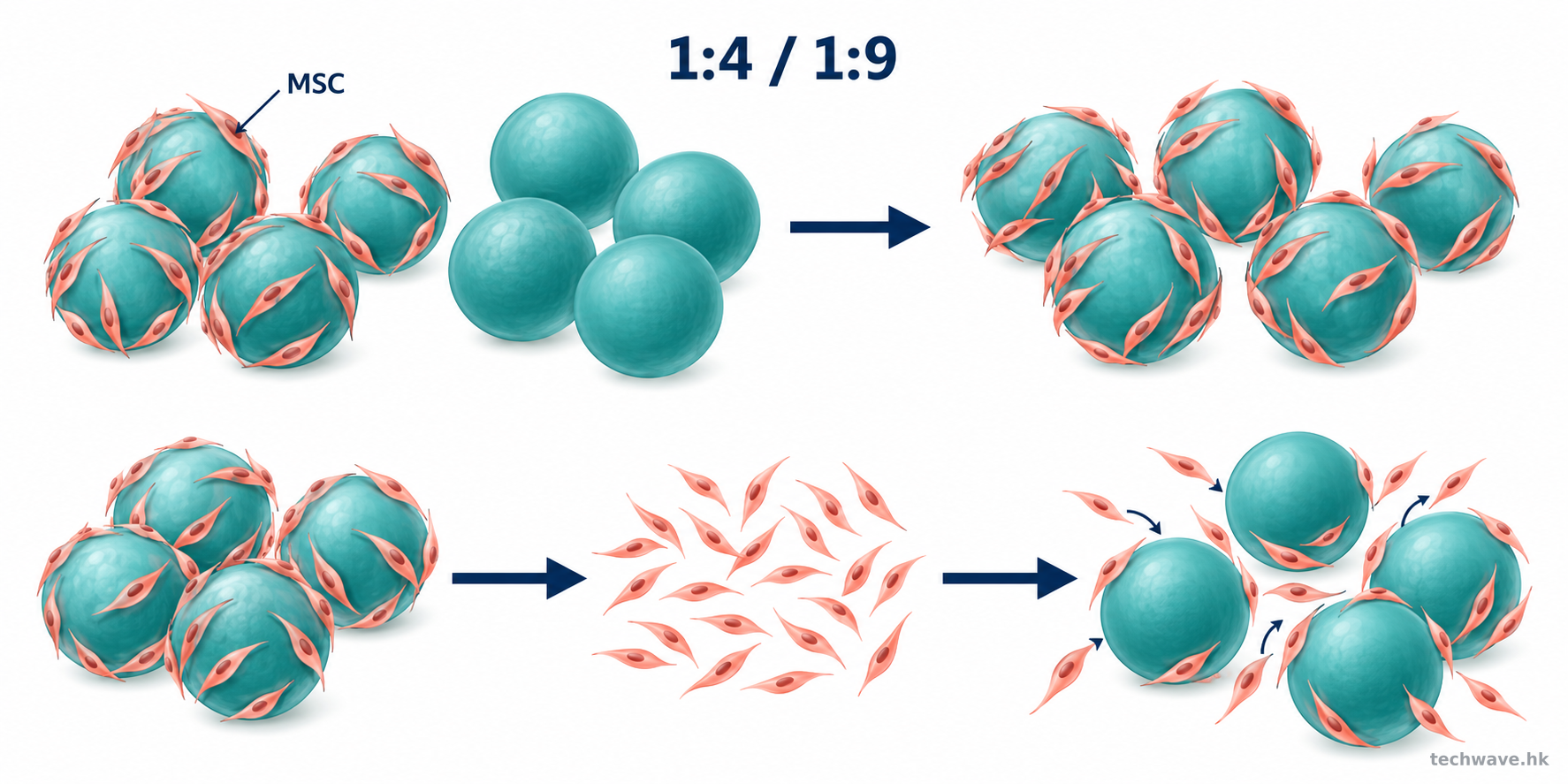
Route 2: bead-to-bead transfer
At approximately 1E5 cells/mL, usually day 4 while cells were proliferating and carrier aggregation remained limited, part of the occupied microcarriers was transferred to a new reactor. Fresh microcarriers were added at occupied:fresh ratios of 1:4 or 1:9, keeping total carrier concentration at 16 g/L. Intermittent stirring during the first 24 hours—two minutes at 100 rpm every 30 minutes—allowed cells to migrate from old to new carriers, followed by continuous agitation [1]. No enzymatic detachment or separation was needed.
The paper also specifies a complete medium replacement when cells harvested from the mother reactor were inoculated in the extended mother-plus-production cultures lasting up to 12 days. The initial 5–8-day no-exchange result must not be generalized to the entire secondary expansion workflow [1].
Data for the two routes
| Metric | Bead transfer 1:4 | Bead transfer 1:9 | Single-cell reseeding |
|---|---|---|---|
| Carrier occupancy at 24 hours after transfer | 74±6% | 34±11% | — |
| Occupancy at harvest | 87±4%, day 8 | 68±5%, day 9 | 92%, day 12 |
| Harvest density | 3.9E5 cells/mL | 3.2E5 cells/mL | 3.8E5 cells/mL |
| Cumulative population doublings, mother plus production reactor | 6.6 | 7.4 | 8.1 |
| Production volume seedable from a 2 L mother reactor | 10 L | 20 L | 26.5 L, assuming 74% harvest efficiency |
| Total culture duration | 8–9 days | 8–9 days | 12 days |
| Total microcarrier use per medium volume | 13.3 g/L | 14.5 g/L | 16 g/L |
| Counterflow concentration recovery | 61% | 80% | 78% |
Viability after either route exceeded 95%, and CD29, CD90, CD73 and CD105 expression exceeded 99%, without statistically significant differences from static controls [1].
Which route fits? Single-cell reseeding adds a population doubling and seeds the largest production reactor, but takes 3–4 extra days and the most handling. Bead transfer removes the intermediate digestion, filtration and centrifugation steps, shortening the process and reducing carrier consumption. At 1:4, comparable final yield came with lower microcarrier use and a shorter cycle [1]. The authors concluded that route selection must consider process efficiency, materials and time alongside yield.
Step 4: closed harvest—recovery and quality
Harvest workflow at 2 L
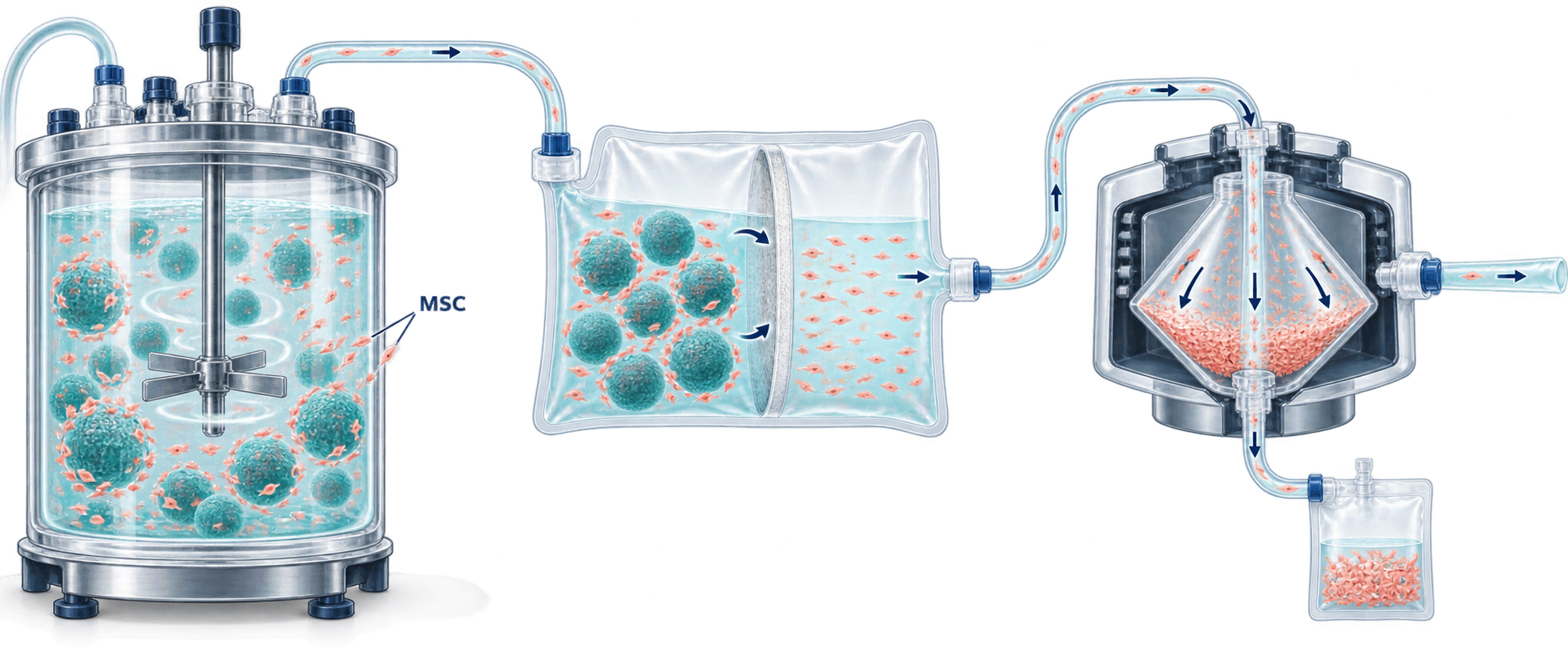
TrypLE Select and high-speed pulses detached cells inside the reactor: five minutes at 185 rpm, then a 15-second pulse at 320 rpm, for 60 minutes in total. Medium containing fetal bovine serum stopped digestion. Material was pumped through a Harvestainer bag to separate carriers, then washed and concentrated with the CTS Rotea counterflow system; conventional centrifugation at 300 g for ten minutes was the comparator [1].
At 0.2 L, a different detachment and separation scheme was used: five minutes at 150 rpm followed by a 15-second pulse at 260 rpm, for 30 minutes in total; a 70 µm strainer then separated microcarriers [1].
Recovery at each step
| Step | Recovery |
|---|---|
| Filtration-bag microcarrier separation | 75±2% |
| Counterflow concentration | 89±6% |
| Conventional centrifugation, comparator | 94±5% |
| Overall: filtration plus counterflow | 67±4% |
| Overall: filtration plus conventional centrifugation | 75±4% |
The largest loss occurred during microcarrier separation, not concentration [1]. Overall counterflow recovery was slightly below conventional centrifugation, but the method was closed and scalable: 1.5 L of suspension became 12 mL, a 125-fold concentration, versus 50-fold in the authors’ previous tangential-flow-filtration (TFF) work [1]. Across the workflow, final recovery was 60–80%, with approximately 10–30% of cells lost during enzymatic detachment and filtration [1].
Quality after harvest
| Quality attribute | Result |
|---|---|
| Viability before cryopreservation | Above 96% in every condition |
| Surface markers | CD29/CD90 and CD73/CD105 above 95% |
| Cell diameter | 16–19 µm |
| IDO activity, kynurenine after 24-hour IFN-γ induction | Above 9 µM in all conditions; stirred-tank cells higher than static culture |
| Suppression of T-cell proliferation | Comparable after counterflow and conventional centrifugation; stirred-tank cells higher than static culture |
Within this study, closed harvest retained the key quality attributes, and some immunomodulation-related measurements were higher than with static culture. For the immunosuppression assay, stirred-tank expansion plus counterflow centrifugation had n=3 and static culture plus conventional centrifugation had n=1; most other Figure 8 panels had n=5. This small-sample comparison does not establish general superiority across other processes [1].
What production scale can the yield support?
After microcarrier filtration and counterflow centrifugation, volumetric yield was approximately 3E8–4E8 cells per reactor litre, or 3.8E7±0.5E7 cells/(day·L) [1]. The literature reports minimum effective MSC doses of 7E7–19E7 cells per patient per dose, so one 2 L batch could already support early clinical trials [1].
What has this study not answered?
- No direct comparator: a conventional 2D seed-train process was not run alongside it; time savings and fewer open operations remain workflow-based inferences, not measured comparisons [1].
- Scale stopped at 2 L: performance in 10–50 L single-use reactors needs further study [1].
- Small route-comparison sample: bead transfer and single-cell reseeding each had only one donor [1].
- Not animal-component-free throughout: banking, cryopreservation and enzyme quenching at harvest used fetal bovine serum; the expansion phase used xeno-free medium [1].
- A combined system: results came from specific medium, peptide-coated carriers and stirred tanks. Changing carriers or reactors requires fresh attachment and expansion validation.
Frequently asked questions
Must thawed cells first adapt to the new medium?
Not in this study. The bank was established in medium with 10% fetal bovine serum, and thawed cells went directly into RoosterNourish xeno-free medium without adaptation, retaining high attachment and consistent expansion [1].
Will 5–8 days without exchange exhaust nutrients or accumulate lactate?
Glucose was not exhausted, and lactate did not reach the approximately 35.4 mM inhibitory level [1]. No antifoam or shear protectant such as Pluronic was needed during culture.
How is harvest day selected?
Donors differed in growth speed: some were harvested on day 6, others on day 8. Because lactate closely correlated with density, R² 0.98–0.99, it could indicate whether peak density had been reached [1].
Choose bead transfer at 1:4 or 1:9?
At 1:4, occupancy developed faster and harvest density was about 20% higher; 1:9 could seed a larger production reactor, 20 L versus 10 L. Choose 1:4 when yield is the priority, or 1:9 when expansion scale is the priority [1].
Summary
This study provides a parameter combination for MSC stirred-tank process development:
- Inoculation: direct from thaw, without 2D seed expansion or adaptation; peptide-coated carriers achieved 90% attachment at 24 hours;
- Expansion: continuous stirring was sufficient; 5–8 days without exchange; all eight runs from three donors reached 4E5–5E5 cells/mL, with lactate predicting yield;
- Scale-up: bead transfer removed three intermediate steps, and a 2 L mother reactor could seed 10–20 L production reactors;
- Harvest: closed filtration-bag plus counterflow processing gave 125-fold concentration without impairing viability, markers or immunosuppressive function.
Within this combination, medium determines whether thawed cells can complete 5–8 days under xeno-free, no-exchange conditions. That is the role the RoosterNourish series played in this study.
Let TechWave help plan your MSC reactor process
Moving MSCs from flasks into bioreactors, or assessing direct thaw inoculation? TechWave can provide information on RoosterBio MSC expansion media, including cGMP-grade prcRoosterNourish-MSC-CC, and help plan medium selection, inoculation density and small-scale validation around your cell source, banking conditions and target scale. Bring your current process and discuss the next step.
References
- Costa MHG, Terrasso AP, Crespo IE, Valero R, Menéndez B, Painho B, Sousa CD, Gamelas B, Tomás H, Mancheno-Corvo P, et al. Scaling the manufacture of adipose tissue-derived mesenchymal stromal cells: integrated bioreactor workflows from inoculation to harvest without the need of seed train. BMC Biotechnology. 2026;26:22. doi:10.1186/s12896-026-01101-9.
Uses and applicable scenarios
- Process development for moving allogeneic MSC cell therapies from 2D flasks to stirred-tank bioreactors
- Designing MSC manufacturing workflows with fewer open manual operations and shorter production cycles
- Evaluating xeno-free medium and microcarrier combinations for attachment and expansion after direct thaw inoculation
- Planning inoculation routes and closed harvest for MSC scale-up from 2 L toward 10–25 L reactors
Limitations
- There was no direct conventional 2D seed-train comparator; time savings and reduced handling were inferred from workflow design
- Experimental validation covered 0.2 L and 2 L; performance at 10–50 L remains to be studied
- Bead-to-bead transfer and single-cell reseeding each had data from only one donor
- Fetal bovine serum was used during banking, cryopreservation and enzyme quenching at harvest, so the entire process cannot be described as animal-component-free
- Results apply to a specific combination of medium, synthetic peptide-coated microcarriers and stirred tanks; replacing any component requires renewed validation