
Technical column
Making iPSC platelets faster and cheaper: 1% hPL instead of HSA raises megakaryocyte output, and the optimized protocol yields 14.9 functional platelets per iPSC
iPSC-derived platelets are held back by heterogeneous differentiation, low yields of mature megakaryocytes and costly cytokines. A study in Stem Cell Reviews and Reports replaced human serum albumin (HSA) with Sexton human platelet lysate (hPL, PL-NH-100): the 1% hPL group outperformed the HSA control in total cells and mature megakaryocytes, with the advantage holding to day 19; combined with seeding-density, small-molecule and polyploidization strategies, each iPSC yielded 14.9 functional platelets and differentiation was shortened to 19 days.
Definition
Human platelet lysate (hPL) is a human-derived, animal-origin-free culture supplement prepared by lysing human platelets and rich in platelet α-granule growth factors such as PDGF, IGF, VEGF, FGF and TGF-β.
Clinical transfusion has long faced platelet shortages: platelets have a short shelf life, depend on donors and fluctuate between supply and demand. Induced pluripotent stem cells (iPSCs) expand indefinitely and are a renewable source for making platelets in vitro, but heterogeneous differentiation, low yields of mature megakaryocytes, high cytokine and medium costs and limited process stability have kept large-scale production out of reach.
A recent study in Stem Cell Reviews and Reports systematically optimized the full iPSC-to-platelet protocol, and one key step was replacing human serum albumin (HSA) with Sexton Biotechnology's human platelet lysate (hPL). The result: the 1% hPL group outperformed the HSA control in total cells and mature megakaryocytes; combined with three other process changes, each iPSC yielded 14.9 functional platelets and differentiation was shortened to 19 days.
Figure 1. The iPSC platelet-differentiation optimization study published in Stem Cell Reviews and Reports
Video explainer
Making Platelets from iPS Cells: What Happens When 1% Platelet Lysate Replaces Albumin?
Watch on YouTube ↗Video transcript
Platelets have a short shelf life and depend on donors, so supply keeps rising and falling. Could iPS cells be used to make platelets in the lab instead? iPS cells can expand indefinitely, which makes them a renewable source for making platelets in vitro.
The hurdles are real: differentiation is uneven, mature megakaryocytes, the large cells that release platelets, come out in low numbers, cytokines and media are costly, and the process is not stable enough. A study by Yue and colleagues in Stem Cell Reviews and Reports systematically optimised the whole differentiation protocol.
One step was simple: replace the human serum albumin in the medium with human platelet lysate from Sexton Biotechnology. What happens when a material made from platelets helps to make platelets? First, meet the two main ingredients.
Human serum albumin, or HSA, is the usual core supplement in traditional serum-free differentiation media. It allows xeno-free culture, free of non-human animal components, but differentiation efficiency and cost control still leave room for improvement.
Human platelet lysate, or hPL, is made by lysing human platelets. It is naturally rich in growth factors from platelet alpha granules, such as PDGF, IGF, VEGF, FGF and TGF-beta, and it has already been validated in the culture of mesenchymal stem cells, endothelial cells and many other cell types.
The study used the embryoid-body route. An embryoid body is a small ball of iPS cells, and differentiation towards blood starts from these balls. The team first optimised the starting density to 8,000 cells per well to raise haematopoietic progenitor output, and only then replaced the albumin.
The control was a traditional serum-free medium with HSA. hPL was first screened broadly at 1%, 3%, 5% and 10%, then narrowly between 0.5% and 1.25%. Every group changed only the albumin component; all other medium components were identical.
The results showed a clear concentration effect. In the low range of 0.5% to 1.25%, hPL effectively supported progenitor expansion and megakaryocyte maturation, and the 1% group outperformed the HSA control under the same conditions in both total cell yield and mature megakaryocyte yield.
More is not better. At 2% to 3%, differentiation efficiency declined step by step; at 5% and 10%, excess growth factors upset the nutrient balance, kept overstimulating the cells and actually inhibited processes related to megakaryocyte differentiation.
So in this iPS cell embryoid-body system, 1% hPL is the appropriate working concentration. Comparing days 14 and 19, the output advantage of 1% hPL held into late differentiation without a marked decline over time. A different differentiation system needs its own concentration series.
Swapping in hPL alone raises baseline megakaryocyte output. To push the final platelet yield much higher, the study combined four independent changes into one optimised scheme. One: raise the starting density of embryoid bodies, which shortens differentiation and enlarges the pool of blood-forming cells from the start.
Two: replace the recombinant cytokines SCF and TPO with the small molecules 740Y-P and butyzamide, cutting the cost of expensive cytokines and improving lot-to-lot consistency. Three: combine blebbistatin with 616452 to promote megakaryocyte polyploidisation, meaning the DNA in the nucleus is copied several times over, which raises how many platelets each megakaryocyte can release.
Four: replace the original HSA with 1% hPL. The study compared the optimised scheme with the basic one. Under the optimised scheme, each iPS cell gave 1.42 CD41-positive megakaryocytes, and each megakaryocyte produced 10.5 platelets on average, for 14.9 platelets per iPS cell, with differentiation completed within 19 days.
Keep one point in mind: 14.9 is the result of all four changes together. hPL is the core base component that replaces HSA; on its own, hPL brings the gain in megakaryocyte yield described earlier. Do the lab-made platelets look like the real thing?
Under transmission electron microscopy, these iPS cell-derived platelets showed typical platelet structures, with an open canalicular system, granules and mitochondria, similar to the PBMC-derived platelets the study used for comparison.
Function was checked too: these platelets had normal clotting function and supported the formation and retraction of fibrin clots. A fibrin clot is the mesh that forms when blood coagulates. Can this protocol be used clinically?
The study used research-grade hPL to validate in-vitro differentiation of iPS cells into megakaryocytes. Only with matching GMP-grade hPL and full clinical-grade safety validation would the approach have potential for developing clinical platelet manufacturing processes.
Three things to remember. In this system, 1% hPL gave more mature megakaryocytes than the HSA control; more hPL is not better; and 14.9 platelets per iPS cell came from all four changes together. The full data and the original figures are in the article of the same name on our website.
Making Platelets from iPS Cells: Is More Platelet Lysate Better? 1% hPL vs Albumin
Watch on YouTube ↗Video transcript
To make platelets from iPS cells, one study replaced the human serum albumin in the medium with human platelet lysate, or hPL, from Sexton Biotechnology. hPL is rich in growth factors, so is more always better? No. In this iPS cell embryoid-body system, the 1% group beat the albumin control under the same conditions in both total cell yield and mature megakaryocyte yield.
Megakaryocytes are the large cells that release platelets. At 2% to 3%, differentiation efficiency declined step by step; at 5% and 10%, excess growth factors upset the nutrient balance and actually inhibited processes related to megakaryocyte differentiation.
Combining 1% hPL with three other changes, a higher seeding density, small molecules in place of cytokines and boosted megakaryocyte polyploidisation, gave 14.9 platelets per iPS cell, with differentiation done in 19 days.
Two caveats: 1% is the working concentration for this system only, and other systems need a new concentration series; the study was an in-vitro validation with research-grade hPL; only with matching GMP-grade hPL and full clinical-grade safety validation would the approach have potential for clinical platelet manufacturing process development.
More hPL is not better; in this system, 1% was the right amount. The full article is on our website.
Produced by TechWave. For research reference only; not medical advice.
Why replace HSA
Medium formulation directly determines differentiation efficiency and production cost and is a key lever in process optimization. Traditional serum-free differentiation systems often rely on human serum albumin (HSA) as the core supplement; it allows xeno-free culture but leaves room to improve efficiency and cost.
Human platelet lysate (hPL) is rich in natural growth factors, has been validated in the culture of mesenchymal stem cells, endothelial cells and many other cell types, and its value in haematopoietic differentiation and platelet production is increasingly being demonstrated.
Experimental design: change only the albumin
The study used Sexton Biotechnology's research-grade hPL (PL-NH-100) and tested medium-component replacement on an optimized embryoid-body (EB) seeding and differentiation protocol:
- Differentiation route: EB-mediated haematopoietic differentiation, first optimizing initial seeding density (8,000 cells per well, the P8000 protocol) to raise progenitor output, then replacing the albumin component to test the effect of hPL on megakaryocyte (MK) differentiation (see the original paper for the seeding-density work);
- Concentration series: against an HSA-supplemented serum-free control, a broad screen at 1%, 3%, 5% and 10% was followed by a narrow 0.5%–1.25% range to find the right concentration for megakaryocyte differentiation;
- Variable control: only the albumin component was replaced in every group; all other medium components were identical.
Result: 1% hPL is the appropriate working concentration
The study compared morphology, total output, marker proportions and long-term stability, and hPL showed a clear concentration-dependent effect:
- Low range, 0.5%–1.25%: effectively supported progenitor expansion and megakaryocyte maturation, with the 1% group outperforming the HSA control under the same conditions in total cell yield and mature CD41+CD42b+ megakaryocyte yield;
- 2%–3%: differentiation efficiency declined progressively;
- 5% and 10%: excess growth factors upset the nutrient balance and overstimulated the cells, inhibiting processes related to megakaryocyte differentiation.
The conclusion is clear: in this iPSC embryoid-body differentiation system, 1% hPL is the appropriate working concentration.
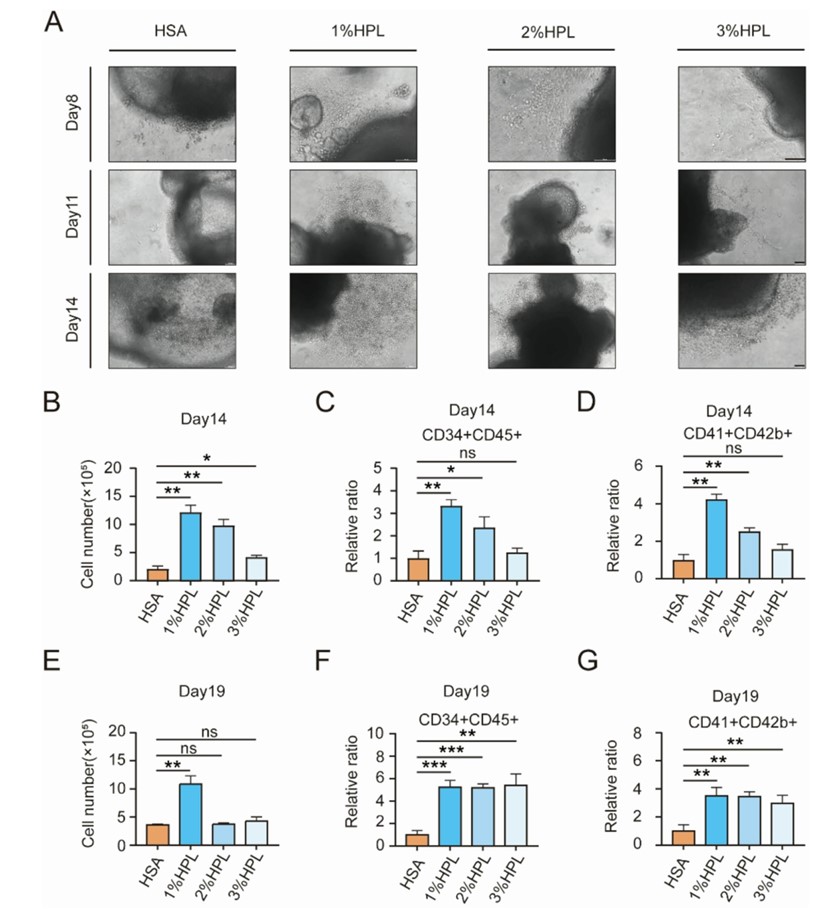
Figure 2. Human platelet lysate (hPL) can largely replace human serum albumin (HSA) and supports stable megakaryocyte generation; (A) bright-field images on days 8, 11 and 14 of EBs and differentiating cells cultured with HSA or a concentration series of hPL; (B) total cell output; (C) haematopoietic progenitor (CD34+CD45+) yield; (D) mature megakaryocyte (CD41+CD42b+) yield; (E–G) comparative analysis on day 19
Just as important is stability: comparing days 14 and 19, the output advantage of the 1% hPL system held into late differentiation without a marked decline over time, showing that the replacement meets the needs of long megakaryocyte maturation cultures.
Four changes together: 14.9 functional platelets per iPSC
Replacing HSA with hPL alone raises baseline megakaryocyte output; to push final platelet yield much higher, the study combined four independent changes into an optimized differentiation scheme (ODS):
- Higher initial EB seeding density: shortens differentiation and raises the haematopoietic cell base from the start;
- Small molecules 740Y-P and butyzamide replacing recombinant SCF and TPO: cut the cost of expensive cytokines and improve lot consistency;
- Blebbistatin combined with 616452: promotes megakaryocyte polyploidization and raises the platelet-release capacity of each megakaryocyte;
- 1% hPL replacing the original HSA component: consistently raises progenitor and mature megakaryocyte yields.
Used together, the four changes shorten differentiation, raise total platelet yield and lower overall production cost, with hPL as the core base component replacing HSA.
Compared with the basic differentiation scheme (BDS), under the optimized scheme each iPSC gave 1.42 CD41⁺ megakaryocytes and each megakaryocyte produced 10.5 platelets on average, for 14.9 platelets per iPSC (Figure 3J–K). Transmission electron microscopy showed that these iPSC-derived platelets (iPSC-PLTs) have typical platelet structures — an open canalicular system, granules and mitochondria — similar to PBMC-derived platelets (Figure 3L). The final protocol completes differentiation in 19 days, and the platelets have normal ultrastructure and clotting function, supporting fibrin clot formation and retraction.
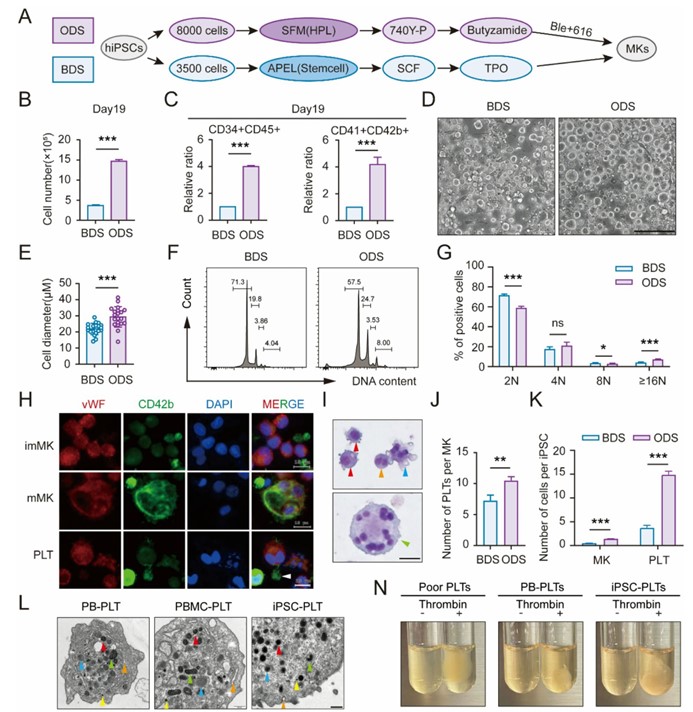
Figure 3. The optimized differentiation scheme (ODS) improved the efficiency of megakaryocyte and platelet production from human induced pluripotent stem cells (hiPSCs) compared with the basic differentiation scheme (BDS). (A) BDS and ODS workflows; (B) total cell yield on day 19; (C) relative yields of CD34⁺CD45⁺ progenitors and CD41⁺CD42b⁺ megakaryocytes; (D) megakaryocyte morphology under BDS and ODS, scale bar 100 μm; (E) MK diameter; (F, G) representative plots and statistics of DNA ploidy in CD41-positive cells; (H) VWF, CD42b and DAPI immunofluorescence of MKs; (I) Wright-Giemsa staining of MKs of different ploidy; (J) platelet generation per megakaryocyte in BDS and ODS; (K) MK and platelet generation per iPSC in BDS and ODS; (L) transmission electron micrographs of platelets from PB, PBMCs and iPSCs; (N) clot retraction by platelets of different origins in platelet-poor plasma after thrombin activation.
Why hPL works
- Composition: hPL is prepared from lysed human platelets and is naturally rich in platelet α-granule growth factors, including PDGF (platelet derived growth factor), IGF (insulin-like growth factor), VEGF (vascular endothelial growth factor), FGF (fibroblast growth factor) and TGF-β (transforming growth factor-β), which regulate proliferation and differentiation on several levels;
- Translational value: hPL contains no animal-derived components and enables xeno-free culture, fitting the cell-therapy goal of avoiding exogenous risk better than systems with xenogeneic additives; compared with traditional serum-containing systems it carries lower pathogen risk and better lot control, suiting standardized, scaled cell manufacturing.
Frequently asked questions
Q1: Why can platelet lysate replace albumin in stem-cell differentiation? hPL provides the basic nutrition and protein protection of albumin while being naturally rich in growth factors and bioactive components that support both proliferation and differentiation signals, so it can replace albumin in serum-free systems and improve differentiation efficiency to some extent.
Q2: What is the right concentration — is more better? In this iPSC platelet-differentiation system, 1% is the validated working concentration. More hPL is not better: above a certain level (2% and above in this system), excess growth factors upset the nutrient balance and cell homeostasis and actually inhibit differentiation.
Q3: Can this protocol be used for clinical translation? This study used research-grade hPL to validate in-vitro differentiation of iPSCs into megakaryocytes. hPL is fully human-derived with no xenogeneic components and provides the basis for a xeno-free system; with matching GMP-grade hPL and a full clinical-grade safety validation, the approach has potential for clinical platelet manufacturing process development.
Q4: Can hPL only replace albumin? No. Its endogenous growth factors can reduce the amount of exogenous recombinant cytokines needed, and together with the small molecules 740Y-P and butyzamide it allows expensive SCF and TPO to be replaced completely, building a more economical differentiation medium.
Let TechWave help you evaluate an hPL approach
If you work on iPSC haematopoietic differentiation or in-vitro megakaryocyte or platelet production, or want to replace albumin with hPL in a serum-free system and cut cytokine cost, contact TechWave. We can provide selection advice for Sexton human platelet lysate (research-grade and GMP-grade options), technical information and quotations.
References
- Yue W, Yang Y, Miao Y, et al. Optimizing the Method for Differentiation of Functional Platelets from Human Induced Pluripotent Stem Cells. Stem Cell Reviews and Reports. 2026;22(3):1325–1340. doi:10.1007/s12015-026-11060-5
Uses and applicable scenarios
- Embryoid-body differentiation of iPSCs into haematopoietic progenitors and megakaryocytes
- Replacing human serum albumin with hPL in serum-free differentiation systems
- Process optimization for in-vitro production of iPSC-derived platelets
- Xeno-free cell-culture process development
Limitations
- The 1% working concentration comes from this study's iPSC embryoid-body differentiation system; other systems need their own concentration series
- The study used research-grade hPL; clinical manufacturing requires matching GMP-grade hPL and full safety and process validation