
Technical column
Forward Look: Can iPS Cardiomyocytes Actually Grow Into a Heart? Heartseed's HS-001 and the Race to Japan's Third iPS Product
On 6 March 2026, Japan approved two iPS cell-derived regenerative medicine products on the same day: Amchepry (ragneprocel) for Parkinson's disease and RiHEART, an allogeneic iPS cell-derived cardiomyocyte sheet for severe heart failure due to ischaemic cardiomyopathy. One sentence in the Ministry of Health, Labour and Welfare review material deserves a careful read by anyone working on cardiac differentiation: the RiHEART graft does not contract as myocardium. It acts mainly through secreted factors that promote angiogenesis and allow 'hibernating' myocardium to recover, and in animal studies the sheet disappeared in about three months. Cuorips's own product page says the same thing. In other words, the first approved iPS cardiac product does not work by growing new muscle. The route that does treat remuscularization as its goal is a different one: Heartseed's HS-001, which assembles iPS-derived cardiomyocytes into spheroids and injects them directly into the myocardium with the SEEDPLANTER needle during coronary artery bypass grafting. On 31 August 2026 the company reported 52-week results from 10 patients (open-label, uncontrolled, all patients also had bypass grafting in the same operation, measures assessed by each site); on 9 November 2026 the Ministry designated it a SAKIGAKE (pioneering) regenerative medical product, under the proposed name remumiocel. This article sets out the mechanistic design of each route, the trade-offs each accepts, how the 10-patient dataset should be read, and what the designation does and does not mean, together with our conditional reading of the timeline. As of 17 November 2026, HS-001 has not been filed for marketing approval anywhere.
Definition
A cardiomyocyte spheroid is a three-dimensional aggregate of iPS cell-derived cardiomyocytes, delivered into the myocardium with a dedicated needle. Compared with forming cardiomyocytes into a sheet and placing it on the heart surface, injection into the muscle is designed so that grafted cells sit in contact with host myocardium and survive, adding tissue that contracts (remuscularization). The trade-off is the injury and arrhythmia risk that come with needle delivery, a risk repeatedly observed in non-human primate studies. Remuscularization has no published histological evidence in humans.
On 6 March 2026, Japan approved two iPS cell-derived regenerative medicine products in a single day. One was Amchepry (general name ragneprocel) for Parkinson's disease, from Sumitomo Pharma — the world's first iPS cell-derived regenerative and cellular medicine [11]. The other was RiHEART, Cuorips' human (allogeneic) iPS cell-derived cardiomyocyte sheet, indicated for severe heart failure due to ischaemic cardiomyopathy inadequately controlled by standard therapy including drug therapy and invasive treatment, and approved on the same day under the conditional, time-limited pathway [12][13][14].
Once the cardiac product was on the market, the review material published by the Ministry of Health, Labour and Welfare contained one sentence that anyone working on cardiac differentiation should read:
The transplanted cardiomyocytes are not there to contract as myocardium.
The review material states that the product does not function as contractile myocardium after transplantation; it acts mainly through secreted cytokines and similar factors that promote angiogenesis and allow myocardium in a "hibernating" state to recover. In animal studies the transplanted sheet disappeared in about three months, while improvement in cardiac function was observed from two weeks after transplantation [3]. Cuorips's own product page describes the same thing: the sheet is placed directly on the heart surface, and cytokines and other factors secreted by the product improve the condition of the myocardium [12].
This is not criticism from the outside. It is the official review conclusion and the manufacturer's own description saying the same thing. And it means that the first approved iPS cardiac product does not work by growing new muscle.
So — can iPS cardiomyocytes actually grow into a heart and become tissue that beats along with it?
The route now taking that question head-on is a different one.
Video explainer
Can iPS Heart Cells Grow Into the Heart? Heartseed HS-001 and RiHEART
Watch on YouTube ↗Video transcript
Japan has approved RiHEART, a cardiac cell sheet made from iPS cells by the company Cuorips. But in the published review material there is one sentence that anyone working on cardiac differentiation should read. The sentence is this: the transplanted cardiomyocytes are not there to contract as myocardium.
So can iPS cardiomyocytes actually grow into a heart and become tissue that beats along with it? The route taking that question head-on is a different one. RiHEART forms iPS-derived cardiomyocytes into a sheet placed on the heart surface. Per the review material, it acts mainly through secreted cytokines and similar factors that promote angiogenesis, allowing myocardium in a hibernating state to recover. Cuorips's own product page says the same.
One more thing is in the review material: in animal studies the transplanted sheet disappeared in about three months, while improvement in cardiac function was observed from two weeks after transplantation. Not puncturing is a deliberate choice. Cuorips presents it as a technical advantage: the sheet is only placed on the heart surface, with no puncture that could directly damage the heart, which minimises arrhythmia risk.
Lowering that risk means accepting two limits. The review report notes that the area reachable through left intercostal thoracotomy is limited, and in the study the sheets were essentially placed on the reachable area; helpfully, in ischaemic cardiomyopathy with reduced ejection fraction, the ischaemia is as a rule in that same area. The second limit is time — what it provides is a bounded period of factor secretion, not a new piece of tissue that stays.
So the logic of this route is: do not try to stay, but wake the host's own myocardium before going. It has been approved under the conditional, time-limited approval framework, which by definition means efficacy is still being inferred and must continue to be verified within the term; it is now covered by Japan's public health insurance.
The other route comes from the Japanese company Heartseed, with a product called HS-001. It does not form sheets. It aggregates cardiomyocytes into three-dimensional spheroids. Heartseed's stated reason for spheroids rather than dispersed single cells is that they survive more readily within the myocardium.
Delivery differs too. Instead of being placed on the surface, the spheroids are put directly into the myocardium with a dedicated seeding device, while the patient is undergoing coronary artery bypass grafting. Like dibbling seeds into soil.
The goal changes as well. This route explicitly states remuscularization as its aim — adding myocardium that genuinely contracts, so that grafted cells beat together with the host's. Note that this is a stated goal: there is no published histological evidence that contractile myocardium has formed in a human heart.
On 31 August 2026 Heartseed reported HS-001 52-week results in 10 patients. The numbers look good: ejection fraction rose from 25% to 31% in the low-dose group and from 22.7% to 31.2% in the high-dose group, the volume index shrank, and most patients maintained or improved their functional class.
But reading this table correctly means holding four things in mind. First, 10 patients — an exploratory dose-escalation study, not a dataset sized to demonstrate efficacy. Second, no control group and no blinding; measures that depend on patient effort and perception, such as the quality-of-life score and the six-minute walk, lean naturally in the favourable direction.
The third is decisive: everyone had bypass surgery. Each patient received coronary artery bypass grafting in the same operation in which the spheroids were delivered, and bypass grafting is itself the standard way to improve function in ischaemic myocardium.
How much of the rise in ejection fraction came from new vessels and how much from new cells, this design cannot separate. Fourth, the values were assessed by each site, not by centralised independent review. So the correct reading is this: in the 26-week primary safety assessment, none of the 10 patients had the pre-specified serious ventricular arrhythmias; at 52 weeks, most measures were maintained or improved, and the direction was more consistent in the high-dose group.
That is a signal worth pursuing, not a conclusion about efficacy. On 9 November 2026 HS-001 was designated in Japan as a SAKIGAKE pioneering regenerative medical product. It brings three support measures — priority consultation, pre-application assessment and priority review — all administrative support and acceleration.
It is not an approval, and not an endorsement of efficacy or safety. How much is that pass worth? The best yardstick is Amchepry, Sumitomo Pharma's iPS product for Parkinson's disease. It received the same class of designation back in February 2017, filed for marketing approval in August 2025, and received conditional, time-limited approval in March 2026.
Designation to approval: nine years. Filing to approval: about seven months. In other words, the designation does not run your trials for you. It can smooth development and the path to filing, and speed the review once a filing is made, but it cannot replace the data or guarantee approval.
And HS-001 has not been filed for marketing approval as of 17 November 2026. Arrhythmia has to be discussed here, because it is the hardest obstacle on the route that puts cells inside the muscle — and it is not speculation; animal studies ran into it repeatedly. Three non-human primate studies published in leading journals in 2014, 2016 and 2018 all saw two things: the cells did form new muscle in monkey hearts, and ventricular arrhythmias did occur. Two of them also reported improved function.
Where do the arrhythmias come from? The most direct clue is in the 2018 study: electrical mapping traced them to a point source in the graft acting as an ectopic pacemaker. In other words, new muscle can itself become a site that fires on its own.
That is also why the sheet route presents no puncture as an advantage: Cuorips says it minimises arrhythmia risk. Minimised is not zero, and the reviewers still require close monitoring after surgery. HS-001 is set on clearing that obstacle.
At 26 weeks there was no ventricular arrhythmia lasting 30 seconds or longer or requiring treatment, which is good news — in 10 patients. Not seeing it in 10 patients says little about how rare it is; a rare but serious risk needs more patients and longer follow-up.
So back to the opening question: can iPS cardiomyocytes grow into a heart? Our judgement is that the question cannot yet be answered. RiHEART has explicitly placed its mechanism in secreted factors and does not count on the cells staying.
Heartseed's HS-001 states remuscularization as its goal, but there is no published histological evidence that contractile myocardium has formed in a human heart. Even if clinical measures improve, that cannot be read backwards as engraftment: bypass grafting, secreted factors and new vessels all explain the same numbers.
The thing to watch is the post-marketing survey for RiHEART — compared against an external control, targeting 75 cases, with a primary endpoint of a 10% or greater improvement in exercise capacity at 52 weeks together with improvement or maintenance of the volume index.
It will test the product under real-world use against a single, pre-defined primary endpoint. And one simpler marker: watch for the announcement of when the marketing application is filed. As of 17 November 2026, HS-001 has not been filed. Until that announcement appears, any date is a guess; Amchepry's seven months from filing to approval is a single precedent.
This is our inference: progress depends on data, not on designations.
These Heart Cells Don't Beat. Could Planted Ones? | Heartseed HS-001
Watch on YouTube ↗Video transcript
Grow heart muscle cells in a lab and lay them on a heart. Will they beat along with it? For RiHEART, the one Japan has already approved from the company Cuorips, the answer is no. The official review says it plainly: this cell sheet does not do the contracting. It is more of a helper.
It releases signals that help new small blood vessels grow, so heart muscle that has gone dormant can wake up. In animal studies it was gone in about three months. Its approval is conditional and time-limited, and its benefit is still being checked.
Heartseed, another Japanese company, takes a bolder route with HS-001. Pack the cells into tiny balls and, during heart bypass surgery, plant them right into the muscle, hoping they take root and grow into muscle that really beats.
That is still only the goal. There is no evidence yet that it has happened in people. So far there is one year of data from 10 patients. In one group, the share of blood the heart pumps out with each beat rose from 25% to 31%. Hold on. Just 10 people, no control group, everyone knew they got the cells, and each hospital measured its own results.
All of them also had bypass surgery, which by itself helps the heart. So it is an early hint, not a verdict. There is also a worry. In animal studies, planting cells into the heart muscle repeatedly threw the heartbeat out of rhythm.
These 10 patients had none of the pre-specified serious events over six months, but that is too few people to reveal rare risks. On 9 November 2026, Japan put it on a fast track: priority consultation and review, but not an approval.
As of 17 November it had not filed. Watch for the day it does.
Produced by TechWave. For research reference only; not medical advice.
A sheet, and a needleful of spheres
Put the two routes side by side and they diverge at step one.
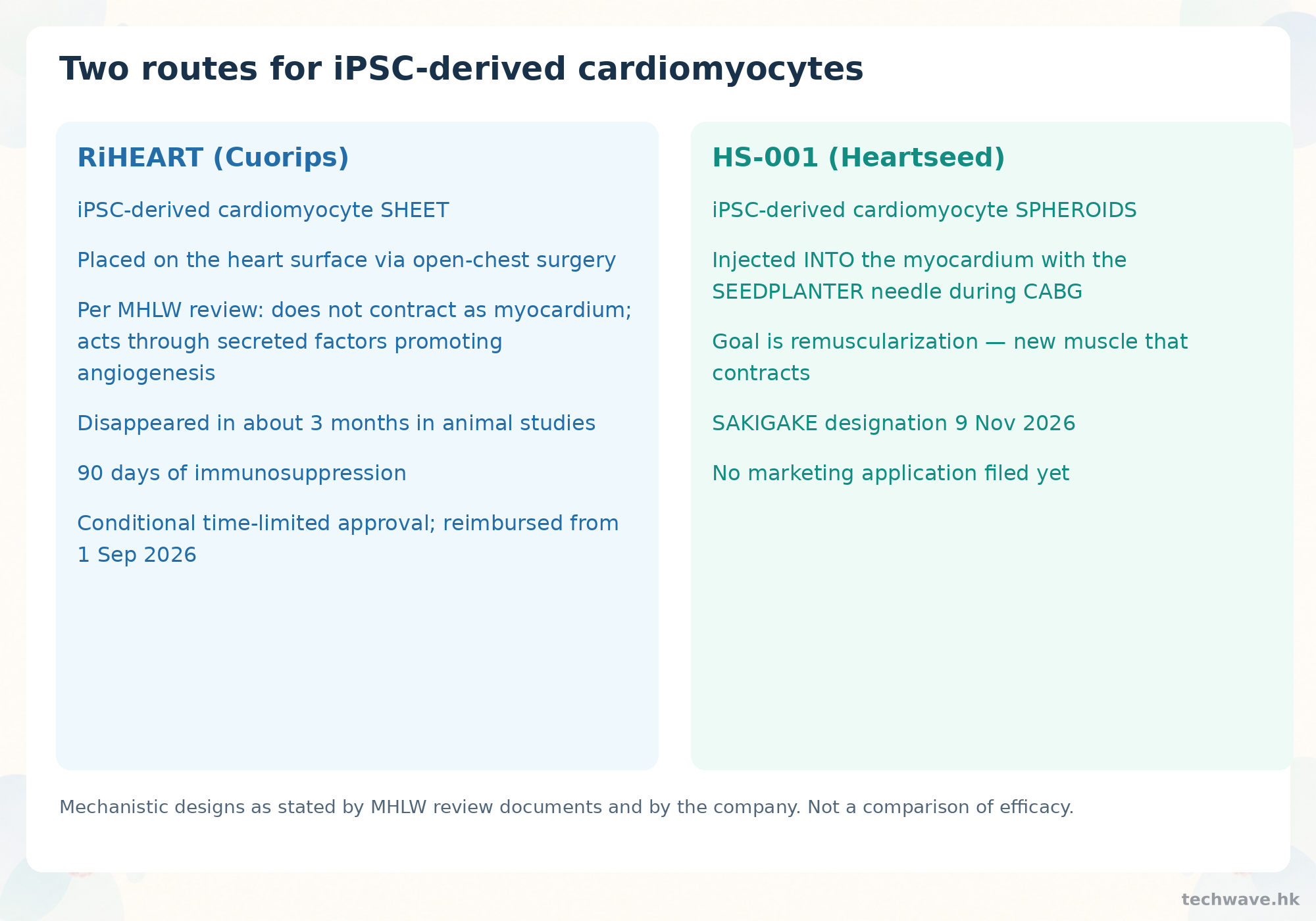
RiHEART is a set of sheets. One product contains four cardiomyocyte sheets, including one spare, with washing solution supplied. Each sheet is formed from roughly 33 million iPS-derived cardiomyocytes; three sheets are transplanted, about 100 million cells in total. Before transplantation the embedding gelatin gel is melted off and the sheet is washed, then the sheets are placed one after another on the heart surface. The approved directions specify left thoracotomy as the standard surgical approach [13]. Patients then take three immunosuppressants — prednisolone, tacrolimus and mycophenolate mofetil — for 90 days, on the same regimen used in heart transplantation [3].
Heartseed's HS-001 is a needleful of spheres. The company assembles iPS-derived cardiomyocytes into three-dimensional spheroids and injects them directly into the myocardium using its own SEEDPLANTER needle, while the patient is undergoing coronary artery bypass grafting [1]. The low-dose group received 50 million cells per patient, the high-dose group 150 million [1]. The company's stated mechanism is remuscularization — adding myocardium that genuinely contracts. The reason for spheroids rather than dispersed single cells is that spheroids survive in the myocardium more readily [1].
One is placed on the surface, the other is injected into the muscle. It sounds like a difference in technique. It is in fact two very different bets.
The sheet route is a deliberate trade-off
Cuorips did not choose sheets because injection was out of reach. It chose sheets in order to avoid injection.
The company presents this as a technical advantage: the sheet is simply placed on the heart surface, with no needle puncture or other invasive step that could directly damage the heart, which minimises the risk of arrhythmia. The sheet is introduced through an incision of about 7 cm between the left ribs, and the procedure can be completed in about 50 minutes, against roughly four hours for a conventional bypass operation [12].
In lowering that risk, the route accepts two limits.
The first is in the PMDA review report: the area reachable through left intercostal thoracotomy — the anterior to lateral wall of the left ventricle — is limited, and in the clinical study the sheets were essentially placed on the reachable area. In ischaemic cardiomyopathy with reduced ejection fraction, ischaemia is also, as a rule, located in the anterior to lateral wall of the left ventricle [13]. The reachable area and the usual site of disease largely coincide — adequate, but not a free choice of location. The review agency also noted that the effect of variation in transplantation technique on efficacy and safety is unknown, and required that the technique used in the study be standardised and disseminated through training materials and courses [13].
The second limit is time. In animal studies the sheet disappeared in about three months [3]. What it provides is a bounded period of factor secretion, not a new piece of tissue that stays on the heart.
So the logic of this route comes down to one sentence: it does not try to stay; it tries to wake the patient's own myocardium before it goes. That is exactly what "recovery of hibernating myocardium" in the review material refers to [3].
Whether it succeeded is the point of the approval pathway itself. RiHEART was approved under the conditional, time-limited approval framework, which by definition means efficacy is at the stage of being inferred and must continue to be verified within the term. The approval term is seven years, and the approval conditions require post-marketing surveillance covering every treated case [13]. The post-marketing use-results survey compares against an external control drawn from a separately conducted prospective clinical study, with a target of 75 cases across 20 institutions; the primary endpoint is the proportion of patients with a 10% or greater improvement in peak VO₂ at 52 weeks together with improvement or maintenance of the left ventricular end-systolic volume index [3]. On 1 September 2026 it entered Japan's public health insurance at a reimbursement price of 53,200,000 yen (the company requested 53,400,000 yen, on a different basis), and a new category, "248 human iPS cell-derived cardiomyocyte sheet", was created [4].
One figure says a great deal about where this field stands. In the eight-patient single-arm study that supported approval, the primary endpoint — improvement in ejection fraction — was met in only 2 of 8 patients. Among secondary measures, exercise capacity (peak VO₂) improved by 10% or more in 4 patients at 52 weeks, and all eight were alive at data cut-off [3]. The review material is candid about this and cites a study published in the New England Journal of Medicine showing that in patients with ischaemic cardiomyopathy, survival after bypass surgery does not correlate with ejection fraction [3]. That is why, for post-marketing verification, the primary endpoint was changed from ejection fraction to peak VO₂ plus the volume index [3].
The fact that the yardstick itself was replaced is the honest state of this field: even "what counts as working" is still being adjusted.
So what about the injected spheres?
Now to the cards HS-001 holds.
On 31 August 2026, Heartseed reported 52-week results from the LAPiS study, presented at the European Society of Cardiology congress (ESC 2026) [1]. It was an open-label, uncontrolled dose-escalation study in 10 patients: five at the low dose and five at the high dose, all of whom underwent coronary artery bypass grafting during the same operation [1].
The primary endpoint was safety at 26 weeks. No ventricular arrhythmia lasting 30 seconds or longer, or requiring treatment, occurred; one case of herpes zoster arose during triple immunosuppression and resolved with treatment [1].
The 52-week measures were as follows [1]:
| Measure | Low dose (n=5, 50 million cells) | High dose (n=5, 150 million cells) |
|---|---|---|
| LV end-diastolic volume index | 141.1→122.2 mL/m²; maintained or reduced in 4 of 5 | 134.5→119.2 mL/m²; maintained or reduced in 4 of 5 |
| LV ejection fraction | 25.0→31.0%; maintained or increased in 4 of 5 | 22.7→31.2%; maintained or increased in 5 of 5 |
| Quality of life (KCCQ-OS) | 66.0→62.7; maintained or increased in 2 of 5 | 75.8→95.5; maintained or increased in 5 of 5 |
| 6-minute walk distance | 374.5→371.5 m; increased in 2 of 4 (1 not measured) | 462.6→500.2 m; increased in 4 of 5 |
| NYHA functional class | maintained or improved in 5 of 5 | maintained or improved in 5 of 5 |
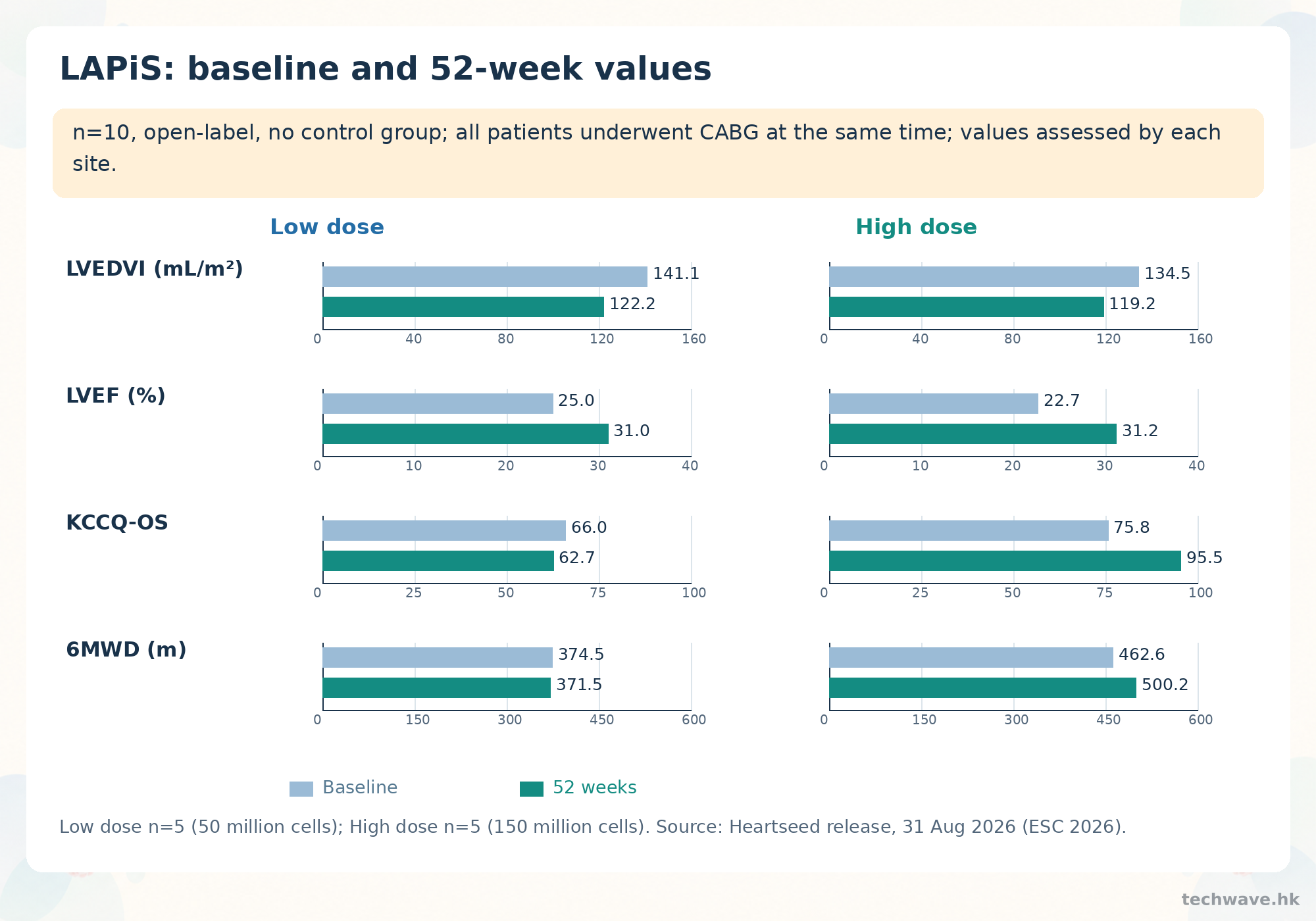
The numbers look good. But reading this table correctly requires holding four things in mind at once; drop any one of them and you will misread it.
First, 10 patients. This is an exploratory dose-escalation study, not a dataset sized to demonstrate efficacy.
Second, no control group and no blinding. Without a control there is no reference for what would have happened without transplantation. Without blinding, measures that depend on patient effort and perception — the KCCQ score and the six-minute walk — lean naturally in the favourable direction.
Third, every patient had bypass surgery. This is the decisive one. Each patient received coronary artery bypass grafting in the same operation in which the spheroids were injected [1], and bypass grafting is itself the standard way to improve function in ischaemic myocardium. When ejection fraction rises from 25% to 31% in the low-dose group and from 22.7% to 31.2% in the high-dose group, this study design cannot separate what came from new vessels and what came from new cells. There is an interesting twist: the NEJM study cited in the RiHEART review material points in the opposite direction, showing that survival after bypass does not correlate with ejection fraction [3]. Either way, the conclusion is the same — in this disease, a cardiac function number is not a clean endpoint.
Fourth, the values were assessed by each site [1]. There was no centralised independent imaging assessment, so differences in measurement between hospitals carry into the numbers.
The correct reading of this table, then, is: in the 26-week primary safety assessment, none of the 10 patients had the pre-specified serious ventricular arrhythmias; at 52 weeks after transplantation plus bypass grafting, most cardiac function and quality-of-life measures were maintained or improved, and the direction was more consistent in the high-dose group than the low-dose group. That is a signal worth pursuing, not a conclusion about efficacy. The company itself has gone exactly one step further: secure the designation, line up the next stage of study.
What that 9 November pass actually is
On 9 November 2026 the Ministry of Health, Labour and Welfare designated HS-001 a SAKIGAKE (pioneering) regenerative medical product, under the proposed name remumiocel [2].
The proposed indication attached to the designation is drawn very narrowly: severe heart failure due to ischaemic cardiomyopathy inadequately controlled by standard drug therapy, restricted to patients undergoing coronary artery bypass grafting whose resting left ventricular ejection fraction is no greater than 40% [2]. Note the bypass condition — it is the same confounder that sits in the study design, now written into the proposed indication.
The designation brings three benefits: priority consultation, pre-application assessment and priority review [2]. All three are administrative support and acceleration measures.
It is not an approval, not an endorsement of efficacy or safety, and not a statement that the state considers the product effective.
The best yardstick for weighing this pass is, as it happens, the Parkinson's product approved in March. Amchepry received SAKIGAKE review designation (then the Sakigake review designation system, now the designation system for pioneering drugs and products) as early as February 2017, was designated an orphan regenerative medical product in December 2025, was filed for marketing approval on 5 August 2025, and received conditional, time-limited approval on 6 March 2026 [11].
From designation to approval: nine years. From filing to approval: about seven months.
Those two numbers separate two things cleanly. SAKIGAKE designation does not run your trials for you. Priority consultation and pre-application assessment can smooth development and filing preparation, and priority review can speed the review once a filing is made, but none of it removes the data that still has to be generated, and whether approval follows is still an open question. Seen from outside, the milestone that actually sets the timetable is when the marketing application is filed.
The problem the monkeys left behind
Arrhythmia has to be discussed here, because it is the hardest obstacle on the route that puts cells inside the muscle — and it is not speculative. Animal studies ran into it repeatedly.
In 2014, Chong and colleagues reported in Nature that human embryonic stem cell-derived cardiomyocytes transplanted into a non-human primate ischaemia-reperfusion model produced extensive remuscularization, with electromechanical coupling between graft and host, but non-fatal ventricular arrhythmias occurred [9].
In 2016, Shiba and colleagues at Shinshu University reported in Nature that, in an MHC-matched allogeneic monkey model with methylprednisolone and tacrolimus immunosuppression, iPS cell-derived cardiomyocytes survived for 12 weeks with no evidence of rejection, coupled electrically with host cells and improved cardiac function, but that ventricular tachycardia increased significantly and transiently compared with controls [8].
In 2018, Liu and colleagues reported in Nature Biotechnology that roughly 750 million cells transplanted into monkey hearts raised ejection fraction by 10.6% at one month, against 2.5% in controls; some animals developed arrhythmias originating from a single ectopic pacemaker site [10].
The common thread is clear: the cells did form new muscle in monkey hearts, and ventricular arrhythmias did occur. The 2016 and 2018 studies also reported improved cardiac function [8][10]; the 2014 abstract reports extensive remuscularization and electromechanical coupling but draws no conclusion on function [9]. The most direct clue to where the arrhythmias come from is in the 2018 study: electrical mapping traced them to a point source in the graft acting as an ectopic pacemaker [10]. In other words, new muscle can itself become a site that fires on its own — but the three studies do not establish one shared, settled cause.
Which is precisely why Cuorips presents "no puncture" as an advantage [12]: placed on the surface, leaving no new muscle inside the myocardium, the manufacturer says the risk of arrhythmia is minimised. Minimised is not zero. The PMDA report records one case of atrial fibrillation in the study; a causal link to the product was ruled out, yet the reviewers noted that the transplantation procedure and the underlying disease could both give rise to arrhythmias and called for thorough monitoring and appropriate management [13].
HS-001 is set on clearing it. No ventricular arrhythmia lasting 30 seconds or longer or requiring treatment occurred at 26 weeks [1], which is good news — in 10 patients. Not seeing an event in 10 patients says little about how rare it is; a rare but serious risk can only be addressed with more patients and longer follow-up, whether from further trials or from observation after approval.
On the choice of spheroids over single cells, the company's stated reason is better survival [1]. Better survival means a given goal may be reachable with fewer cells — Liu and colleagues used roughly 750 million cells in monkeys [10], while the HS-001 high dose was 150 million [1]. A smaller cell load also changes the size and distribution of graft foci. Whether that also changes arrhythmia risk is not addressed in published material, and we will not infer it.
There is a third card: the version without the open chest
Heartseed has another line, easy to overlook, that may determine how wide this technology can go.
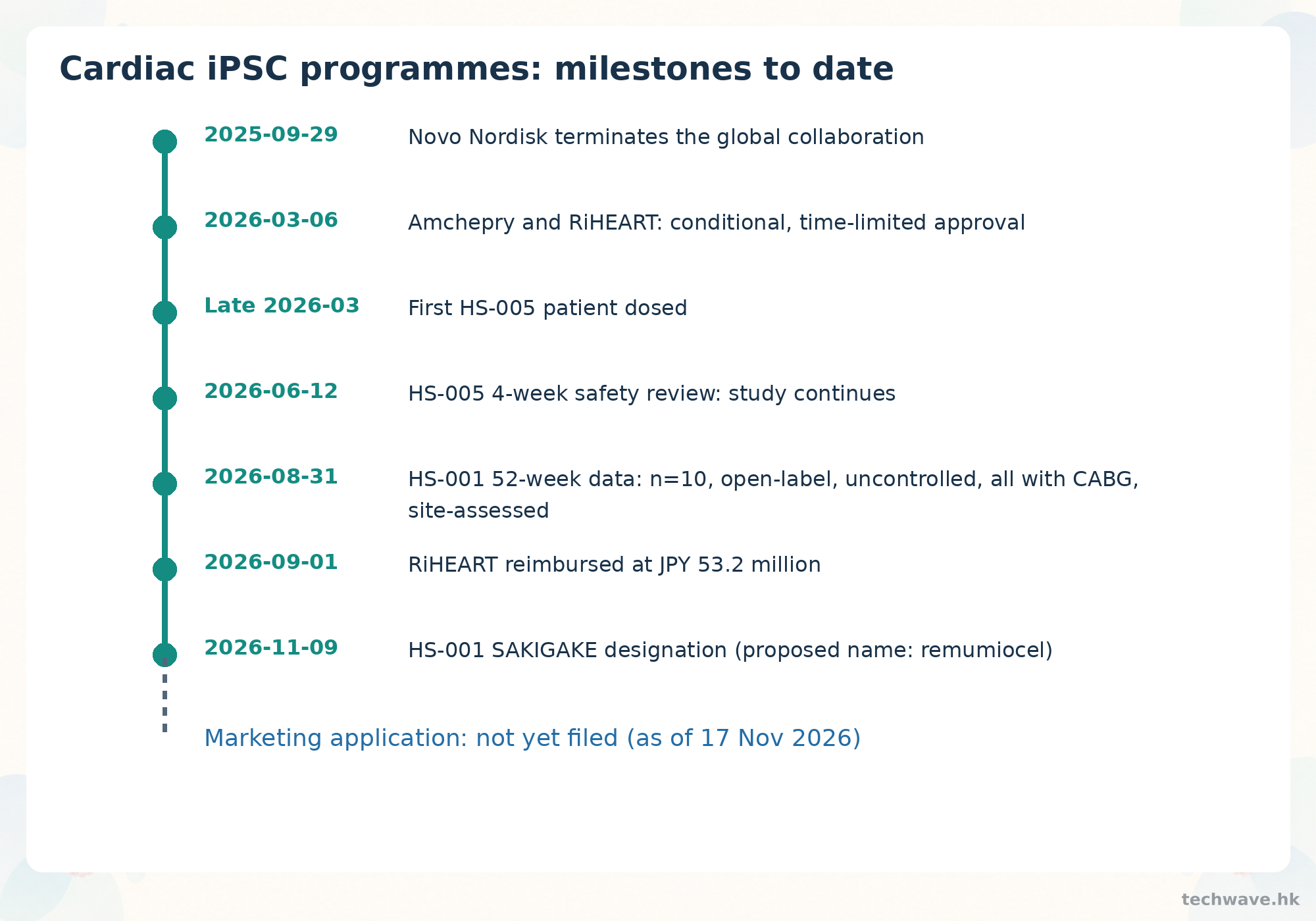
HS-005 does not require opening the chest. It delivers cells by catheter from inside the heart, targeting ischaemic heart disease or dilated cardiomyopathy [5]. The first patient had dilated cardiomyopathy, was dosed at Shinshu University Hospital in late March 2026 and has been discharged; the independent safety committee reviewed four-week data and agreed the study would continue [5].
Why does this matter? Because the proposed indication for HS-001 is tied to undergoing coronary artery bypass grafting [2]. Tied to bypass, the treatment can only reach patients already scheduled for open-chest bypass surgery — which is both the scientific confounder and the commercial ceiling. If the catheter route works, that ceiling comes off; and the fact that the first patient had dilated cardiomyopathy shows the company is aiming beyond the ischaemic group [5].
One piece of background: on 29 September 2025, Heartseed received notice from Novo Nordisk terminating their global collaboration, with the stated reason being a focus on diabetes and obesity; global rights to HS-001 and HS-005 returned to Heartseed [6]. A biotechnology company of limited size advancing two cardiac cell therapies alone faces real resource constraints, and that affects pace.
Our reading
What follows is our own reading. It is not company guidance and does not predict a regulatory outcome.
On timing. HS-001's public status today is a designation secured and 52-week data in 10 patients reported, with no marketing application filed. Whether the next step is a filing on the existing data or a further study, the company has not said; RiHEART was conditionally approved on an 8-patient exploratory study [3], so neither path can be ruled out. Our judgement is therefore that HS-001 becoming Japan's third approved iPS cell-derived product is a realistic possibility; until a filing is announced, any date is a guess, and the milestone to watch is not the designation — it is the announcement of when the marketing application is filed. Amchepry's roughly seven months from filing to conditional approval [11] is a single-case reference point, not a review period for HS-001.
On form. If HS-001 is approved, we expect its indication to follow the wording used at designation: tied to bypass grafting, tied to an ejection fraction ceiling [2]. What would genuinely widen the addressable group is more likely the HS-005 catheter route than HS-001 itself.
On whether cells can grow into a heart. Our judgement is that the question cannot yet be answered. The RiHEART route has explicitly placed its mechanism in secreted factors and does not count on the cells staying [3][12]. HS-001 states remuscularization as its goal, but there is no published histological evidence that contractile myocardium has formed in a human heart — such evidence can only come from pathological examination of a transplanted heart, and those samples are extremely hard to obtain. Even then, improved clinical measures cannot be read backwards as engraftment: bypass grafting, secreted factors and new vessels all explain the same numbers.
So the thing to watch is those 75 post-marketing cases. The RiHEART use-results survey compares against an external control, targets 75 cases, and uses a 10% or greater improvement in peak VO₂ together with improvement or maintenance of the volume index as its primary endpoint [3]. The survey will test an iPS cardiac product under real-world use against a single, pre-defined primary endpoint. When those results land, we will have an answer on whether sheets are enough; and for HS-001 to show that injection is better, it will eventually face the same class of yardstick.
For scale, one more comparison. At insurance listing, the estimated number of eligible patients for RiHEART was 690 (first-year basis), with 96 patients treated and sales of 5.11 billion yen projected in year 10 [4]. Japan has roughly 1.2 million heart failure patients, and the world more than 65 million [1]. The gap between those numbers is the hole this technology has to fill over the next decade.
What this means in the lab
If you work on iPSC-derived cardiomyocytes, the developments above land on three concrete things.
First, three-dimensional aggregation is becoming part of the dosage form, not just a culture technique. HS-001 adopted spheroids as the product form, citing survival [1]; RiHEART adopted sheets, citing avoidance of puncture [12]. For a laboratory moving cardiac differentiation towards process development, size uniformity of aggregates, viability loss during aggregation and the shipping tolerance of aggregates all move from "experimental conditions" to specification lines.
Second, purity is a precondition on this route. In the RiHEART review material, residual undifferentiated cells and tumourigenicity are central control points: purity is tested with undifferentiation markers at each manufacturing stage, and the release specification is set at a level where no undifferentiated iPS cells should theoretically remain [3]. A note on technical lineage: a 2013 study in Cell Stem Cell showed that a glucose-free, lactate-rich medium allows cardiomyocytes to survive selectively, reaching up to 99% purity, with no tumour formation after transplantation [7]. One of its authors, Fukuda K, shares a name with Heartseed's representative; however, the purification process and raw materials actually used for HS-001 are not disclosed in published material, and we draw no correspondence.
Third, the cell-source question already has an industrial answer. Amchepry explicitly uses iPS cell stock supplied by the Kyoto University CiRA Foundation as its starting material [11], and RiHEART likewise uses clinical-grade human iPS cell stock from the Center for iPS Cell Research and Application (CiRA) at Kyoto University [12]. Both approved products are built on public cell stocks. The cell source and medium used for HS-001 are not disclosed, and we will not guess.
TechWave Biotech supplies raw materials for human iPSC expansion and directed differentiation: the Ajinomoto StemFit media family (Basic03 GMP, Basic04 Complete Type GMP, StemFit For Differentiation), Matrixome's iMatrix-511 laminin fragment, and the associated recombinant growth factors and differentiation proteins. If you are working on cardiac, neural or other directed differentiation and need a GMP statement, Product Information or SDS, ask us.
> Building an iPSC cardiac differentiation or spheroid workflow? Tell us your cell line, target differentiation stage and scale, and we will align the raw-material list and available quality documents to your process stage.
References
- Heartseed Inc. Notice Regarding 52-Week Results of the LAPiS Study of HS-001 in Patients with Heart Failure Secondary to Ischemic Heart Disease (company release, 31 August 2026; results presented at ESC 2026). https://heartseed.jp/news/
- Heartseed Inc. Notice Regarding Designation of HS-001 (remumiocel) as a SAKIGAKE Designated Product by the Ministry of Health, Labour and Welfare (company release, 10 November 2026; designated 9 November 2026).
- Ministry of Health, Labour and Welfare, Japan. Conditional and Time-Limited Approval of Three Regenerative Medical Products: Review of RiHEART, Amchepry and Acuugo (Central Social Insurance Medical Council reference material, 8 April 2026). https://www.mhlw.go.jp/content/10808000/001687611.pdf
- Ministry of Health, Labour and Welfare, Japan. Insurance Listing of Regenerative Medical Products, Effective 1 September 2026: RiHEART (Central Social Insurance Medical Council material). https://www.mhlw.go.jp/content/10808000/001726219.pdf
- Heartseed Inc. Notice Regarding Continuation of the EMERALD Study of HS-005 Following Independent Safety Committee Review of 4-Week Data from the First Patient (company release, 12 June 2026). https://heartseed.jp/en/news/
- Heartseed Inc. Notice Regarding Termination of the Global Collaboration with Novo Nordisk (company release, 30 September 2025).
- Tohyama S, Hattori F, Sano M, et al. Distinct Metabolic Flow Enables Large-Scale Purification of Mouse and Human Pluripotent Stem Cell-Derived Cardiomyocytes. Cell Stem Cell. 2013;12(1):127-137. doi:10.1016/j.stem.2012.09.013
- Shiba Y, Gomibuchi T, Seto T, et al. Allogeneic transplantation of iPS cell-derived cardiomyocytes regenerates primate hearts. Nature. 2016;538(7625):388-391. doi:10.1038/nature19815
- Chong JJH, Yang X, Don CW, et al. Human embryonic-stem-cell-derived cardiomyocytes regenerate non-human primate hearts. Nature. 2014;510(7504):273-277. doi:10.1038/nature13233
- Liu YW, Chen B, Yang X, et al. Human embryonic stem cell-derived cardiomyocytes restore function in infarcted hearts of non-human primates. Nature Biotechnology. 2018;36(7):597-605. doi:10.1038/nbt.4162
- Sumitomo Pharma Co., Ltd. Notice Regarding Marketing Approval of Amchepry, Allogeneic iPS Cell-Derived Dopaminergic Progenitor Cells, in Japan (company release, 6 March 2026). https://www.sumitomo-pharma.co.jp/news/20260306.html
- Cuorips Inc. RiHEART (Human (Allogeneic) iPS Cell-Derived Cardiomyocyte Sheet) Product Page (manufacturer product page). https://www.cuorips.co.jp/riheart
- Pharmaceuticals and Medical Devices Agency, Japan. Deliberation Result Report and Review Report for RiHEART (deliberation result report and review report, February 2026). https://www.pmda.go.jp/regenerative_medicines/2026/R20260406001/252508000_30800FZX00001_A100_2.pdf
- Iyaku Tsushinsha. Cuorips Obtains Conditional, Time-Limited Marketing Approval for Human iPS Cell-Derived Cardiomyocyte Sheet RiHEART (trade news, 6 March 2026; reports the approval date from the company announcement). https://iyakutsushinsha.com/2026/03/06/
Uses and applicable scenarios
- Separate Japan's two approved iPS cell-derived products (Amchepry, RiHEART) from the investigational HS-001 by mechanism of action, delivery route and regulatory stage, instead of treating them as one category
- Recognise how sample size, single-arm design without a control, concomitant surgery and site-assessed endpoints limit the strength of exploratory cell-therapy datasets
- Understand what Japan's SAKIGAKE designation and conditional, time-limited approval each solve, and what they do not
- Plan raw materials and quality-control points for differentiation, purification and three-dimensional aggregation of iPSC-derived cardiomyocytes
Limitations
- As of 17 November 2026, HS-001 has not been filed for marketing approval and is not approved in any country. What it received on 9 November 2026 is designation as a SAKIGAKE (pioneering) regenerative medical product, an administrative support measure for development and review (priority consultation, pre-application assessment, priority review); it is not an approval and not an endorsement of efficacy or safety
- The HS-001 52-week data come from an open-label, uncontrolled, dose-escalation study in 10 patients. Every patient underwent coronary artery bypass grafting during the same operation, and the cardiac endpoints were assessed by each participating site. Bypass grafting by itself improves cardiac function, so these values cannot be attributed to the grafted cells and do not constitute evidence of efficacy
- Remuscularization — grafted cells forming muscle that contracts — is the company's stated mechanistic design. There is no published histological evidence of long-term graft survival and contractile function in humans
- Any reading of the approval timeline in this article is our own conditional judgement based on published regulatory frameworks and disclosed progress. It is not company guidance and does not predict a regulatory outcome
- Non-human primate studies have reported ventricular arrhythmias after cardiomyocyte transplantation. The 26-week primary endpoint of the HS-001 study was the absence of ventricular arrhythmia lasting 30 seconds or longer or requiring treatment; this is a safety result in 10 patients and cannot be read as having excluded arrhythmia risk
- This article reviews technical progress. It is not medical advice and contains no diagnostic or treatment recommendation. Indications, directions for use and availability of the products discussed are governed by the official approval documents in each jurisdiction
Frequently asked questions
Japan has approved an iPS cardiomyocyte product — does that mean growing new myocardium has been achieved?
No. The approved product, RiHEART, is a cardiomyocyte sheet, and the Ministry of Health, Labour and Welfare review material states that it does not function as contractile myocardium after transplantation; it acts mainly through secreted cytokines and similar factors that promote angiogenesis and allow myocardium in a "hibernating" state to recover, and in animal studies the sheet disappeared in about three months. The manufacturer's product page says the same. The route that does state remuscularization — new myocardium that contracts — as its goal is the investigational HS-001, which injects cells as spheroids into the myocardium; but there is no published histological evidence that contractile myocardium has formed in a human heart.
In the HS-001 52-week data, ejection fraction rose from 25% to 31% in the low-dose group and from 22.7% to 31.2% in the high-dose group — does that demonstrate efficacy?
No. This was an open-label, uncontrolled dose-escalation study in 10 patients, and every patient underwent coronary artery bypass grafting during the same operation in which the spheroids were injected. Bypass grafting is itself the standard way to improve function in ischaemic myocardium, and this design cannot separate what came from new vessels and what came from new cells. The values were also assessed by each site rather than by centralised independent review, and in an unblinded study, measures that depend on patient effort and perception — the quality-of-life score and the six-minute walk — lean naturally in the favourable direction. The correct reading is that this is a signal worth pursuing, not a conclusion about efficacy.
Does SAKIGAKE designation mean HS-001 will be approved soon?
No. The designation provides three administrative support measures — priority consultation, pre-application assessment and priority review. It is not an approval and not an endorsement of efficacy or safety. Use the Parkinson's product approved in March as a yardstick: Amchepry received Sakigake review designation back in February 2017, was filed for marketing approval on 5 August 2025, and received conditional, time-limited approval on 6 March 2026 — nine years from designation to approval, about seven months from filing to approval. In other words, the designation can smooth development and filing preparation and speed the review once a filing is made, but it does not remove the data that still has to be generated and does not guarantee approval. As of 17 November 2026, HS-001 has not been filed.
Why does the sheet route avoid injection — wouldn't injecting into the myocardium be more direct?
It is more direct, at a cost. Cuorips presents "no puncture" as a technical advantage: the sheet is only placed on the heart surface, with no puncture that could directly damage the heart, which minimises arrhythmia risk; the sheet is introduced through an incision of about 7 cm between the left ribs and the procedure takes about 50 minutes (manufacturer's statement). Behind this is a problem animal studies ran into repeatedly: in non-human primates, cardiomyocyte transplantation produced non-fatal ventricular arrhythmias, a marked transient increase in ventricular tachycardia, and arrhythmias originating from a single ectopic pacemaker site within the graft — in other words, new muscle can itself become a site that fires on its own, though the three studies do not establish one shared, settled cause. The sheet lowers this kind of risk rather than removing all arrhythmia: the PMDA report records one case of atrial fibrillation in the study, and although a causal link to the product was ruled out, the reviewers still called for thorough monitoring and management. The sheet route has its own limits: the PMDA review report notes that the area reachable through left intercostal thoracotomy, the anterior to lateral wall of the left ventricle, is limited, and in animal studies the sheet disappeared in about three months. Under the approved directions, the transplantation procedure still specifies left thoracotomy as the standard approach.
What are the milestones to watch next?
Two. First, the announcement of when HS-001 is filed for marketing approval — until it appears, any date is a guess; the Parkinson's iPS product took about seven months from filing to approval, which is a single-case reference point and not a review period for HS-001 (this is our inference). Note that the proposed indication at designation is tied to undergoing coronary artery bypass grafting and to a resting ejection fraction no greater than 40%; the catheter route HS-005, which does not require opening the chest, is the line that could genuinely widen the addressable group. Second, RiHEART's 75 post-marketing cases: this use-results survey compares against an external control drawn from a separately conducted prospective clinical study, targets 75 cases across 20 institutions, and uses a 10% or greater improvement in peak VO₂ at 52 weeks together with improvement or maintenance of the left ventricular end-systolic volume index as its primary endpoint. The survey will test an iPS cardiac product under real-world use against a single, pre-defined primary endpoint.