
Technical column
Hundreds of designs a day but weeks to validate? Cell-free expression × SpyBLI: no purification, no concentration measurement, from gene fragment to KD, kon and koff in under 24 hours across 6 orders of magnitude
AI design and NGS screening can produce a hundred candidate binders in a single round; what slows projects down is validation, because conventional SPR/BLI needs each molecule purified, quantified and immobilized, taking days to weeks per molecule. The SpyBLI method published by Pietro Sormanni's group at the University of Cambridge in RSC Chemical Biology uses SpyCatcher003–SpyTag003 covalent capture to orient binders on a BLI sensor and read kinetics directly from unpurified samples. Combined with Nuclera eProtein Discovery cell-free expression, which screened 192 expression conditions in parallel within 24 hours, it needs only 10 µL of reaction mixture, takes under 24 hours from receipt of gene fragments to kinetic data and covers KD from about 772 nM to about 3 pM.
Definition
SpyBLI is a bio-layer interferometry (BLI) binding-kinetics method developed by a University of Cambridge team: using the SpyCatcher003–SpyTag003 isopeptide covalent link, SpyTag-labelled binders are captured onto the sensor in a uniform, oriented layer, so KD, kon and koff can be measured from crude samples without purification or concentration measurement; combined with Nuclera eProtein Discovery cell-free expression, linear gene fragments can go straight into kinetic measurement.
The pace of antibody engineering and protein design is being rewritten by AI and next-generation sequencing (NGS). One round of computational design, or high-throughput sequencing of a phage- or yeast-display library, can easily produce dozens or even hundreds of candidate binders.
What really slows R&D down is the validation that follows: to measure accurate binding kinetics for each candidate — the equilibrium dissociation constant KD, association rate kon and dissociation rate koff — conventional SPR/BLI workflows require every molecule to be purified, its concentration determined and the ligand carefully immobilized. A single molecule can take days to weeks. Design can iterate hundreds of times a day while validation takes weeks — that mismatch is the real pain point of antibody and binder engineering today.
Research published in RSC Chemical Biology by Pietro Sormanni's group at the University of Cambridge offers a new paradigm: Nuclera eProtein Discovery cell-free expression combined with SpyBLI covalent capture reads KD, kon and koff directly from unpurified samples, with no purification and no concentration measurement, in under 24 hours from receipt of gene fragments to kinetic data.
Cambridge's answer: SpyBLI, one covalent capture that removes three problems
SpyBLI is inspired by the SpyCatcher003–SpyTag003 pair, a "molecular glue" that forms a fast, specific and irreversible covalent isopeptide bond. SpyBLI uses this to capture SpyTag-labelled binders onto the BLI biosensor in a uniform, oriented layer, removing three problems of conventional methods at once:
- No purification: read directly from unpurified mammalian cell supernatant or cell-free expression mixtures, skipping lengthy chromatographic purification;
- No concentration measurement: covalent capture sidesteps the classic problem of unknown ligand concentration in crude samples, so no separate quantification is needed;
- Oriented immobilization: all molecules share the same orientation, eliminating the surface heterogeneity and mass-transport artefacts of random orientation and substantially improving data quality.
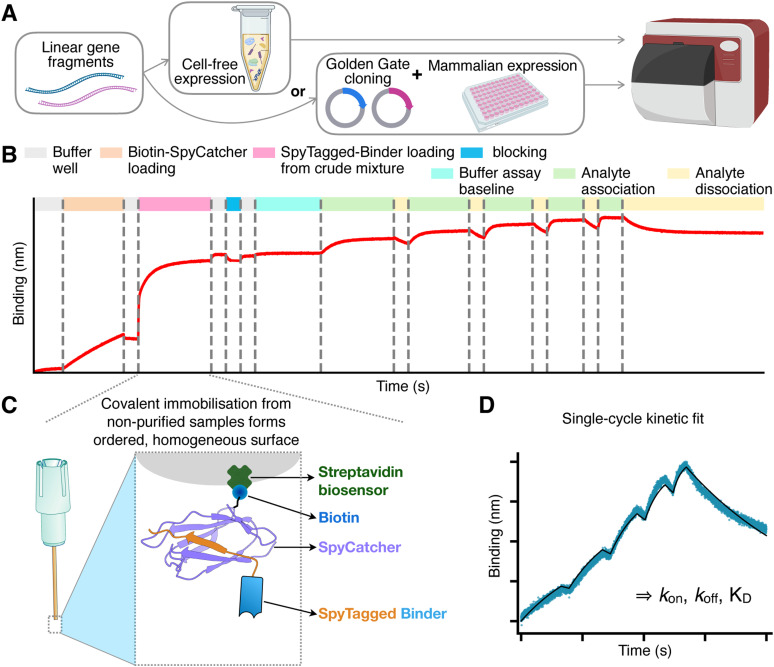
Figure 1. Overview of the SpyBLI workflow. (A) Target binders are encoded by linear gene fragments that can be used directly for cell-free expression or inserted into a vector by Golden Gate cloning for expression in mammalian cell culture. (B) Overview of the complete BLI experiment on a single sensor, with all steps labelled. (C) Schematic of a fully loaded BLI sensor, forming a uniform binder surface with similar orientation. (D) Example single-cycle kinetic binding curve (blue): the sensor probes increasing antigen concentrations in successive association steps; fitting a binding model (black curve) yields the association rate kon, dissociation rate koff and equilibrium dissociation constant KD = koff/kon.
eProtein Discovery: protein production that keeps pace with measurement
The team faced a difficult class of targets: some nanobodies contain non-canonical disulfide bonds that are critical for stabilizing CDR3 conformation, but the reducing environment of E. coli cell-free systems hinders correct disulfide formation.
Using the Nuclera eProtein Discovery system, the team screened 24 constructs × 8 cell-free reaction systems — 192 conditions — in parallel within 24 hours, systematically comparing solubility tags and redox and folding additives (PDI, GSSG, TrxB1, DnaK chaperone combinations and others) to identify the right expression conditions: removing the solubility tag and strengthening the oxidizing environment clearly increased the soluble yield of every protein tested. 12 antibody fragments were then successfully expressed and purified, with correct disulfide formation confirmed by mass spectrometry.
According to Nuclera, eProtein Discovery uses a digital microfluidic cartridge to run fully automated combinatorial screening of 24 DNA constructs with 8 cell-free reaction systems at once, generating 192 expression data points per run, completing expression testing and preliminary purification analysis within 24 hours and delivering active protein for downstream work in 48 hours. This automated, high-throughput optimization of expression conditions is what makes the route from linear gene fragment to kinetics-ready protein reliable, fast and almost hands-free.
The hard data: 6 orders of magnitude, consistent across three sample sources
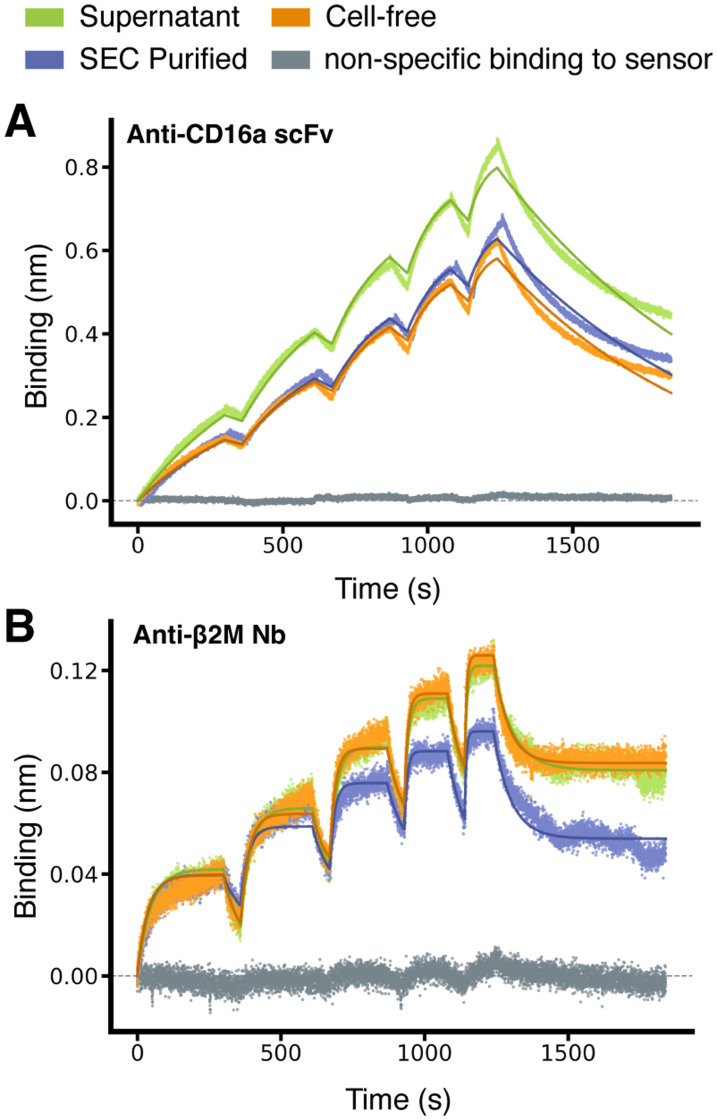
Figure 2. The primary data compare kinetic measurements across purified, mammalian and cell-free sample formats.
| Metric | Result |
|---|---|
| Affinity range | 6 orders of magnitude: from high nM (Nb.B201 binding HSA, KD ≈ 772 nM) to low pM (ixekizumab scFv binding IL-17A, KD ≈ 3 pM) |
| Consistency across three sources | KD values from purified samples, mammalian supernatant and cell-free expression agree closely |
| Speed | Under 24 hours from receipt of gene fragments to kinetic data |
| Sample requirement | Only 10 µL of cell-free reaction mixture |
| Disulfide challenge | Nanobodies with non-canonical disulfide bonds folded correctly |
| Conventional comparison | Mammalian expression needs cloning, transfection and expression, about 10 days |
Table 1. Performance validation of SpyBLI combined with cell-free expression.
Even more important, the binding kinetics measured for cell-free-expressed antibody fragments are fully comparable with those of mammalian-expressed samples and even of samples purified by affinity chromatography plus size exclusion. This means cell-free products from eProtein Discovery stand up to the demanding test of whether they can be used for high-precision kinetic characterization.
Who needs this workflow most?
- Computational protein design and AI antibody design teams: fast, accurate experimental feedback that keeps the design–test–optimize cycle turning;
- NGS antibody-library and display-library screening: high-throughput kinetic pre-screening of hundreds or thousands of sequencing hits to lock onto high-affinity molecules quickly;
- Early bispecific and multispecific antibody development: rank candidates by affinity and kinetics before committing to expensive purification;
- Characterization of disulfide-containing nanobodies and single-chain antibodies: solving expression and folding problems for redox-dependent molecules.
Conclusion: bring validation down to a matter of days
When AI brings design down to hours, validation has to keep up. Combining SpyBLI with eProtein Discovery compresses the old weeks-long "clone–express–purify–measure kinetics" route into a cycle measured in days — no cloning, no PCR, no purification and no concentration measurement. Note that these performance figures come from the molecules and conditions tested in the paper; new targets still need appropriate controls, fit diagnostics and orthogonal confirmation.
Let TechWave help you speed up antibody validation
If your team is held back by too many candidate molecules and slow purification and kinetic measurement, or needs to express nanobodies and single-chain antibodies containing disulfide bonds, contact TechWave. Based on your number of constructs, expression challenges and downstream assay needs, we can help evaluate applications of the Nuclera eProtein Discovery cell-free protein expression and screening system, provide technical documents and arrange a quotation.
Reference
Predeina O, Atkinson M, Wissett O, et al. The SpyBLI cell-free pipeline for the rapid quantification of binding kinetics from crude samples. RSC Chemical Biology, 2025, 6, 1313–1327. DOI: 10.1039/d5cb00079c
Uses and applicable scenarios
- Fast experimental feedback for computational protein design and AI antibody design
- High-throughput kinetic pre-screening of hits from NGS antibody and display libraries
- Affinity and kinetic ranking in early bispecific and multispecific antibody development
- Expression and characterization of nanobodies and single-chain antibodies with non-canonical disulfide bonds
Limitations
- Performance figures such as under 24 hours, 6 orders of magnitude and 10 µL come from the molecules and conditions tested in the paper; new targets still need appropriate controls, fit diagnostics and orthogonal confirmation
- Cell-free expression conditions (tags, redox additives and so on) must be screened for each construct rather than copying the combination selected in the paper