
Technical column
A RMB 1.29 Million CAR-T Enters China's Basic Medical Insurance: Where Does the Money in One CAR-T Dose Go? Materials and Consumables Are 55%–70% of Modeled Manufacturing Cost
On November 14, 2026, China's National Healthcare Security Administration and Ministry of Human Resources and Social Security released the 2026 National Reimbursement Drug List and Commercial Health Insurance Innovative Drug List. JW Therapeutics' CD19 CAR-T relmacabtagene autoleucel (relma-cel, Carteyva) became the first CAR-T included in China's basic medical insurance drug list. Its list price was RMB 1.29 million per dose. The official reimbursement standard has not been published; media reports cite industry estimates that the price may fall within RMB 300,000 and that patients' out-of-pocket cost after reimbursement may be within RMB 100,000. Why the price can fall, and how much further it can go, comes down to manufacturing economics: an open-access cost model published in 2026 estimated that, in a German manufacturing scenario, one CAR-T product costs roughly EUR 42,000–63,000 to make, with materials and consumables accounting for 55%–70%. Automation saves labor, but not the materials every new product requires. This article breaks the bill into three layers—drug price, manufacturing cost and raw materials—and explains why, after reimbursement, raw material selection turns from a cost question into a supply question.
Definition
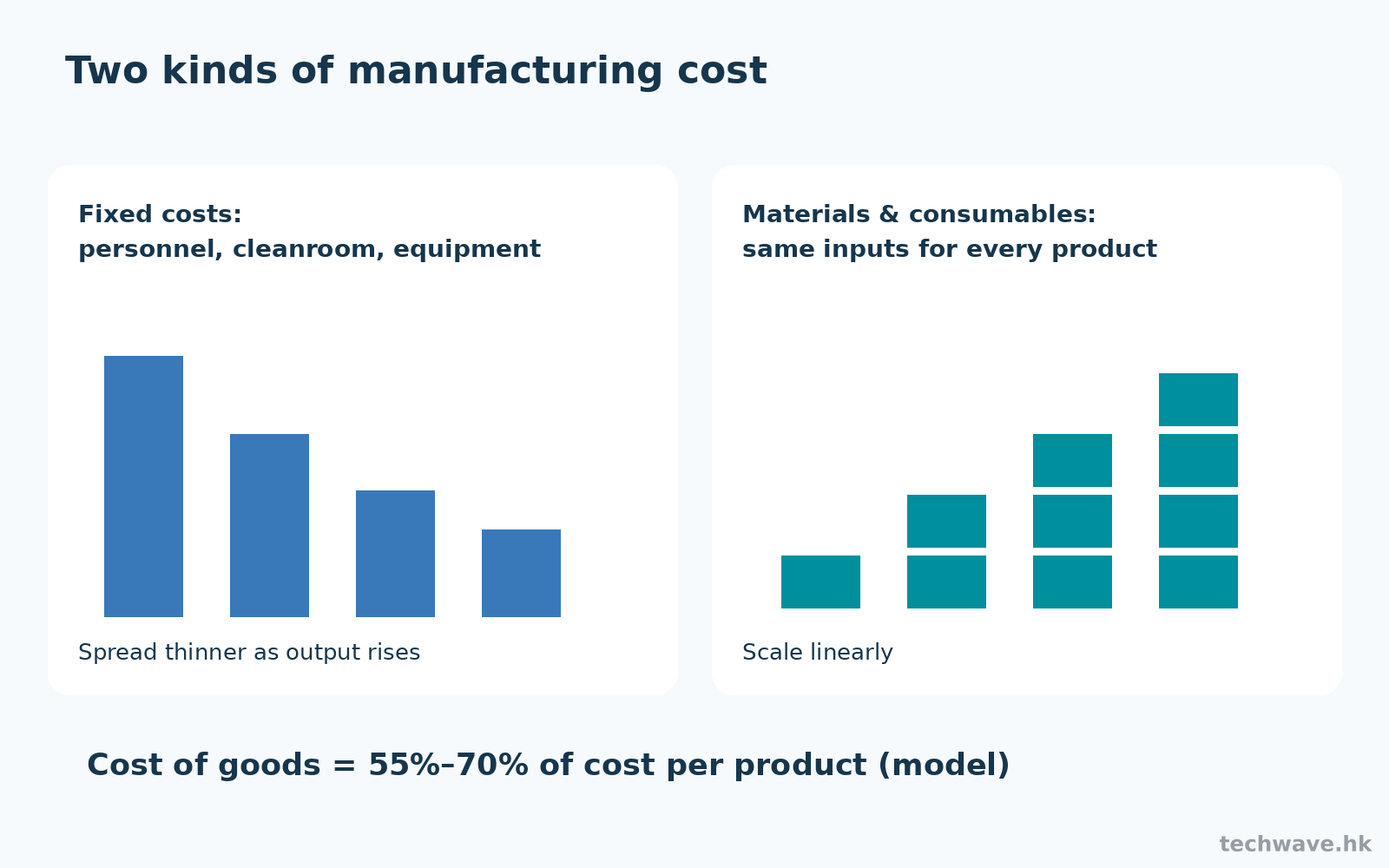
CAR-T manufacturing cost per product is the total cost of producing one patient's CAR-T product, typically including materials and consumables (media, cytokines, beads, buffers, single-use plasticware and similar items), personnel, depreciation and maintenance of cleanrooms and equipment, and quality control testing. Because each autologous CAR-T product is a separate batch made for one patient, materials scale linearly with the number of products, while fixed costs such as personnel and facilities are spread thinner as output rises.
On November 14, the price of one CAR-T dose started being calculated a different way.
Relmacabtagene autoleucel (relma-cel, brand name Carteyva), a CAR-T with a list price of RMB 1.29 million per dose, was added that day to China's national basic medical insurance drug list, becoming the first—and so far the only—CAR-T on that list [3][4][5]. Its reimbursement standard has not been officially published; media reports cite industry estimates that its price after inclusion may be within RMB 300,000, and that patients' out-of-pocket cost after reimbursement may be within RMB 100,000 [4][5].
From RMB 1.29 million to "out-of-pocket within RMB 100,000", one number shrinks by more than tenfold. Most people's first reaction is: if it can fall that far, why was it so expensive in the first place?
The answer is not in the price tag. It is in the manufacturing ledger.
Video explainer
RMB 1.29M CAR-T Enters China's Basic Insurance: Materials Are 55%–70% of Modeled Cost
Watch on YouTube ↗Video transcript
One CAR-T dose, list price 1.29 million yuan. On November 14 it entered China's basic medical insurance list. Industry estimates cited by media say patients may pay within 100,000 yuan after reimbursement. By industry estimates, the list price and the out-of-pocket cost may differ more than tenfold.
With a gap that big, why was it so expensive in the first place? First, the official release. The new national list adds 107 drugs, 51 of them Category 1 innovative drugs; the commercial insurance innovative drug list adds 12; and 2 drugs moved from the commercial list into basic medical insurance. The new lists take effect on January 1, 2027.
Media identified it as JW Therapeutics' relma-cel, an autologous CAR-T targeting CD19, approved in 2021. It became the first CAR-T on the basic medical insurance list. Not so fast. The official reimbursement standard hasn't been published; "within 300,000" and "out-of-pocket within 100,000 " are industry estimates cited by media.
CAR-T faced two hurdles. Price: CAR-T products in China are generally priced at 900,000 to 1.3 million yuan. And eligibility: applications are generally limited to drugs launched within five years, but it was approved in 2021.
The turning point was two lists working together. In 2025 it entered the commercial insurance innovative drug list; in 2026 a new rule let drugs on that 2025 list apply for basic insurance. A year later, it moved in through negotiation.
Why so expensive? A regular drug comes off one line by the thousands of boxes. Autologous CAR-T is made as a separate batch for every patient. One dose is one batch. From collection to freezing, about nine steps: collection, washing, T-cell selection, activation, genetic modification, expansion, harvest, another wash, then formulation and freezing. Manufacturing takes place in a clean environment, and every batch needs release testing.
In 2026, a team including Germany's Fraunhofer Institute for Production Technology published an open-access cost model. Cost per CAR-T product: about 63,000 euros manual, 61,000 semi-automated, 57,000 fully automated; with 12 made in parallel, about 61,000, 52,000 and 42,000.
The largest item is materials and consumables: 55% to 70% of the cost per product, with reagents more than half of that. The variable costs the study lists include media, cytokines, beads, buffers and single-use consumables.
One caveat: this models a German setting using electroporation, excludes costs for other gene-delivery methods, and is not the real cost of any product marketed in China. Automation saves on people. With 12 made in parallel, full automation costs about 10,000 euros less per product than semi-automation, close to 20%.
Interestingly, swapping a grade B cleanroom for grade C barely changes total cost. But materials can't be saved. Every product needs the same inputs, so materials scale linearly with the number of products; the more automated, the more it relies on specialized single-use consumables.
And failed batches: the model assumes failure rates of 10% manual, 3% semi-automated and 1% automated. One failure wastes a full set of materials and means making it again. The more patients treated, the thinner fixed costs like people, facilities and equipment are spread.
What's left as the biggest share is the materials each product needs anew. Materials turn from a cost question into a supply question. For materials, that means three things. One: scale with demand and stay consistent as batches grow.
Two: connect directly into closed, automated tubing, with one less vial to open and reconstitute. Three: help the line avoid a failed batch. That's where the products we sell come in: Akron cGMP cytokines IL-2, IL-7, IL-15 and IL-21, some available as ready-to-use liquids in closed bags; Akron human AB serum and human serum albumin; and Sexton human platelet lysate.
Finally, not so fast: the official reimbursement standard isn't published, and out-of-pocket costs depend on local policies; the cost model is a German scenario and can't be applied directly. Full article and sources: the technical column at techwave.hk.
Produced by TechWave. For research reference only; not medical advice.
What happened
| Item | Details |
|---|---|
| Release | On November 14, 2026, the National Healthcare Security Administration (NHSA) and the Ministry of Human Resources and Social Security released the National Basic Medical Insurance, Maternity Insurance and Work Injury Insurance Drug List (2026) and the Commercial Health Insurance Innovative Drug List (2026) [1] |
| Basic medical insurance list | 107 drugs added, 51 of them Category 1 innovative drugs; 34 removed; 3,331 drugs in total [1] |
| Commercial insurance innovative drug list | 12 drugs added, 28 in total after the update; 2 drugs from the 2025 commercial list moved into the basic medical insurance list [1] |
| CAR-T | The NHSA release states that CAR-T products for lymphoma with an original price above RMB 1 million were included in the basic list [1]; multiple media outlets identified the product as JW Therapeutics' relmacabtagene autoleucel injection [3][4][5] |
| Effective date | Both new lists take effect on January 1, 2027 [2] |
Relma-cel is an autologous CAR-T targeting CD19. It was approved by China's National Medical Products Administration in 2021, first for adult patients with relapsed or refractory large B-cell lymphoma after two or more lines of systemic therapy [6]. According to media reports, it now holds three approved indications in China: in addition to large B-cell lymphoma, adult follicular lymphoma that is refractory or relapsed within 24 months after two or more lines of systemic therapy, and adult relapsed or refractory mantle cell lymphoma after two or more lines of systemic therapy including a Bruton's tyrosine kinase inhibitor [3].
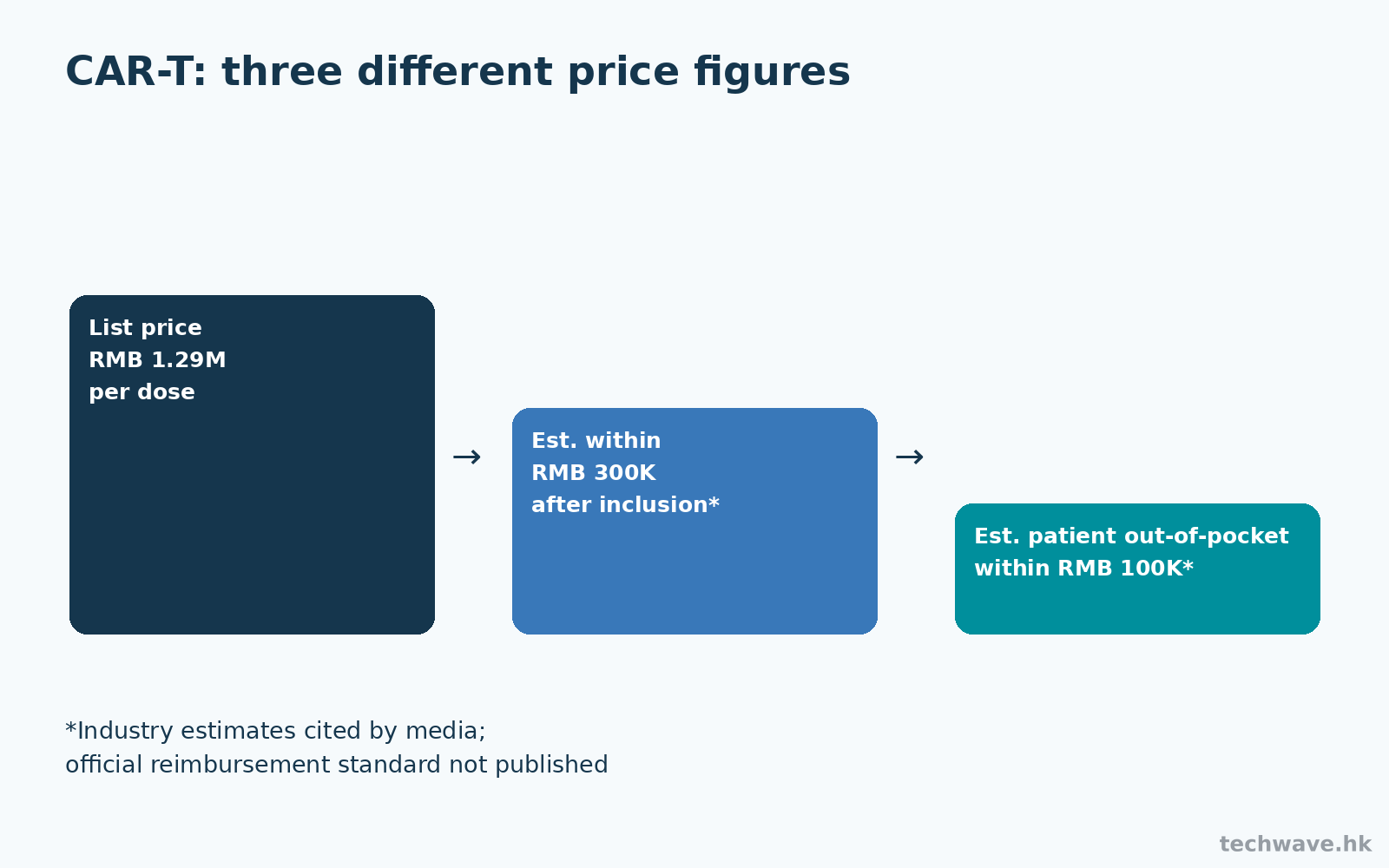
How the route opened: commercial insurance list first, basic medical insurance a year later
Ten CAR-T products have been approved in China, generally priced between RMB 900,000 and 1.3 million. None had previously entered the basic medical insurance list; patients either paid in full or relied on commercial health insurance, including city-sponsored supplementary plans, to share the cost [4]. An unwritten rule has long circulated in the industry that reimbursement negotiations "won't discuss above RMB 500,000 and won't admit above RMB 300,000" [3]; a CAR-T priced near RMB 1 million could hardly even reach the negotiating table.
The turning point came from two lists working together. The commercial insurance innovative drug list covers innovative drugs that go beyond the "basic coverage" remit and cannot yet enter the reimbursement list, but are highly innovative, clinically valuable and deliver significant patient benefit [7]. Relma-cel entered the first edition of this commercial list in 2025 [5].
To apply for the basic list, however, it faced another hurdle: applications are generally limited to new drugs launched within the past five years, and some drugs on the commercial list had been approved in 2021 or earlier, outside that window [7]. Relma-cel was approved in 2021 [6]. The 2026 adjustment plan added a new eligibility condition for exactly this case: any drug included in the 2025 commercial insurance innovative drug list could apply for this year's basic medical insurance list. Huang Xinyu, Director-General of the NHSA's Department of Pharmaceutical Services Management, explained that this opens a bridge between the two lists, and encourages high-value innovative drugs to apply for the commercial list early after launch to leave room for later reimbursement [7].
The result: one year after joining the commercial insurance innovative drug list, relma-cel moved into the basic medical insurance list through negotiation [4]. This year, 2 drugs from the commercial list entered the basic list through this mechanism [1].
For those who follow, two points matter:
- The bridge is now written into policy. The notice states that once a drug from the commercial list enters the basic list, it continues to benefit from the policies supporting innovative drugs for two agreement periods (four years) [2].
- Among the 12 drugs newly added to the commercial insurance innovative drug list this year, the NHSA highlights innovative products such as "the world's first CAR-T for solid tumors" and "China's first gene therapy for hemophilia" [1]; media also report that several other CAR-T products entered the commercial list this year [5].
In other words, CAR-T entering basic medical insurance is no longer a one-off; it is a route that someone has already walked.
Why CAR-T is expensive: one dose is one batch
A conventional drug comes off a production line by the thousands of boxes, so the cost per box is low. Autologous CAR-T is the opposite: each patient's product is made as a separate batch.
From patient cell collection to finished product, one autologous CAR-T goes through roughly these steps: collection, washing, T-cell selection, activation, genetic modification (giving the T cells their CAR), expansion, harvest, another wash, and finally formulation and freezing [8]. The manufacturing steps take place in a GMP-compliant clean environment, every batch undergoes release testing, and the materials used in one batch cannot be shared with any other patient.
So the price of CAR-T carries a "batch of one" manufacturing bill. To know how much that bill can shrink, you first need to see where it goes.
Where the manufacturing cost of one CAR-T product goes
In January 2026, a research team from the Fraunhofer Institute for Production Technology (Fraunhofer IPT) and other institutions published an open-access cost and space analysis in Frontiers in Bioengineering and Biotechnology [8]. Using a published CAR-T case-study process, they compared the costs of manual, semi-automated and fully automated manufacturing.
At each modality's maximum annual capacity, and accounting for different failure rates, the manufacturing cost per CAR-T product was approximately [8]:
| Modality | Cost per product (at maximum annual capacity) | With 12 products made in parallel | Cleanroom area | Assumed failure rate |
|---|---|---|---|---|
| Manual | ~EUR 63,000 | ~EUR 61,000 | 60 m² | 10% |
| Semi-automated | ~EUR 61,000 | ~EUR 52,000 | 50 m² | 3% |
| Fully automated | ~EUR 57,000 | ~EUR 42,000 | 40 m² | 1% |
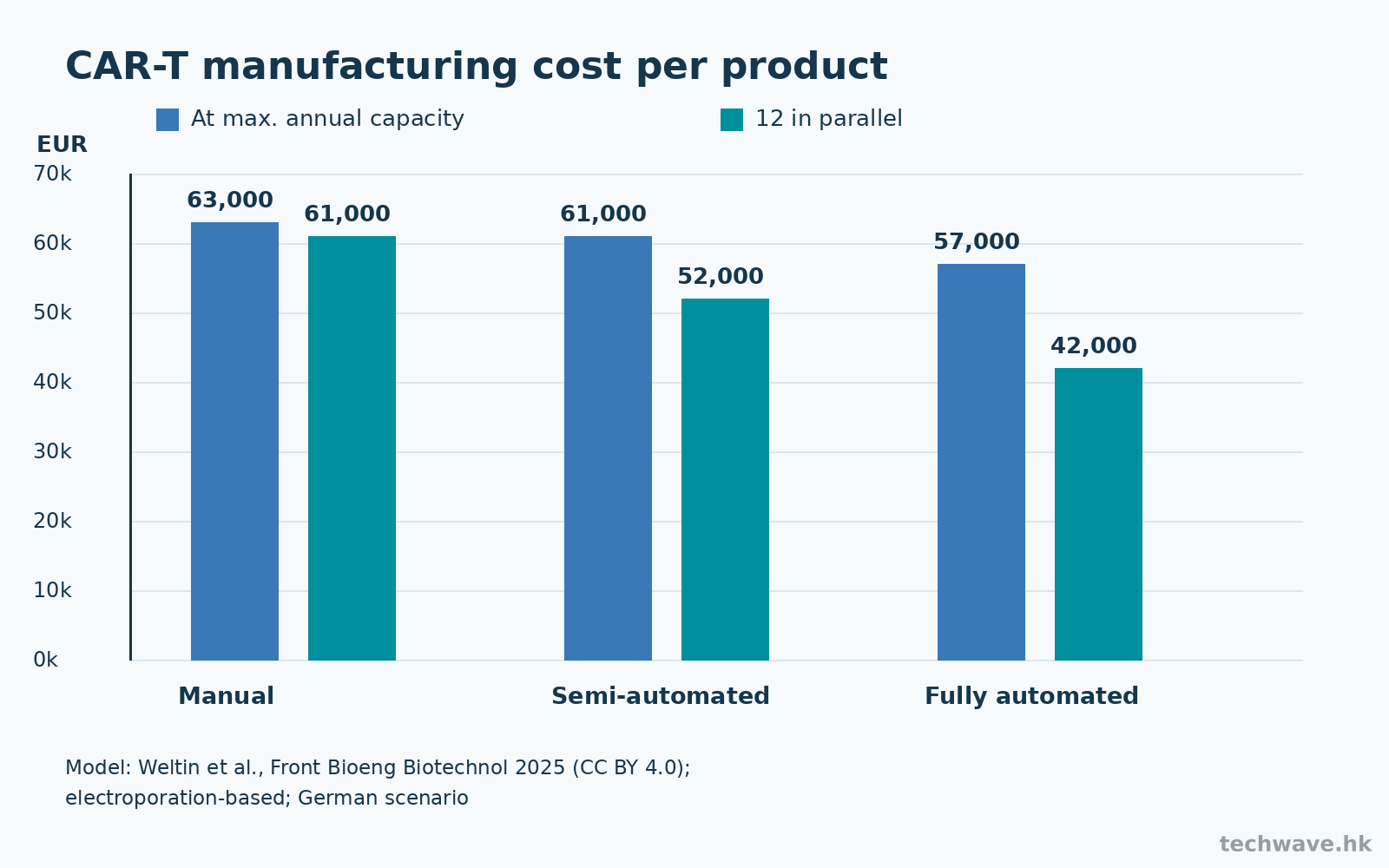
The most important number is not in the table: across all three modalities, materials and consumables (cost of goods) were the largest cost item, accounting for 55%–70% of the total cost per product [8]. Reagents made up more than half of that cost of goods; the variable costs the study lists are mainly media, cytokines, beads, buffers and single-use plasticware [8].
One caveat: the model uses electroporation for genetic modification, and the authors state explicitly that costs for other gene-delivery methods were not included because their cost structure differs substantially [8]. So this is not the real cost of any CAR-T marketed in China; it is an "anatomy chart" for understanding the cost structure.
What automation saves, and what it cannot
The most interesting part of the study is how it splits costs into two kinds.
The first kind can be spread out: personnel, cleanrooms and equipment. Full automation sharply reduced personnel input, and cleanroom area fell from 60 m² to 40 m², with the grade B area falling from 47 m² to 13 m² [8]. Interestingly, the study also found that simply replacing a grade B cleanroom with grade C had only a small effect on total cost [8]; what really made the difference was personnel. Once annual output exceeded eight products, the cost advantage of automation became evident, because fixed costs were spread over more units [8]. With 12 products made in parallel, full automation saved about EUR 10,000 per product compared with semi-automation—close to 20% [8].
The second kind cannot be spread out: materials and consumables. The study puts it plainly: because they come into direct contact with the product and are subject to GMP requirements, the same input materials are needed for every product, so the cost of goods rises linearly with the number of products, in all three modalities [8]. More automated platforms also rely more on highly specific, pre-packaged single-use consumables, so the share of consumables in total cost actually increases with the degree of automation [8].
There is one more easily overlooked cost: failed batches. The model assumes failure rates of 10%, 3% and 1% for manual, semi-automated and fully automated manufacturing [8]. For autologous CAR-T, one failed batch wastes not only a full set of materials but also means the patient must wait for the product to be made again.
Put the two kinds of cost side by side, and it becomes clear what happens after reimbursement:
- The more patients are treated, the thinner fixed costs such as personnel, facilities and equipment are spread;
- What remains as the largest share in the end are the materials and consumables that must be paid for again with every new product.
After reimbursement, raw materials turn from a cost question into a supply question
Tian Feng, Chairman and Chief Executive Officer of JW Therapeutics, said publicly that reimbursement has opened the door to access for innovative drugs, while companies need continuous technological innovation to keep lowering costs [3][4]. Yicai's report also noted that inclusion in the basic medical insurance list places higher demands on companies to secure stable supply and reduce manufacturing costs [4].
For upstream raw materials, this means three things.
First, materials must scale with demand
Materials and consumables grow linearly with the number of products. As patient numbers rise from dozens to hundreds a year, material demand has to multiply with them. Whether key ancillary materials such as GMP cytokines and culture supplements stay consistent as batch sizes scale up determines whether a production line can expand smoothly.
Second, materials must fit closed and automated processing
Automation saves labor and cleanroom space, but only if materials can be connected directly into closed tubing. Every extra vial opening, reconstitution and aliquoting step adds one more open manipulation and one more line in the batch record. Our article "The Last Mile for Cytokines: Akron Liquid IL-7 and IL-15 in Closed-System Bags Keep Their Activity for 9–12 Months at 2–8 °C and Match Lyophilized Cytokines in CAR-T Culture" covers exactly this approach: supplying cytokines as ready-to-use liquids filled into weldable closed bags.
Third, materials should help avoid failed batches
Failed batches are a hidden cost. The smaller the lot-to-lot variation in materials and the more traceable their origin, the easier it is to keep a process stable. Take culture supplements: our article "What Happens When Human Platelet Lysate Replaces Serum in T-Cell and CAR-T Culture?" brings together three studies. When multi-donor pooled human platelet lysate replaced fetal bovine serum or human AB serum, transduction efficiency did not fall and fold expansion was similar to human AB serum and slightly lower than fetal bovine serum; two of the studies observed a higher proportion of memory T cells.
What TechWave offers upstream of CAR-T manufacturing
Cost reduction is not a slogan; it is earned one material and one process step at a time. For cell and gene therapy customers, TechWave offers:
- Akron cGMP cytokines: IL-2, IL-7, IL-15 and IL-21, with selected products available as ready-to-use liquids in Closed System Solutions (CSS) bags for sterile welding into closed tubing;
- Akron human AB serum, human serum albumin and other human-derived culture supplements and formulation excipients;
- Sexton human platelet lysate (hPL), pooled from multiple donors, as a human-derived alternative to fetal bovine serum.
Planning to scale up, close or automate a CAR-T or other T-cell process? Bring us your process stage, culture scale and current materials list, and TechWave can help you compare ancillary material options item by item.
References
- National Healthcare Security Administration. NHSA and MOHRSS issue the 2026 National Basic Medical Insurance, Maternity Insurance and Work Injury Insurance Drug List and the Commercial Health Insurance Innovative Drug List [in Chinese]. November 14, 2026.
- National Healthcare Security Administration; Ministry of Human Resources and Social Security. Notice on issuing the National Basic Medical Insurance, Maternity Insurance and Work Injury Insurance Drug List and the Commercial Health Insurance Innovative Drug List (2026) [in Chinese]. November 13, 2026.
- Yicai. Million-yuan CAR-T finally enters medical insurance, price cut to within RMB 300,000 [in Chinese]. November 14, 2026.
- Wu Simin. From commercial insurance innovative drug to nationally negotiated drug: million-yuan CAR-T enters basic medical insurance for the first time [in Chinese]. Yicai, November 14, 2026.
- 21st Century Business Herald. Million-yuan-per-dose life-saving drug enters medical insurance after steep price cut [in Chinese]. November 14, 2026; The Paper. Million-yuan CAR-T therapy enters national basic medical insurance list for the first time; patient out-of-pocket cost after reimbursement may be within RMB 100,000 [in Chinese]. November 14, 2026.
- JW (Cayman) Therapeutics Co. Ltd. Inside information announcement: Research and development update – NMPA approval of relmacabtagene autoleucel injection in China. September 3, 2021.
- Peng Yunjia. Key points of the 2026 adjustment plan for the basic medical insurance and commercial insurance "dual lists" [in Chinese]. Xinhua News Agency, May 17, 2026 (republished by www.gov.cn).
- Weltin AL, De Graaf Y, Goudarzi A, Müller M, Herbst L, Nießing B, Vrijhoef HJM, Schmitt RH. Industrializing CAR-T cell therapy: impact of automation on cost and space efficiency of manufacturing facilities. Front Bioeng Biotechnol. 2025;13:1612248. doi:10.3389/fbioe.2025.1612248
Uses and applicable scenarios
- Understanding how CAR-T list prices, reimbursement standards and patient out-of-pocket costs relate, and the new route from the commercial insurance innovative drug list into basic medical insurance
- Assessing the cost structure of an autologous CAR-T process across materials and consumables, personnel, cleanroom and equipment, and failed batches
- Separating costs that can be spread over higher output from costs that scale linearly with each product when planning automated, closed CAR-T manufacturing
- Evaluating in advance the consistency and supply stability of GMP cytokines, serum alternatives and other ancillary materials for T-cell products serving larger patient populations
Limitations
- The reimbursement standard for relma-cel has not been officially published; the figures of within RMB 300,000 and patient out-of-pocket cost within RMB 100,000 are industry estimates cited by media, and actual out-of-pocket costs depend on local reimbursement policies
- The cost model is based on a German manufacturing scenario and the authors' institutional cost data, uses electroporation for genetic modification and does not include material costs for other gene-delivery methods; the euro figures cannot be converted directly into the manufacturing cost of Chinese companies
- The failure rates in the cost model (10% manual, 3% semi-automated, 1% automated) are assumptions made by the authors, not measured statistics
Frequently asked questions
Now that CAR-T is in basic medical insurance, will patients pay only RMB 100,000?
Not necessarily. The official reimbursement standard for relma-cel has not been published, and "out-of-pocket within RMB 100,000" is an industry estimate cited by media. The new list takes effect on January 1, 2027, and what patients actually pay depends on local reimbursement ratios and coverage scope. Reimbursement applies only within the approved indications and the specified coverage limits.
Why couldn't CAR-T enter basic medical insurance before, and how did it get in this time?
Two obstacles: price, since CAR-T products in China are generally priced at RMB 900,000–1.3 million, and eligibility, since applications are generally limited to drugs launched within five years while relma-cel was approved in 2021. The 2026 adjustment plan added a condition allowing drugs on the 2025 commercial insurance innovative drug list to apply. Relma-cel entered the commercial list first and moved into basic medical insurance through negotiation a year later.
What is the largest part of the manufacturing cost of one CAR-T product?
In a German CAR-T manufacturing cost model published in 2026, materials and consumables were the largest item at 55%–70% of the total cost per product, with reagents making up more than half of that; the variable costs the study lists include media, cytokines, beads, buffers and single-use consumables. The model uses electroporation for genetic modification and excludes costs for other gene-delivery methods, so it does not directly represent the real cost of products marketed in China.
How much can automated manufacturing reduce CAR-T cost?
In the same model, with 12 products made in parallel, full automation cost about EUR 42,000 per product versus about EUR 52,000 for semi-automation, saving about EUR 10,000, close to 20%, mainly in personnel. Materials and consumables, however, rise linearly with the number of products and are not reduced by automation; more automated platforms also rely more on specialized single-use consumables.
What does CAR-T reimbursement mean for raw material suppliers?
As more patients are treated, fixed costs such as personnel and facilities are spread thinner, and the materials and consumables required for every new product become a more prominent cost item. Whether materials stay consistent from lot to lot at larger scale, connect directly into closed and automated tubing, and help reduce failed batches will directly affect how smoothly production can expand and how stable supply remains.