
Technical column
AEC Red Gone After Dehydration? The Problem Is the Mount, Not the Stain: Aqueous Mounting and Troubleshooting for Alcohol-Soluble Chromogens
AEC (3-amino-9-ethylcarbazole) staining looks crisp right after development, yet after graded ethanol, xylene and resin mounting the red fades or disappears. That is not fading: the red precipitate dissolves in alcohol and organic solvents. This article separates dissolution from light-driven fading, shows which of seven common chromogens can be dehydrated, flags the two alcohol-containing steps that are easy to miss (Harris hematoxylin and acid-alcohol differentiation), and gives an aqueous route that changes only the last three steps, a guide to the three classes of aqueous mountant and a bench troubleshooting table. It also introduces Polysciences Aqua-Poly/Mount (18606), an aqueous mountant with a refractive index of 1.46 that cures in about 24 hours at room temperature.
Definition
An alcohol-soluble chromogen system is one whose coloured enzymatic reaction product dissolves in ethanol, xylene and other organic solvents, such as AEC, Fast Red TR, Fast Blue BB and 4-chloro-1-naphthol; such sections cannot go through graded ethanol dehydration, xylene clearing and resin mounting and are instead mounted directly in an aqueous mountant without dehydration.
An AEC-stained section usually looks its best the moment development finishes: crisp red signal, a clean background and good contrast against blue hematoxylin nuclei. Then it goes through the routine graded ethanol dehydration, xylene clearing and resin mounting, and under the microscope the red is much paler, or missing altogether in places.
The reflex is to go back and adjust antibody concentration, lengthen development or suspect an over-strong hematoxylin. But if the section looked right before dehydration, the staining is probably fine; the problem sits in the dehydration and mounting steps that follow. Once that is clear, changing just the last few steps of the protocol is usually enough to keep the red across the whole slide.
Video explainer
AEC Red Gone After Dehydration? It Dissolved in Alcohol: Mount Aqueously, Change Only 3 Steps
Watch on YouTube ↗Video transcript
The red looked perfect. Then you dehydrated it, and it's gone? If the colour looked right before dehydration, the staining is probably fine. AEC's red precipitate dissolves in ethanol and xylene. It isn't fading. It's dissolving.
DAB polymerises into a fairly dense polymer that tolerates alcohol, so it can be dehydrated. The step people miss comes before mounting: Harris hematoxylin contains alcohol, so counterstaining with it can dissolve the red.
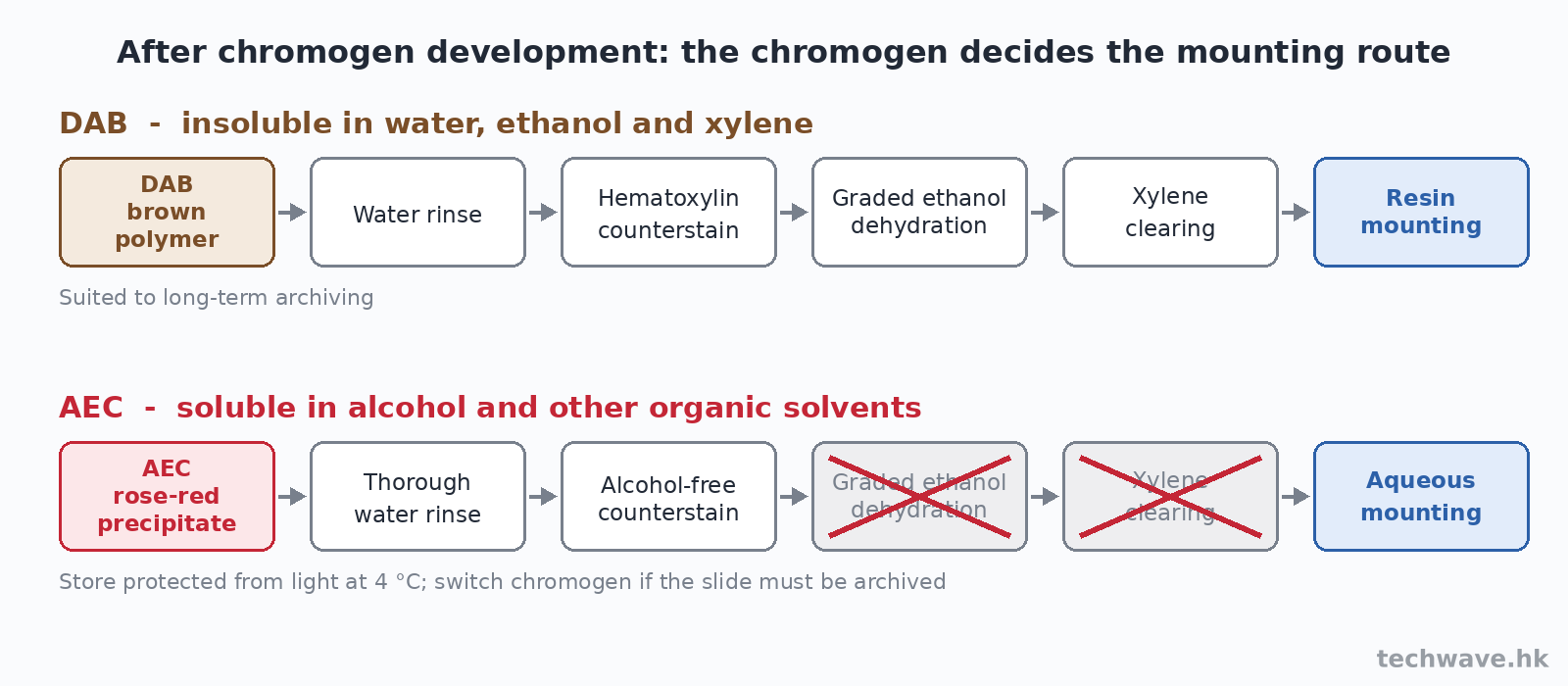
Switch to Mayer or Gill hematoxylin, or methyl green, and check the instructions for alcohol first. Change only the last three steps: rinse well in water, counterstain without alcohol, then skip graded ethanol and xylene and mount directly in an aqueous mountant.
For brightfield AEC, start with a curing aqueous mountant, such as Polysciences Aqua-Poly/Mount. If you use a glycerol type, seal the edges. Store mounted slides in the dark at 4 °C. But AEC isn't an archival chromogen. For long-term archiving, changing the chromogen is the better move.
The bench troubleshooting table is in the full article.
Produced by TechWave. For research reference only; not medical advice.
The short answer: AEC dissolves, it does not fade
Oxidised by horseradish peroxidase (HRP), AEC forms a rose-red precipitate. That precipitate dissolves in alcohol and other organic solvents: as soon as the section enters graded ethanol, the red starts moving into solution, and a pass through xylene leaves little of what remains. The process is usually fast and essentially irreversible.
What people normally call fading is a different mechanism. The AEC precipitate is sensitive to light and to continued oxidation, so even a section that never touches an organic solvent can slowly lose colour under light.
The two are easy to confuse but need different fixes. Storing a slide in the dark will not bring back red that ethanol has already dissolved; keeping organic solvents out of the whole workflow will not stop light-driven loss. Avoiding alcohol and avoiding light are two independent requirements, and both have to be met.
Whether a section can be dehydrated depends on solubility
Oxidised AEC forms a carbazole-type red precipitate whose molecules do not build a stable network, so organic solvents carry it away easily. In alkaline phosphatase systems, Fast Red and Fast Blue are azo dyes: chemically different from AEC, but likewise soluble in alcohol.
DAB behaves differently. It polymerises as it is oxidised, forming a fairly dense polymer that resists water, ethanol and xylene. DAB sections can therefore be dehydrated, cleared and resin-mounted for long-term storage, which is why DAB is commonly used for archived slides. Note that DAB is a potential carcinogen; handling and waste disposal must follow the applicable rules.
In other words, whether a section can be dehydrated has nothing to do with how dark or strong the colour is; it depends only on how soluble the reaction product is in organic solvents.
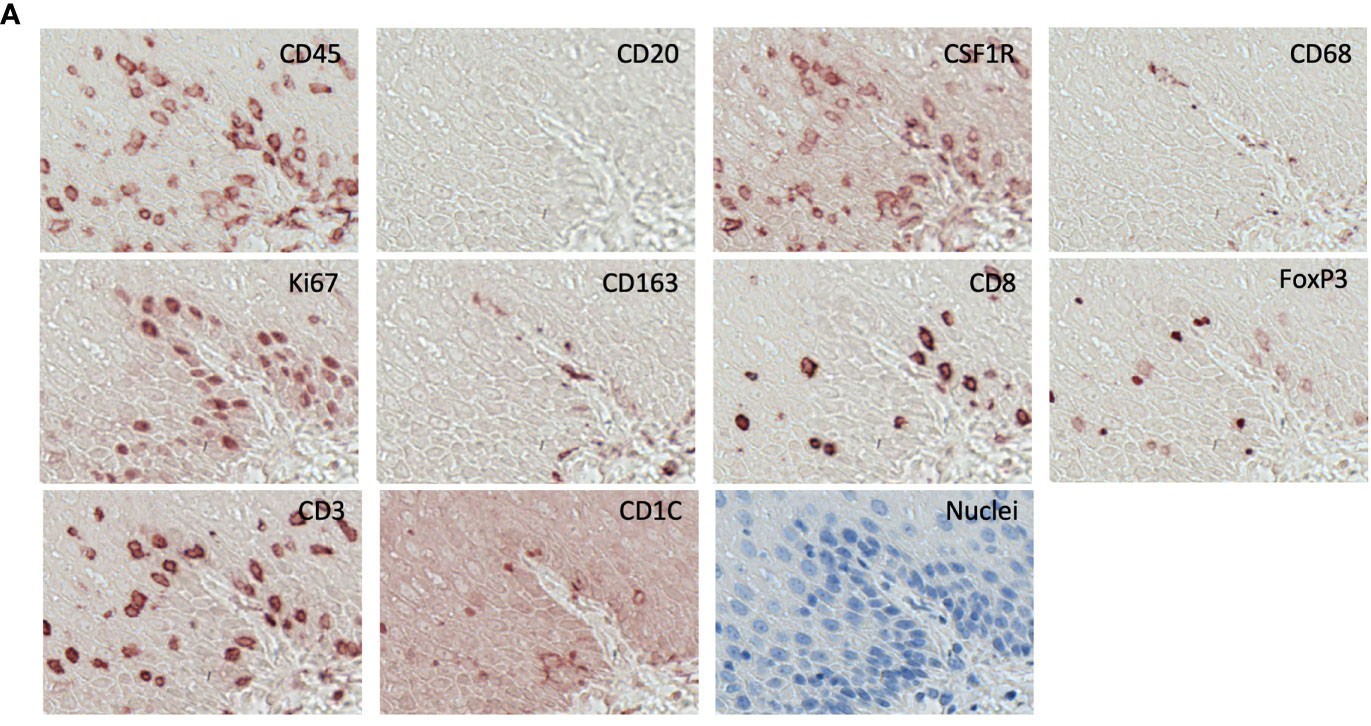
In sequential multiplex immunohistochemistry, AEC's alcohol solubility becomes a feature. Sundaram et al. (2022) detected 10 markers cycle by cycle on oesophageal adenocarcinoma and precancerous tissue: in each cycle AEC was developed, the slide was temporarily mounted in Tris-buffered saline with 0.1% Triton X-100 (TBST) for brightfield imaging, the AEC was then removed with ethanol and the antibodies stripped before the next cycle; hematoxylin was added in the final cycle to stain nuclei. Each marker panel above comes from one such develop-and-image cycle, with ethanol washing the AEC off between cycles. That a few minutes of ethanol washing is enough to remove AEC shows exactly what a routine dehydration does to an AEC slide.
Seven common chromogens: which can be dehydrated and which need aqueous mounting
| Chromogen | Colour | Alcohol/xylene | Mounting route |
|---|---|---|---|
| AEC | Rose red | Soluble | Aqueous mounting, no dehydration |
| Fast Red TR | Bright red | Soluble | Aqueous mounting |
| Fast Blue BB | Blue | Soluble | Aqueous mounting |
| 4-Chloro-1-naphthol (CN) | Blue | Soluble | Aqueous mounting |
| TRAP, standard development | Red | Soluble | Aqueous mounting, or air-dry before coverslipping |
| DAB | Brown | Insoluble | Dehydration + resin mounting |
| NewFuchsin | Red | Insoluble | Can be dehydrated + resin mounting |
The most frequently asked case is AEC with DAB double labelling. The pair is popular because brown against red is easy to read, but their solvent behaviour is opposite: DAB tolerates alcohol, AEC does not. As soon as AEC is used anywhere on a slide, the whole slide has to follow the aqueous route; the DAB part cannot be resin-mounted on its own, so the long-term storage advantage of resin mounting is lost.
The step most often missed: the counterstain contains alcohol too
Harris hematoxylin is formulated with alcohol, so counterstaining with it can dissolve AEC before the slide ever reaches mounting. The step is easy to overlook because it happens before mounting, and counterstaining is usually assumed to mean hematoxylin.
Alternatives include Mayer hematoxylin, Gill hematoxylin (check the formulation for alcohol) and methyl green. In the early AEC literature, methyl green/blue were already common counterstains.
Another easily overlooked step is acid-alcohol differentiation: the reagent contains both alcohol and acid, which is even harder on AEC, so avoid it where possible. The most direct way to judge a reagent is to read the components and solvent in its instructions; a product labelled "ready-to-use" is not necessarily alcohol-free.
Aqueous mounting without dehydration: change only the last three steps
Keeping the red on an AEC section does not mean redoing the whole staining protocol; the changes sit in the last three steps:
- Rinse thoroughly in water after development: wash away residual substrate so the section does not keep oxidising while it waits.
- Counterstain aqueously: use an alcohol-free counterstain as described in the previous section.
- Skip graded ethanol and xylene and mount directly in an aqueous mountant: this is the key step of the whole route. No dehydration means the section stays wet, so the mountant must be compatible with an aqueous phase. Drain excess buffer around the tissue, but do not blot it too dry; uneven wetting can leave marks under the microscope.
Everything else is routine: apply the mountant, lower the coverslip slowly, remove bubbles and let it cure away from light.
Three classes of aqueous mountant and how to choose
Aqueous mountants suitable for AEC fall roughly into three classes:
- Glycerol/gelatin types: low cost, ready to use and simple to handle, but they dry out easily and usually need the coverslip edge sealed (nail polish or a dedicated sealant); their refractive index is also relatively low, which can compromise imaging of thicker samples.
- Curing aqueous mountants: form a cured film between slide and coverslip. Polysciences Aqua-Poly/Mount is one example, with a refractive index of 1.46 and a cure of about 24 hours at room temperature (24–48 hours at 20–50% relative humidity).
- Anti-fade types: contain anti-fade agents and are designed mainly for fluorescence imaging, so brightfield AEC generally does not need them; formulations vary widely between brands, so check the solvent before switching.
One more point to remember: "aqueous" is a property of the formulation, not of the product name. Before using an unfamiliar mountant, confirm whether it contains alcohol.
Aqua-Poly/Mount: a curing aqueous mountant ready for alcohol-sensitive chromogens
Polysciences Aqua-Poly/Mount (catalogue number 18606) is a water-soluble, ready-to-use mounting medium designed for mounting microscope sections directly from aqueous solution, exactly the step the no-dehydration route depends on. According to the manufacturer, it shows no autofluorescence and is compatible with chromogenic systems such as DAB, alkaline phosphatase–Fast Red and AEC, as well as with immunofluorescence, frozen sections, lipid staining and enzyme histochemistry such as TRAP.
| Parameter | Aqua-Poly/Mount (manufacturer information) |
|---|---|
| Catalogue numbers and sizes | 18606-5 (5×20 mL), 18606-20 (20 mL), 18606-100 (100 mL) |
| Formulation | Water-soluble, ready to use, no pre-mixing |
| Autofluorescence | None |
| Refractive index | 1.46 (manufacturer specification range 1.454–1.460 nD), close to glass at 1.518 nD |
| Viscosity | 390 cps, suitable for manual mounting and automated coverslippers |
| Curing | About 24 hours at room temperature; 24–48 hours at 20%–50% relative humidity and room temperature; 4 °C prolongs curing |
| Storage | 4 °C |
For AEC sections, the most useful features are:
- Curing formulation: according to the manufacturer, it cures into a clear, stable seal between slide and coverslip with no need for extra sealing such as nail polish, avoiding the drying-out problem of glycerol-type mountants.
- A second chance: before it has fully cured, the mountant can be dissolved by rinsing with distilled water or PBS and the section remounted, which matters for hard-to-replace samples.
- No autofluorescence: the same mountant also works for fluorescence sections, so the lab does not need separate stock for brightfield and fluorescence.
- From manual to batch: the 20 mL dropper bottle suits manual mounting, and larger packs can be used on automated coverslippers; viscosity changes with temperature, so bring the liquid to room temperature before adjusting instrument flow rates.
The manufacturer's handling points match the aqueous route above: rinse the section in distilled or deionised water before mounting and drain off excess liquid without blotting it completely dry; apply 2 drops at the end of the slide or over the tissue, lower the coverslip slowly at an angle with gentle pressure to push excess mountant and bubbles out of the tissue area; the section can be viewed immediately or after drying; dry at room temperature or 4 °C, but do not heat the slide, which can damage or fade the staining; keep sections with fluorescent substrates away from light.
How long will a mounted AEC section keep?
There is no uniform figure. Storage life depends on whether the mountant cures, whether the coverslip is sealed, light exposure, storage temperature and ambient humidity. The clear measures are to store slides away from light at 4 °C and to decide on sealing according to the mountant type.
Keep one boundary in mind: AEC is not an archival chromogen. Aqueous mounting can preserve the signal for a period, but it cannot ensure the slide is still readable years later. If you genuinely need long-term archiving, the better move is to change the chromogen rather than rely on the mountant alone.
Bench troubleshooting table
| What you see under the microscope | Likely cause | What to do |
|---|---|---|
| Whole section evenly paler, worse at the edges | Exposure to graded ethanol or xylene | Trace back through the dehydration and clearing steps |
| Patchy loss with flow marks | Mountant contains alcohol, or uneven draining | Switch to an aqueous mountant; drain consistently |
| Fine at mounting, paler after a few weeks | Light and continued oxidation | Store away from light at 4 °C |
| Very dark nuclei, weak red | Alcohol-containing Harris hematoxylin used | Switch to Mayer/Gill/methyl green |
| Bubbles or dried areas under the coverslip | Aqueous mountant not cured or not sealed | Seal according to type, or switch to a curing mountant |
Where it fits and how to choose
- AEC, Fast Red TR, Fast Blue BB, 4-chloro-1-naphthol or standard TRAP development: never dehydrate, and choose alcohol-free reagents for both counterstaining and mounting.
- AEC with DAB double labelling: route the whole slide as AEC, aqueously; do not count on resin-mounting the DAB part separately.
- Long-term archiving: prefer chromogens that do not dissolve in organic solvents, such as DAB, and keep AEC slides for short to medium term away from light at 4 °C.
- Choosing a mountant: for brightfield AEC, start with a curing aqueous mountant; if you use a glycerol/gelatin type, remember to seal the edges.
Mounting is often treated as the tail end of staining, but for alcohol-soluble chromogens it is a step that decides the result. The chromogen decides whether a section can be dehydrated; the mountant affects how long it keeps. Think about the two separately and the cause of pale or missing red can usually be pinned down.
Keep the red on your AEC slides with TechWave
Running AEC immunohistochemistry or AEC/DAB double labelling, or looking to standardise on one mountant for both fluorescence and brightfield sections? TechWave can provide product information, selection advice and quotations for Polysciences Aqua-Poly/Mount aqueous mountant (catalogue numbers 18606-5, 18606-20 and 18606-100), and can help you map an aqueous route from development to mounting around your chromogen, counterstain and storage needs. Contact TechWave for technical support.
References
- Sundaram S, Kim EN, Jones GM, Sivagnanam S, Tripathi M, Miremadi A, Di Pietro M, Coussens LM, Fitzgerald RC, Chang YH, Zhuang L. Deciphering the Immune Complexity in Esophageal Adenocarcinoma and Pre-Cancerous Lesions With Sequential Multiplex Immunohistochemistry and Sparse Subspace Clustering Approach. Frontiers in Immunology. 2022;13:874255. doi:10.3389/fimmu.2022.874255
Uses and applicable scenarios
- Troubleshooting AEC immunohistochemistry sections whose red fades or disappears after dehydration, clearing or mounting
- Choosing counterstains and aqueous mountants for alcohol-soluble chromogens such as AEC, Fast Red and Fast Blue
- Planning the mounting route and storage of AEC and DAB double-labelled sections
- Selecting a curing aqueous mountant for immunohistochemistry, enzyme histochemistry and fluorescence sections
Limitations
- AEC is not an archival chromogen: aqueous mounting keeps the signal for a period, but cannot ensure the slide is still readable years later; for long-term archiving, change the chromogen
- There is no uniform figure for how long a mounted section keeps; it depends on whether the mountant cures, whether the coverslip is sealed, light exposure, storage temperature and humidity
- A counterstain or mountant labelled "ready-to-use" is not necessarily alcohol-free; check the components and solvent in its instructions before use
- DAB is a potential carcinogen; handling and waste disposal must follow the applicable rules