
Products
PG-014 PDGF-AA Alternative Peptide (PDGFRα Agonist)
PG-014: a fully chemically synthesized homodimeric peptide that binds PDGFRα with activity equivalent to native PDGF-AA. In PDGFRα-overexpressing Ba/F3 cells it reaches equal receptor phosphorylation and cell viability at lower concentrations, and it performed like PDGF-AA when neural progenitors were differentiated into astrocytes.
Product information
- Brand
- PeptiGrowth
- Catalog no.
- PG-014
- Specification
- 5 µg / 50 µg / 500 µg
A synthetic PDGF-AA: one homodimeric peptide opens PDGFRα
PeptiGrowth's PG-014 is a homodimeric peptide built from cyclic peptides designed to bind PDGFRα specifically; like PDGF-AA it interacts effectively with PDGFRα and acts as a PDGFRα agonist, with activity equivalent to native PDGF-AA. PG-014 went on the market in July 2026 and can be supplied with an animal component-free (ACF) certificate.
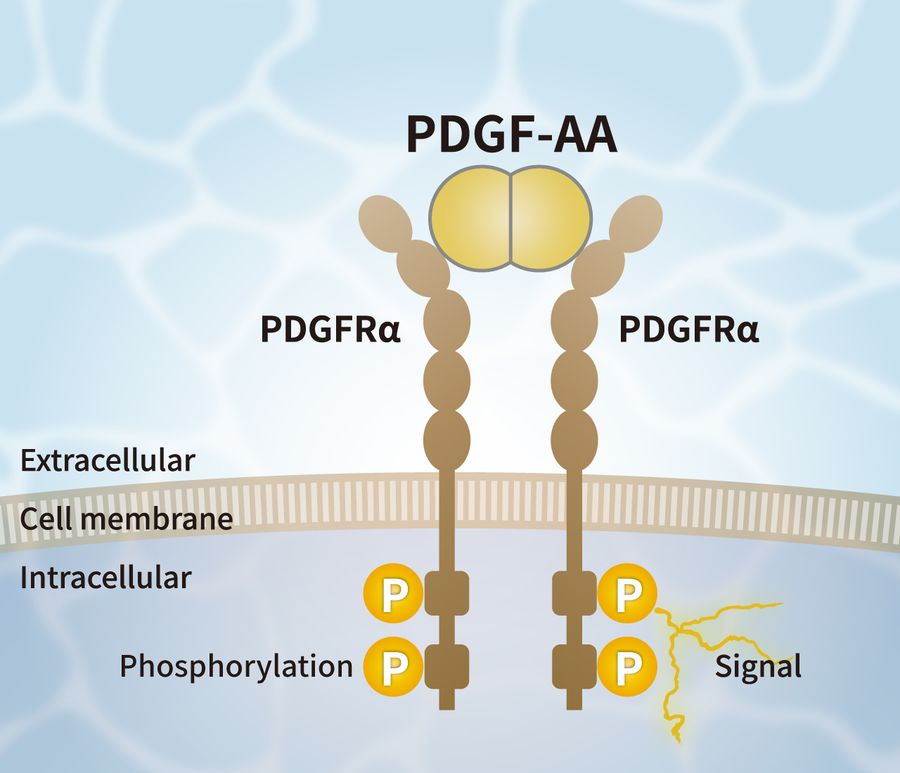
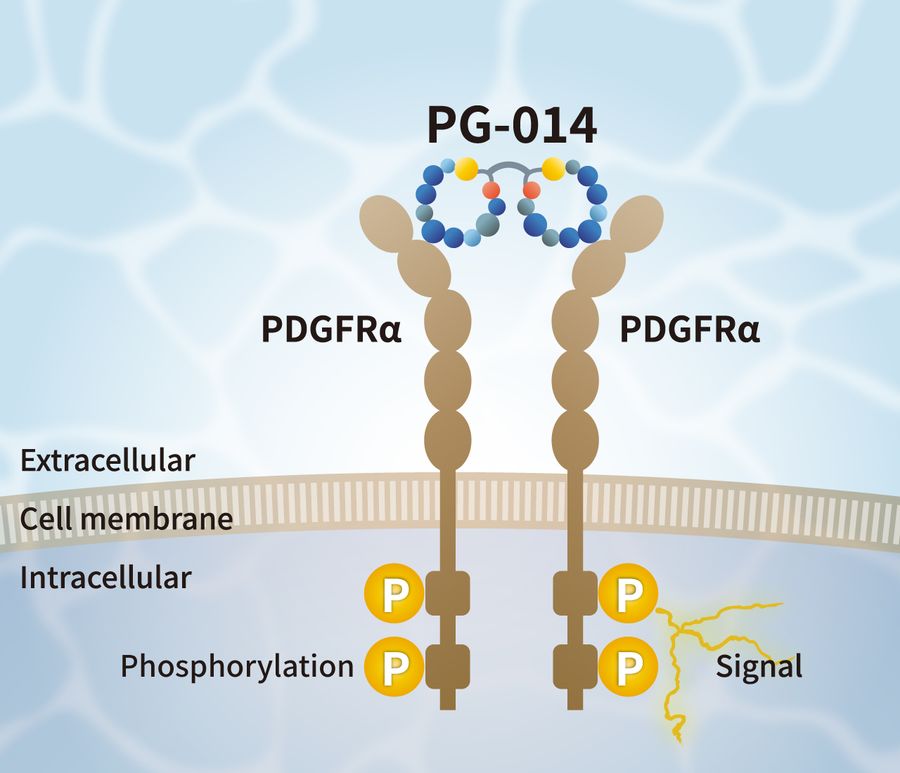
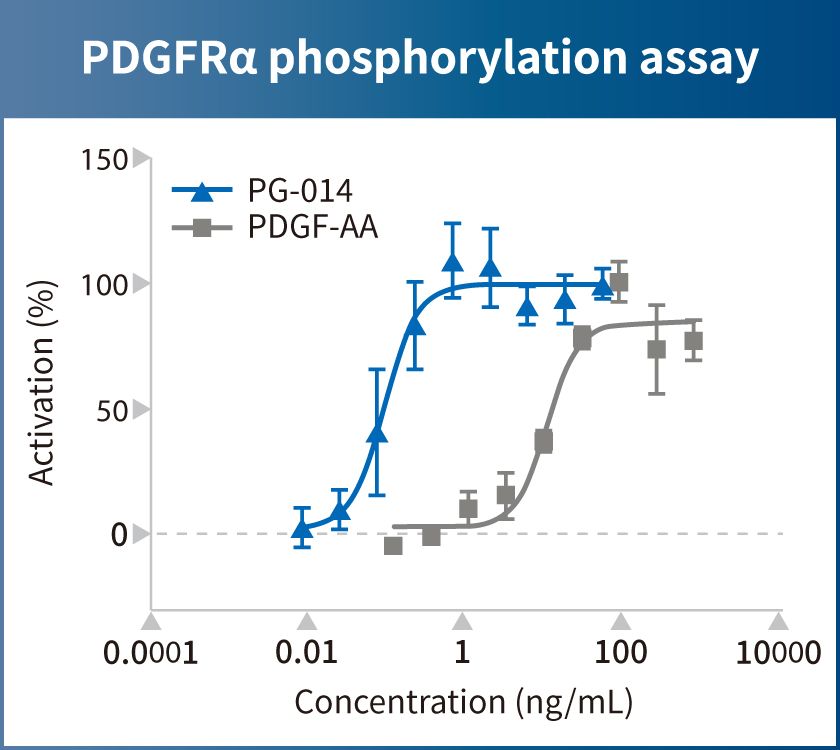
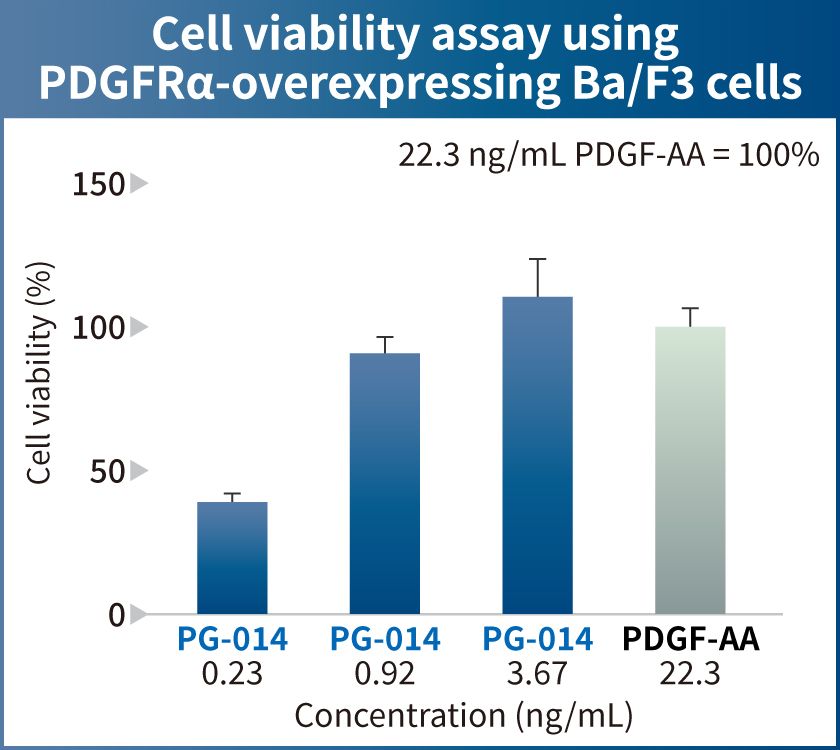
Manufacturer data: receptor phosphorylation and cell viability
In Ba/F3 cells overexpressing human PDGFRα, PG-014 reached PDGFRα phosphorylation and cell viability equivalent to native PDGF-AA at lower concentrations (ng/mL basis). In the viability assay, 22.3 ng/mL PDGF-AA was set to 100%, and PG-014 was tested at 0.23, 0.92 and 3.67 ng/mL. The information sheet gives an expected EC50 of 0.2–1 ng/mL.
Application data: neural progenitors to astrocytes
As a further functional test, the manufacturer compared PG-014 and PDGF-AA during differentiation of neural progenitor cells (NPCs) into astrocytes through immature glial-restricted progenitor cells (iGRPs). PG-014 matched PDGF-AA in cell proliferation up to the iGRP stage, in iGRP surface-marker expression and in astrocyte surface-marker expression, confirming that it can serve as a PDGF-AA alternative. These experiments were conducted by REPROCELL.
Specifications
| Item | Details |
|---|---|
| Catalogue number | PG-014 |
| Replaces | PDGF-AA (platelet-derived growth factor AA) |
| Target | PDGFRα (agonist) |
| Pack sizes | 5 µg, 50 µg, 500 µg |
| Formulation | Lyophilized |
| Purity | ≥95% (HPLC) |
| Molecular weight | 5634.42 |
| Storage | −20 °C or below |
| Grade | Research use only (RUO), available with an animal component-free (ACF) certificate; the manufacturer offers GMP-grade product and bulk supply on request |
Starting concentration and reconstitution
- The manufacturer expects PG-014 to match recombinant PDGF-AA at 1/5 of its mass concentration. Start at 1/5 of rPDGF-AA and test several points around it, such as 1/3 and 1× the rPDGF-AA concentration.
- Reconstitute at 100–200 µg/mL in DMSO: centrifuge the vial before opening and rinse the inside thoroughly with DMSO. For example, 5 µg in 50 µL DMSO gives 100 µg/mL. For further dilution use a buffered solution (such as PBS) with a carrier component.
Where it fits
The manufacturer anticipates these regenerative-medicine and cell-therapy uses for PG-014:
- Promoting proliferation of vascular smooth muscle cells, fibroblasts and capillary endothelial cells
- Inducing differentiation of neural progenitor cells into astrocytes or oligodendrocytes
- Xeno-free differentiation systems that replace recombinant PDGF-AA with a chemically synthesized component
Looking for a PDGF-AA alternative for glial or stromal-cell protocols? Contact TechWave for PG-014 selection advice and a quotation.